
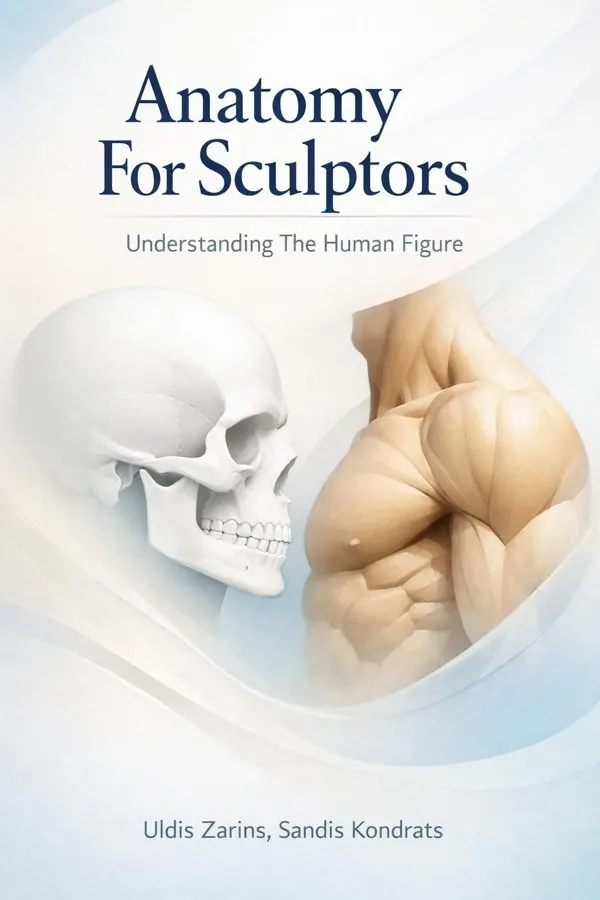
Anatomy For Sculptors: Understanding The Human Figure: Summary & Key Insights
by Uldis Zarins, Sandis Kondrats
 10 min9 chaptersAudio available
Key Takeaways from Anatomy For Sculptors: Understanding The Human Figure
What looks soft and expressive on the surface is governed by something rigid underneath.
Expression begins in structure long before it appears in features.
The body’s most expressive movements often come from the largest masses, not the smallest details.
We often read a figure’s intention through the limbs before we notice the face.
A figure feels believable only when it seems able to stand, walk, push, or fall.
What Is Anatomy For Sculptors: Understanding The Human Figure About?
Anatomy For Sculptors: Understanding The Human Figure by Uldis Zarins, Sandis Kondrats is a design book spanning 11 pages. Great figure art does not begin with surface detail. It begins with structure. Anatomy For Sculptors: Understanding The Human Figure is a practical, visually driven guide that teaches artists how the human body is built, how it moves, and how its internal architecture creates believable form on the outside. Rather than presenting anatomy as a dense medical subject, Uldis Zarins and Sandis Kondrats translate bones, muscles, proportions, and landmarks into clear visual principles that sculptors, illustrators, painters, character designers, and 3D artists can use immediately. What makes this book matter is its focus on artistic application. It shows not only what the body contains, but why those structures change silhouette, affect balance, and determine gesture. Readers learn to see the body as a system of masses, rhythms, pivots, and tensions instead of a confusing collection of parts. Zarins brings the perspective of a sculptor and anatomy teacher, while Kondrats contributes strong visual design and 3D educational clarity. Together, they offer a rare resource: an anatomy book made specifically for artists who want to create figures that feel solid, dynamic, and alive.
This FizzRead summary covers all 9 key chapters of Anatomy For Sculptors: Understanding The Human Figure in approximately 10 minutes, distilling the most important ideas, arguments, and takeaways from Uldis Zarins, Sandis Kondrats's work. Also available as an audio summary and Key Quotes Podcast.
Anatomy For Sculptors: Understanding The Human Figure
Great figure art does not begin with surface detail. It begins with structure. Anatomy For Sculptors: Understanding The Human Figure is a practical, visually driven guide that teaches artists how the human body is built, how it moves, and how its internal architecture creates believable form on the outside. Rather than presenting anatomy as a dense medical subject, Uldis Zarins and Sandis Kondrats translate bones, muscles, proportions, and landmarks into clear visual principles that sculptors, illustrators, painters, character designers, and 3D artists can use immediately.
What makes this book matter is its focus on artistic application. It shows not only what the body contains, but why those structures change silhouette, affect balance, and determine gesture. Readers learn to see the body as a system of masses, rhythms, pivots, and tensions instead of a confusing collection of parts. Zarins brings the perspective of a sculptor and anatomy teacher, while Kondrats contributes strong visual design and 3D educational clarity. Together, they offer a rare resource: an anatomy book made specifically for artists who want to create figures that feel solid, dynamic, and alive.
Who Should Read Anatomy For Sculptors: Understanding The Human Figure?
This book is perfect for anyone interested in design and looking to gain actionable insights in a short read. Whether you're a student, professional, or lifelong learner, the key ideas from Anatomy For Sculptors: Understanding The Human Figure by Uldis Zarins, Sandis Kondrats will help you think differently.
- ✓Readers who enjoy design and want practical takeaways
- ✓Professionals looking to apply new ideas to their work and life
- ✓Anyone who wants the core insights of Anatomy For Sculptors: Understanding The Human Figure in just 10 minutes
Want the full summary?
Get instant access to this book summary and 100K+ more with Fizz Moment.
Get Free SummaryAvailable on App Store • Free to download
Key Chapters
What looks soft and expressive on the surface is governed by something rigid underneath. One of the book’s most important lessons is that the skeleton is not merely a hidden support system; it is the framework that determines proportion, balance, range of motion, and the major planes of the body. Artists often focus too early on muscles or skin, but convincing figure work starts with understanding the bones as structural masses in space.
Zarins and Kondrats treat the skeleton as an artist’s construction map. The rib cage, pelvis, skull, spine, and limb bones are explained as three-dimensional forms with directional relationships. The clavicles set the width of the shoulders, the pelvis governs stance, and the spine creates rhythm and gesture. Even the visible surface of the body often depends on bony landmarks: the acromion at the shoulder, the iliac crest at the hips, the patella at the knee, or the ulna at the forearm. These are not anatomical trivia. They are the landmarks that help artists orient the figure and build believable volume.
In practice, this means a sculptor blocking in a figure should begin by establishing the skeletal masses first: skull, rib cage, pelvis, and limb axes. A life drawer can simplify the pose into these underlying units before adding contour. A character designer can use skeletal understanding to make a stylized body feel plausible even when proportions are exaggerated.
The takeaway is simple: before rendering the body’s surface, build the invisible architecture. If you can place the skeleton correctly, the rest of the figure becomes easier to understand, correct, and animate.
Expression begins in structure long before it appears in features. The book’s treatment of the skull and face shows that the head is not a symbolic oval with eyes and a mouth added on, but a complex construction of planes, cavities, and bony anchors that shape identity and emotion. Artists who understand the skull can place facial features more accurately and invent heads more confidently from imagination.
The skull determines the broad architecture of the face: the brow ridge influences shadow and intensity, the cheekbones affect facial width and light patterns, the jaw defines strength and direction, and the eye sockets create depth and focus. The authors help readers see how the cranium and facial mass relate in volume, and how subtle changes in bone structure create major differences in age, character, and expression. Even when facial muscles animate the surface, they are always stretching over fixed structural forms.
This insight is especially useful in portrait sculpting and character design. If a face looks flat, the issue often lies not in detail but in weak underlying planes. If a likeness fails, it may be because the artist copied features without understanding the head’s deeper geometry. By studying the skull, artists learn to rotate the head mentally, place ears in relation to jaw and brow, and construct believable faces from any angle.
A practical exercise is to sketch or sculpt the skull beneath every portrait you make, even loosely. Mark the brow, zygomatic arch, jaw angle, and chin before refining features. The actionable takeaway: stop treating the face as decoration. Build it from bone, and expression will gain structure, clarity, and credibility.
The body’s most expressive movements often come from the largest masses, not the smallest details. In Anatomy For Sculptors, the torso is presented as the central engine of the figure: the rib cage, pelvis, and spine together create posture, twisting, compression, extension, and balance. If these major forms are convincing, the entire figure gains life. If they are wrong, no amount of surface rendering can save the pose.
The rib cage and pelvis are especially important because they function as large, readable blocks that shift in relation to one another. Their tilt, rotation, and compression communicate whether the body is resting, straining, bending, or moving dynamically through space. The spine is not just a line; it is the flexible connector that links these masses and distributes motion throughout the torso. The abdominal wall, obliques, and back muscles then wrap over this structure, revealing the body’s action.
For artists, this approach turns complex anatomy into manageable design. When drawing a standing figure, first compare the angle of the rib cage to the angle of the pelvis. Is one raised? Is the torso twisting? Is there compression on one side and stretch on the other? In sculpture, blocking these masses separately before unifying them helps prevent stiffness. In animation and game character design, this relationship is critical for believable motion and weight.
The practical takeaway is to think of the torso as interacting volumes, not a single tube. Before refining muscles or contours, establish the rib cage, pelvis, and spinal rhythm clearly. This will instantly improve posture, balance, and the sense that the figure is truly alive in space.
We often read a figure’s intention through the limbs before we notice the face. The book emphasizes that arms and hands are not secondary appendages but powerful tools of communication. They show effort, direction, grace, tension, hesitation, and contact with the world. For artists, mastering them means understanding both the underlying mechanics and the visible forms they create.
The arm is built from simple but elegant structural relationships. The humerus rotates at the shoulder, the radius and ulna create turning possibilities in the forearm, and the wrist acts as a transition into the complex architecture of the hand. The authors make clear that the hand is not a flat shape with fingers attached; it is a layered construction of palm mass, knuckle arc, thumb opposition, and segmented digits. Its complexity becomes easier when reduced to major volumes and directional axes.
This matters in practical art because weak hands can undermine an otherwise strong figure. A sculpted gesture may feel lifeless if the fingers lack purpose. A drawn arm may look disconnected if the bony landmarks at the elbow and wrist are ignored. By understanding the flexors and extensors, artists can also show tension more credibly: a gripping hand differs visibly from a relaxed one, and a reaching arm changes form depending on rotation.
A useful application is to study hand poses as action statements: grasping, pointing, pressing, lifting, releasing. Build each from palm block, finger direction, and thumb relationship before adding detail. The takeaway: treat arms and hands as carriers of action and emotion. Construct them from clear forms, and they will strengthen the narrative power of the entire figure.
A figure feels believable only when it seems able to stand, walk, push, or fall. That sense of physical truth comes largely from the legs and feet. In this book, the lower body is explained not just as anatomy to memorize, but as the foundation of weight, movement, and stability. The legs carry mass, absorb force, and transmit motion; the feet negotiate contact with the ground and reveal balance instantly.
The femur, knee joint, tibia, fibula, ankle, and foot structure all affect how the body occupies space. The pelvis-to-femur relationship determines stance and weight shift. The knee is a hinge with visible bony logic, not a vague rounded shape. The calf muscles, shin plane, and ankle landmarks create distinct rhythms that artists can use to avoid stiffness. The foot, meanwhile, is best understood as an arching support system with heel, bridge, and toes rather than a wedge-shaped afterthought.
This anatomical understanding has direct artistic benefits. In sculpture, a standing figure becomes stable when the weight-bearing leg aligns properly under the pelvis and the planted foot supports the center of gravity. In drawing, a walking pose becomes convincing when the feet show different functions: one pushes, one receives weight. In stylized design, exaggerated legs still need believable joint placement and foot mechanics to feel grounded.
An effective practice is to identify the supporting leg, the free leg, and the pressure path through the foot in every pose you study. Observe where weight compresses forms and where muscles lengthen. The actionable takeaway: never treat the lower body as filler. Build legs and feet as the figure’s physical base, and the whole body will gain credibility, force, and movement.
The body’s surface is not random complexity; it is the visible result of layered forms interacting. One of the strongest contributions of Anatomy For Sculptors is its explanation of how muscles, bones, tendons, fat, and skin combine to produce the outer look of the human figure. Artists often memorize isolated muscles and still struggle to make the body look real because they have not learned how layers overlap and simplify into readable surface patterns.
The book teaches that major muscle groups should be understood by function and placement, not by textbook naming alone. The deltoid caps the shoulder because it wraps over the joint. The pectoral and abdominal masses stretch and compress with torso movement. The latissimus, trapezius, and scapular region create flowing transitions across the back. Tendons become visible in some places because flesh thins over structure, while softer fat deposits smooth or obscure other forms. Surface anatomy therefore changes with pose, body type, age, and exertion.
This helps artists make better decisions about detail. A lean athletic figure may show sharper separations and clearer bony landmarks. A softer or older body may display broader transitions and less muscular definition. In sculpture and digital modeling, knowing which forms are primary prevents overworking tiny anatomical details before the large surface logic is correct. In drawing, it helps simplify shadows into structural statements rather than decorative marks.
A useful exercise is to identify in each region what is bone, what is muscle mass, and what is soft transitional tissue. Ask why a contour rises, dips, or changes direction. The takeaway: do not copy the body’s surface blindly. Learn the layers beneath it, and your figures will become more coherent, believable, and intentionally designed.
Without proportion, even anatomically informed art can feel wrong. The book makes clear that proportion is not about rigid formulas alone, but about relational measurement: how one part compares to another, how symmetry and asymmetry coexist, and how variation can still remain believable. For artists, proportion provides an organizing system that keeps the figure readable before finer anatomy is added.
The authors discuss traditional measuring approaches while also showing how proportion changes with sex, age, physique, and artistic intent. The head count method can help establish overall height, but equally important are comparative widths, joint positions, and the distribution of masses. The elbows roughly relate to the waist, the hands fall near mid-thigh, and the knees divide the leg rhythm in recognizable ways. Yet these are guides, not prison bars. Real bodies vary, and good artists learn to use proportional norms as a base from which meaningful deviations can emerge.
This is especially valuable for those working from imagination. A sculptor inventing a heroic figure, a comic artist pushing stylization, or a concept designer creating a creature with human anatomy can all benefit from first understanding standard relationships. Once proportion is grounded, exaggeration becomes expressive instead of accidental. Symmetry also matters, but the book reminds us that living bodies are not perfectly mirrored. Small asymmetries in shoulders, hips, and muscles create naturalism.
A practical method is to check every figure in stages: first overall height and major masses, then limb lengths, then the placement of landmarks like elbows, knees, and pelvis. Correct proportion early, before investing in detail. The actionable takeaway: use proportion as your structural compass. It turns complex anatomy into an ordered system and gives your figures both clarity and freedom.
A static copy of anatomy is not the same as a living figure. One of the book’s key lessons is that movement should be understood as a pattern of opposing forces, directional flows, and shifting masses. Dynamic anatomy is not just about showing muscles in action; it is about capturing the body’s internal logic as it twists, reaches, pushes, recoils, or rests. Life appears when structure and gesture are joined.
The authors show that dynamic poses can be analyzed through compression and extension, weight transfer, contrapposto, spiral action, and the changing relationships between the torso, limbs, and head. A raised arm affects the scapula and rib cage. A turning pelvis changes the line of the legs. A step forward redistributes weight across hips, knees, and feet. These interactions are what make movement believable. The body is a chain of connected forms, so motion in one area usually echoes elsewhere.
For artists, this means gesture should not be separated from anatomy study. In fact, anatomical knowledge becomes most useful when it helps explain why a pose looks the way it does. A quick figure sketch can be stronger if the artist notes where forms compress, where they stretch, and which landmarks shift. A sculptor can create more vitality by establishing major rhythms before refining muscles. A 3D modeler can avoid stiffness by ensuring that underlying masses rotate and counter-rotate naturally.
A valuable exercise is to analyze action poses using three questions: where is the weight, where is the tension, and what is the dominant rhythm? Build your figure around those answers before adding detail. The takeaway: movement is anatomy organized by force. Study rhythm and tension, and your figures will feel active rather than assembled.
There is no single human body to memorize. One of the most artistically liberating ideas in Anatomy For Sculptors is that anatomy must be studied through variation: age, sex, body fat, musculature, bone prominence, and individual character all change how the figure appears. Learning anatomy is therefore not about producing identical ideal bodies, but about understanding the principles that allow endless believable differences.
The book addresses how male and female bodies often differ in skeletal proportions, fat distribution, muscle mass, and silhouette tendencies. It also helps readers see how children, adults, and older figures change structurally and visually. A child’s cranial proportion, softer forms, and shorter limb relationships create a distinct read. An older body may show sagging soft tissue, reduced muscular tension, and different postural habits. These changes are not superficial styling; they arise from anatomy and must be understood as such.
This principle is invaluable in creative work. Character design becomes richer when the artist can vary body types intentionally instead of relying on stereotypes. Sculptors can create more truthful portrait figures by observing which landmarks are softened or emphasized in a specific person. Illustrators can communicate age and physical history through structural choices rather than costume alone.
A practical application is to study the same pose across different body types and note what remains constant and what changes. Identify the universal framework, then the variable surface expression. The actionable takeaway: do not chase a single idealized anatomy. Learn the structural rules deeply enough that you can adapt them to many kinds of human bodies with confidence, sensitivity, and artistic precision.
All Chapters in Anatomy For Sculptors: Understanding The Human Figure
About the Authors
Uldis Zarins is a Latvian sculptor, educator, and anatomy specialist best known for helping artists understand the human figure through clear structural thinking. Drawing from his background in figurative sculpture and teaching, he has developed a practical approach to anatomy that emphasizes form, volume, movement, and artistic application over medical complexity. Sandis Kondrats is a visual artist and designer with expertise in 3D visualization, educational graphics, and visual communication. His ability to present complex anatomical information through accessible imagery has been central to the success of their collaborative work. Together, Zarins and Kondrats founded the Anatomy For Sculptors project, creating books and resources that have become widely used by sculptors, illustrators, concept artists, and 3D modelers around the world.
Get This Summary in Your Preferred Format
Read or listen to the Anatomy For Sculptors: Understanding The Human Figure summary by Uldis Zarins, Sandis Kondrats anytime, anywhere. FizzRead offers multiple formats so you can learn on your terms — all free.
Available formats: App · Audio · PDF · EPUB — All included free with FizzRead
Download Anatomy For Sculptors: Understanding The Human Figure PDF and EPUB Summary
Key Quotes from Anatomy For Sculptors: Understanding The Human Figure
“What looks soft and expressive on the surface is governed by something rigid underneath.”
“Expression begins in structure long before it appears in features.”
“The body’s most expressive movements often come from the largest masses, not the smallest details.”
“We often read a figure’s intention through the limbs before we notice the face.”
“A figure feels believable only when it seems able to stand, walk, push, or fall.”
Frequently Asked Questions about Anatomy For Sculptors: Understanding The Human Figure
Anatomy For Sculptors: Understanding The Human Figure by Uldis Zarins, Sandis Kondrats is a design book that explores key ideas across 9 chapters. Great figure art does not begin with surface detail. It begins with structure. Anatomy For Sculptors: Understanding The Human Figure is a practical, visually driven guide that teaches artists how the human body is built, how it moves, and how its internal architecture creates believable form on the outside. Rather than presenting anatomy as a dense medical subject, Uldis Zarins and Sandis Kondrats translate bones, muscles, proportions, and landmarks into clear visual principles that sculptors, illustrators, painters, character designers, and 3D artists can use immediately. What makes this book matter is its focus on artistic application. It shows not only what the body contains, but why those structures change silhouette, affect balance, and determine gesture. Readers learn to see the body as a system of masses, rhythms, pivots, and tensions instead of a confusing collection of parts. Zarins brings the perspective of a sculptor and anatomy teacher, while Kondrats contributes strong visual design and 3D educational clarity. Together, they offer a rare resource: an anatomy book made specifically for artists who want to create figures that feel solid, dynamic, and alive.
You Might Also Like

The Design of Everyday Things
Don Norman
10 min
The Better Angels of Our Nature
Steven Pinker
10 min
A Designer's Art
Paul Rand
10 min
Architects' Sketchbooks
Various Editors
10 min
Architectural Graphic Standards
The American Institute of Architects
10 min
Design Is Storytelling
Ellen Lupton
10 minFeatured In
Browse by Category
Ready to read Anatomy For Sculptors: Understanding The Human Figure?
Get the full summary and 100K+ more books with Fizz Moment.