
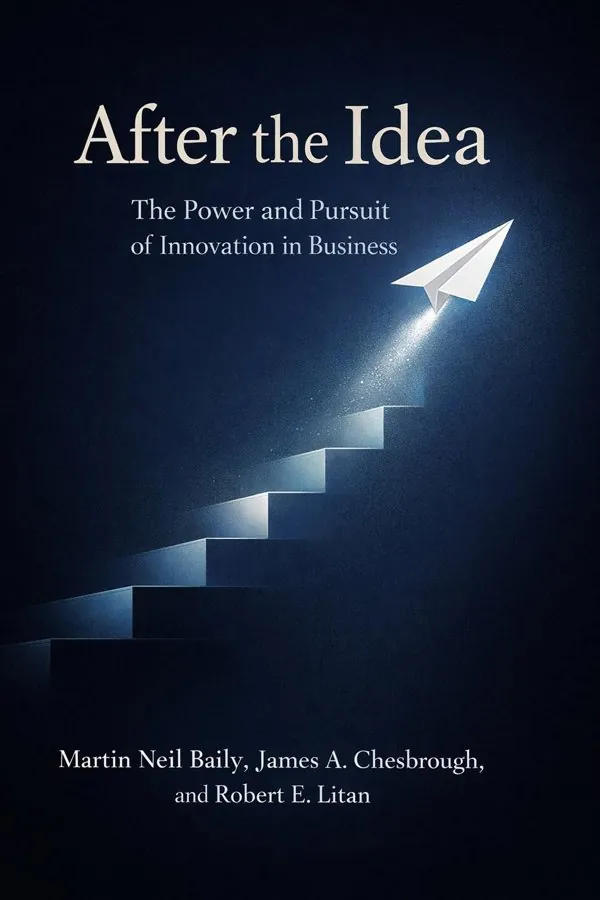
After the Idea: The Power and Pursuit of Innovation in Business: Summary & Key Insights
by Martin Neil Baily, James A. Chesbrough, and Robert E. Litan
 10 min10 chaptersAudio available
What Is After the Idea: The Power and Pursuit of Innovation in Business About?
After the Idea: The Power and Pursuit of Innovation in Business by Martin Neil Baily, James A. Chesbrough, and Robert E. Litan is a entrepreneurship book spanning 10 pages. This book explores how innovation drives business success and economic growth, analyzing the processes that transform ideas into marketable products and services. It discusses the challenges organizations face in sustaining innovation and offers insights into policy and management practices that foster creative enterprise.
This FizzRead summary covers all 10 key chapters of After the Idea: The Power and Pursuit of Innovation in Business in approximately 10 minutes, distilling the most important ideas, arguments, and takeaways from Martin Neil Baily, James A. Chesbrough, and Robert E. Litan's work. Also available as an audio summary and Key Quotes Podcast.
After the Idea: The Power and Pursuit of Innovation in Business
This book explores how innovation drives business success and economic growth, analyzing the processes that transform ideas into marketable products and services. It discusses the challenges organizations face in sustaining innovation and offers insights into policy and management practices that foster creative enterprise.
Who Should Read After the Idea: The Power and Pursuit of Innovation in Business?
This book is perfect for anyone interested in entrepreneurship and looking to gain actionable insights in a short read. Whether you're a student, professional, or lifelong learner, the key ideas from After the Idea: The Power and Pursuit of Innovation in Business by Martin Neil Baily, James A. Chesbrough, and Robert E. Litan will help you think differently.
- ✓Readers who enjoy entrepreneurship and want practical takeaways
- ✓Professionals looking to apply new ideas to their work and life
- ✓Anyone who wants the core insights of After the Idea: The Power and Pursuit of Innovation in Business in just 10 minutes
Want the full summary?
Get instant access to this book summary and 100K+ more with Fizz Moment.
Get Free SummaryAvailable on App Store • Free to download
Key Chapters
The global economy in the late twentieth century, and even more so today, moves at a breathtaking pace. Technologies spread across borders instantaneously, competitors emerge overnight, and consumer preferences shift like living organisms. In such an environment, innovation is no longer optional. It is the only durable source of competitive advantage. We open our analysis by underscoring this innovation imperative: productivity growth, corporate performance, and national prosperity all depend fundamentally on an economy’s ability to generate and apply new ideas.
Globalization multiplies the pressure to innovate. Companies can no longer rely on domestic markets for protection; the lowest-cost producer or the fastest-adapting firm anywhere in the world can upend an established business model. Likewise, rapid technological change creates both new opportunities and existential risks. Those who rest on yesterday’s successes eventually face extinction.
But why is innovation so powerful? Because it multiplies the value of all other factors of production. It enhances capital, enriches labor, and expands markets. Economies that integrate innovation effectively achieve not just quantitative growth but qualitative transformation — a higher productivity frontier. Yet the imperative also brings tension: firms must allocate resources today for uncertain returns tomorrow. The discipline of innovation lies precisely in managing that tension — between risk and reward, exploration and execution, creativity and control.
An idea, no matter how brilliant, holds no economic value until it enters the marketplace. The journey from thought to product involves a series of challenging transitions — research, development, testing, and commercialization. In this chapter, we analyze these stages and the factors that accelerate or stall progress between them.
In research, curiosity dominates. It is the realm of discovery, where scientists and engineers seek new insights without immediate commercial pressure. Yet, the transition from research to development demands translation: converting abstract knowledge into usable technology. This step is often the most fragile. Many promising discoveries die here because organizations lack mechanisms for knowledge transfer, or because managers fail to perceive commercial potential.
Development introduces discipline. Here, prototypes are refined, manufacturability assessed, regulatory hurdles addressed, and financial viability considered. When we study the firms that consistently innovate — from technology pioneers to pharmaceutical leaders — we find common threads: cross-functional collaboration, early market feedback, and willingness to iterate. Successful commercialization requires another skill altogether — marketing insight, customer engagement, and the ability to scale.
The innovation pipeline thus involves two kinds of management: one that protects creativity, and one that enforces rigor. Firms that understand this duality are the ones that repeatedly convert ideas into profitable realities.
+ 8 more chapters — available in the FizzRead app
All Chapters in After the Idea: The Power and Pursuit of Innovation in Business
About the Authors
Martin Neil Baily is a senior fellow at the Brookings Institution and former chairman of the Council of Economic Advisers. James A. Chesbrough is a leading scholar on open innovation and a professor at the Haas School of Business, University of California, Berkeley. Robert E. Litan is an economist and attorney known for his work on entrepreneurship and public policy.
Get This Summary in Your Preferred Format
Read or listen to the After the Idea: The Power and Pursuit of Innovation in Business summary by Martin Neil Baily, James A. Chesbrough, and Robert E. Litan anytime, anywhere. FizzRead offers multiple formats so you can learn on your terms — all free.
Available formats: App · Audio · PDF · EPUB — All included free with FizzRead
Download After the Idea: The Power and Pursuit of Innovation in Business PDF and EPUB Summary
Key Quotes from After the Idea: The Power and Pursuit of Innovation in Business
“The global economy in the late twentieth century, and even more so today, moves at a breathtaking pace.”
“An idea, no matter how brilliant, holds no economic value until it enters the marketplace.”
Frequently Asked Questions about After the Idea: The Power and Pursuit of Innovation in Business
After the Idea: The Power and Pursuit of Innovation in Business by Martin Neil Baily, James A. Chesbrough, and Robert E. Litan is a entrepreneurship book that explores key ideas across 10 chapters. This book explores how innovation drives business success and economic growth, analyzing the processes that transform ideas into marketable products and services. It discusses the challenges organizations face in sustaining innovation and offers insights into policy and management practices that foster creative enterprise.
You Might Also Like

Lean Analytics
Alistair Croll, Benjamin Yoskovitz
10 min
21 Days To A Big Idea: Creating Breakthrough Business Concepts
Bryan Mattimore
10 min
Sam Walton: Made in America: My Story
Sam Walton
10 min
10x Is Easier Than 2x: How World-Class Entrepreneurs Achieve More by Doing Less
Dan Sullivan, Benjamin Hardy
10 min
12 Months to $1 Million: How to Pick a Winning Product, Build a Real Business, and Become a Seven-Figure Entrepreneur
Ryan Daniel Moran
10 min
24 Assets: Create a Digital, Scalable, Valuable Business
Daniel Priestley
10 minFeatured In
Browse by Category
Ready to read After the Idea: The Power and Pursuit of Innovation in Business?
Get the full summary and 100K+ more books with Fizz Moment.