
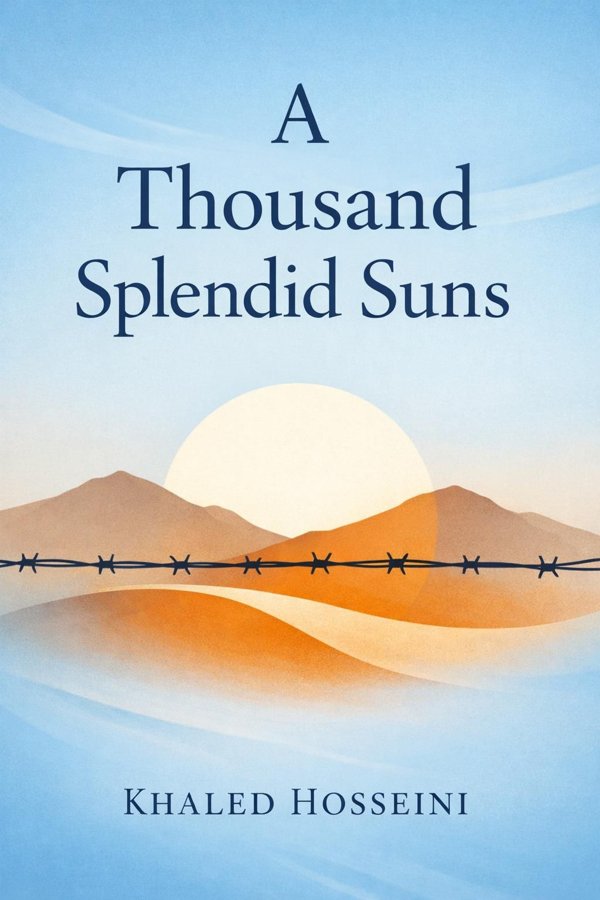
A Thousand Splendid Suns: Summary & Key Insights
 10 min9 chaptersAudio available
Key Takeaways from A Thousand Splendid Suns
One of the novel’s most powerful insights is that political catastrophe is never abstract; it enters kitchens, bedrooms, and family bonds.
Their suffering is personal, yet it is also institutional.
Some relationships save lives not by removing suffering, but by making suffering bearable.
The novel offers a moving redefinition of motherhood: it is not limited to blood ties, but expressed through protection, sacrifice, and devotion.
A central emotional lesson of the novel is that trauma changes people deeply, but it does not completely erase their capacity for meaning, love, or moral choice.
What Is A Thousand Splendid Suns About?
A Thousand Splendid Suns by Khaled Hosseini is a classics book. What makes a life bearable when history seems determined to crush it? In A Thousand Splendid Suns, Khaled Hosseini answers that question through an unforgettable story of love, suffering, endurance, and sacrifice. Set in Afghanistan from the 1960s through the Taliban era and into the years after their fall, the novel follows two women, Mariam and Laila, whose lives become intertwined under brutal circumstances. What begins as a portrait of private pain expands into a sweeping view of a nation shattered by war, political upheaval, patriarchy, and loss. Yet the novel is never merely tragic. It is also a profound meditation on friendship, motherhood, dignity, and the quiet forms of courage that allow people to survive the unimaginable. Hosseini, an Afghan-born novelist and physician, writes with emotional clarity and deep cultural knowledge, bringing both intimacy and historical scope to the page. A Thousand Splendid Suns matters because it humanizes headlines, turning distant conflict into deeply personal experience, and reminds readers that resilience can be as transformative as power.
This FizzRead summary covers all 9 key chapters of A Thousand Splendid Suns in approximately 10 minutes, distilling the most important ideas, arguments, and takeaways from Khaled Hosseini's work. Also available as an audio summary and Key Quotes Podcast.
A Thousand Splendid Suns
What makes a life bearable when history seems determined to crush it? In A Thousand Splendid Suns, Khaled Hosseini answers that question through an unforgettable story of love, suffering, endurance, and sacrifice. Set in Afghanistan from the 1960s through the Taliban era and into the years after their fall, the novel follows two women, Mariam and Laila, whose lives become intertwined under brutal circumstances. What begins as a portrait of private pain expands into a sweeping view of a nation shattered by war, political upheaval, patriarchy, and loss. Yet the novel is never merely tragic. It is also a profound meditation on friendship, motherhood, dignity, and the quiet forms of courage that allow people to survive the unimaginable. Hosseini, an Afghan-born novelist and physician, writes with emotional clarity and deep cultural knowledge, bringing both intimacy and historical scope to the page. A Thousand Splendid Suns matters because it humanizes headlines, turning distant conflict into deeply personal experience, and reminds readers that resilience can be as transformative as power.
Who Should Read A Thousand Splendid Suns?
This book is perfect for anyone interested in classics and looking to gain actionable insights in a short read. Whether you're a student, professional, or lifelong learner, the key ideas from A Thousand Splendid Suns by Khaled Hosseini will help you think differently.
- ✓Readers who enjoy classics and want practical takeaways
- ✓Professionals looking to apply new ideas to their work and life
- ✓Anyone who wants the core insights of A Thousand Splendid Suns in just 10 minutes
Want the full summary?
Get instant access to this book summary and 100K+ more with Fizz Moment.
Get Free SummaryAvailable on App Store • Free to download
Key Chapters
One of the novel’s most powerful insights is that political catastrophe is never abstract; it enters kitchens, bedrooms, and family bonds. A Thousand Splendid Suns shows Afghanistan’s modern history not through policy debates or battlefield strategy, but through the daily lives of ordinary people trying to endure impossible conditions. Mariam’s childhood, Laila’s adolescence, and the future of their families are all shaped by regime change, invasion, civil war, and Taliban rule. The result is a story that reveals how public violence becomes private suffering.
Hosseini makes this clear by tying major historical shifts to practical consequences. A government change means a girl can attend school one year and be banned from learning the next. A rocket attack is not just a line in a news report; it becomes a shattered home, dead parents, and a forced marriage. Food shortages, checkpoints, bombings, and fear alter every decision the characters make, from where they live to whether they can seek medical care. Through this structure, the novel teaches readers to understand history as lived experience.
This idea has relevance far beyond Afghanistan. When we hear news about war, migration, political repression, or economic collapse, it is easy to think in broad terms and statistics. The novel challenges that distance. It invites us to ask: Who is losing education, safety, family, and freedom because of these events? In everyday life, this perspective can make us more empathetic citizens, more attentive readers of current events, and less likely to reduce suffering to headlines.
Actionable takeaway: when following world events, go beyond the headline and seek the human stories underneath the political narrative.
A painful truth at the heart of the novel is that oppression does not always arrive as a single act of cruelty; it is often embedded in social customs, legal structures, and family expectations. Mariam and Laila suffer under Rasheed’s abuse, but Hosseini makes it clear that his violence is intensified by a broader culture that gives women limited protection and little autonomy. Their suffering is personal, yet it is also institutional.
Mariam grows up marked by shame because she is born outside marriage. From childhood, she absorbs the message that her worth is conditional and fragile. Laila, though raised with more affection and educational opportunity, eventually finds herself trapped by the same structures when war removes her choices. Under Taliban rule, these constraints become even harsher: women cannot move freely, work openly, or access healthcare with dignity. The novel’s insight is that injustice becomes especially dangerous when private domination is reinforced by public authority.
This matters because it helps readers recognize how inequality operates in real life. Abuse is often discussed as if it were only about one bad individual, but the novel asks us to look at the environment that allows abuse to continue. In workplaces, schools, households, or legal systems, harmful norms can silence victims and protect aggressors. Understanding this encourages deeper responses: not only condemning cruelty, but questioning the cultural assumptions that excuse it.
For readers, this can translate into practical awareness. Pay attention to how language, tradition, and institutions shape who is believed, who is protected, and who is made vulnerable. Real change requires more than sympathy; it requires noticing the systems behind the pain.
Actionable takeaway: when you see injustice, ask not only who caused it, but what structures allowed it to flourish.
Some relationships save lives not by removing suffering, but by making suffering bearable. The emotional center of A Thousand Splendid Suns is the bond that develops between Mariam and Laila. They begin as reluctant co-wives joined by coercion and jealousy, yet over time they become each other’s family, refuge, and reason to keep going. In a world shaped by brutality, their friendship becomes an act of resistance.
Hosseini carefully builds this transformation. At first, the women are divided by age, background, and circumstance. Mariam carries years of disappointment and emotional deprivation, while Laila enters the household young, educated, and fiercely attached to memories of another life. Rasheed benefits from their separation because isolation strengthens his control. But everyday acts gradually shift the balance: shared meals, caregiving, whispered conversations, protection of children, and mutual recognition of pain. Their solidarity does not erase hardship, but it gives both women a sense of dignity and belonging that abuse tried to destroy.
The novel suggests a larger truth: oppressive systems often rely on isolation. People become easier to dominate when they are cut off from trust, community, and support. Conversely, connection can restore agency. This applies to many forms of struggle today, whether someone is dealing with grief, domestic instability, discrimination, or mental exhaustion. A compassionate friend, mentor, colleague, or neighbor can become a turning point.
Practically, the book encourages readers to value relationships not only for comfort but for strength. Offering childcare, listening without judgment, checking in consistently, or helping someone access resources may seem small, yet those gestures can change the course of a life.
Actionable takeaway: build and protect supportive relationships, because solidarity is often the first step toward survival and change.
The novel offers a moving redefinition of motherhood: it is not limited to blood ties, but expressed through protection, sacrifice, and devotion. Mariam, denied tenderness for much of her life, discovers profound purpose through her love for Laila’s children and through her growing bond with Laila herself. Hosseini shows that family can be chosen, created, and sustained through acts of care rather than inherited through biology alone.
This theme is especially poignant because so many traditional structures in the novel fail the characters. Biological parents are absent, powerless, or lost to war. Social institutions are cruel or collapsing. In that void, caregiving becomes sacred. Mariam, who has been told all her life that she is unwanted and unworthy, becomes a figure of stability and moral courage. Her care is practical as well as emotional: feeding children, comforting them, shielding them from fear, and giving them a sense of home inside chaos.
Laila also embodies motherhood as fierce, forward-looking love. Her desire to preserve her children’s safety, education, and future drives many of her most difficult decisions. Through both women, the book presents motherhood as endurance guided by hope. It is less sentimental than moral: the willingness to put another life ahead of your own without losing sight of what dignity requires.
Readers can apply this idea by broadening their understanding of care. Parenting, mentoring, teaching, and supporting vulnerable people all involve forms of maternal responsibility. You do not need a formal title to shape a child’s emotional world. Consistency, protection, and belief in someone’s future can have lasting impact.
Actionable takeaway: measure family not only by blood, but by who shows up with steady care, protection, and love.
A central emotional lesson of the novel is that trauma changes people deeply, but it does not completely erase their capacity for meaning, love, or moral choice. Mariam is shaped by abandonment, humiliation, and violence from a young age. Laila endures war, devastating loss, and domestic terror. These experiences leave scars, narrow options, and distort self-worth. Yet Hosseini refuses to reduce either woman to victimhood alone.
The book portrays trauma realistically. It affects trust, hope, decision-making, and the body itself. Characters learn to anticipate danger, hide emotion, and adapt to instability. Survival often requires silence and compromise. But the novel also shows that people remain more than what happened to them. Mariam grows into courage. Laila retains intelligence, imagination, and the capacity to dream of a different future. Their pain is real, but so is their agency.
This is an important distinction in how we think about hardship today. People who have experienced abuse, displacement, grief, or chronic stress are often viewed either as permanently broken or simplistically inspirational. The novel offers a better model: trauma matters profoundly, and healing is uneven, but human beings still make choices, form bonds, and create meaning within damaged circumstances.
In practical terms, this theme encourages compassion without condescension. If someone you know is carrying visible or invisible wounds, support them without assuming their story is over. Likewise, if you are processing your own hardship, the novel suggests that survival is not your only identity. Your past may shape you, but it does not hold exclusive claim over your future.
Actionable takeaway: honor the reality of trauma while refusing to let it become the only lens through which a life is understood.
In a novel filled with war, loss, and cruelty, hope does not usually appear as grand victory. Instead, it emerges through ordinary gestures that preserve humanity: a lesson taught, a child protected, a secret shared, a plan imagined, a kind word spoken at the right time. Hosseini’s message is subtle but powerful: when circumstances are overwhelming, small acts can become the architecture of hope.
This idea is visible throughout the story. Education represents hope for Laila long before it becomes a practical path. Mariam’s decision to care deeply for others, even after years of emotional deprivation, is itself a hopeful act. Attempts to escape abuse, though risky and imperfect, signal a refusal to surrender inwardly. Even the persistence of memory matters. Remembering beauty, love, and possibility helps the characters resist total despair.
The lesson here is especially useful because many readers face situations that cannot be solved quickly. Illness, family conflict, economic pressure, grief, or political anxiety can make life feel too large to manage. In those moments, waiting for one dramatic breakthrough may be paralyzing. The novel suggests a different approach: hope can be built incrementally. A small routine, a supportive conversation, a saved amount of money, a skill learned, or a safe place created for someone else may not fix everything, but it can begin to shift what feels possible.
Hosseini does not romanticize suffering; he shows that small acts matter precisely because circumstances are harsh. Hope is not naive optimism. It is disciplined attention to the next humane choice available.
Actionable takeaway: when life feels overwhelming, focus on the smallest meaningful action that protects dignity, safety, or possibility.
Few ideas in A Thousand Splendid Suns are as quietly radical as the importance of education. In the novel, learning is not just academic achievement; it symbolizes selfhood, mobility, and the right to imagine a future beyond immediate circumstances. Laila’s father, Babi, understands this deeply. He insists that education matters, especially for girls, because it gives them a way to think independently and claim a broader life.
This belief becomes more striking as the novel progresses. War destroys institutions, and Taliban restrictions turn girls’ education into a political battleground. By showing how access to school rises and falls with social conditions, Hosseini reveals that education is never neutral. It can be a tool of liberation or a privilege denied in order to maintain control. For Laila, what she learns in childhood becomes an inner resource she carries even when external freedom disappears.
The novel’s message extends well beyond formal schooling. Education includes literacy, critical thinking, memory, and the confidence to ask what kind of life should be possible. In real life, this matters for children and adults alike. Learning can improve employment opportunities, but it also strengthens judgment, reduces vulnerability to manipulation, and expands one’s sense of agency. Communities that educate girls, in particular, often see improvements across health, stability, and social well-being.
For readers, the practical implication is clear: treat education as a long-term form of protection and empowerment. Support schools, value teachers, encourage reading, and help young people imagine futures that oppression would prefer they never see.
Actionable takeaway: invest in education—your own or someone else’s—because knowledge can preserve freedom even when circumstances become hostile.
Love becomes most visible when it costs something. A Thousand Splendid Suns builds toward the idea that sacrifice, when rooted in protection and moral clarity, can transform a life that seemed defined by suffering into one marked by purpose. Mariam’s arc, in particular, shows how someone denied respect and tenderness can still claim profound dignity through what she chooses to give.
Importantly, Hosseini does not portray sacrifice as passive resignation. The novel distinguishes between submission imposed by fear and sacrifice chosen for another’s survival. Mariam spends much of her life enduring what others decide for her. But later, when she acts decisively out of love, her choice carries a different moral weight. It is not the erasure of self; it is the fullest expression of selfhood she has ever known. In that moment, she becomes larger than the roles assigned to her.
This theme resonates because many people associate meaningful lives with achievement, recognition, or control. The novel suggests another measure: what have you protected, whom have you loved, and what suffering have you interrupted? Sacrifice may not always be dramatic. It can mean giving time to a child, standing up for someone vulnerable, leaving a destructive situation, or accepting personal risk to uphold what is right. The key is intention. True sacrifice enlarges life rather than feeding ego.
Readers should also apply this theme carefully. The novel does not glorify endless self-denial, especially in abusive contexts. Instead, it highlights sacrifice that defends life and dignity. That distinction matters. Healthy sacrifice serves love and justice, not exploitation.
Actionable takeaway: let your deepest values guide what you are willing to give, and make sure your sacrifices protect dignity rather than enable harm.
We often imagine resilience as dramatic comeback or visible triumph, but Hosseini presents it as something quieter: enduring another day, preserving tenderness under pressure, adapting without surrendering one’s humanity. In A Thousand Splendid Suns, resilience is woven into routine. It appears in caregiving, endurance, memory, humor, planning, and the refusal to stop loving despite repeated loss.
This matters because the characters rarely have the luxury of heroic gestures. Their lives are constrained by war, poverty, gendered oppression, and fear. Under such conditions, resilience looks less like winning and more like not collapsing spiritually. Mariam continues to care after being denied care. Laila keeps imagining a future for her children when evidence offers little reassurance. These forms of resilience may seem modest from a distance, yet they are morally immense.
The novel also reminds readers that resilience is relational. People endure more effectively when they have attachment, meaning, and even fragile hope. It is not simply an internal personality trait; it is shaped by support, purpose, and context. This is useful in modern life, where resilience is often framed as an individual responsibility: be tougher, work harder, bounce back faster. Hosseini offers a more humane view. Resilience grows when people are seen, helped, and given reasons to continue.
Practically, this can change how we treat ourselves and others. Instead of dismissing small efforts, recognize them as real endurance. Making a meal, going to work through grief, asking for help, protecting a child’s routine, or choosing kindness under stress are all forms of strength.
Actionable takeaway: redefine resilience as the steady practice of preserving your humanity, especially when life offers little reward for doing so.
All Chapters in A Thousand Splendid Suns
About the Author
Khaled Hosseini is an Afghan-born American novelist, physician, and humanitarian whose fiction has introduced millions of readers to the emotional realities of Afghan history and family life. Born in Kabul in 1965, he spent part of his childhood in Paris before his family sought asylum in the United States after political upheaval in Afghanistan. He later trained as a doctor while pursuing writing. Hosseini rose to international prominence with The Kite Runner, followed by A Thousand Splendid Suns and And the Mountains Echoed. His work is known for its accessible style, strong emotional impact, and focus on displacement, memory, love, and loss. Beyond literature, he has supported refugee and humanitarian causes, deepening his role as both storyteller and advocate.
Get This Summary in Your Preferred Format
Read or listen to the A Thousand Splendid Suns summary by Khaled Hosseini anytime, anywhere. FizzRead offers multiple formats so you can learn on your terms — all free.
Available formats: App · Audio · PDF · EPUB — All included free with FizzRead
Download A Thousand Splendid Suns PDF and EPUB Summary
Key Quotes from A Thousand Splendid Suns
“One of the novel’s most powerful insights is that political catastrophe is never abstract; it enters kitchens, bedrooms, and family bonds.”
“A painful truth at the heart of the novel is that oppression does not always arrive as a single act of cruelty; it is often embedded in social customs, legal structures, and family expectations.”
“Some relationships save lives not by removing suffering, but by making suffering bearable.”
“The novel offers a moving redefinition of motherhood: it is not limited to blood ties, but expressed through protection, sacrifice, and devotion.”
“A central emotional lesson of the novel is that trauma changes people deeply, but it does not completely erase their capacity for meaning, love, or moral choice.”
Frequently Asked Questions about A Thousand Splendid Suns
A Thousand Splendid Suns by Khaled Hosseini is a classics book that explores key ideas across 9 chapters. What makes a life bearable when history seems determined to crush it? In A Thousand Splendid Suns, Khaled Hosseini answers that question through an unforgettable story of love, suffering, endurance, and sacrifice. Set in Afghanistan from the 1960s through the Taliban era and into the years after their fall, the novel follows two women, Mariam and Laila, whose lives become intertwined under brutal circumstances. What begins as a portrait of private pain expands into a sweeping view of a nation shattered by war, political upheaval, patriarchy, and loss. Yet the novel is never merely tragic. It is also a profound meditation on friendship, motherhood, dignity, and the quiet forms of courage that allow people to survive the unimaginable. Hosseini, an Afghan-born novelist and physician, writes with emotional clarity and deep cultural knowledge, bringing both intimacy and historical scope to the page. A Thousand Splendid Suns matters because it humanizes headlines, turning distant conflict into deeply personal experience, and reminds readers that resilience can be as transformative as power.
More by Khaled Hosseini
You Might Also Like

Browse by Category
Ready to read A Thousand Splendid Suns?
Get the full summary and 100K+ more books with Fizz Moment.