
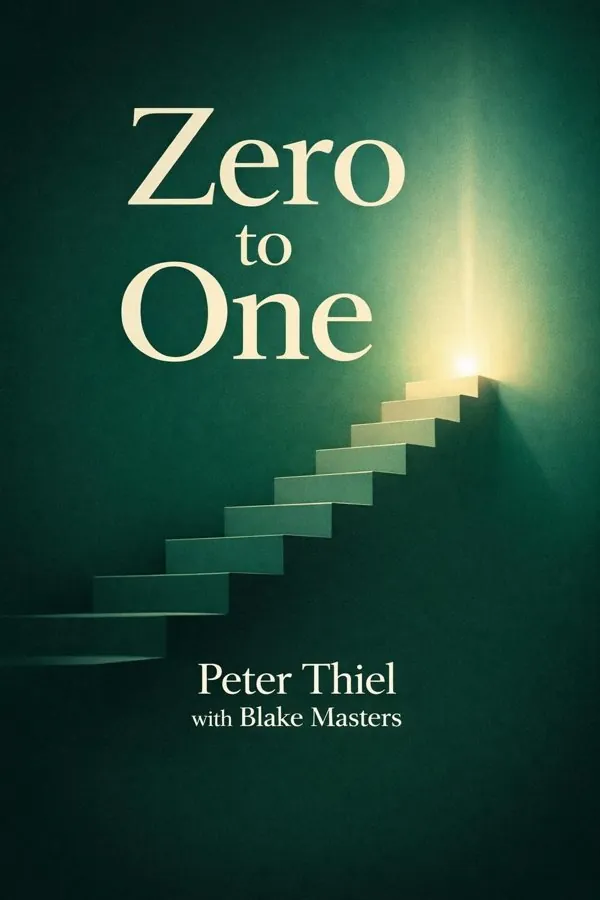
Zero to One: Notes on Startups, or How to Build the Future: Summary & Key Insights
by Peter Thiel with Blake Masters
 10 min10 chaptersAudio available
Key Takeaways from Zero to One: Notes on Startups, or How to Build the Future
Most people talk about the future as if it will simply arrive on schedule.
Bubbles do not just destroy money; they distort judgment.
One of Thiel’s most provocative arguments is that competition is overrated.
Many founders obsess over being first.
A surprising theme in Zero to One is that people’s beliefs about the future shape their actions more than they realize.
What Is Zero to One: Notes on Startups, or How to Build the Future About?
Zero to One: Notes on Startups, or How to Build the Future by Peter Thiel with Blake Masters is a entrepreneurship book spanning 13 pages. Zero to One is a bold, contrarian guide to building companies that create genuinely new value. Rather than teaching entrepreneurs how to copy existing business models or compete in crowded markets, Peter Thiel argues that the most important businesses go from “zero to one”: they bring something new into the world that did not exist before. Drawing on Thiel’s experience as a co-founder of PayPal, an early investor in Facebook, and a major voice in Silicon Valley, the book challenges many of the assumptions people hold about startups, competition, technology, and progress. Blake Masters shaped these ideas into book form from notes taken during Thiel’s Stanford startup course, making the work both intellectually sharp and highly practical. What makes this book matter is its insistence that the future is not automatic. Progress depends on founders who can think independently, discover hidden truths, and build companies that solve meaningful problems. For entrepreneurs, investors, and ambitious professionals, Zero to One is not just a startup manual. It is a framework for seeing opportunity where others see convention.
This FizzRead summary covers all 10 key chapters of Zero to One: Notes on Startups, or How to Build the Future in approximately 10 minutes, distilling the most important ideas, arguments, and takeaways from Peter Thiel with Blake Masters's work. Also available as an audio summary and Key Quotes Podcast.
Zero to One: Notes on Startups, or How to Build the Future
Zero to One is a bold, contrarian guide to building companies that create genuinely new value. Rather than teaching entrepreneurs how to copy existing business models or compete in crowded markets, Peter Thiel argues that the most important businesses go from “zero to one”: they bring something new into the world that did not exist before. Drawing on Thiel’s experience as a co-founder of PayPal, an early investor in Facebook, and a major voice in Silicon Valley, the book challenges many of the assumptions people hold about startups, competition, technology, and progress. Blake Masters shaped these ideas into book form from notes taken during Thiel’s Stanford startup course, making the work both intellectually sharp and highly practical. What makes this book matter is its insistence that the future is not automatic. Progress depends on founders who can think independently, discover hidden truths, and build companies that solve meaningful problems. For entrepreneurs, investors, and ambitious professionals, Zero to One is not just a startup manual. It is a framework for seeing opportunity where others see convention.
Who Should Read Zero to One: Notes on Startups, or How to Build the Future?
This book is perfect for anyone interested in entrepreneurship and looking to gain actionable insights in a short read. Whether you're a student, professional, or lifelong learner, the key ideas from Zero to One: Notes on Startups, or How to Build the Future by Peter Thiel with Blake Masters will help you think differently.
- ✓Readers who enjoy entrepreneurship and want practical takeaways
- ✓Professionals looking to apply new ideas to their work and life
- ✓Anyone who wants the core insights of Zero to One: Notes on Startups, or How to Build the Future in just 10 minutes
Want the full summary?
Get instant access to this book summary and 100K+ more with Fizz Moment.
Get Free SummaryAvailable on App Store • Free to download
Key Chapters
Most people talk about the future as if it will simply arrive on schedule. Thiel’s first major insight is that the future is something people actively create. A better tomorrow does not emerge from vague optimism, market momentum, or repeating what already works. It comes from individuals and companies that choose to build something new.
He distinguishes between horizontal progress and vertical progress. Horizontal progress means copying things that already exist and spreading them wider, such as opening another restaurant with a proven formula or bringing existing technology into new markets. Vertical progress means creating something fundamentally new, like the invention of the microchip, the internet, or a breakthrough medicine. Horizontal progress takes the world from 1 to n. Vertical progress takes it from 0 to 1.
This distinction matters because many businesses confuse growth with innovation. Expanding a familiar service can be profitable, but it rarely changes the world. True startups should aim to solve important problems in ways nobody else has imagined. That requires clear thinking, courage, and a willingness to reject imitation.
A practical example is the difference between launching another food-delivery app in a crowded city and building a new logistics system that cuts delivery times in half through proprietary routing technology. One is competition inside an existing category. The other has the potential to redefine the category itself.
Actionable takeaway: Ask yourself one hard question: what valuable thing could you build that is new, not just more common? Start there, because that is where real entrepreneurial opportunity begins.
Bubbles do not just destroy money; they distort judgment. In the chapter often summarized as “Party Like It’s 1999,” Thiel revisits the dot-com era to show how startup culture can become dangerously detached from sound business thinking. The internet boom was not wrong in believing technology would transform society. It was wrong in assuming every internet company would win simply because it was online.
After the crash, founders and investors overcorrected. They became skeptical of big visions and favored incrementalism, lean experimentation, and risk avoidance. Thiel thinks that response also misses the mark. The real lesson of the dot-com bubble is not to avoid ambition. It is to pair ambition with durable fundamentals.
He identifies several principles that founders should remember: make bold plans rather than tiny ones, because small ambitions are often not worth the effort; prioritize strong unit economics over vanity metrics; avoid intense competition; and build a product that can become dominant in a small market before expanding.
Consider a startup raising money today. It may be tempted to chase user growth at any cost, celebrate downloads, and ignore retention or profit margins. That resembles the worst habits of the late 1990s. A stronger company would ask whether users are becoming loyal customers, whether the product is hard to replace, and whether the economics improve with scale.
Actionable takeaway: Pursue a big vision, but pressure-test it with one question investors often skip in euphoric times: if this company succeeds, will it become a durable business or just a temporary story?
One of Thiel’s most provocative arguments is that competition is overrated. In business culture, competition is often treated as healthy, noble, and unavoidable. Thiel flips that assumption. He argues that truly great businesses escape competition by creating monopolies: companies so uniquely valuable that they dominate a market and capture lasting profits.
He does not mean illegal or exploitative monopolies. He means businesses that become the only serious choice in a defined market because they offer something meaningfully better. Google in search, for example, became dominant because it solved the problem far better than alternatives. A monopoly can invest in the future, attract top talent, survive downturns, and focus on long-term innovation. Highly competitive companies, by contrast, are trapped in price wars, thin margins, and constant imitation.
This idea connects with the chapter “All Happy Companies Are Different.” Every successful monopoly is different because it has discovered a unique edge. Failed companies resemble each other because they compete without differentiation.
For founders, the practical lesson is to avoid entering large, crowded markets where many players offer similar products. Start by dominating a small niche. PayPal initially targeted power sellers on eBay rather than “everyone who sends money online.” Facebook began at Harvard before expanding to other campuses.
Actionable takeaway: Define the smallest market you can dominate with a product that is meaningfully better than anything else available. Winning narrowly first is often the path to winning broadly later.
Many founders obsess over being first. Thiel argues that being first matters less than being the last mover: the company that captures a market so effectively that it remains dominant for years. The real value of a business lies not in the excitement of launch but in the cash it can generate far into the future.
This perspective changes how you evaluate startups. A business with early buzz but weak retention, low margins, or easy substitutes may look promising now but have little long-term value. A slower-growing company with strong network effects, proprietary technology, brand strength, or economies of scale can become far more valuable over time.
Thiel emphasizes four characteristics that help create durable monopoly power: proprietary technology, network effects, economies of scale, and branding. Proprietary technology gives you a hard-to-copy advantage. Network effects make the product more useful as more people use it. Economies of scale lower costs as the business grows. Branding creates trust and emotional preference.
Think about Amazon’s infrastructure advantage, Apple’s brand ecosystem, or LinkedIn’s network effects. None of these companies rely only on being early. They built systems that became stronger over time and harder to displace.
For entrepreneurs, this means asking a strategic question early: if we succeed, what protects us five or ten years from now? If the answer is “we will just keep hustling,” the business may be weaker than it appears.
Actionable takeaway: Design your company around long-term defensibility, not launch-day excitement. Build something that becomes stronger as it grows and harder for others to copy.
A surprising theme in Zero to One is that people’s beliefs about the future shape their actions more than they realize. Thiel contrasts definite optimism with indefinite optimism. Definite optimists believe the future will be better and can be intentionally designed. Indefinite optimists hope things improve but lack a concrete plan. In modern careers and business culture, Thiel sees too much drift and too little direction.
This is the idea behind “You Are Not a Lottery Ticket.” Many talented people treat success as a matter of chance, prestige, or optionality. They collect credentials, keep doors open, and avoid committing too strongly. Thiel argues that this mindset weakens creative achievement. Building something important requires making specific decisions about what future you want and how to reach it.
This applies beyond startups. A professional who says, “I’m open to whatever comes next,” may appear flexible but often remains passive. A founder who says, “We will build the best software for clinical trial recruitment in Europe,” has a sharper path and a better chance of assembling resources, talent, and strategy.
Planning does not eliminate uncertainty. But refusing to plan guarantees dependence on external forces. The best entrepreneurs are not gamblers; they are designers of outcomes.
Actionable takeaway: Replace vague ambition with a definite plan. Write down the specific future you want to build in the next three to five years and identify the few critical choices required to make that future real.
Important breakthroughs often begin with a hidden truth. Thiel argues that great companies are built on secrets: valuable realities that are true but not yet widely recognized. If everyone already agrees on an opportunity, it is probably too late to build something extraordinary around it.
This is why he asks a famous interview question: what important truth do very few people agree with you on? The point is not to be eccentric for its own sake. It is to train the mind to think independently. Progress depends on discovering insights that conventional wisdom overlooks.
Secrets can exist in nature or in society. Natural secrets are scientific or technical discoveries, such as a better battery chemistry or a new medical treatment. Social secrets involve hidden needs, neglected customer frustrations, or broken institutional assumptions. Airbnb, for example, was built on a social secret: many people were willing to stay in strangers’ homes if the trust and interface systems were designed correctly.
Founders often miss secrets because they assume every major opportunity has already been found. Thiel rejects this fatalism. He believes there are still vast areas of undiscovered value, but they require curiosity and skepticism. Instead of asking what market is hot, ask what problem everyone accepts but nobody has solved well.
Actionable takeaway: List three beliefs in your industry that “everyone knows.” Then challenge each one. The best startup idea may sit on the other side of an assumption that nobody has seriously questioned.
A startup’s early decisions have outsized consequences. Thiel compares founding choices to the moment of creation in a relationship or a country: what is set at the beginning often persists much longer than people expect. The chapter on “Foundations” emphasizes that bad beginnings are hard to repair.
One of the biggest startup mistakes is choosing co-founders casually. Co-founders should be selected with the same seriousness as a spouse because the relationship will affect strategy, morale, ownership, and survival under stress. Misalignment at the top can destroy even a strong product.
Thiel also stresses the importance of clean ownership structures, clear roles, and a thoughtful board. A startup should avoid vague authority and political confusion. Equity should reward long-term commitment. Decision-making should be efficient. Governance should help the company execute, not burden it.
Culture begins here too. The “mechanics of mafia” refers to the intense, mission-driven culture of teams like the original PayPal group. Great startups feel less like loose workplaces and more like aligned tribes. People join because they believe in the mission and want to build with specific others.
In practical terms, this means founders should think carefully about who they hire first, what standards they set, and how honestly they communicate. Early hires shape norms that later become difficult to change.
Actionable takeaway: Treat founding decisions as long-term architecture. Before scaling anything, make sure your co-founder alignment, ownership, roles, and culture are strong enough to carry the company through conflict and growth.
A common startup myth says that a great product will naturally attract customers. Thiel strongly disagrees. Even the best product can fail if nobody knows about it, trusts it, or understands why it matters. Distribution is not an afterthought; it is a core function of building a business.
In “If You Build It, Will They Come?” and “Follow the Money,” Thiel shows that revenue concentration and sales strategy reveal a lot about business quality. Some companies depend heavily on a small number of customers, which can be either a strength or a risk depending on the model. Enterprise software firms may thrive with a few large accounts if they have strong retention and deep integration. Consumer apps, by contrast, may need broad distribution and low-cost acquisition.
Founders often underestimate sales because they romanticize engineering. But every company has a distribution channel, whether direct sales, viral growth, channel partnerships, content, brand, or paid acquisition. The right channel depends on price point and customer type. Expensive B2B software may justify a long consultative sales process. A low-cost consumer product likely needs scalable self-serve adoption.
Consider Slack’s growth, which combined product-led adoption with enterprise expansion, or Tesla’s use of brand and direct sales to control customer experience. Product quality mattered, but so did deliberate distribution choices.
Actionable takeaway: Map your product’s path to customers before you overinvest in features. Be specific about who buys, how they discover you, what convinces them, and what keeps them paying.
People often frame technology as a battle between humans and machines. Thiel offers a more useful lens: the most powerful companies combine human judgment with machine efficiency. In “Man and Machine,” he argues that computers are excellent at processing data, performing repetitive tasks, and optimizing patterns, while humans remain better at interpretation, context, and complex social understanding.
This means the future of work is not simply automation replacing people. It is often collaboration between software and skilled workers. PayPal used software to detect fraud patterns but still relied on human analysts to interpret edge cases. Modern examples include doctors using AI to support diagnosis, lawyers using software to review documents faster, and designers using generative tools to explore more options before applying taste and judgment.
The implication for founders is important. Startups should not assume that full automation is always the best path. Sometimes the winning product is one that makes humans more productive or more accurate rather than eliminating them. This can lead to faster adoption because customers trust augmentation before replacement.
Thiel is also skeptical of technological stagnation disguised as digital novelty. He wants innovation that meaningfully improves productivity, not just more entertainment or shallow convenience. Great technology should expand what people can do.
Actionable takeaway: When evaluating a product idea, ask not only “What can software automate?” but also “How can software make talented people dramatically better at what they already do?” That question often leads to more valuable and adoptable products.
Many founders assume that if an idea is good, the market will reward it quickly. Thiel’s discussion of clean technology in “Seeing Green” shows why that is not enough. Even sectors with huge social importance can produce weak businesses if founders ignore timing, differentiation, and distribution.
He argues that many cleantech companies failed not because sustainability was unimportant, but because they violated core startup principles. Some entered massive markets without a narrow beachhead. Others lacked proprietary technology, had weak margins, or depended on political support rather than customer demand. They pursued worthy missions with flawed business models.
This lesson applies far beyond energy. Mission alone cannot substitute for product-market fit. A startup solving climate change, education, healthcare, or housing still needs an approach that is better, cheaper, or more compelling than alternatives. The future belongs to companies that unite vision with execution.
Timing matters too. An idea can be brilliant but premature if infrastructure, regulation, customer behavior, or complementary technologies are not ready. At the same time, waiting for perfect conditions can mean missing the window. Founders need to judge when the world is just ready enough for a new solution to take hold.
Actionable takeaway: If your startup has a grand mission, break it into a sequence: a narrow initial market, a clear technological edge, a workable distribution strategy, and a realistic timing thesis. Big visions succeed when they are staged intelligently.
All Chapters in Zero to One: Notes on Startups, or How to Build the Future
About the Author
Peter Thiel is a German-American entrepreneur, investor, and author known for shaping modern Silicon Valley. He co-founded PayPal, where he served as CEO, and later co-founded Palantir Technologies, a major data analytics company. Thiel was also the first outside investor in Facebook, making him one of the most influential venture capitalists of his generation. Beyond investing, he is recognized for his contrarian views on startups, technology, and the future of innovation. Blake Masters is an American entrepreneur, investor, and writer who collaborated with Thiel on Zero to One. The book grew out of Masters’s notes from Thiel’s popular Stanford University course on startups. Together, they produced a concise but influential work on building businesses that create genuinely new value rather than competing in crowded markets.
Get This Summary in Your Preferred Format
Read or listen to the Zero to One: Notes on Startups, or How to Build the Future summary by Peter Thiel with Blake Masters anytime, anywhere. FizzRead offers multiple formats so you can learn on your terms — all free.
Available formats: App · Audio · PDF · EPUB — All included free with FizzRead
Download Zero to One: Notes on Startups, or How to Build the Future PDF and EPUB Summary
Key Quotes from Zero to One: Notes on Startups, or How to Build the Future
“Most people talk about the future as if it will simply arrive on schedule.”
“Bubbles do not just destroy money; they distort judgment.”
“One of Thiel’s most provocative arguments is that competition is overrated.”
“Thiel argues that being first matters less than being the last mover: the company that captures a market so effectively that it remains dominant for years.”
“A surprising theme in Zero to One is that people’s beliefs about the future shape their actions more than they realize.”
Frequently Asked Questions about Zero to One: Notes on Startups, or How to Build the Future
Zero to One: Notes on Startups, or How to Build the Future by Peter Thiel with Blake Masters is a entrepreneurship book that explores key ideas across 10 chapters. Zero to One is a bold, contrarian guide to building companies that create genuinely new value. Rather than teaching entrepreneurs how to copy existing business models or compete in crowded markets, Peter Thiel argues that the most important businesses go from “zero to one”: they bring something new into the world that did not exist before. Drawing on Thiel’s experience as a co-founder of PayPal, an early investor in Facebook, and a major voice in Silicon Valley, the book challenges many of the assumptions people hold about startups, competition, technology, and progress. Blake Masters shaped these ideas into book form from notes taken during Thiel’s Stanford startup course, making the work both intellectually sharp and highly practical. What makes this book matter is its insistence that the future is not automatic. Progress depends on founders who can think independently, discover hidden truths, and build companies that solve meaningful problems. For entrepreneurs, investors, and ambitious professionals, Zero to One is not just a startup manual. It is a framework for seeing opportunity where others see convention.
You Might Also Like
Lean Analytics
Alistair Croll, Benjamin Yoskovitz
10 min
21 Days To A Big Idea: Creating Breakthrough Business Concepts
Bryan Mattimore
10 min
Sam Walton: Made in America: My Story
Sam Walton
10 min
10x Is Easier Than 2x: How World-Class Entrepreneurs Achieve More by Doing Less
Dan Sullivan, Benjamin Hardy
10 min
12 Months to $1 Million: How to Pick a Winning Product, Build a Real Business, and Become a Seven-Figure Entrepreneur
Ryan Daniel Moran
10 min
24 Assets: Create a Digital, Scalable, Valuable Business
Daniel Priestley
10 minBrowse by Category
Ready to read Zero to One: Notes on Startups, or How to Build the Future?
Get the full summary and 100K+ more books with Fizz Moment.