
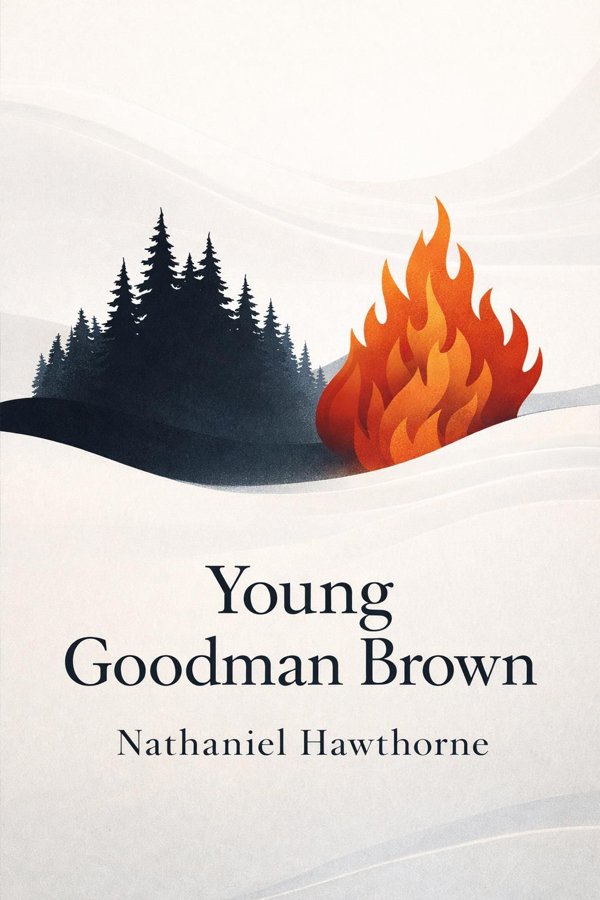
Young Goodman Brown: Summary & Key Insights
 10 min9 chaptersAudio available
Key Takeaways from Young Goodman Brown
Innocence often looks strongest just before it is tested.
Temptation becomes most persuasive when it looks familiar.
Some places in literature are not locations so much as states of mind.
Disillusionment often begins with overheard fragments rather than full proof.
The most frightening idea in the story is not that evil exists, but that it may include everyone.
What Is Young Goodman Brown About?
Young Goodman Brown by Nathaniel Hawthorne is a classics book spanning 5 pages. Nathaniel Hawthorne’s “Young Goodman Brown” is a brief story with the force of a nightmare and the depth of a moral philosophy. First published in 1835 and set in Puritan New England, it follows a young husband who leaves his wife one evening and ventures into the forest, where he encounters a mysterious traveler and witnesses what appears to be a shocking gathering of the town’s most respected people. What begins as a simple journey quickly becomes a crisis of faith, identity, and trust. The story matters because it asks a timeless question: what happens when a person discovers, or merely suspects, that evil lives beneath the surface of respectable society? Hawthorne explores religious hypocrisy, inherited guilt, temptation, and the danger of seeing humanity in absolute terms. The result is not just a tale about sin, but about suspicion and the collapse of innocence. Hawthorne is uniquely suited to this subject. Descended from Puritan ancestors and deeply preoccupied with sin and conscience, he wrote with unusual authority about the moral tensions of early America. “Young Goodman Brown” remains one of the clearest and most haunting expressions of his vision.
This FizzRead summary covers all 9 key chapters of Young Goodman Brown in approximately 10 minutes, distilling the most important ideas, arguments, and takeaways from Nathaniel Hawthorne's work. Also available as an audio summary and Key Quotes Podcast.
Young Goodman Brown
Nathaniel Hawthorne’s “Young Goodman Brown” is a brief story with the force of a nightmare and the depth of a moral philosophy. First published in 1835 and set in Puritan New England, it follows a young husband who leaves his wife one evening and ventures into the forest, where he encounters a mysterious traveler and witnesses what appears to be a shocking gathering of the town’s most respected people. What begins as a simple journey quickly becomes a crisis of faith, identity, and trust.
The story matters because it asks a timeless question: what happens when a person discovers, or merely suspects, that evil lives beneath the surface of respectable society? Hawthorne explores religious hypocrisy, inherited guilt, temptation, and the danger of seeing humanity in absolute terms. The result is not just a tale about sin, but about suspicion and the collapse of innocence.
Hawthorne is uniquely suited to this subject. Descended from Puritan ancestors and deeply preoccupied with sin and conscience, he wrote with unusual authority about the moral tensions of early America. “Young Goodman Brown” remains one of the clearest and most haunting expressions of his vision.
Who Should Read Young Goodman Brown?
This book is perfect for anyone interested in classics and looking to gain actionable insights in a short read. Whether you're a student, professional, or lifelong learner, the key ideas from Young Goodman Brown by Nathaniel Hawthorne will help you think differently.
- ✓Readers who enjoy classics and want practical takeaways
- ✓Professionals looking to apply new ideas to their work and life
- ✓Anyone who wants the core insights of Young Goodman Brown in just 10 minutes
Want the full summary?
Get instant access to this book summary and 100K+ more with Fizz Moment.
Get Free SummaryAvailable on App Store • Free to download
Key Chapters
Innocence often looks strongest just before it is tested. At the start of “Young Goodman Brown,” Hawthorne presents a newly married couple whose names carry symbolic weight: Goodman Brown suggests an ordinary, respectable Christian man, while Faith is both a loving wife and a living emblem of spiritual trust. Their farewell at dusk feels tender, but it is also uneasy. Faith pleads with her husband to stay, and Brown leaves anyway, already divided between outward morality and inward curiosity.
This opening matters because Hawthorne uses the domestic scene to establish what is at stake. Brown is not simply taking a walk; he is stepping away from a world of order, love, and certainty. Salem represents a rigid moral community that claims spiritual clarity, and Brown initially seems to belong fully within it. Yet his decision to enter the forest hints that innocence is rarely as secure as it appears. He wants to believe he can flirt with darkness and return unchanged.
That pattern is familiar beyond literature. People often assume they can compartmentalize risky choices: a hidden betrayal, a private vice, a cynical compromise at work. We tell ourselves we can preserve our public identity while exploring what contradicts it. Hawthorne suggests the split itself is dangerous.
Faith’s pink ribbons further deepen the symbolism. They evoke sweetness, youth, and fragile purity. Brown’s relationship to Faith is emotional, spiritual, and social all at once. As his trust in her falters, so does his trust in the entire moral order around him.
Actionable takeaway: Pay attention to the small decisions that lead you away from your stated values. Character rarely collapses in one dramatic moment; it erodes when curiosity and compromise begin to outrun conviction.
Temptation becomes most persuasive when it looks familiar. Deep in the forest, Goodman Brown meets a traveler who resembles him, only older, calmer, and more experienced. This is one of Hawthorne’s most unsettling inventions. Evil does not appear as a monstrous outsider. Instead, it arrives as a plausible companion, speaking reasonably, moving confidently, and carrying a serpent-shaped staff that recalls the biblical story of deception in Eden.
The traveler’s resemblance to Brown suggests that the real struggle may not be between a pure self and an external devil, but between innocence and the darker possibilities already present within the self. The older man knows Brown’s family history, the town’s hidden sins, and the private weaknesses of respected people. He offers not crude seduction but sophisticated rationalization. He implies that Brown’s ancestors were not as righteous as he imagines and that corruption is more universal than Brown has admitted.
This scene reveals how temptation often works in real life. It does not usually say, “Become evil.” It says, “Be realistic.” It says, “Everyone does this.” It says, “Your heroes were flawed too, so your standards are naïve.” In workplaces, relationships, and politics, moral compromise often enters disguised as maturity or insider knowledge.
The serpent staff matters because it is both symbolic and functional. Brown resists, then lingers, then continues. The staff seems to animate the journey, just as rationalized compromise can generate its own momentum. Once someone accepts the logic that goodness is mostly hypocrisy, resistance weakens.
Actionable takeaway: When a voice invites you to lower your standards in the name of sophistication, pause. Ask whether you are gaining wisdom or merely acquiring a convenient excuse to betray what you already know is right.
Some places in literature are not locations so much as states of mind. In “Young Goodman Brown,” the forest is the most important example. It stands in sharp contrast to Salem’s ordered streets, homes, and meetinghouses. If the town represents public religion and social control, the forest represents secrecy, instinct, ambiguity, and the hidden life beneath respectable appearances.
Hawthorne draws on a deep cultural fear from Puritan New England, where the wilderness was often imagined as spiritually dangerous. But he expands that fear into something more psychologically modern. The forest is where categories blur. Brown enters it physically, yet he also descends into uncertainty. He no longer knows whom to trust, what is real, or whether goodness can survive scrutiny. The path grows darker as his confidence weakens.
This setting helps explain why the story still feels contemporary. Most people experience their own version of the forest: moments when familiar moral maps fail. It may happen after discovering betrayal in a family, corruption in an institution, or hypocrisy in a mentor. The world suddenly seems less clear, and cynicism becomes tempting because it feels safer than trust.
The forest also strips away social performance. In town, people are protected by roles: minister, deacon, wife, catechist. In the woods, names and titles matter less than inner reality. Hawthorne suggests that much of human life depends on a fragile architecture of appearances, and that entering the “wilderness” means confronting what those appearances conceal.
Actionable takeaway: When life pushes you into moral uncertainty, resist the urge to conclude that everything is false. Confusion is not the same as truth. Use difficult revelations to become more discerning, not more nihilistic.
The most frightening idea in the story is not that evil exists, but that it may include everyone. In the climactic scene, Goodman Brown arrives at a nightmarish ceremony in the forest clearing, where he sees respected townspeople gathered in a satanic assembly. There he also sees Faith, and the shock reaches its peak. The woman who symbolized his innocence now appears to stand on the edge of initiation beside him.
The ceremony functions as a grotesque inversion of a religious sacrament. Instead of entering a community of grace, Brown is invited into a community of shared guilt. The presiding figure declares that all people, whether outwardly holy or openly sinful, participate in secret corruption. Hawthorne’s point is profound: evil gains power not only through acts of wrongdoing but through the belief that sin is universal, inevitable, and final.
Brown’s cry to Faith to resist is one of the story’s defining moments. It may be brave, desperate, or futile. The ambiguity is essential. Did he truly witness the ceremony? Was it a dream, hallucination, temptation, or revelation? Hawthorne refuses to settle the matter, because the psychological effect matters more than the factual answer.
In modern terms, this scene resembles moments when a person feels that every ideal has been exposed as fraudulent. If all institutions are corrupt, all leaders compromised, all relationships mixed with selfishness, then why keep believing in goodness at all? That is the ceremony’s deepest seduction.
Actionable takeaway: Reject all-or-nothing thinking about human nature. Acknowledging that everyone is flawed should lead to humility and vigilance, not surrender. The presence of sin does not erase the possibility of virtue.
Some journeys end physically where they began but leave the traveler spiritually exiled. When Goodman Brown returns to Salem, he is no longer the man who left at sunset. Whether his experience in the forest was real or imagined, it becomes the lens through which he sees everyone around him. The minister’s blessing sounds hollow, the deacon’s prayer false, and Faith herself becomes a source of pain rather than comfort.
This aftermath is crucial because it reveals Hawthorne’s deepest warning. The greatest damage is not the possibility that Brown witnessed evil; it is that he loses the ability to love, trust, or participate in human community. He does not emerge with moral discernment. He emerges with permanent suspicion. He lives the rest of his life gloomy, withdrawn, and emotionally estranged, and Hawthorne’s closing description suggests that he dies without peace.
In practical terms, Brown suffers from a destructive absolutism. He cannot accept that people may be mixed creatures, capable of both devotion and weakness. Once innocence is broken, he chooses bitterness instead of mature understanding. That response is more tragic than naïveté because it turns knowledge into poison.
This pattern is common after betrayal. A person discovers one lie in a relationship and concludes no intimacy is possible. A citizen sees institutional corruption and decides all public service is fake. A believer encounters religious hypocrisy and abandons not just false piety but all possibility of grace. Brown teaches us that disillusionment without charity becomes self-imprisonment.
Actionable takeaway: After a painful revelation, guard against becoming defined by distrust. Healing does not require blindness. It requires learning how to live with complexity without letting it harden your heart.
Sometimes the most important question in a story is the one the author refuses to answer. Did Goodman Brown actually witness a satanic gathering, or did he experience a dream, vision, or psychological breakdown? Hawthorne deliberately leaves the event unresolved, and that ambiguity is not a trick. It is the engine of the story’s meaning.
If the forest scene was real, then Brown has glimpsed the hidden corruption of his community. If it was a dream, then he has confronted his own fears, doubts, and capacity for suspicion. Either way, the consequences are real. Hawthorne shifts attention from external proof to inward effect: what a person believes about others can shape an entire life, even when certainty is impossible.
This ambiguity makes the story remarkably modern. In everyday life, people often act on incomplete information, emotional impressions, or imagined motives. A rumor destroys trust. A vague sign becomes evidence of betrayal. A fearful interpretation hardens into a worldview. The mind can create prisons as powerful as any objective event.
Hawthorne is especially interested in the danger of interpretive certainty. Brown does not live with mystery; he turns it into conviction. He chooses to believe the darkest possible meaning of what he experienced, and then organizes his life around that conclusion. In that sense, the story is about perception as much as morality.
Readers can apply this insight widely. Before deciding that someone is false, that an institution is irredeemable, or that one painful experience reveals a universal truth, it is wise to ask what is known, what is feared, and what has merely been inferred.
Actionable takeaway: When evidence is ambiguous, resist the urge to build your identity around the worst interpretation. Humility in judgment can protect both relationships and inner peace.
A culture’s moral language can outlive its original beliefs and continue shaping the imagination. Hawthorne’s story is saturated with the legacy of Puritanism: a worldview intensely concerned with sin, election, temptation, and the hidden state of the soul. Goodman Brown’s crisis does not emerge in a vacuum. It grows within a culture that treats moral life as a battlefield and sees evil as both intimate and pervasive.
Hawthorne had a personal connection to this material. He was descended from Puritan ancestors, including one associated with the Salem witch trials, and much of his fiction explores inherited guilt and moral severity. In “Young Goodman Brown,” that inheritance appears in Brown’s assumptions about holiness, depravity, and the terrifying possibility that outward righteousness can conceal inward corruption.
This historical setting enriches the story, but it also extends beyond it. Many modern readers no longer share Puritan theology, yet they still recognize the psychological pattern: environments where moral purity is demanded, public virtue is heavily performed, and hidden failure becomes especially devastating when exposed. Communities built on flawless appearances often produce either hypocrisy or despair.
The story therefore speaks to religious groups, ideological movements, and even high-pressure professional cultures. Whenever people are taught to divide the world cleanly into the righteous and the fallen, they may become vulnerable to Brown’s collapse when reality proves messier.
Hawthorne’s insight is subtle. He does not simply reject morality. He shows that rigid moral absolutism can make genuine moral life harder, because it leaves no room for weakness, repentance, or mixed motives.
Actionable takeaway: Build a moral framework that takes human imperfection seriously without making perfection the price of belonging. Communities endure best when they allow honesty, accountability, and grace.
A classic survives because it keeps describing crises that each new generation thinks are uniquely its own. “Young Goodman Brown” endures because its central conflict remains painfully recognizable: how do you live after discovering that people are not as pure as they seem? Hawthorne’s answer is deliberately tragic. Brown fails because he cannot move from innocence to wisdom; he leaps instead from innocence to contempt.
That movement feels especially modern in an age of exposure. We constantly learn disturbing truths about public figures, institutions, and communities. Social media accelerates disillusionment, rewarding outrage and suspicion. In such an environment, Brown’s worldview can seem almost natural. Once hypocrisy is visible everywhere, cynicism begins to masquerade as intelligence.
Yet Hawthorne suggests that cynicism is not a mark of depth. It is often a wound that has become a philosophy. Brown’s life shrinks because he cannot imagine goodness coexisting with imperfection. He wants saints or devils, not complicated people. That demand leaves him unable to love real human beings.
The story also endures because it is stylistically elegant. Hawthorne compresses theology, psychology, symbolism, and social critique into a narrative that can be read in one sitting yet debated for years. Students, general readers, and scholars all find something in it: suspense, allegory, ambiguity, and moral inquiry.
Its lasting practical value lies in this challenge: can you remain morally serious without becoming morally simplistic? Can you recognize evil without turning all humanity into a tribunal of suspects?
Actionable takeaway: Treat disillusionment as an invitation to deepen your understanding of people, not to withdraw from them. Wisdom begins when you stop demanding purity and start practicing discernment joined to mercy.
All Chapters in Young Goodman Brown
About the Author
Nathaniel Hawthorne (1804–1864) was an American novelist and short story writer whose work helped define 19th-century American literature. Born in Salem, Massachusetts, he drew heavily on the history of Puritan New England, especially its moral rigidity, religious intensity, and legacy of guilt. Much of his fiction explores sin, secrecy, conscience, and the tension between public virtue and private wrongdoing. His best-known novel is “The Scarlet Letter,” though he also wrote “The House of the Seven Gables,” “The Blithedale Romance,” and many acclaimed short stories, including “Young Goodman Brown.” Hawthorne’s style combines symbolism, psychological insight, and moral ambiguity, making his work both accessible and intellectually rich. He remains one of the most widely taught and influential figures in American literary history.
Get This Summary in Your Preferred Format
Read or listen to the Young Goodman Brown summary by Nathaniel Hawthorne anytime, anywhere. FizzRead offers multiple formats so you can learn on your terms — all free.
Available formats: App · Audio · PDF · EPUB — All included free with FizzRead
Download Young Goodman Brown PDF and EPUB Summary
Key Quotes from Young Goodman Brown
“Innocence often looks strongest just before it is tested.”
“Temptation becomes most persuasive when it looks familiar.”
“Some places in literature are not locations so much as states of mind.”
“Disillusionment often begins with overheard fragments rather than full proof.”
“The most frightening idea in the story is not that evil exists, but that it may include everyone.”
Frequently Asked Questions about Young Goodman Brown
Young Goodman Brown by Nathaniel Hawthorne is a classics book that explores key ideas across 9 chapters. Nathaniel Hawthorne’s “Young Goodman Brown” is a brief story with the force of a nightmare and the depth of a moral philosophy. First published in 1835 and set in Puritan New England, it follows a young husband who leaves his wife one evening and ventures into the forest, where he encounters a mysterious traveler and witnesses what appears to be a shocking gathering of the town’s most respected people. What begins as a simple journey quickly becomes a crisis of faith, identity, and trust. The story matters because it asks a timeless question: what happens when a person discovers, or merely suspects, that evil lives beneath the surface of respectable society? Hawthorne explores religious hypocrisy, inherited guilt, temptation, and the danger of seeing humanity in absolute terms. The result is not just a tale about sin, but about suspicion and the collapse of innocence. Hawthorne is uniquely suited to this subject. Descended from Puritan ancestors and deeply preoccupied with sin and conscience, he wrote with unusual authority about the moral tensions of early America. “Young Goodman Brown” remains one of the clearest and most haunting expressions of his vision.
More by Nathaniel Hawthorne

You Might Also Like





Browse by Category
Ready to read Young Goodman Brown?
Get the full summary and 100K+ more books with Fizz Moment.