
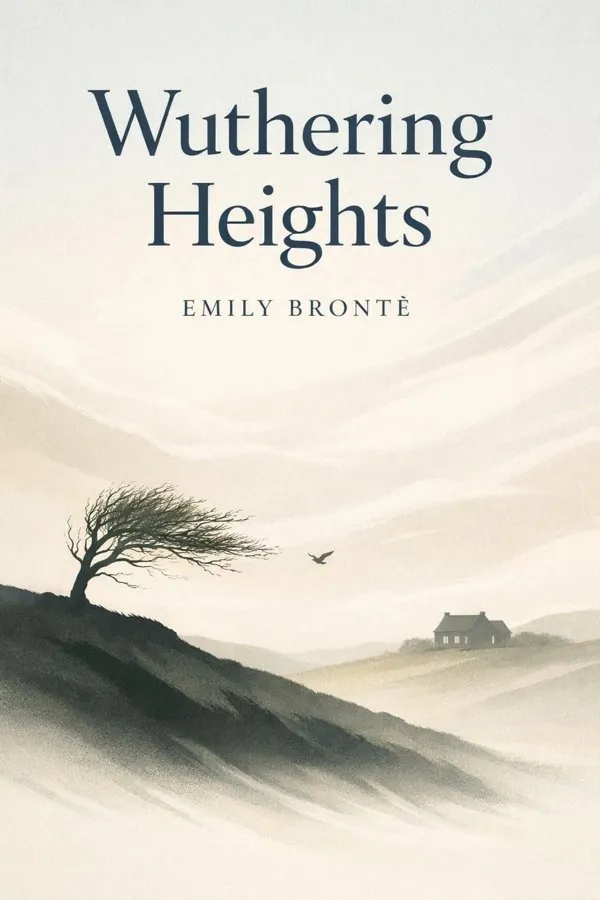
Wuthering Heights: Summary & Key Insights
by Emily Brontë
 10 min9 chaptersAudio available
Key Takeaways from Wuthering Heights
Sometimes the best way into a closed world is through the eyes of someone who does not understand it.
The deepest attachments are not always the healthiest ones.
A single choice made for status can alter generations.
Unhealed humiliation often disguises itself as justice.
Intensity can feel profound while still being deeply destructive.
What Is Wuthering Heights About?
Wuthering Heights by Emily Brontë is a classics book spanning 6 pages. Wuthering Heights is one of the most haunting and unconventional novels in English literature: a story of love so fierce it becomes indistinguishable from hatred, grief, and revenge. Set on the desolate Yorkshire moors, Emily Brontë’s only novel follows the tangled lives of the Earnshaw and Linton families, centered on the volatile bond between Catherine Earnshaw and the orphan Heathcliff. What begins as childhood intimacy hardens into social ambition, wounded pride, and a campaign of destruction that spans generations. Yet this is far more than a tragic romance. It is a study of class, cruelty, inheritance, emotional obsession, and the ways unresolved pain reproduces itself in family systems. Brontë’s achievement lies in her refusal to simplify her characters into heroes and villains; instead, she gives us people driven by need, memory, and desire in unsettling ways that still feel modern. First published in 1847, Wuthering Heights remains powerful because it asks difficult questions: What happens when love becomes possession? Can revenge ever heal humiliation? And is redemption possible after years of damage? Few novels explore the storms of the human heart with such daring intensity.
This FizzRead summary covers all 9 key chapters of Wuthering Heights in approximately 10 minutes, distilling the most important ideas, arguments, and takeaways from Emily Brontë's work. Also available as an audio summary and Key Quotes Podcast.
Wuthering Heights
Wuthering Heights is one of the most haunting and unconventional novels in English literature: a story of love so fierce it becomes indistinguishable from hatred, grief, and revenge. Set on the desolate Yorkshire moors, Emily Brontë’s only novel follows the tangled lives of the Earnshaw and Linton families, centered on the volatile bond between Catherine Earnshaw and the orphan Heathcliff. What begins as childhood intimacy hardens into social ambition, wounded pride, and a campaign of destruction that spans generations. Yet this is far more than a tragic romance. It is a study of class, cruelty, inheritance, emotional obsession, and the ways unresolved pain reproduces itself in family systems. Brontë’s achievement lies in her refusal to simplify her characters into heroes and villains; instead, she gives us people driven by need, memory, and desire in unsettling ways that still feel modern. First published in 1847, Wuthering Heights remains powerful because it asks difficult questions: What happens when love becomes possession? Can revenge ever heal humiliation? And is redemption possible after years of damage? Few novels explore the storms of the human heart with such daring intensity.
Who Should Read Wuthering Heights?
This book is perfect for anyone interested in classics and looking to gain actionable insights in a short read. Whether you're a student, professional, or lifelong learner, the key ideas from Wuthering Heights by Emily Brontë will help you think differently.
- ✓Readers who enjoy classics and want practical takeaways
- ✓Professionals looking to apply new ideas to their work and life
- ✓Anyone who wants the core insights of Wuthering Heights in just 10 minutes
Want the full summary?
Get instant access to this book summary and 100K+ more with Fizz Moment.
Get Free SummaryAvailable on App Store • Free to download
Key Chapters
Sometimes the best way into a closed world is through the eyes of someone who does not understand it. Wuthering Heights opens not with Catherine or Heathcliff, but with Mr. Lockwood, a polished outsider from the city who rents Thrushcross Grange and visits his landlord, Heathcliff, at the remote manor called Wuthering Heights. His first impressions are filled with discomfort: hostile dogs, curt conversation, strange family dynamics, and an atmosphere heavy with old resentment. He sees only fragments, but those fragments matter because they teach us how mystery works in human relationships. A household can appear merely rude or eccentric on the surface while concealing years of injury beneath it.
Lockwood’s role is important because he mirrors the reader. He misreads people, makes assumptions, and slowly learns that every room in the house is shaped by the past. His nightmare in Catherine’s old chamber, where he encounters the desperate ghostly cry of a woman begging to be let in, signals that this is a story where memory is not dead. The past intrudes physically, emotionally, and morally.
In everyday life, we often meet institutions, families, or workplaces that seem tense without knowing why. Lockwood’s experience reminds us that surface behavior often reflects hidden histories. A difficult colleague may be carrying humiliation; a rigid family rule may be built on an old wound. Curiosity, though, must be paired with humility. Lockwood wants the story, but he is not immediately capable of understanding it.
Actionable takeaway: When entering a complicated environment, resist snap judgments. Observe carefully, ask better questions, and remember that present behavior often makes sense only when its history is known.
The deepest attachments are not always the healthiest ones. Nelly Dean’s account begins when Mr. Earnshaw brings home a homeless orphan boy from Liverpool and names him Heathcliff. From that moment, the balance at Wuthering Heights changes. Hindley Earnshaw resents the newcomer, but Catherine forms an immediate, fierce bond with him. Together they roam the moors, resist discipline, and build a shared identity outside ordinary social rules. Their connection feels elemental rather than civilized; each recognizes in the other a kind of freedom and intensity the household cannot contain.
Brontë presents childhood not as innocence alone, but as the place where loyalties and wounds are formed. Heathcliff grows up humiliated by Hindley’s abuse and by his uncertain social standing. Catherine, meanwhile, develops in two directions at once: she is drawn to Heathcliff’s wildness, yet she also enjoys admiration, comfort, and status. Their intimacy is real, but it is not stable. It grows in a house already poisoned by favoritism, grief, and rivalry.
This section of the novel shows how early belonging shapes adult identity. People who feel chosen or rejected in childhood often carry those patterns for years. Consider how siblings may still replay old roles in adulthood, or how a child made to feel inferior may become intensely defensive later in life. Heathcliff’s later brutality does not excuse itself through suffering, but his suffering explains the emotional logic of his character.
Actionable takeaway: Take childhood dynamics seriously. Whether reflecting on your own life or supporting others, notice how early experiences of exclusion, favoritism, or emotional fusion can still govern present choices.
A single choice made for status can alter generations. The turning point in Wuthering Heights comes after Catherine and Heathcliff trespass at Thrushcross Grange and encounter the refined world of the Lintons. Catherine is temporarily absorbed into that environment and returns changed in outward manners, dress, and social aspirations. She still loves Heathcliff at the level of identity, famously insisting that he is more herself than she is, yet she decides to marry Edgar Linton because he is respectable, wealthy, and socially appropriate. Her logic is painfully divided: she thinks marriage to Edgar will secure position, while her bond with Heathcliff will somehow remain untouched.
This is the novel’s great emotional contradiction. Catherine does not lack feeling; she lacks honesty about consequences. She wants incompatible things without accepting the cost. Heathcliff overhears part of her confession—specifically her degrading statement that marrying him would lower her—and leaves before hearing her fuller declaration of spiritual attachment. That half-heard conversation becomes catastrophic.
Brontë is merciless in showing how class pressures distort love. Social mobility, reputation, and comfort are not trivial concerns, especially for a woman in Catherine’s position, but when ambition is separated from emotional truth, it produces damage. Modern readers can recognize this pattern in relationships shaped by external approval: choosing partners for image, income, family acceptance, or lifestyle while denying deeper incompatibilities or loyalties.
Actionable takeaway: Before making a life-defining commitment, identify the real forces guiding you. Ask plainly: Am I choosing from love, fear, status, convenience, or some unstable mixture of them?
Unhealed humiliation often disguises itself as justice. When Heathcliff returns after years away, he is transformed outwardly into a man of wealth, discipline, and intimidating composure. But his inner purpose is not renewal; it is revenge. He intends to punish those who degraded him: Hindley, Edgar, and in a more complicated way Catherine herself. He exploits Hindley’s weakness for gambling and drink to gain control of Wuthering Heights. He inserts himself into the Lintons’ domestic life. He courts Isabella not from love, but as a weapon against Edgar and Catherine.
What makes Heathcliff such a compelling figure is that his vengeance is understandable without being admirable. He has suffered genuine cruelty, class contempt, and emotional abandonment. Yet Brontë shows that once revenge becomes a person’s organizing principle, it expands beyond its original target. Heathcliff does not simply retaliate against the guilty; he poisons entire households and destroys the innocent along with the offending.
This dynamic appears far beyond fiction. A manager overlooked for promotion may spend years undermining others. A person betrayed in one relationship may become controlling in the next. Pain seeks symmetry, but revenge rarely restores dignity; it usually enlarges the original wound by turning the victim into a source of new harm.
The novel also captures the seduction of delayed retaliation. Heathcliff’s patience makes him powerful, yet morally emptier. His success only equips him to become more destructive.
Actionable takeaway: When you feel consumed by the desire to make someone suffer as you suffered, pause and name the underlying injury. Healing begins when pain is addressed directly rather than converted into a long-term identity.
Intensity can feel profound while still being deeply destructive. Wuthering Heights is often remembered as one of literature’s great love stories, but Brontë’s novel is more accurately a study of love fused with obsession, possession, pride, and self-erasure. Catherine and Heathcliff are bound at the level of imagination and identity; they do not simply love each other, they experience each other as extensions of the self. That fusion gives their bond its unforgettable force, but it also makes separation intolerable and maturity nearly impossible.
Healthy love recognizes another person as distinct. Obsessive attachment experiences the other as necessary for one’s own existence. That is why Catherine’s marriage and Heathcliff’s exile do not lead to grief alone, but to psychic disintegration. Their emotions are not moderated by responsibility, empathy, or mutual flourishing. Instead, their bond consumes everyone around them. Isabella is treated as an instrument. Edgar becomes a rival presence rather than a human being. Even after Catherine’s death, Heathcliff does not seek peace for her; he demands continued haunting.
This idea has modern relevance. Culture often romanticizes extremes: jealousy as devotion, emotional volatility as passion, inability to move on as proof of depth. Brontë offers a corrective. Feeling something intensely does not make it pure. If a relationship destroys your integrity, isolates you, or turns you cruel, the problem is not that it is too small; it may be that it is too fused with unresolved need.
Actionable takeaway: In your own relationships, distinguish intensity from health. Ask whether the bond allows truth, boundaries, and growth—or whether it thrives on control, idealization, and emotional chaos.
What adults refuse to heal, children are often forced to inherit. One of Brontë’s most remarkable achievements is her two-generation structure. The story does not end with Catherine’s death or Heathcliff’s triumph. Instead, the emotional damage of the first generation spreads into the lives of young Cathy Linton, Hareton Earnshaw, and Linton Heathcliff. Heathcliff deliberately engineers their futures in order to complete his revenge. He brutalizes Hareton by raising him in ignorance, repeating the degradation once inflicted on himself. He manipulates young Cathy into a marriage with his sickly son Linton to seize property and power.
This second generation reveals how trauma reproduces itself through systems, not just feelings. Heathcliff is not merely angry; he creates conditions that keep anger alive. He turns inheritance law, education, marriage, and guardianship into tools of domination. Yet the younger characters also show variation. They begin under the weight of old conflicts but are not wholly determined by them.
In practical terms, this part of the novel speaks to family patterns that repeat until someone interrupts them. Emotional neglect can become a parenting style. Shame can become mockery. Class anxiety can become rigid control over children’s choices. The novel reminds us that revenge rarely stays personal; it becomes environmental, shaping what the next generation believes is normal.
Readers today may see this in families where silence, favoritism, addiction, or contempt pass from one era to another. Change begins when inherited roles are recognized rather than unconsciously reenacted.
Actionable takeaway: Identify one harmful pattern you may have inherited—communication, conflict, control, withdrawal—and consciously choose a different practice before it becomes someone else’s burden.
Redemption often begins not with grand declarations, but with small acts of gentleness in damaged places. After so much cruelty, the gradual relationship between Hareton Earnshaw and young Cathy Linton offers the novel’s most hopeful development. At first, their interactions repeat older patterns of pride and humiliation. Cathy mocks Hareton’s lack of education; Hareton responds with rough defensiveness. Yet unlike the first generation, they slowly move toward mutual recognition. Cathy begins teaching Hareton to read. Hareton, in turn, responds with loyalty, patience, and emotional steadiness.
Their bond matters because it is built on growth rather than fusion. They do not mirror Catherine and Heathcliff’s destructive intensity; they model something quieter and more durable. Hareton has every reason to become another Heathcliff—deprived, insulted, denied cultivation—but he retains a capacity for affection. Cathy has inherited grief, loss, and bitterness, yet she learns humility. Together they create the possibility of love without domination.
This shift is one of Brontë’s central insights: cycles are powerful, but not absolute. Repair comes through education, tenderness, and the willingness to see another person not as a symbol of old injury, but as a full human being. In modern relationships, this may look like replacing sarcasm with explanation, contempt with curiosity, or inherited distrust with deliberate openness.
The novel does not suggest that healing erases the past. Instead, it shows that a different future can be built amid the ruins of a painful history.
Actionable takeaway: If you want to break a harmful relational pattern, start small. Offer respect where contempt is expected, teach where you might mock, and let consistency do the work that intensity cannot.
Landscape in great fiction is rarely just scenery. In Wuthering Heights, the Yorkshire moors function as emotional and philosophical terrain. The exposed, windswept setting mirrors the untamed energies of the novel’s characters: freedom, danger, loneliness, and sublimity. Wuthering Heights itself stands for elemental force—harsh, enduring, and resistant—while Thrushcross Grange represents cultivated order, comfort, and social polish. The movement between these spaces helps Brontë dramatize the conflict between nature and civilization, instinct and restraint, passion and decorum.
Catherine and Heathcliff belong spiritually to the moors, where social categories seem to dissolve. But life cannot be lived entirely in that register. Society demands property, marriage, inheritance, and manners. The tragedy arises partly because the characters cannot integrate these worlds. Catherine is split between wild inward affinity and outward social ambition. Heathcliff rejects domestication almost entirely, then masters social mechanisms only to weaponize them.
Readers can apply this idea by noticing the environments that shape their own emotional states. Some spaces invite authenticity; others reward performance. Some relationships feel expansive, others constricting. Brontë’s symbolic geography reminds us that identity is influenced by place as well as personality.
More broadly, the novel suggests that repression has limits. What is denied returns—through illness, cruelty, dreams, or memory. The storm outside often names the storm within.
Actionable takeaway: Pay attention to the environments you inhabit. Ask which settings bring out your clarity, generosity, and truth—and which ones intensify division, pretense, or emotional volatility.
A life organized around one obsession eventually empties itself out. In the final movement of the novel, Heathcliff appears to lose interest in the practical machinery of revenge that once animated him. He becomes distracted, restless, and increasingly drawn toward death, as if the boundary between memory, haunting, and desire has dissolved. He sees Catherine everywhere, neglects food, abandons ordinary concerns, and welcomes the approach of his own end. His death is not presented simply as punishment, nor as peaceful reconciliation, but as the final consequence of a life unable to release the dead.
What makes this ending so powerful is its ambiguity. Heathcliff remains terrifying, but he is also diminished by the very passion that made him formidable. Revenge has not restored his childhood, healed his humiliation, or given him true union with Catherine. It has merely prolonged his bondage to loss. By contrast, the younger generation begins to move toward marriage, domestic stability, and a future not wholly controlled by the past.
This contrast offers one of the novel’s clearest lessons: fixation can make a person feel purposeful while actually narrowing life into repetition. Grievances replay. Fantasies harden. The world shrinks to one absent person, one injury, one unfinished scene. Modern life provides many versions of this pattern, from unresolved breakups to career resentments to family estrangements that become core identity.
Actionable takeaway: If you notice your life orbiting a single old wound, interrupt the pattern deliberately. Seek conversation, reflection, therapy, ritual, or creative expression—anything that helps turn fixation into mourning, and mourning into movement.
All Chapters in Wuthering Heights
About the Author
Emily Brontë (1818–1848) was an English novelist and poet whose reputation rests primarily on her extraordinary first and only novel, Wuthering Heights. Born in Yorkshire, she grew up in the Brontë family alongside her sisters Charlotte and Anne, both accomplished writers. Deeply influenced by the stark beauty of the moors surrounding her home, Emily developed a literary voice marked by emotional intensity, wild imagination, and unusual originality. In 1847, she published Wuthering Heights under the pen name Ellis Bell. Although early readers were unsettled by its violence and moral ambiguity, the novel later became a cornerstone of English literature. Emily also wrote powerful poetry, much of it reflecting solitude, nature, and inner strength. She died in 1848 at just thirty years old, leaving behind a body of work small in quantity but immense in influence.
Get This Summary in Your Preferred Format
Read or listen to the Wuthering Heights summary by Emily Brontë anytime, anywhere. FizzRead offers multiple formats so you can learn on your terms — all free.
Available formats: App · Audio · PDF · EPUB — All included free with FizzRead
Download Wuthering Heights PDF and EPUB Summary
Key Quotes from Wuthering Heights
“Sometimes the best way into a closed world is through the eyes of someone who does not understand it.”
“The deepest attachments are not always the healthiest ones.”
“A single choice made for status can alter generations.”
“Unhealed humiliation often disguises itself as justice.”
“Intensity can feel profound while still being deeply destructive.”
Frequently Asked Questions about Wuthering Heights
Wuthering Heights by Emily Brontë is a classics book that explores key ideas across 9 chapters. Wuthering Heights is one of the most haunting and unconventional novels in English literature: a story of love so fierce it becomes indistinguishable from hatred, grief, and revenge. Set on the desolate Yorkshire moors, Emily Brontë’s only novel follows the tangled lives of the Earnshaw and Linton families, centered on the volatile bond between Catherine Earnshaw and the orphan Heathcliff. What begins as childhood intimacy hardens into social ambition, wounded pride, and a campaign of destruction that spans generations. Yet this is far more than a tragic romance. It is a study of class, cruelty, inheritance, emotional obsession, and the ways unresolved pain reproduces itself in family systems. Brontë’s achievement lies in her refusal to simplify her characters into heroes and villains; instead, she gives us people driven by need, memory, and desire in unsettling ways that still feel modern. First published in 1847, Wuthering Heights remains powerful because it asks difficult questions: What happens when love becomes possession? Can revenge ever heal humiliation? And is redemption possible after years of damage? Few novels explore the storms of the human heart with such daring intensity.
You Might Also Like


Browse by Category
Ready to read Wuthering Heights?
Get the full summary and 100K+ more books with Fizz Moment.