
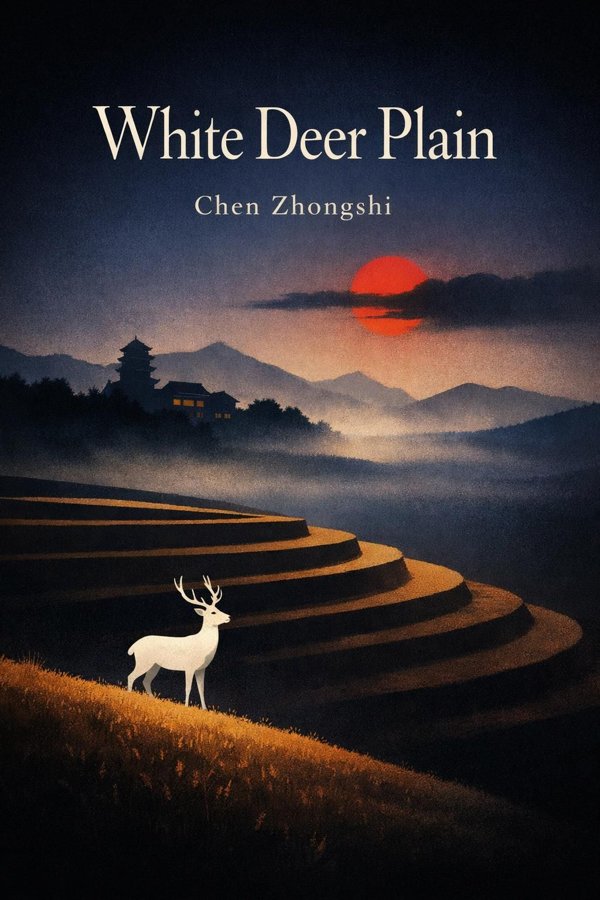
White Deer Plain: Summary & Key Insights
 10 min9 chaptersAudio available
Key Takeaways from White Deer Plain
A village can look timeless even as history is already loosening the ground beneath it.
People like to imagine they choose their lives freely, but White Deer Plain shows how often fate begins with the family one is born into.
History does not arrive in remote places as an abstract idea; it enters through rumor, policy, fear, and opportunity.
The customs that preserve a society can also suffocate the people living inside it.
Societies often pretend that moral breakdown begins in public institutions, but novels like White Deer Plain remind us that private desire can be just as disruptive.
What Is White Deer Plain About?
White Deer Plain by Chen Zhongshi is a classics book spanning 3 pages. White Deer Plain is one of modern Chinese literature’s great panoramic novels: a vast, earthy, morally charged portrait of rural life caught in the shockwaves of history. Set in White Deer Village on the Guanzhong Plain of Shaanxi, Chen Zhongshi follows the intertwined destinies of the Bai and Lu clans across the collapse of the Qing dynasty, the rise of the Republic, warlord rule, revolution, civil conflict, and the social transformations that remake village life. Yet this is not history from the viewpoint of emperors or generals. It is history as felt in family compounds, fields, ancestral halls, marriages, feuds, rituals, and private acts of loyalty and betrayal. What makes the novel enduring is its refusal to simplify human character. Chen presents a world where virtue and cruelty, duty and desire, tradition and rebellion coexist in painful tension. His realism is unsentimental, but never empty; beneath the violence and upheaval lies a serious inquiry into how people preserve honor, adapt to change, and pass on culture when old certainties are collapsing. As a writer deeply rooted in Shaanxi’s land, language, and customs, Chen Zhongshi brings unusual authority to this story, creating a masterpiece that is at once regional, national, and universal.
This FizzRead summary covers all 9 key chapters of White Deer Plain in approximately 10 minutes, distilling the most important ideas, arguments, and takeaways from Chen Zhongshi's work. Also available as an audio summary and Key Quotes Podcast.
White Deer Plain
White Deer Plain is one of modern Chinese literature’s great panoramic novels: a vast, earthy, morally charged portrait of rural life caught in the shockwaves of history. Set in White Deer Village on the Guanzhong Plain of Shaanxi, Chen Zhongshi follows the intertwined destinies of the Bai and Lu clans across the collapse of the Qing dynasty, the rise of the Republic, warlord rule, revolution, civil conflict, and the social transformations that remake village life. Yet this is not history from the viewpoint of emperors or generals. It is history as felt in family compounds, fields, ancestral halls, marriages, feuds, rituals, and private acts of loyalty and betrayal.
What makes the novel enduring is its refusal to simplify human character. Chen presents a world where virtue and cruelty, duty and desire, tradition and rebellion coexist in painful tension. His realism is unsentimental, but never empty; beneath the violence and upheaval lies a serious inquiry into how people preserve honor, adapt to change, and pass on culture when old certainties are collapsing. As a writer deeply rooted in Shaanxi’s land, language, and customs, Chen Zhongshi brings unusual authority to this story, creating a masterpiece that is at once regional, national, and universal.
Who Should Read White Deer Plain?
This book is perfect for anyone interested in classics and looking to gain actionable insights in a short read. Whether you're a student, professional, or lifelong learner, the key ideas from White Deer Plain by Chen Zhongshi will help you think differently.
- ✓Readers who enjoy classics and want practical takeaways
- ✓Professionals looking to apply new ideas to their work and life
- ✓Anyone who wants the core insights of White Deer Plain in just 10 minutes
Want the full summary?
Get instant access to this book summary and 100K+ more with Fizz Moment.
Get Free SummaryAvailable on App Store • Free to download
Key Chapters
A village can look timeless even as history is already loosening the ground beneath it. White Deer Plain opens in White Deer Village, where everyday life appears ordered by lineage, farming rhythms, ritual obligations, and the long coexistence of the Bai and Lu families. They are connected by geography, memory, marriage ties, and mutual dependence, yet they are also divided by pride, temperament, and competing ideas of authority. This balance gives the village its stability, but it also contains the seeds of conflict.
Chen Zhongshi uses this opening not simply to introduce characters, but to establish a whole moral ecosystem. Land is not only an economic resource; it is inheritance, status, and identity. Family names are not just labels; they shape expectations about duty, masculinity, obedience, and reputation. Even seemingly small decisions—whom to marry, how to settle a dispute, when to bow to custom—carry consequences because village life is intensely communal.
What makes this section powerful is that it shows how social order often depends on habits people rarely question. Once those habits are disrupted by new politics, new education, and new forms of violence, the old world does not disappear cleanly; it begins to crack from within. Readers can apply this insight beyond the novel. Workplaces, communities, and families also rely on unspoken rules. When conditions change, those hidden assumptions become visible.
An actionable takeaway: pay attention to the invisible structures in your own environment—the customs, loyalties, and expectations people take for granted—because they often determine how individuals respond when change arrives.
People like to imagine they choose their lives freely, but White Deer Plain shows how often fate begins with the family one is born into. The Bai and Lu clans stand at the center of the novel, and their relationship is one of the book’s deepest engines. Their rivalry is not a simple feud between good and evil. Instead, Chen presents two houses whose values overlap but whose styles of power differ, creating a lasting tension between moral discipline, ambition, prestige, and resentment.
This rivalry matters because it turns private emotion into public consequence. A family dispute can affect marriages, inheritance, village leadership, and the social standing of future generations. In such a setting, no action is purely individual. A son’s recklessness stains the clan; a patriarch’s decision reshapes the lives of women, servants, and descendants; an old grievance can outlive the people who first felt it. Chen therefore uses family conflict to reveal a broader truth about traditional society: kinship is both protection and burden.
The novel also makes clear that clan identity can preserve continuity during chaos. When political institutions are weak or violent, people often retreat into family structures for security. But that same instinct can reinforce exclusion and revenge. Modern readers can see parallels in corporate dynasties, political families, or social networks where loyalty offers support but narrows perspective.
An actionable takeaway: honor the communities that formed you, but regularly ask whether inherited loyalties are helping you act justly or merely repeating old conflicts in new forms.
History does not arrive in remote places as an abstract idea; it enters through rumor, policy, fear, and opportunity. In White Deer Plain, the fall of imperial order and the spread of republican and revolutionary movements do not instantly transform rural life. Instead, new ideologies seep into the village through schools, officials, returning young men, soldiers, taxes, and violence. What once seemed permanent begins to feel negotiable.
Chen is especially insightful about the uneven pace of political change. Some villagers embrace new slogans because they genuinely believe in justice. Others use them instrumentally, sensing a path to power. Still others resist not because they are foolish, but because the old order still gives meaning to their lives. This complexity keeps the novel from becoming propaganda or nostalgia. Revolution is neither pure liberation nor pure destruction. It opens possibilities while also unleashing opportunism, fear, and fracture.
The Bai family’s struggle to uphold moral order amid upheaval and the Lu family’s varied responses to political currents illustrate a key idea: when systems collapse, character matters, but character alone is not enough. Even decent people can be overwhelmed by forces larger than themselves. This has practical relevance today. In times of technological disruption, political polarization, or economic change, communities rarely shift all at once. Different groups move at different speeds, often misunderstanding one another.
An actionable takeaway: when confronting social change, avoid simple labels like progressive or backward. Instead, ask what each person fears losing, what they hope to gain, and how institutions can help communities adapt without destroying dignity.
The customs that preserve a society can also suffocate the people living inside it. One of White Deer Plain’s greatest strengths is its nuanced portrayal of traditional rural culture. Ancestor worship, Confucian ethics, ritual propriety, kinship hierarchy, and agricultural discipline create a coherent world. They teach restraint, responsibility, reverence for elders, and a sense that life belongs to a chain of generations rather than to the individual alone.
Yet Chen never romanticizes this order. The same structures that sustain communal life also enforce conformity, punish deviation, and limit emotional and personal freedom. Women in particular bear the weight of moral codes they did not design. Desire, shame, sexuality, and reputation become sites of control. Men, too, are trapped by expectations of authority and endurance. A person may know that a custom is unjust and still feel powerless to defy it because identity itself is woven into ritual.
This tension gives the novel much of its moral depth. Tradition in White Deer Plain is not a museum piece; it is a lived force. It gives people language for virtue, but it can also conceal cruelty behind the mask of order. In modern life, we see similar patterns in family businesses, religious communities, elite institutions, or cultural expectations that offer belonging while resisting necessary reform.
An actionable takeaway: treat tradition neither as sacred beyond criticism nor as useless baggage. Ask of every inherited practice: what human good does it protect, who benefits from it, who is harmed by it, and what deserves to be preserved, revised, or left behind?
Societies often pretend that moral breakdown begins in public institutions, but novels like White Deer Plain remind us that private desire can be just as disruptive. Beneath the village’s formal codes lies a turbulent world of attraction, jealousy, resentment, humiliation, and longing. Chen Zhongshi does not separate politics from the body; he shows how sexuality, pride, and emotional hunger shape family decisions, social reputations, and even larger conflicts.
This matters because White Deer Plain is deeply concerned with hypocrisy. People defend virtue publicly while acting recklessly in secret. They condemn others to protect themselves. They invoke morality not always to safeguard the community, but sometimes to police weakness selectively. The result is not simply scandal. It is the exposure of a larger truth: when a social order leaves little room for honesty about desire, that desire does not disappear. It returns in distorted forms—betrayal, manipulation, violence, self-destruction.
Chen’s treatment of intimate life also enlarges the novel beyond historical chronicle. The village is not only a stage for revolutions; it is a place where human beings struggle with shame, need, pleasure, and loneliness. Modern readers can apply this insight to any culture that prizes appearances over candor. Organizations, families, and communities become unstable when they deny ordinary emotional realities and punish truthful conversation.
An actionable takeaway: create spaces in your life—personal, relational, or institutional—where difficult truths about desire, vulnerability, and failure can be discussed honestly before secrecy turns them into larger harm.
Political slogans may promise renewal, but in White Deer Plain change is often delivered through coercion, fear, and bloodshed. As the Republican era deepens and armed struggles spread, violence ceases to be an exceptional event and becomes a structuring force in village life. Banditry, punitive campaigns, factional revenge, military intrusion, and ideological purges transform how people farm, trust, marry, and remember.
Chen’s realism is especially sharp here because he shows that violence does not only kill bodies; it reorganizes moral perception. People learn to speak cautiously, hide loyalties, suspect neighbors, and normalize what once would have been unthinkable. The categories of hero, victim, collaborator, and survivor blur. Some exploit turmoil for advancement. Others perform bravery publicly while collapsing privately. Many simply endure, trying to protect a fragment of ordinary life.
This idea is central to the novel’s historical vision. White Deer Plain is not about progress as a straight line. It is about the way large political transformations sink into daily existence, leaving scars that persist long after the immediate crisis passes. Communities emerging from conflict often discover that rebuilding roads or institutions is easier than rebuilding trust.
The same lesson applies wherever polarization intensifies. When a social environment rewards humiliation, intimidation, or moral absolutism, collective life becomes brittle. People stop telling the truth and start calculating survival.
An actionable takeaway: in any group under stress, prioritize practices that protect trust—clear accountability, memory of harms, and opportunities for repair—because once fear becomes normal, communities degrade faster than they realize.
One of the most unsettling truths in White Deer Plain is that goodness does not guarantee safety, success, or historical vindication. Chen respects moral seriousness, especially the disciplined ethic associated with upright family leadership and Confucian self-restraint. Yet he also shows the limits of personal virtue in an age of systemic breakdown. Honest people suffer. Principled choices can isolate rather than reward. Decency can preserve dignity without altering the outcome.
This is one reason the novel feels so mature. It avoids both cynicism and moral fantasy. Character matters profoundly: it shapes how people endure hardship, treat others, and interpret loss. But character operates within conditions it did not create. War, ideology, social collapse, and economic desperation can overwhelm even the wisest individuals. The result is tragic, yet not meaningless. Chen suggests that moral action may be valuable precisely because it refuses to be measured only by immediate victory.
For readers, this idea is deeply practical. In careers, politics, and personal crises, people often expect ethics to produce clear rewards. When that does not happen, they become disillusioned. White Deer Plain offers a sterner lesson: virtue is not a strategy for control. It is a way of remaining human when control has been lost.
This perspective can be freeing. It allows us to judge actions by integrity, not just outcomes, while still recognizing the need for better institutions.
An actionable takeaway: cultivate principles that do not depend entirely on favorable circumstances, and pair personal integrity with realistic awareness of the systems that shape what individuals can and cannot change.
After great upheaval, people hope for a clean beginning, but White Deer Plain insists that renewal is always burdened by memory. The later movement of the novel asks what survives after generations of conflict, moral compromise, and social transformation. The answer is not simple triumph or total ruin. What remains is a damaged continuity: land still worked, names still remembered, stories still told, and human beings still trying to make meaning from suffering.
This final perspective expands the novel beyond the fate of any single character. Chen portrays history as cyclical in some respects and irreversible in others. Old institutions may collapse, but emotional inheritances remain. Shame, pride, grief, and longing pass from one generation to the next just as surely as fields and houses do. At the same time, life does not stop. Children grow up. Communities reassemble. New moral arrangements emerge, however imperfectly.
The book’s power lies in its refusal to offer easy consolation. Renewal is possible, but it is fragile. It depends on memory that is honest rather than sentimental, and on a willingness to rebuild without pretending the past can be restored intact. This is a lesson for post-conflict societies, families after betrayal, and individuals after loss. Healing is not erasure; it is disciplined continuation.
An actionable takeaway: when beginning again after disruption, resist the urge either to glorify the past or to deny it. Name what was lost, identify what still deserves preservation, and build the next stage of life on truth rather than nostalgia.
All Chapters in White Deer Plain
About the Author
Chen Zhongshi (1942–2016) was a celebrated Chinese novelist born in Xi'an and deeply rooted in the culture of Shaanxi Province. He is best known for White Deer Plain, the landmark novel that won the Fourth Mao Dun Literature Prize and secured his place among the leading figures of contemporary Chinese literature. Much of his writing centers on rural northwestern China, where he drew on local history, dialect, customs, and social memory to create works of unusual authenticity and power. Chen’s fiction is marked by realism, strong regional atmosphere, and a sustained interest in moral conflict, family structure, and the impact of historical change on ordinary people. Through White Deer Plain in particular, he offered one of the most influential literary portraits of rural Chinese society in the twentieth century.
Get This Summary in Your Preferred Format
Read or listen to the White Deer Plain summary by Chen Zhongshi anytime, anywhere. FizzRead offers multiple formats so you can learn on your terms — all free.
Available formats: App · Audio · PDF · EPUB — All included free with FizzRead
Download White Deer Plain PDF and EPUB Summary
Key Quotes from White Deer Plain
“A village can look timeless even as history is already loosening the ground beneath it.”
“People like to imagine they choose their lives freely, but White Deer Plain shows how often fate begins with the family one is born into.”
“History does not arrive in remote places as an abstract idea; it enters through rumor, policy, fear, and opportunity.”
“The customs that preserve a society can also suffocate the people living inside it.”
“Societies often pretend that moral breakdown begins in public institutions, but novels like White Deer Plain remind us that private desire can be just as disruptive.”
Frequently Asked Questions about White Deer Plain
White Deer Plain by Chen Zhongshi is a classics book that explores key ideas across 9 chapters. White Deer Plain is one of modern Chinese literature’s great panoramic novels: a vast, earthy, morally charged portrait of rural life caught in the shockwaves of history. Set in White Deer Village on the Guanzhong Plain of Shaanxi, Chen Zhongshi follows the intertwined destinies of the Bai and Lu clans across the collapse of the Qing dynasty, the rise of the Republic, warlord rule, revolution, civil conflict, and the social transformations that remake village life. Yet this is not history from the viewpoint of emperors or generals. It is history as felt in family compounds, fields, ancestral halls, marriages, feuds, rituals, and private acts of loyalty and betrayal. What makes the novel enduring is its refusal to simplify human character. Chen presents a world where virtue and cruelty, duty and desire, tradition and rebellion coexist in painful tension. His realism is unsentimental, but never empty; beneath the violence and upheaval lies a serious inquiry into how people preserve honor, adapt to change, and pass on culture when old certainties are collapsing. As a writer deeply rooted in Shaanxi’s land, language, and customs, Chen Zhongshi brings unusual authority to this story, creating a masterpiece that is at once regional, national, and universal.
You Might Also Like


Browse by Category
Ready to read White Deer Plain?
Get the full summary and 100K+ more books with Fizz Moment.