
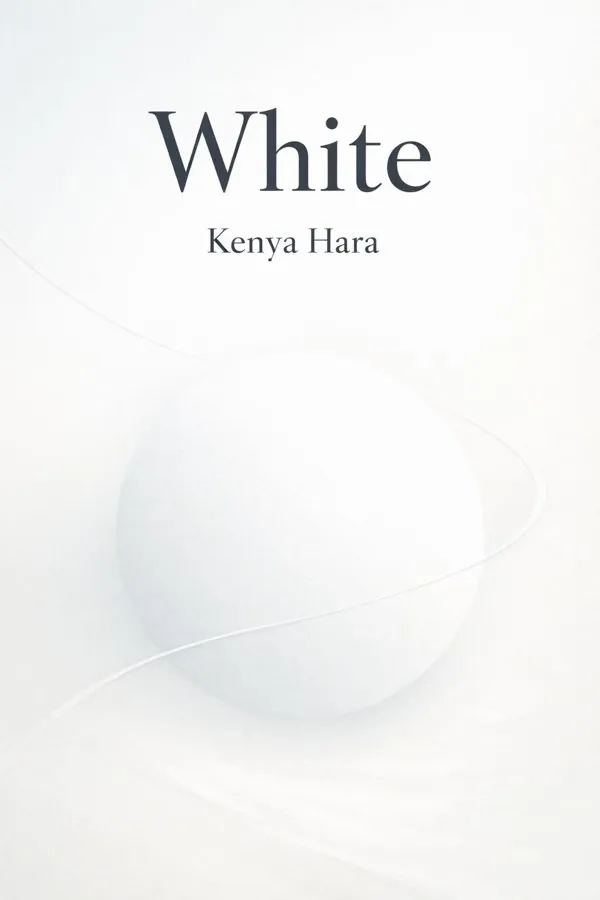
White: Summary & Key Insights
by Kenya Hara
 10 min9 chaptersAudio available
Key Takeaways from White
The most meaningful spaces are often the ones that do not force meaning on us.
The loudest thing in a room is not always what communicates most powerfully.
A color becomes truly meaningful when it is rooted in culture, ritual, and touch.
The most memorable designs are often the ones that leave something unfinished for the mind to complete.
What we omit can be as expressive as what we declare.
What Is White About?
White by Kenya Hara is a design book spanning 8 pages. What if white were not simply a color, but a way of thinking? In White, Japanese designer Kenya Hara turns a seemingly ordinary visual element into a profound meditation on perception, culture, beauty, and design. Rather than treating white as blankness or neutrality, Hara presents it as a field of possibility: a space that invites attention, imagination, and human participation. Through reflections on Japanese aesthetics, materials, architecture, communication, and everyday objects, he shows how emptiness can be active, silence can be expressive, and restraint can deepen meaning. This short but richly layered book matters because it challenges many modern assumptions about design. In a world crowded with noise, branding, and visual excess, Hara argues for the power of subtlety. His ideas are especially relevant to designers, artists, architects, and anyone interested in how form shapes feeling. Hara writes not only as a philosopher of aesthetics, but as one of Japan’s most influential contemporary designers, widely known for his work with MUJI and for his thoughtful approach to minimalism. White is a compact book, but its implications extend far beyond design into daily life, attention, and how we experience the world.
This FizzRead summary covers all 9 key chapters of White in approximately 10 minutes, distilling the most important ideas, arguments, and takeaways from Kenya Hara's work. Also available as an audio summary and Key Quotes Podcast.
White
What if white were not simply a color, but a way of thinking? In White, Japanese designer Kenya Hara turns a seemingly ordinary visual element into a profound meditation on perception, culture, beauty, and design. Rather than treating white as blankness or neutrality, Hara presents it as a field of possibility: a space that invites attention, imagination, and human participation. Through reflections on Japanese aesthetics, materials, architecture, communication, and everyday objects, he shows how emptiness can be active, silence can be expressive, and restraint can deepen meaning.
This short but richly layered book matters because it challenges many modern assumptions about design. In a world crowded with noise, branding, and visual excess, Hara argues for the power of subtlety. His ideas are especially relevant to designers, artists, architects, and anyone interested in how form shapes feeling. Hara writes not only as a philosopher of aesthetics, but as one of Japan’s most influential contemporary designers, widely known for his work with MUJI and for his thoughtful approach to minimalism. White is a compact book, but its implications extend far beyond design into daily life, attention, and how we experience the world.
Who Should Read White?
This book is perfect for anyone interested in design and looking to gain actionable insights in a short read. Whether you're a student, professional, or lifelong learner, the key ideas from White by Kenya Hara will help you think differently.
- ✓Readers who enjoy design and want practical takeaways
- ✓Professionals looking to apply new ideas to their work and life
- ✓Anyone who wants the core insights of White in just 10 minutes
Want the full summary?
Get instant access to this book summary and 100K+ more with Fizz Moment.
Get Free SummaryAvailable on App Store • Free to download
Key Chapters
The most meaningful spaces are often the ones that do not force meaning on us. In White, Kenya Hara draws on the Japanese principle of emptiness, or ku, to argue that emptiness is not a void to be feared but an openness that allows perception to awaken. White becomes the visual expression of this idea. It does not dictate a single message; instead, it creates room for interpretation, anticipation, and mental participation.
This is a deeply Japanese sensibility. In many Western contexts, emptiness can seem unfinished or lacking. Hara reframes it as potential. An uncluttered room, an understated package, or a quiet pause in communication can feel alive because it leaves space for the viewer or user to complete the experience. Meaning is not handed over fully formed; it emerges through engagement.
This idea has broad implications for design. A homepage with fewer competing elements can help users focus more clearly. A product with restrained form can invite curiosity instead of immediate consumption. Even a conversation benefits when not every silence is filled. White, in this sense, is the condition that makes awareness possible.
Hara’s larger point is that design should not only present information. It should shape conditions in which understanding can arise. White is powerful precisely because it does less on the surface while enabling more beneath it.
Actionable takeaway: Remove one unnecessary element from a space, interface, or object you use every day, and notice whether the resulting openness improves clarity, calm, or attention.
The loudest thing in a room is not always what communicates most powerfully. Hara sees white as the visual equivalent of silence: a quiet presence that makes subtle distinctions, textures, and meanings more noticeable. Silence in design is not emptiness in the negative sense. It is a form of disciplined restraint that allows people to feel, imagine, and interpret without being overwhelmed.
White absorbs visual noise. It softens boundaries, diffuses intensity, and encourages reflection. Hara connects this to the emotional and psychological effect of simplicity. When too many signals compete for attention, perception becomes shallow and reactive. But when design creates silence, people become more alert. They begin to notice shadow, proportion, rhythm, and materiality. This is why a simple package, a sparse exhibition space, or an uncluttered poster can feel more sophisticated than a louder alternative.
In practice, this does not mean every design must be minimalist. It means every design should be conscious of what it asks people to process. White teaches designers to treat restraint as an active tool. A website with generous spacing, a brand identity with disciplined typography, or a retail display that leaves room around objects can all communicate confidence and care.
Silence is also ethical. It respects the user’s mental space instead of trying to dominate it. In that sense, white is not merely elegant; it is humane.
Actionable takeaway: In your next design decision, ask not only what to add, but what can be quieted so the essential message has room to breathe.
A color becomes truly meaningful when it is rooted in culture, ritual, and touch. Hara explores white not as an abstract idea alone, but as something embodied in Japanese life through paper, ceramics, architecture, clothing, packaging, and ceremonial practices. White carries associations of purity, freshness, beginnings, and attention to the unseen. It is cultural memory made visible.
In Japanese aesthetics, white often appears in ways that emphasize refinement rather than display. Think of washi paper, whose whiteness is never flat but alive with fibers, softness, and light. Think of rice, porcelain, or the white garments associated with transition and ritual. In these cases, white is not sterile. It is textured, human, and material. Hara wants us to notice that whiteness gains depth through context. A white wall, sheet, or vessel is never just white. It absorbs history, craftsmanship, use, and atmosphere.
This matters for designers because materials communicate before words do. A matte white package says something different from glossy white plastic. A slightly warm paper stock evokes a different emotional response than bright industrial white. Even the same color can feel sacred, clinical, or inviting depending on texture and setting.
Hara’s insight is that cultural sensitivity and material sensitivity are inseparable. Designers must understand not just form and color, but how materials carry collective meaning and sensory resonance.
Actionable takeaway: The next time you choose a material or color, evaluate it in context: light, texture, cultural association, and use matter as much as appearance.
The most memorable designs are often the ones that leave something unfinished for the mind to complete. Hara argues that white is powerful because it activates imagination. Instead of over-explaining, it creates a perceptual gap into which the viewer steps. In that gap, meaning is not delivered like a package; it is co-created.
This is one of White’s central philosophical contributions. Hara suggests that perception is never passive. We do not simply receive the world; we interpret it through memory, expectation, and attention. White amplifies this process because it offers fewer predetermined cues. A sparse visual field can stimulate more imagination than a fully saturated one. A simple object can invite deeper emotional projection than a heavily decorated one.
In design practice, this means leaving room for users. Packaging that hints rather than shouts can create intrigue. A store environment that avoids clutter can make products feel more discoverable. An editorial layout with generous negative space can help readers form stronger relationships with the content. Even in branding, mystery can be more engaging than total explanation.
This idea also applies to education, art, and leadership. If everything is made explicit, people stop participating mentally. White reminds us that incompleteness, used skillfully, can create stronger involvement.
The challenge is balance. Too little guidance becomes confusion. Too much guidance becomes deadening. Hara asks us to design for participation, not just transmission.
Actionable takeaway: In your communication, leave one intentional opening, such as space, pause, or ambiguity, that invites the audience to think rather than merely consume.
What we omit can be as expressive as what we declare. Hara extends the idea of white into communication itself, proposing that meaningful communication includes the unspoken. White functions like a pause, a margin, or a silence in language. It frames content, gives it rhythm, and allows emotional nuance to emerge.
Modern communication often assumes that effectiveness means explicitness, speed, and repetition. Hara questions this. He suggests that oversaturation dulls perception. When every space is filled with messaging, audiences no longer feel invited; they feel pushed. White counters this by introducing intervals. In a book layout, margins make text readable. In advertising, restraint can generate curiosity. In conversation, a pause can show respect, gravity, or tenderness.
This is especially relevant in branding and user experience. Brands often try to maximize every touchpoint, adding claims, visuals, prompts, and calls to action. But a brand that knows how to leave space often appears more trustworthy and mature. Likewise, an interface that guides without constant interruption feels calmer and easier to use.
Hara’s point is not anti-communication. It is a call for richer communication. The unspoken is not empty; it is charged with relation, timing, and inference. Good design allows the message to resonate rather than merely arrive.
Actionable takeaway: Review one piece of communication you control, such as a slide, page, ad, or email, and remove anything that explains too much or interrupts the audience’s ability to infer meaning.
Some of the strongest design experiences arise at the threshold between what we can touch and what we can only sense. Hara is fascinated by the way white exists between the material and the immaterial. It has physical presence, but it also seems to dissolve into light, atmosphere, and idea. This ambiguity gives white a unique philosophical depth.
A sheet of paper is material, yet its whiteness feels like a space waiting for thought. A wall is solid, yet when painted white it can appear less as an object and more as an environment for light and shadow. In this way, white makes us aware that design is never just about objects. It is about the invisible relationships those objects create: mood, expectation, orientation, memory.
Hara uses this insight to expand the role of the designer. Design is not merely the shaping of things, but the shaping of conditions. A product is one layer; the atmosphere around it is another. Packaging is one layer; anticipation is another. Architecture is one layer; the quality of emptiness inside it is another.
This perspective helps explain why highly minimal work can feel emotionally rich. What seems materially reduced may be experientially amplified. White strips away distraction so that subtler dimensions become perceptible.
Actionable takeaway: When evaluating a design, assess not only the object itself but also the invisible effects it creates, such as mood, pause, expectation, and sense of space.
White is often mistaken for neutrality, but Hara shows that it can be surprisingly emotional. Far from being empty or cold by default, white can evoke tenderness, freshness, reverence, fragility, distance, or calm depending on how it is used. Its meaning is inseparable from sensory context.
One reason white feels so rich is that we rarely encounter it as a pure abstraction. We encounter white through paper fibers, daylight, cloth, snow, porcelain, skin tones in contrast, and the subtle shadows that fall across surfaces. These sensory variations make white dynamic. A warm white can feel intimate. A sharp bright white can feel clinical or futuristic. A weathered white can carry memory and age. Hara invites us to become attentive to these distinctions.
This attentiveness matters for design because emotional tone often emerges from sensory subtleties rather than big gestures. A retail environment lit with soft white can feel welcoming, while harsh white light can produce alienation. A product package in textured off-white may communicate craftsmanship better than a perfectly glossy finish. White amplifies whatever surrounds it, so small choices become significant.
Hara’s insight is that sensory intelligence is emotional intelligence. Designers who understand how white behaves in light, texture, scale, and sequence can shape experiences with greater precision and empathy.
Actionable takeaway: Compare three different whites, such as paper, paint, or fabric, under natural and artificial light, and observe how their emotional effects change with context.
True minimalism is not about making things look empty. It is about directing attention with care. Hara’s treatment of white helps distinguish profound simplicity from superficial style. Minimalism in his view is not a decorative trend of clean surfaces and muted palettes. It is an ethics of reduction in service of awareness.
White becomes a discipline that forces designers to ask what is essential. When visual excess is removed, the quality of what remains becomes more important. Typography must be more considered. Materials must be more honest. Proportions must be more exact. Interaction must be more intuitive. White does not hide weak design; it exposes it.
This is why Hara’s ideas remain so relevant to contemporary practice. In digital products, minimalism can improve usability when it clarifies hierarchy and reduces cognitive load. In retail, it can create stronger focus on the product. In publishing, it can support reading and contemplation. But when minimalism is used merely as a fashionable aesthetic, it becomes empty mannerism. Hara pushes designers beyond style toward thoughtfulness.
His philosophy also applies personally. A simplified workspace, wardrobe, or schedule can reveal what actually matters. Reduction is not deprivation when it enables richer engagement.
Actionable takeaway: Choose one project and define its single most important experience, then remove any visual or structural element that does not support that core intention.
In a world designed to capture attention, choosing restraint can become a radical act. Hara’s concept of white offers a practical framework for contemporary design practice across branding, product design, digital interfaces, architecture, and everyday living. White is not a literal prescription to make everything pale or blank. It is a mindset: design should create space for awareness instead of adding noise for its own sake.
For brands, this means building trust through clarity and understatement rather than exaggerated claims. For product designers, it means honoring texture, function, and user intuition over ornamental complexity. For interface designers, it means reducing friction, visual clutter, and interruptive patterns. For architects and spatial designers, it means understanding how emptiness, light, and material can shape mood as strongly as objects do.
Hara’s influence is visible in design cultures that value simplicity, but his deeper message is easy to miss. White is not about absence for its own sake. It is about preparing a field in which life, behavior, and interpretation can unfold. The best design often disappears into use, leaving behind not emptiness but heightened experience.
This makes White especially valuable today. At a time of endless stimulation, Hara reminds us that thoughtful subtraction can be more generous than constant addition.
Actionable takeaway: Before finalizing any design, ask one strategic question: does this element increase genuine awareness and usefulness, or is it only adding volume?
All Chapters in White
About the Author
Kenya Hara, born in 1958, is a Japanese graphic designer, curator, writer, and educator whose work has had a major influence on contemporary minimalist design. He studied at Musashino Art University and later became a professor there, helping shape new generations of designers. Internationally, he is best known as the art director of MUJI, where he helped define the brand’s quiet, functional, and deeply refined identity. Hara’s work extends beyond commercial design into exhibitions, theory, and cultural commentary, often focusing on perception, everyday life, and the emotional power of simplicity. Through books such as Designing Design and White, he has become one of the most articulate voices in design philosophy, especially on themes of emptiness, restraint, and sensory awareness.
Get This Summary in Your Preferred Format
Read or listen to the White summary by Kenya Hara anytime, anywhere. FizzRead offers multiple formats so you can learn on your terms — all free.
Available formats: App · Audio · PDF · EPUB — All included free with FizzRead
Download White PDF and EPUB Summary
Key Quotes from White
“The most meaningful spaces are often the ones that do not force meaning on us.”
“The loudest thing in a room is not always what communicates most powerfully.”
“A color becomes truly meaningful when it is rooted in culture, ritual, and touch.”
“The most memorable designs are often the ones that leave something unfinished for the mind to complete.”
“What we omit can be as expressive as what we declare.”
Frequently Asked Questions about White
White by Kenya Hara is a design book that explores key ideas across 9 chapters. What if white were not simply a color, but a way of thinking? In White, Japanese designer Kenya Hara turns a seemingly ordinary visual element into a profound meditation on perception, culture, beauty, and design. Rather than treating white as blankness or neutrality, Hara presents it as a field of possibility: a space that invites attention, imagination, and human participation. Through reflections on Japanese aesthetics, materials, architecture, communication, and everyday objects, he shows how emptiness can be active, silence can be expressive, and restraint can deepen meaning. This short but richly layered book matters because it challenges many modern assumptions about design. In a world crowded with noise, branding, and visual excess, Hara argues for the power of subtlety. His ideas are especially relevant to designers, artists, architects, and anyone interested in how form shapes feeling. Hara writes not only as a philosopher of aesthetics, but as one of Japan’s most influential contemporary designers, widely known for his work with MUJI and for his thoughtful approach to minimalism. White is a compact book, but its implications extend far beyond design into daily life, attention, and how we experience the world.
More by Kenya Hara
You Might Also Like

The Design of Everyday Things
Don Norman
10 min
The Better Angels of Our Nature
Steven Pinker
10 min
A Designer's Art
Paul Rand
10 min
Architects' Sketchbooks
Various Editors
10 min
Architectural Graphic Standards
The American Institute of Architects
10 min
Design Is Storytelling
Ellen Lupton
10 minBrowse by Category
Ready to read White?
Get the full summary and 100K+ more books with Fizz Moment.