
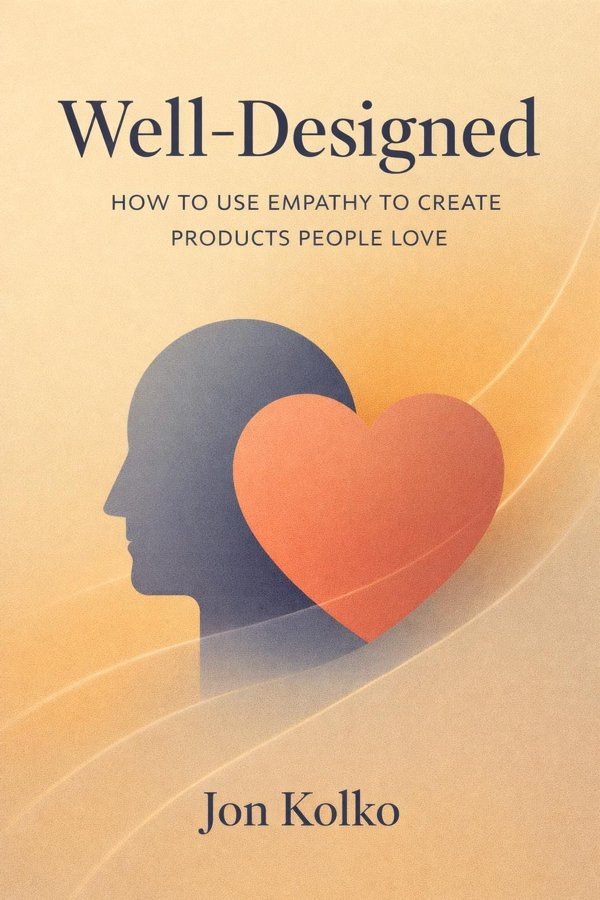
Well-Designed: How to Use Empathy to Create Products People Love: Summary & Key Insights
by Jon Kolko
 10 min6 chaptersAudio available
What Is Well-Designed: How to Use Empathy to Create Products People Love About?
Well-Designed: How to Use Empathy to Create Products People Love by Jon Kolko is a design book spanning 6 pages. Well-Designed explores how empathy and design thinking can be used to create meaningful products that resonate with users. Jon Kolko draws on his experience as a designer and educator to show how emotional engagement and human-centered design lead to better innovation and business success. The book provides practical frameworks for integrating empathy into product development and organizational culture.
This FizzRead summary covers all 6 key chapters of Well-Designed: How to Use Empathy to Create Products People Love in approximately 10 minutes, distilling the most important ideas, arguments, and takeaways from Jon Kolko's work. Also available as an audio summary and Key Quotes Podcast.
Well-Designed: How to Use Empathy to Create Products People Love
Well-Designed explores how empathy and design thinking can be used to create meaningful products that resonate with users. Jon Kolko draws on his experience as a designer and educator to show how emotional engagement and human-centered design lead to better innovation and business success. The book provides practical frameworks for integrating empathy into product development and organizational culture.
Who Should Read Well-Designed: How to Use Empathy to Create Products People Love?
This book is perfect for anyone interested in design and looking to gain actionable insights in a short read. Whether you're a student, professional, or lifelong learner, the key ideas from Well-Designed: How to Use Empathy to Create Products People Love by Jon Kolko will help you think differently.
- ✓Readers who enjoy design and want practical takeaways
- ✓Professionals looking to apply new ideas to their work and life
- ✓Anyone who wants the core insights of Well-Designed: How to Use Empathy to Create Products People Love in just 10 minutes
Want the full summary?
Get instant access to this book summary and 100K+ more with Fizz Moment.
Get Free SummaryAvailable on App Store • Free to download
Key Chapters
Every successful product lives at the intersection of functionality and feeling. In my work, I’ve observed how emotion drives the deepest form of engagement. We buy, use, and advocate for products not only because they solve problems but because they express who we are. Emotional engagement fosters loyalty because it transforms a purchase into a relationship.
To achieve this, we must move beyond utility. Utility tells us what people *can* do with a product; emotion reveals what they *want* to feel while doing it. That is why empathy is the designer’s most critical tool—it enables us to connect to the moments of frustration, joy, pride, and belonging that define people’s experiences.
When teams ignore emotion, they fall into the trap of functionalism: they make things that work but fail to inspire. Contrast that with companies that listen emotionally. A product’s interface, its tone of voice, even its onboarding process can evoke trust and delight when designed with emotional awareness. I often use examples from education technology and social apps—how empathy-driven refinements in design language and flow dramatically increase retention and satisfaction.
Consider how the Nest thermostat reframed climate control as an expression of care for one’s home and family. The device feels alive, responsive, considerate—qualities that are inherently emotional. Good design recognizes and reinforces those feelings. Emotional engagement differentiates in crowded markets because no competitor can replicate the genuine empathy that sits at the core of a design’s soul.
Design thinking has become a global movement, but its power is often misinterpreted. At its heart, design thinking is not a formula—it is a posture of curiosity and humility. It requires stepping into the emotional world of users with sensitivity and courage. Empathy transforms design thinking from a problem-solving process into a people-understanding journey.
In this book, I emphasize that empathy in design is not intuition—it is method. It entails deliberate, rigorous practices of observation, interpretation, and immersion. Through ethnographic studies, contextual interviews, and emotional mapping, designers uncover not just what users do but why they do it. A banking app may reveal anxiety around money management; a learning platform might expose a yearning for mastery. These insights are emotional in nature and therefore powerful.
When empathy integrates with design thinking, teams become storytellers and interpreters rather than analysts. They collate emotional evidence, synthesize contradictions, and shape design principles that honor human complexity. The process demands iteration, reflection, and vulnerability. I’ve seen organizations transform when they start asking not only “What should we build?” but “What pain does this alleviate?” and “What joy does this amplify?”
Through this integration, design evolves from an engineering challenge into a human one. And when empathy drives the process, innovation follows naturally—because the most innovative ideas often emerge from understanding the deepest emotional truths.
+ 4 more chapters — available in the FizzRead app
All Chapters in Well-Designed: How to Use Empathy to Create Products People Love
About the Author
Get This Summary in Your Preferred Format
Read or listen to the Well-Designed: How to Use Empathy to Create Products People Love summary by Jon Kolko anytime, anywhere. FizzRead offers multiple formats so you can learn on your terms — all free.
Available formats: App · Audio · PDF · EPUB — All included free with FizzRead
Download Well-Designed: How to Use Empathy to Create Products People Love PDF and EPUB Summary
Key Quotes from Well-Designed: How to Use Empathy to Create Products People Love
“Every successful product lives at the intersection of functionality and feeling.”
“Design thinking has become a global movement, but its power is often misinterpreted.”
Frequently Asked Questions about Well-Designed: How to Use Empathy to Create Products People Love
Well-Designed: How to Use Empathy to Create Products People Love by Jon Kolko is a design book that explores key ideas across 6 chapters. Well-Designed explores how empathy and design thinking can be used to create meaningful products that resonate with users. Jon Kolko draws on his experience as a designer and educator to show how emotional engagement and human-centered design lead to better innovation and business success. The book provides practical frameworks for integrating empathy into product development and organizational culture.
You Might Also Like
The Design of Everyday Things
Don Norman
10 min
The Better Angels of Our Nature
Steven Pinker
10 min
A Designer's Art
Paul Rand
10 min
Architects' Sketchbooks
Various Editors
10 min
Architectural Graphic Standards
The American Institute of Architects
10 min
Design Is Storytelling
Ellen Lupton
10 minBrowse by Category
Ready to read Well-Designed: How to Use Empathy to Create Products People Love?
Get the full summary and 100K+ more books with Fizz Moment.