
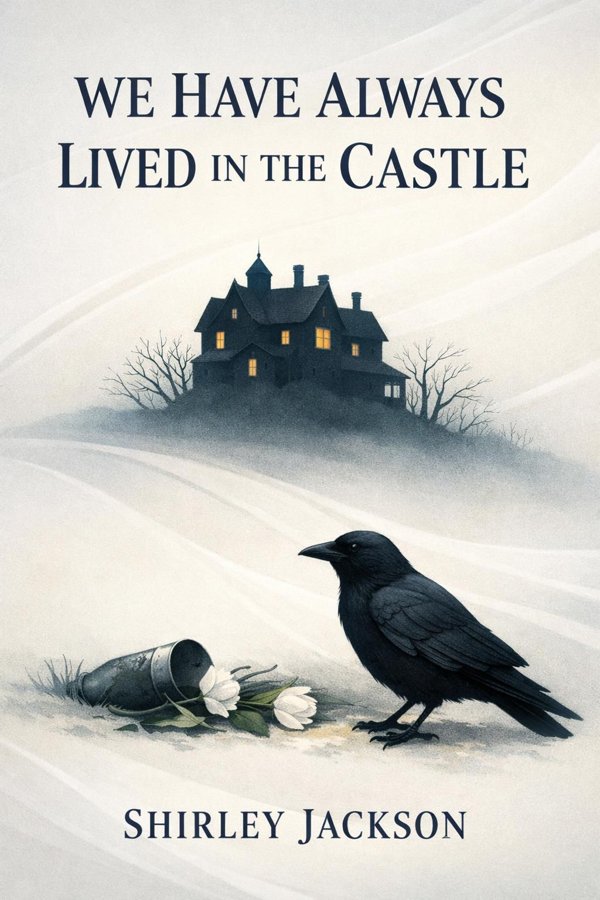
We Have Always Lived in the Castle: Summary & Key Insights
 10 min5 chaptersAudio available
What Is We Have Always Lived in the Castle About?
We Have Always Lived in the Castle by Shirley Jackson is a classics book spanning 5 pages. A gothic novel centered on the Blackwood sisters, Merricat and Constance, who live in isolation after most of their family was poisoned. The story explores themes of family, isolation, and societal judgment through a darkly psychological lens.
This FizzRead summary covers all 5 key chapters of We Have Always Lived in the Castle in approximately 10 minutes, distilling the most important ideas, arguments, and takeaways from Shirley Jackson's work. Also available as an audio summary and Key Quotes Podcast.
We Have Always Lived in the Castle
A gothic novel centered on the Blackwood sisters, Merricat and Constance, who live in isolation after most of their family was poisoned. The story explores themes of family, isolation, and societal judgment through a darkly psychological lens.
Who Should Read We Have Always Lived in the Castle?
This book is perfect for anyone interested in classics and looking to gain actionable insights in a short read. Whether you're a student, professional, or lifelong learner, the key ideas from We Have Always Lived in the Castle by Shirley Jackson will help you think differently.
- ✓Readers who enjoy classics and want practical takeaways
- ✓Professionals looking to apply new ideas to their work and life
- ✓Anyone who wants the core insights of We Have Always Lived in the Castle in just 10 minutes
Want the full summary?
Get instant access to this book summary and 100K+ more with Fizz Moment.
Get Free SummaryAvailable on App Store • Free to download
Key Chapters
I begin my story with a rhythm of routine. Merricat narrates the life she, Constance, and Uncle Julian lead in their grand yet decaying house beyond the village. Immediately, readers sense the oddness of this world. Merricat is nineteen but behaves like a child who has never grown up. She speaks of her buried belongings—coins, a silver spoon, even her beloved books—as charms to ward off danger. Her imagination and rituals fill the silence where normal human contact should be.
The memory of the poisoning defines everything. Six years ago, the Blackwood family sat down to dinner with arsenic-laced sugar in the berry dessert. Everyone died except Merricat, Constance, and Uncle Julian. Constance was tried but eventually acquitted. Yet the village has never forgiven her; to them, she remains the murderer who evaded justice. Only within their house do the three survivors feel safe, and even safety feels like imprisonment.
Uncle Julian spends his days obsessively rewriting his account of the poisoning, piecing together scraps of conversation, times, and menus, though his memory falters. His rambling serves as both exposition and haunting. The act of chronicling is his way of ordering a tragedy he can no longer comprehend. For Merricat, his fixation deepens her sense that the outside world is impossible; her world has shrunk to her sister, her cat Jonas, and the rituals that keep intruders away.
The Blackwood house, untouched since that terrible night, becomes a shrine to the dead and a fortress against judgment. Its silver, its locked dining room, and its routines mark time in a slow, dreamlike way. The reader begins to suspect that the real horror is not the crime that occurred but the life that followed—an existence sustained by denial, routine, and superstition.
Merricat’s isolation is both self-imposed and enforced. Every Tuesday she must venture into the village for supplies—a journey that feels like entering hostile territory. The villagers’ disdain bursts from every corner: shopkeepers whisper, children chant mocking rhymes about the Blackwood family, and adults avert their eyes. The poisonings have become legend, and Merricat, in their eyes, an extension of that cursed lineage.
Inside her own mind, Merricat transforms rejection into magic. She plants tokens in the earth, nails books to trees, and buries items from home like relics. These rituals are acts of control, mystical extensions of her will. They let her believe she can command protection against outsiders. Yet underneath this fantasy lurks a deep psychological fracture: she cannot bear change or intrusion. Her hatred of the villagers fuses with her love for Constance, creating a closed loop of devotion and aggression.
During one of her visits to the village, the hostility reaches a crescendo. A child’s rhyme about the Blackwoods—chanted sing-song—turns into a mob’s laughter. The cruelty in this moment exposes the villagers as mirror images of Merricat’s own madness: their need to define and punish difference equals her need to annihilate everything that threatens her small world. Her return home after each trip feels like a retreat into another realm, one where her imagination is law. Her spells, her buried tokens, her private rules—these keep the house alive and the world at bay. But the same walls that protect her also mark the boundary of her growing delusion.
+ 3 more chapters — available in the FizzRead app
All Chapters in We Have Always Lived in the Castle
About the Author
Shirley Jackson (1916–1965) was an American writer known for her works of horror and psychological suspense, including 'The Lottery' and 'The Haunting of Hill House'. Her writing often delved into the darker aspects of human nature and social conformity.
Get This Summary in Your Preferred Format
Read or listen to the We Have Always Lived in the Castle summary by Shirley Jackson anytime, anywhere. FizzRead offers multiple formats so you can learn on your terms — all free.
Available formats: App · Audio · PDF · EPUB — All included free with FizzRead
Download We Have Always Lived in the Castle PDF and EPUB Summary
Key Quotes from We Have Always Lived in the Castle
“I begin my story with a rhythm of routine.”
“Merricat’s isolation is both self-imposed and enforced.”
Frequently Asked Questions about We Have Always Lived in the Castle
We Have Always Lived in the Castle by Shirley Jackson is a classics book that explores key ideas across 5 chapters. A gothic novel centered on the Blackwood sisters, Merricat and Constance, who live in isolation after most of their family was poisoned. The story explores themes of family, isolation, and societal judgment through a darkly psychological lens.
You Might Also Like






Browse by Category
Ready to read We Have Always Lived in the Castle?
Get the full summary and 100K+ more books with Fizz Moment.