
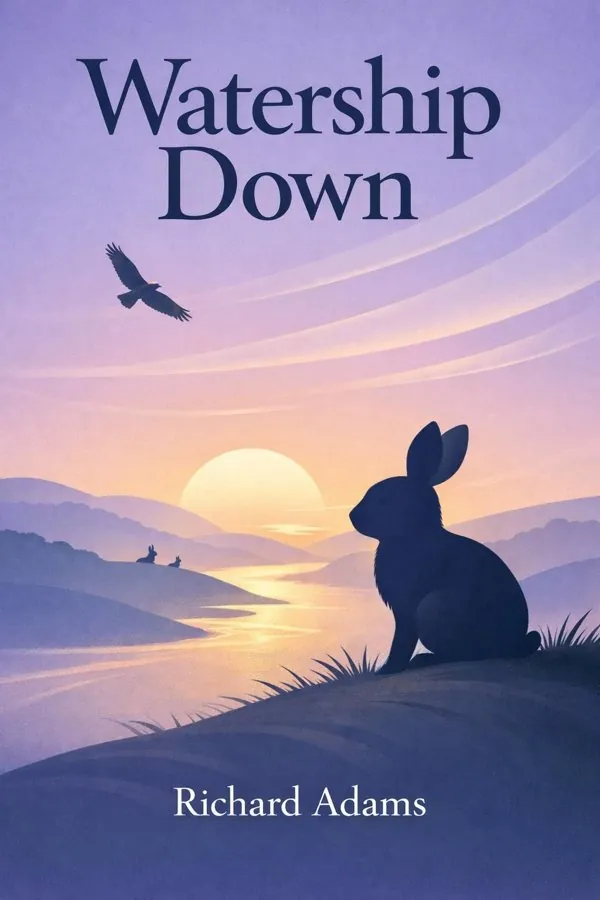
Watership Down: Summary & Key Insights
 10 min9 chaptersAudio available
Key Takeaways from Watership Down
Transformation often begins when one unsettled voice notices danger before anyone else does.
Freedom is exhilarating, but it becomes meaningful only when tested by reality.
The most dangerous traps are often the ones that feel like blessings.
A community is not defined by where it begins, but by what it chooses to become.
Order without freedom may look efficient, but it crushes the life it claims to protect.
What Is Watership Down About?
Watership Down by Richard Adams is a classics book spanning 7 pages. Great adventure stories often begin with a warning ignored, and Richard Adams’s Watership Down turns that simple idea into one of the most memorable novels of the twentieth century. On its surface, the book follows a band of rabbits who flee their doomed home and cross a dangerous countryside in search of safety. At a deeper level, it is a story about leadership, exile, political power, friendship, storytelling, and the difficult work of building a just community. Guided by the anxious but prophetic Fiver and led by the practical, compassionate Hazel, the rabbits encounter predators, deception, authoritarian control, and the constant uncertainty of survival. What makes the novel endure is the seriousness with which Adams treats this animal world: the rabbits are believable creatures, yet their struggles illuminate human questions about freedom, responsibility, and belonging. Adams, a keen observer of the English landscape and a gifted storyteller, created a rich mythology, language, and social order that give the novel unusual depth. Watership Down matters because it combines suspense, emotional resonance, and moral insight in a way few classics manage.
This FizzRead summary covers all 9 key chapters of Watership Down in approximately 10 minutes, distilling the most important ideas, arguments, and takeaways from Richard Adams's work. Also available as an audio summary and Key Quotes Podcast.
Watership Down
Great adventure stories often begin with a warning ignored, and Richard Adams’s Watership Down turns that simple idea into one of the most memorable novels of the twentieth century. On its surface, the book follows a band of rabbits who flee their doomed home and cross a dangerous countryside in search of safety. At a deeper level, it is a story about leadership, exile, political power, friendship, storytelling, and the difficult work of building a just community. Guided by the anxious but prophetic Fiver and led by the practical, compassionate Hazel, the rabbits encounter predators, deception, authoritarian control, and the constant uncertainty of survival. What makes the novel endure is the seriousness with which Adams treats this animal world: the rabbits are believable creatures, yet their struggles illuminate human questions about freedom, responsibility, and belonging. Adams, a keen observer of the English landscape and a gifted storyteller, created a rich mythology, language, and social order that give the novel unusual depth. Watership Down matters because it combines suspense, emotional resonance, and moral insight in a way few classics manage.
Who Should Read Watership Down?
This book is perfect for anyone interested in classics and looking to gain actionable insights in a short read. Whether you're a student, professional, or lifelong learner, the key ideas from Watership Down by Richard Adams will help you think differently.
- ✓Readers who enjoy classics and want practical takeaways
- ✓Professionals looking to apply new ideas to their work and life
- ✓Anyone who wants the core insights of Watership Down in just 10 minutes
Want the full summary?
Get instant access to this book summary and 100K+ more with Fizz Moment.
Get Free SummaryAvailable on App Store • Free to download
Key Chapters
Transformation often begins when one unsettled voice notices danger before anyone else does. In Sandleford Warren, that voice belongs to Fiver, a small, nervous rabbit whose gift is not strength but perception. He senses that disaster is coming and pleads for the warren to leave. Most dismiss him. His warning is too vague, too inconvenient, and too frightening to accept. Yet Hazel, his older brother, chooses to trust what others cannot fully understand. That choice launches the entire journey.
This opening idea establishes one of the book’s deepest themes: wisdom does not always arrive in impressive form. Fiver is no warrior, chief, or grand strategist. He is anxious, physically slight, and socially easy to overlook. But his sensitivity becomes a life-saving form of intelligence. Adams suggests that healthy groups need more than confidence and hierarchy; they need people who can sense weak signals, question false security, and speak up before catastrophe becomes obvious.
The lesson applies well beyond fiction. In families, teams, and organizations, trouble rarely appears without warning. A struggling employee, a flawed strategy, a failing partnership, or a neglected risk often becomes visible first to someone lower in status or quieter in temperament. The challenge is not just having visionaries; it is creating conditions where they are heard. Hazel’s greatness begins not in domination but in attention.
The exodus from Sandleford is therefore more than an escape. It is the first act of deliberate courage: leaving the familiar without certainty of success. The rabbits exchange known comforts for possible survival. In life, many of our necessary changes feel exactly like this—messy, premature, and unsupported by consensus.
Actionable takeaway: pay close attention to the uneasy insight you or someone around you cannot shake, and treat early warnings as invitations to investigate rather than annoyances to dismiss.
Freedom is exhilarating, but it becomes meaningful only when tested by reality. Once Hazel’s small band leaves Sandleford, the open countryside offers possibility and danger in equal measure. The rabbits must navigate fields, woods, rivers, roads, weather, hunger, and the ever-present threat of predators. What looked like liberation quickly reveals itself as exposure. Outside the warren, survival depends not on habit but on adaptation.
Adams uses the journey to show how hardship forms character and community. Each rabbit contributes differently: Bigwig brings strength and courage, Blackberry supplies ingenuity, Dandelion offers morale through storytelling, and Fiver provides instinctive insight. Hazel’s particular gift is not being the strongest or smartest in any narrow sense. It is recognizing talent in others and using it well. The journey becomes a living test of leadership under pressure.
The countryside also reshapes the rabbits’ understanding of themselves. At Sandleford, life followed inherited routines. On the road, they must improvise. Blackberry learns to think beyond customary rabbit behavior. Bigwig learns that bravery is most useful when directed toward a common purpose. Hazel learns to make decisions with incomplete information. Survival is no longer an automatic condition; it is a collective achievement.
This is true in human life as well. New ventures, relocations, career changes, and personal reinventions often feel glamorous in imagination and punishing in practice. We discover quickly that independence requires skill, resilience, and cooperation. The people who thrive are not those who avoid uncertainty altogether, but those who learn quickly and share the burden.
The rabbits’ flight through the wild reminds us that real growth rarely happens in controlled environments. It happens where comfort ends and capability must begin.
Actionable takeaway: when entering a difficult new phase, stop asking whether conditions feel comfortable and start asking what abilities the situation is demanding that you develop.
The most dangerous traps are often the ones that feel like blessings. When Hazel’s group discovers Cowslip’s warren, it seems at first like a miracle. The rabbits are well-fed, sleek, and sheltered. There is an eerie abundance that contrasts sharply with the hardship of the journey. Yet almost immediately, something feels wrong. The rabbits behave strangely, avoid honest speech, and live with a quiet dread they refuse to name. Beneath the surface comfort lies a terrible bargain: they enjoy human-provided food while accepting that some among them will periodically die in snares.
This episode is one of the novel’s sharpest moral critiques. Adams shows that security purchased through denial can deform an entire culture. The rabbits of Cowslip’s warren preserve their comfort by refusing truth. Their poetry is evasive, their manners are brittle, and their communal life is hollowed out by fear they cannot confront openly. They have adapted to oppression not by resisting it, but by normalizing it.
Hazel’s band cannot remain there because survival alone is not enough. A life stripped of honesty, dignity, and freedom becomes spiritually intolerable. The scene asks readers to consider what kinds of compromise slowly corrupt individuals and communities. In the modern world, this might mean staying in a lucrative but exploitative workplace, maintaining an image-based relationship, or participating in systems we know are harmful because they offer convenience.
The brilliance of this chapter is that the danger is not obvious aggression. It is passivity, numbness, and the surrender of moral clarity. Fiver detects the corruption because he is attuned not just to physical peril, but to deeper wrongness.
Actionable takeaway: examine any source of comfort that depends on silence, denial, or someone else’s hidden suffering, and be willing to leave what looks safe if it requires you to abandon what is true.
A community is not defined by where it begins, but by what it chooses to become. Reaching Watership Down is not the end of the rabbits’ struggle; it is the start of a more demanding challenge: creation. On the hill, Hazel and his companions must turn refuge into a functioning home. They need shelter, order, purpose, and eventually a future beyond mere survival. Adams makes clear that founding something worthwhile requires patience, cooperation, and imagination.
What distinguishes Watership Down from the warrens that came before is not simply geography. It is the principles shaping it. Hazel leads through consultation rather than tyranny. Different gifts are valued. Stories matter because they preserve identity and courage. Practical tasks matter because ideals without structure cannot endure. The new warren becomes a living experiment in balancing freedom with responsibility.
Yet the rabbits soon realize that a society of only bucks cannot last. Their problem is biological, but Adams treats it as civic reality: no community survives unless it is socially complete and capable of renewal. This introduces a central truth about institution-building. It is not enough to escape a bad system or to gather talented people in a promising place. Lasting success requires planning for continuity, inclusion, and sustainability.
The same principle applies to businesses, creative projects, friendships, and families. Founding energy is exciting, but maintenance is what proves seriousness. A team needs culture, not just ambition. A household needs rituals, not just affection. A new chapter of life needs structure, not just relief from the old one.
Watership Down becomes meaningful because the rabbits do more than survive there—they shape a way of living together that reflects what they have learned.
Actionable takeaway: if you are building something new, ask not only how to launch it, but what systems, values, and relationships will allow it to endure.
Order without freedom may look efficient, but it crushes the life it claims to protect. This truth comes into focus when Hazel’s rabbits learn of Efrafa, a large and highly organized warren ruled by General Woundwort. On one level, Efrafa is impressive: disciplined, secure, and tightly controlled. On another, it is a society built on fear, surveillance, and obedience. Rabbits are regimented into strict routines, movement is monitored, and independent will is treated as a threat.
Adams does not portray Efrafa as cartoon evil. Woundwort is formidable because his system answers real dangers. Rabbits do face predators. Disorder can bring disaster. But the novel asks what happens when the desire for safety grows so absolute that it justifies domination. Efrafa survives physically by suffocating individuality and freedom. It has solved one problem by creating another, equally destructive one.
The mission to free does from Efrafa becomes both a rescue operation and a moral confrontation. Bigwig’s infiltration reveals tremendous courage, but also highlights the psychological toll of authoritarian systems. Fear makes resistance difficult. People and animals alike can become accustomed to control when it is presented as necessity.
The relevance is enduring. In workplaces, governments, schools, and even families, excessive control can masquerade as competence. Rules multiply. Risk is minimized. Dissent is discouraged. At first this can feel stable; over time it drains trust, creativity, and dignity. The novel insists that a healthy community must manage danger without destroying autonomy.
Hazel’s group offers a contrast: looser, messier, but rooted in consent and mutual respect. Their example suggests that legitimacy matters as much as efficiency.
Actionable takeaway: when evaluating any system of leadership, ask not only whether it produces order, but whether it preserves freedom, trust, and the ability to speak honestly.
The strongest leaders are often the ones least interested in appearing powerful. Hazel is the emotional and strategic center of Watership Down, yet he never rules like Woundwort or commands like a hero from myth. His authority grows from judgment, humility, and care for others. He listens to Fiver, respects Bigwig, depends on Blackberry’s intelligence, and knows when to delegate. He is not fearless, but he is steady. That steadiness allows others to become their best selves.
Hazel’s leadership style is especially compelling because it is practical. He does not pretend to know everything. He makes decisions under pressure, adjusts when necessary, and keeps the group focused on what matters most. He understands morale, timing, and the value of letting capable individuals act. His bravery is often expressed not through dramatic force but through responsible action.
Adams contrasts this with forms of leadership based on intimidation, tradition, or rigidity. The Chief Rabbit at Sandleford cannot imagine changing course. Woundwort cannot imagine yielding power. Hazel, by contrast, remains flexible because his goal is not personal control but collective flourishing. He serves the future of the warren rather than his own image.
This model translates directly to everyday life. Good managers create space for competence instead of hoarding authority. Strong parents guide without crushing independence. Effective founders invite disagreement and remain teachable. In friendships and communities, trust grows when people feel seen, valued, and safe to contribute.
Hazel’s greatness lies in turning a vulnerable group into a durable community without demanding worship. He shows that leadership is less about dominance than about helping others survive, grow, and belong.
Actionable takeaway: lead your group by identifying each person’s strengths, listening seriously to unusual perspectives, and making decisions that serve the whole rather than your ego.
Victory is not always won by greater force; sometimes it belongs to those who think more creatively under pressure. The final conflict over Watership Down brings together many of the novel’s central strengths: courage, loyalty, strategy, and the refusal to submit to tyranny. When Woundwort threatens the hard-won freedom of Hazel’s community, the rabbits cannot defeat him through simple physical superiority. They must rely on planning, improvisation, and daring.
The battle is tense because the stakes are larger than territory. Watership Down represents a way of life built on mutual trust and chosen belonging. To lose it would mean not just displacement, but the destruction of an alternative to fear-driven power. Hazel’s group fights not for conquest, but for the right to exist freely.
What stands out most is the role of imagination. The rabbits use the landscape, timing, deception, and ultimately the unpredictable force of a farm dog to counter Woundwort’s disciplined aggression. Blackberry’s inventiveness, Bigwig’s courage, and Hazel’s willingness to risk himself all matter. The climax shows that practical intelligence can overcome seemingly overwhelming strength when a group remains coordinated and committed.
This idea has broad application. Many people face opponents that seem larger—bureaucracies, entrenched habits, financial constraints, dominant competitors, or personal fears. Raw power is not always available. What is available, often, is ingenuity: a better question, a new angle, an unlikely ally, a well-timed move.
The battle also underscores that defending what matters may require confrontation. Peace is precious, but it sometimes depends on the willingness to resist domination rather than accommodate it.
Actionable takeaway: when facing a stronger opponent or harder problem, focus less on matching force and more on using creativity, coordination, and courage to change the terms of the struggle.
The final measure of a life is not how brightly it burns in a moment, but what kind of world it leaves behind. The epilogue of Watership Down gives the novel its emotional completion by showing Hazel in old age, having lived long enough to see the community he helped build become stable and thriving. The danger, flight, and conflict of earlier chapters are not erased, but redeemed through continuity. What began as a desperate escape becomes a legacy.
This ending matters because Adams refuses the shallow version of heroism. Hazel’s greatness is not only that he survives extraordinary trials. It is that he creates conditions under which ordinary life can flourish afterward. Young rabbits are born, stories continue, and Watership Down endures as more than a refuge. It becomes home. In this sense, the novel offers a mature vision of success: not glory for its own sake, but stewardship.
Hazel’s passing is gentle rather than tragic. The Black Rabbit of Inlé, previously associated with fear and mortality, becomes part of the natural order. Death is not denied, but placed within a broader cycle of life, memory, and succession. The tone is poignant without despair. Adams suggests that a meaningful life is one in which courage serves continuity and leadership becomes inheritance.
For modern readers, this reframes ambition. Many people chase achievements that are visible but temporary. Hazel points toward a deeper goal: build something humane, strengthen others, and leave your community better than you found it. That may apply to parenting, mentoring, teaching, creating, or simply living with integrity.
Actionable takeaway: define success not only by what you accomplish now, but by what values, relationships, and structures will remain strong because you were here.
All Chapters in Watership Down
About the Author
Richard Adams (1920–2016) was an English novelist whose debut, Watership Down, became one of the most beloved literary works of the modern era. He was educated at Worcester College, Oxford, served in the British Army during World War II, and later worked for many years in the British Civil Service. Adams began telling the stories that would become Watership Down to his daughters during car journeys, eventually shaping them into a novel that combined adventure, mythology, and close observation of animal life. His writing often explored themes of survival, leadership, freedom, and the relationship between creatures and their environments. Though he published several other books, including Shardik and The Plague Dogs, Watership Down remains his most enduring achievement and a landmark of English fiction.
Get This Summary in Your Preferred Format
Read or listen to the Watership Down summary by Richard Adams anytime, anywhere. FizzRead offers multiple formats so you can learn on your terms — all free.
Available formats: App · Audio · PDF · EPUB — All included free with FizzRead
Download Watership Down PDF and EPUB Summary
Key Quotes from Watership Down
“Transformation often begins when one unsettled voice notices danger before anyone else does.”
“Freedom is exhilarating, but it becomes meaningful only when tested by reality.”
“The most dangerous traps are often the ones that feel like blessings.”
“A community is not defined by where it begins, but by what it chooses to become.”
“Order without freedom may look efficient, but it crushes the life it claims to protect.”
Frequently Asked Questions about Watership Down
Watership Down by Richard Adams is a classics book that explores key ideas across 9 chapters. Great adventure stories often begin with a warning ignored, and Richard Adams’s Watership Down turns that simple idea into one of the most memorable novels of the twentieth century. On its surface, the book follows a band of rabbits who flee their doomed home and cross a dangerous countryside in search of safety. At a deeper level, it is a story about leadership, exile, political power, friendship, storytelling, and the difficult work of building a just community. Guided by the anxious but prophetic Fiver and led by the practical, compassionate Hazel, the rabbits encounter predators, deception, authoritarian control, and the constant uncertainty of survival. What makes the novel endure is the seriousness with which Adams treats this animal world: the rabbits are believable creatures, yet their struggles illuminate human questions about freedom, responsibility, and belonging. Adams, a keen observer of the English landscape and a gifted storyteller, created a rich mythology, language, and social order that give the novel unusual depth. Watership Down matters because it combines suspense, emotional resonance, and moral insight in a way few classics manage.
You Might Also Like






Browse by Category
Ready to read Watership Down?
Get the full summary and 100K+ more books with Fizz Moment.