
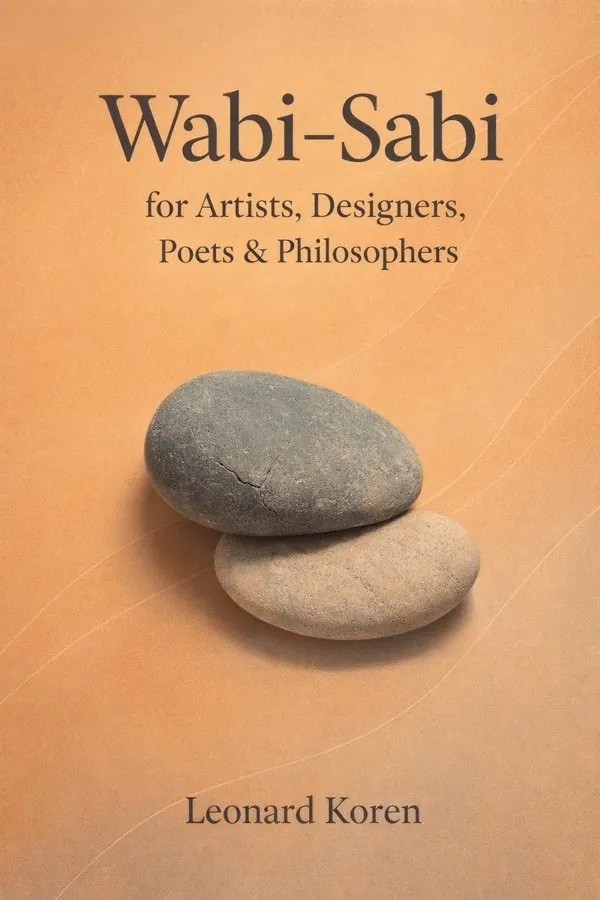
Wabi-Sabi for Artists, Designers, Poets & Philosophers: Summary & Key Insights
 10 min9 chaptersAudio available
Key Takeaways from Wabi-Sabi for Artists, Designers, Poets & Philosophers
Some of the most important truths in art cannot be pinned down without diminishing them.
Beauty deepens when we stop demanding that things resist time.
In a noisy world, subtle things often carry the greatest depth.
Time is not only a destroyer; it is also a collaborator.
The most memorable works often feel less manufactured than discovered.
What Is Wabi-Sabi for Artists, Designers, Poets & Philosophers About?
Wabi-Sabi for Artists, Designers, Poets & Philosophers by Leonard Koren is a design book spanning 9 pages. What if beauty is not found in polish, permanence, and perfection, but in weathering, irregularity, and quiet simplicity? In Wabi-Sabi for Artists, Designers, Poets & Philosophers, Leonard Koren introduces readers to one of Japan’s most elusive and profound aesthetic ideas: a way of seeing that honors the imperfect, the transient, and the incomplete. Rather than defining wabi-sabi as a style or trend, Koren approaches it as a worldview, a felt sensibility, and a corrective to modern obsessions with control, luxury, and flawless surfaces. This short but remarkably influential book has become a touchstone for artists, architects, makers, and thinkers because it translates a subtle Japanese concept into language that Western readers can grasp without flattening its mystery. Drawing on Japanese aesthetics, Zen-inflected philosophy, and his own background in design and architecture, Koren explores how wabi-sabi appears in materials, objects, spaces, and attitudes toward life. The result is both practical and philosophical: a meditation on how we create, how we perceive, and how we might live more honestly. For anyone tired of sterile perfection, this book offers a richer, humbler idea of beauty.
This FizzRead summary covers all 9 key chapters of Wabi-Sabi for Artists, Designers, Poets & Philosophers in approximately 10 minutes, distilling the most important ideas, arguments, and takeaways from Leonard Koren's work. Also available as an audio summary and Key Quotes Podcast.
Wabi-Sabi for Artists, Designers, Poets & Philosophers
What if beauty is not found in polish, permanence, and perfection, but in weathering, irregularity, and quiet simplicity? In Wabi-Sabi for Artists, Designers, Poets & Philosophers, Leonard Koren introduces readers to one of Japan’s most elusive and profound aesthetic ideas: a way of seeing that honors the imperfect, the transient, and the incomplete. Rather than defining wabi-sabi as a style or trend, Koren approaches it as a worldview, a felt sensibility, and a corrective to modern obsessions with control, luxury, and flawless surfaces.
This short but remarkably influential book has become a touchstone for artists, architects, makers, and thinkers because it translates a subtle Japanese concept into language that Western readers can grasp without flattening its mystery. Drawing on Japanese aesthetics, Zen-inflected philosophy, and his own background in design and architecture, Koren explores how wabi-sabi appears in materials, objects, spaces, and attitudes toward life. The result is both practical and philosophical: a meditation on how we create, how we perceive, and how we might live more honestly. For anyone tired of sterile perfection, this book offers a richer, humbler idea of beauty.
Who Should Read Wabi-Sabi for Artists, Designers, Poets & Philosophers?
This book is perfect for anyone interested in design and looking to gain actionable insights in a short read. Whether you're a student, professional, or lifelong learner, the key ideas from Wabi-Sabi for Artists, Designers, Poets & Philosophers by Leonard Koren will help you think differently.
- ✓Readers who enjoy design and want practical takeaways
- ✓Professionals looking to apply new ideas to their work and life
- ✓Anyone who wants the core insights of Wabi-Sabi for Artists, Designers, Poets & Philosophers in just 10 minutes
Want the full summary?
Get instant access to this book summary and 100K+ more with Fizz Moment.
Get Free SummaryAvailable on App Store • Free to download
Key Chapters
Some of the most important truths in art cannot be pinned down without diminishing them. That is the challenge and allure of wabi-sabi. Koren explains that wabi-sabi is not a rigid doctrine but a Japanese aesthetic sensibility shaped by centuries of cultural refinement, contact with nature, and the influence of Zen Buddhism. Historically, it emerged in contrast to displays of grandeur and formal perfection. In particular, the tea ceremony helped crystallize its spirit: rustic bowls, subdued rooms, rough textures, and modest gestures replaced ornate splendor with intimacy and presence.
The word itself contains layered meanings. “Wabi” once carried connotations of loneliness, poverty, and the austere life away from society, but over time it came to suggest rustic simplicity, humility, and quiet sufficiency. “Sabi” referred to the patina of age, the beauty that comes from time, wear, and natural deterioration. Together, they point toward an aesthetic that values the imperfect object, the fleeting moment, and the understated arrangement.
Koren stresses that wabi-sabi is best understood indirectly. It is sensed in a cracked tea bowl, a faded wall, a sparse flower arrangement, or an asymmetrical room where nothing is trying too hard. In contemporary life, this might mean favoring honest materials over glossy finishes, or making room for silence and emptiness instead of constant visual stimulation.
Actionable takeaway: When evaluating an object, room, or creative work, ask not “Is it impressive?” but “Does it feel honest, humble, and alive with time?”
Beauty deepens when we stop demanding that things resist time. Koren identifies three core realities at the heart of wabi-sabi: nothing lasts, nothing is finished, and nothing is perfect. These are not flaws to overcome; they are the basic conditions of existence. Wabi-sabi begins when we stop seeing transience as a problem and start seeing it as a source of poignancy and meaning.
Impermanence appears in everything from a wilting flower to the discoloration of wood, the fading of fabric, and the changing light in a room over the course of a day. Imperfection appears in irregular lines, handmade surfaces, and objects whose asymmetry reveals the hand of the maker. Incompleteness appears in spaces that leave room for imagination, in forms that suggest rather than declare, and in works that remain open rather than over-resolved.
Koren’s insight is deeply liberating for artists and designers. Instead of chasing sterile exactness, they can allow irregularity, weathering, and looseness to contribute meaning. A ceramic bowl with an uneven rim may feel more human and moving than a factory-perfect one. A poem that leaves silence between images may linger longer than one that explains everything.
This idea also applies beyond art. Our bodies age, our plans shift, our homes accumulate marks of use. Wabi-sabi invites us to meet these conditions with tenderness instead of denial. It asks us to replace mastery with participation.
Actionable takeaway: Choose one object or project this week and let its marks of change, asymmetry, or openness remain visible rather than correcting them away.
In a noisy world, subtle things often carry the greatest depth. Koren shows that wabi-sabi is inseparable from simplicity, but not the slick simplicity of branding or fashionable minimalism. Wabi-sabi simplicity is quieter, rougher, and less self-conscious. It removes what is unnecessary not to appear elegant, but to make room for the essential qualities of an object, material, or moment to emerge.
This restraint affects all the senses. Visually, wabi-sabi favors muted colors, shadow, emptiness, and irregular composition over symmetry and spectacle. Tactilely, it values texture: rough clay, worn wood, soft paper, oxidized metal. Spatially, it leaves breathing room. Emotionally, it avoids excess sentiment and theatricality. The result is not emptiness for its own sake, but a calm environment in which nuance can be perceived.
Koren suggests that modern culture often confuses more with better. We add decorative details, visual noise, constant stimulation, and technological polish in an attempt to create value. Wabi-sabi takes the opposite path. It trusts understatement. A nearly bare room with one branch in a vase can feel richer than a perfectly styled interior full of expensive objects. A handmade notebook with unbleached paper can invite attention more deeply than a glossy luxury product.
For creators, this means editing with sensitivity. For everyday life, it means reducing distraction so materials, relationships, and moments can be felt more fully. Quietness becomes a design principle and a spiritual practice.
Actionable takeaway: Remove one unnecessary element from a space, design, or routine and notice whether the remaining details become more vivid and meaningful.
Time is not only a destroyer; it is also a collaborator. One of Koren’s most memorable contributions is his insistence that wabi-sabi beauty often intensifies through age, weathering, and contact with the natural world. Unlike modern design cultures that prize surfaces untouched by time, wabi-sabi finds character in patina, erosion, fading, tarnish, moss, and wear.
Nature is central here because wabi-sabi does not treat the natural world as raw material to be perfected. Instead, it recognizes the elegance of organic processes. A stone is beautiful partly because it has been shaped by forces beyond intention. A wooden tabletop gains richness through scratches, oil, sunlight, and use. A garden becomes more compelling when it feels slightly ungoverned, allowing seasonality and decay to participate in its design.
Texture matters because it reveals process. Roughness, porosity, grain, and irregularity make us aware of the life of materials. In contrast, highly polished and synthetic surfaces often isolate us from that awareness. Koren is not arguing that all polished objects are bad, but that depth often comes from visible history.
This perspective changes how we choose and care for things. Instead of discarding an aging object, we might appreciate how it records living. In creative work, we can select materials that mature well rather than degrade into ugliness. In architecture, we can prefer finishes that weather gracefully.
Actionable takeaway: Surround yourself with at least one material that improves through use and age—such as wood, linen, leather, clay, or stone—and pay attention to how it changes over time.
The most memorable works often feel less manufactured than discovered. Koren applies wabi-sabi to artistic practice by showing how it shifts priorities in making. Instead of pursuing grand statements, flawless execution, and universal formulas, wabi-sabi encourages modest scale, intimacy, asymmetry, irregularity, and responsiveness to materials.
In art, this might mean valuing suggestion over declaration, leaving traces of process visible, or creating pieces that feel provisional and alive. In design, it might mean using natural materials, embracing variation, and allowing spaces to feel humane rather than clinically resolved. In craft, it means honoring the hand of the maker. A handmade cup, for example, is not meaningful despite its inconsistencies but because of them. Its slight imbalance or rough foot reminds us that it was formed through attention and bodily contact.
Koren also helps readers distinguish wabi-sabi from style imitation. It is easy to produce a fake “rustic” look by adding distressed finishes or decorative imperfection. But genuine wabi-sabi does not perform roughness; it arises from integrity, modest means, and respect for process. A truly wabi-sabi object has coherence between material, making, use, and feeling.
For creative professionals, this is a practical challenge. Design not merely for appearance but for emotional resonance. Ask whether the work creates intimacy, humility, and presence. Ask whether it can age well, whether it leaves room for human participation, and whether it avoids unnecessary display.
Actionable takeaway: In your next creative project, preserve one sign of process or handmade variation that reveals authenticity instead of concealing it.
When everything looks flawless, very little feels alive. Koren contrasts wabi-sabi with the logic of industrial production, where uniformity, scalability, and surface perfection are treated as ideals. Mass production delivers convenience and consistency, but it often strips objects of local character, tactile richness, and individuality. Wabi-sabi offers a countervalue system: the singular over the standardized, the weathered over the new, the intimate over the optimized.
This does not mean Koren rejects technology outright. Rather, he asks us to notice what is lost when efficiency becomes the sole measure of value. Machine-made objects typically hide process. Their seams disappear, their surfaces are controlled, and their identity depends on reproducibility. Wabi-sabi, by contrast, allows evidence of making and time to remain visible. It does not fear irregularity because irregularity is what ties an object to the real world.
In practical terms, this critique speaks directly to contemporary consumer culture. We are encouraged to replace rather than repair, upgrade rather than deepen attachment, standardize rather than adapt. Wabi-sabi suggests another path: choose fewer things, choose things with material truth, and accept small flaws as signs of individuality. In design fields, this may mean resisting over-polishing, generic templates, or perfection that erases character.
The point is not nostalgia. It is discernment. Industrial tools can be used intelligently, but not at the expense of soul. The question is whether an object feels inhabited by care or emptied by sameness.
Actionable takeaway: Before buying or making something new, ask whether you value it for its convenience alone or for its capacity to gain character, meaning, and attachment over time.
An aesthetic becomes transformative when it changes how we live, not just what we admire. Koren makes clear that wabi-sabi is more than a theory of objects; it is an attitude toward existence. To live with wabi-sabi is to accept limits, appreciate smallness, and become more intimate with ordinary life. It means finding richness in the modest, the seasonal, and the unfinished.
This way of life opposes the modern hunger for endless improvement, accumulation, and self-display. Wabi-sabi asks us to be less aggressive in our pursuit of control. A home need not be immaculate to be beautiful. A life need not be exceptional to be meaningful. A person need not hide signs of age, vulnerability, or change in order to be worthy.
There is also a deep ethical humility in this stance. Wabi-sabi reduces the pressure to dominate the world and oneself. It softens perfectionism. It encourages frugality not as deprivation, but as sufficiency. A simple meal, a quiet morning, a repaired object, or a solitary walk can become aesthetically and spiritually complete.
In everyday practice, this may look like slowing down enough to notice shifting light, using objects until they mature, allowing spaces to remain slightly incomplete, or releasing unrealistic standards for productivity and self-image. Wabi-sabi does not celebrate neglect; it celebrates care without excess control.
Actionable takeaway: Create one daily ritual—tea, journaling, tidying, walking, or sitting quietly—that helps you appreciate ordinary, transient moments rather than rushing past them.
The strongest creative voice often emerges when control relaxes just enough for truth to enter. Koren’s ideas are especially valuable for makers because they translate philosophical insight into a creative method. To create with wabi-sabi is to begin with respect for materials, context, and limitation rather than imposing a predetermined ideal of perfection.
This approach changes the design process. Instead of asking, “How can I make this look complete and impressive?” the better question becomes, “What is the essential nature of this thing, and how can I reveal it with honesty?” Materials should be allowed to speak. Wood should look like wood, clay like clay, paper like paper. Constraints should not be hidden but used as compositional strengths. Irregularity can guide form. Empty space can become part of the expression.
Wabi-sabi creation also values editing. It is often less about adding distinctive features than removing what feels forced. A designer may choose a muted palette and uncoated surfaces. A writer may leave a sentence spare rather than ornate. A photographer may favor ambient light and subtle atmosphere over heavy manipulation. In each case, the goal is resonance rather than perfection.
Crucially, Koren implies that creators must cultivate sensitivity, not just technique. Wabi-sabi cannot be generated by formula because it depends on perception, patience, and emotional maturity. It asks makers to collaborate with chance, aging, and incompletion.
Actionable takeaway: In your next project, identify one area where you are overcontrolling the outcome, then simplify, subtract, or allow the material and process to contribute more visibly.
We notice beauty most sharply when we remember that it will pass. Beneath Koren’s design language lies a spiritual insight: wabi-sabi is inseparable from mortality. The aesthetic power of a fading flower, a weathered gate, or a cracked vessel comes from the fact that each reveals the fragility of existence. Rather than denying death, wabi-sabi allows beauty and loss to coexist.
This is where its connection to Zen and contemplative thought becomes deepest. Wabi-sabi does not offer transcendence through perfection; it offers intimacy with reality as it is. Because all things are unstable, they are precious. Because all forms are incomplete, they invite attention and care. Because life decays, it glows.
Koren suggests that this awareness changes both perception and conduct. We become less attached to possession, status, and permanence. We may also become more compassionate, because we see that everything and everyone is passing through states of becoming and dissolution. A chipped cup is no longer merely damaged; it becomes a reminder that use, time, and vulnerability are the very conditions of meaning.
This spiritual dimension prevents wabi-sabi from becoming a decorative trend. It is not just an earthy palette or rustic styling. It is an aesthetic response to impermanence. It teaches us to love the world without pretending we can hold it still.
Actionable takeaway: Spend a few minutes each week observing something changing—a plant, a building, your own face, the evening light—and practice seeing transience as a source of gratitude rather than anxiety.
All Chapters in Wabi-Sabi for Artists, Designers, Poets & Philosophers
About the Author
Leonard Koren is an American artist, writer, and aesthetician known for translating subtle design ideas into clear, memorable insights. Trained as an architect at UCLA, he developed a career that moves across art, design theory, publishing, and cultural criticism. He first gained wide attention as the founder of WET: The Magazine of Gourmet Bathing, an influential and unconventional publication that reflected his curiosity about ritual, environment, and sensory experience. Koren has since written several admired books on aesthetics, including Undesigning the Bath and Arranging Things: A Rhetoric of Object Placement. His work often explores how ordinary objects, spaces, and arrangements shape feeling and meaning. With Wabi-Sabi for Artists, Designers, Poets & Philosophers, he helped introduce a nuanced Japanese aesthetic concept to an international audience of creatives and thoughtful readers.
Get This Summary in Your Preferred Format
Read or listen to the Wabi-Sabi for Artists, Designers, Poets & Philosophers summary by Leonard Koren anytime, anywhere. FizzRead offers multiple formats so you can learn on your terms — all free.
Available formats: App · Audio · PDF · EPUB — All included free with FizzRead
Download Wabi-Sabi for Artists, Designers, Poets & Philosophers PDF and EPUB Summary
Key Quotes from Wabi-Sabi for Artists, Designers, Poets & Philosophers
“Some of the most important truths in art cannot be pinned down without diminishing them.”
“Beauty deepens when we stop demanding that things resist time.”
“In a noisy world, subtle things often carry the greatest depth.”
“Time is not only a destroyer; it is also a collaborator.”
“The most memorable works often feel less manufactured than discovered.”
Frequently Asked Questions about Wabi-Sabi for Artists, Designers, Poets & Philosophers
Wabi-Sabi for Artists, Designers, Poets & Philosophers by Leonard Koren is a design book that explores key ideas across 9 chapters. What if beauty is not found in polish, permanence, and perfection, but in weathering, irregularity, and quiet simplicity? In Wabi-Sabi for Artists, Designers, Poets & Philosophers, Leonard Koren introduces readers to one of Japan’s most elusive and profound aesthetic ideas: a way of seeing that honors the imperfect, the transient, and the incomplete. Rather than defining wabi-sabi as a style or trend, Koren approaches it as a worldview, a felt sensibility, and a corrective to modern obsessions with control, luxury, and flawless surfaces. This short but remarkably influential book has become a touchstone for artists, architects, makers, and thinkers because it translates a subtle Japanese concept into language that Western readers can grasp without flattening its mystery. Drawing on Japanese aesthetics, Zen-inflected philosophy, and his own background in design and architecture, Koren explores how wabi-sabi appears in materials, objects, spaces, and attitudes toward life. The result is both practical and philosophical: a meditation on how we create, how we perceive, and how we might live more honestly. For anyone tired of sterile perfection, this book offers a richer, humbler idea of beauty.
You Might Also Like
The Design of Everyday Things
Don Norman
10 min
The Better Angels of Our Nature
Steven Pinker
10 min
A Designer's Art
Paul Rand
10 min
Architects' Sketchbooks
Various Editors
10 min
Architectural Graphic Standards
The American Institute of Architects
10 min
Design Is Storytelling
Ellen Lupton
10 minBrowse by Category
Ready to read Wabi-Sabi for Artists, Designers, Poets & Philosophers?
Get the full summary and 100K+ more books with Fizz Moment.