
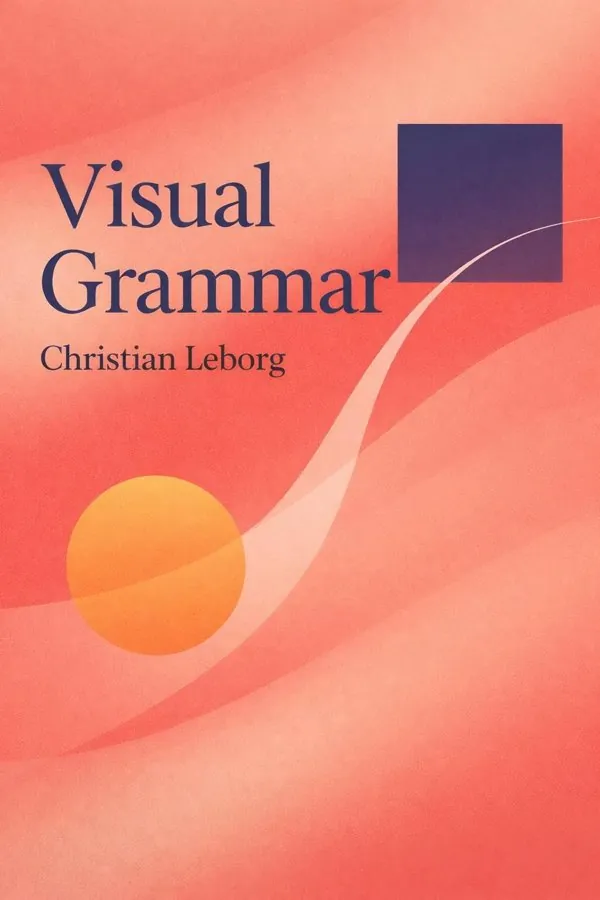
Visual Grammar: Summary & Key Insights
 10 min8 chaptersAudio available
Key Takeaways from Visual Grammar
Every complex image begins with something astonishingly simple.
Nothing in design means much by itself; things become meaningful through relationship.
A design succeeds not only because of what it contains, but because of how those parts are arranged.
Empty space is never truly empty.
Form gives structure, but surface gives character.
What Is Visual Grammar About?
Visual Grammar by Christian Leborg is a design book spanning 6 pages. Visual Grammar by Christian Leborg is a compact yet remarkably powerful guide to the building blocks of visual communication. Rather than treating design as a matter of vague intuition or personal taste, Leborg argues that visual expression has a structure that can be studied, named, and used deliberately. He breaks visual language down into its essential components—point, line, shape, volume, color, rhythm, contrast, proportion, and spatial relationships—so readers can understand why certain images feel balanced, dynamic, clear, or confusing. What makes this book especially valuable is its clarity. Leborg offers a vocabulary for seeing, helping designers, artists, students, and creative thinkers analyze what appears on a page, screen, poster, package, or interface. Once you can name visual relationships, you can control them. That turns design from guesswork into intentional communication. Leborg’s authority comes from his dual perspective as both practicing designer and educator. He understands the realities of making visual work, but he also knows how to explain abstract principles in a systematic way. The result is a practical reference that sharpens perception, strengthens design decisions, and reveals how visual form creates meaning.
This FizzRead summary covers all 8 key chapters of Visual Grammar in approximately 10 minutes, distilling the most important ideas, arguments, and takeaways from Christian Leborg's work. Also available as an audio summary and Key Quotes Podcast.
Visual Grammar
Visual Grammar by Christian Leborg is a compact yet remarkably powerful guide to the building blocks of visual communication. Rather than treating design as a matter of vague intuition or personal taste, Leborg argues that visual expression has a structure that can be studied, named, and used deliberately. He breaks visual language down into its essential components—point, line, shape, volume, color, rhythm, contrast, proportion, and spatial relationships—so readers can understand why certain images feel balanced, dynamic, clear, or confusing.
What makes this book especially valuable is its clarity. Leborg offers a vocabulary for seeing, helping designers, artists, students, and creative thinkers analyze what appears on a page, screen, poster, package, or interface. Once you can name visual relationships, you can control them. That turns design from guesswork into intentional communication.
Leborg’s authority comes from his dual perspective as both practicing designer and educator. He understands the realities of making visual work, but he also knows how to explain abstract principles in a systematic way. The result is a practical reference that sharpens perception, strengthens design decisions, and reveals how visual form creates meaning.
Who Should Read Visual Grammar?
This book is perfect for anyone interested in design and looking to gain actionable insights in a short read. Whether you're a student, professional, or lifelong learner, the key ideas from Visual Grammar by Christian Leborg will help you think differently.
- ✓Readers who enjoy design and want practical takeaways
- ✓Professionals looking to apply new ideas to their work and life
- ✓Anyone who wants the core insights of Visual Grammar in just 10 minutes
Want the full summary?
Get instant access to this book summary and 100K+ more with Fizz Moment.
Get Free SummaryAvailable on App Store • Free to download
Key Chapters
Every complex image begins with something astonishingly simple. Christian Leborg shows that visual communication is built from a small set of fundamental elements: the point, the line, the plane, and the volume. These are not merely technical categories; they are the visual equivalent of an alphabet. A point indicates position and focus. A line suggests direction, connection, edge, or movement. A plane creates surface and shape. A volume introduces depth, mass, and presence. Once you understand these building blocks, visual form becomes less mysterious and more readable.
Leborg’s insight is that meaning emerges before words ever appear. A thin diagonal line can imply speed or instability. A heavy block of volume can feel solid, authoritative, or oppressive. A single isolated point in a large empty field can create tension, loneliness, or emphasis. Designers constantly use these effects, often without naming them. The book helps readers move from instinct to awareness.
This matters in practice across every design field. In logo design, a mark made of points and fine lines communicates differently from one built from thick geometric planes. In interface design, lines guide navigation and planes separate functions. In editorial layout, blocks of text act as planes, while rules and margins behave like lines that organize reading. Even photography relies on points of focus, leading lines, flat fields, and implied volume.
Leborg encourages readers to see visual form as active, not neutral. The smallest element influences perception and interpretation. When you work with basic forms consciously, you gain more control over clarity, mood, and emphasis.
Actionable takeaway: Study any design you admire and identify its points, lines, planes, and volumes. Then redesign a simple composition using only one or two of these elements to understand how each changes meaning.
Nothing in design means much by itself; things become meaningful through relationship. Leborg explains that three core relationships—similarity, contrast, and harmony—shape how visual elements interact and how viewers make sense of them. Similarity groups elements together. Contrast separates them and creates emphasis. Harmony allows different parts to coexist in a coherent whole. These relationships help transform scattered forms into intelligible visual systems.
Similarity is one of the strongest tools for creating order. When shapes repeat in size, color, orientation, or style, viewers naturally read them as related. This is essential in layouts, branding, and interfaces, where consistency supports usability and recognition. Contrast does the opposite but is equally important. It creates difference: light against dark, large against small, smooth against rough, static against dynamic. Without contrast, compositions become dull and unreadable. With too much contrast, they become chaotic. Harmony is the balancing force that prevents either uniformity or tension from overwhelming the design.
A practical example is a website dashboard. If all buttons look identical, the interface may feel orderly but fail to direct attention. Add contrast to the primary call-to-action through color and scale, and the hierarchy becomes clear. But if every panel, icon, and button competes for attention, the result is noise. Harmony comes from limiting the number of visual variables and making differences meaningful.
Leborg’s larger point is that visual relationships are not decoration; they are structure. They organize information, influence emotional tone, and determine whether viewers feel guided or overwhelmed.
Actionable takeaway: In your next design, list which elements should be read as related, which should stand apart, and what overall feeling of unity you want. Then use similarity, contrast, and harmony intentionally instead of by habit.
A design succeeds not only because of what it contains, but because of how those parts are arranged. Leborg presents composition as the art of organizing visual elements so that meaning becomes legible, emphasis becomes intentional, and the eye moves with purpose. Three especially important compositional principles are balance, rhythm, and proportion. Together, they determine whether a layout feels stable, lively, elegant, awkward, heavy, or unresolved.
Balance concerns the distribution of visual weight. Symmetrical balance often feels formal, calm, and controlled. Asymmetrical balance can feel dynamic and contemporary while still remaining stable if visual weight is carefully managed. Rhythm emerges through repetition and variation. It is what makes the eye move across a page, poster, or screen rather than stop in confusion. Proportion governs the relative size of parts, shaping hierarchy and aesthetic character.
Consider a magazine spread. If every image and text block is the same size, the result may be orderly but monotonous. Introduce a dominant image, supporting captions, and measured white space, and the page gains rhythm and hierarchy. In a poster, large type paired with a small secondary line creates proportion that tells viewers what matters first. In packaging, a centered label creates calm, while an off-center arrangement may create energy and distinction.
Leborg’s contribution is to show that composition is not merely about beauty; it is about communication. It tells the viewer where to look, how to read, and what to feel. Strong composition reduces effort and increases impact.
Actionable takeaway: Before refining details, create several rough compositions using only simple blocks. Test how balance, rhythm, and proportion change the reading path, then choose the arrangement that communicates most clearly.
Empty space is never truly empty. One of Leborg’s most valuable insights is that space functions as an active part of visual language, shaping how forms relate and how movement is perceived. Designers often focus on objects—text, images, icons, shapes—but the intervals between them are equally expressive. Space creates breathing room, tension, hierarchy, and direction. It can isolate, connect, calm, or dramatize.
Leborg also emphasizes that movement in design does not require animation. Static compositions can still suggest motion through diagonals, repetition, sequencing, perspective, and the arrangement of forces within the frame. A line that ascends implies upward movement. Repeated forms can produce a pulse or progression. Cropped forms can imply continuation beyond the visible field. These are visual forces that guide the eye and energize the composition.
In practice, this is essential for posters, editorial spreads, interfaces, and even product packaging. A cluttered mobile screen with little negative space feels stressful and hard to navigate. By increasing spacing around key controls, the interface becomes more usable and visually confident. In a poster, a bold image pushed to one edge can create directional tension, making the whole format feel more dynamic. In branding, generous white space often communicates luxury or clarity.
What Leborg makes clear is that space is not a leftover. It is one of the primary tools designers use to control attention and emotional tone. Movement, likewise, is not just literal motion but a designed experience of visual flow.
Actionable takeaway: Review one of your designs and remove one nonessential element. Then increase or refine the surrounding space. Ask whether the composition now feels clearer, more forceful, or easier to navigate.
Form gives structure, but surface gives character. Leborg expands visual grammar beyond shape and layout to include color, texture, and material—qualities that strongly influence mood, symbolism, and sensory perception. These attributes can support meaning, create emotional associations, and affect how trustworthy, playful, luxurious, technical, or human a design feels.
Color is one of the most immediate visual signals. It can create hierarchy, attract attention, establish identity, and carry cultural or emotional connotations. A muted palette may suggest sophistication or restraint, while saturated primaries may signal energy or accessibility. Texture introduces another layer of meaning. Smooth surfaces can feel modern and controlled; rough textures can feel tactile, natural, or expressive. Material extends these ideas into physical reality. Paper stock, gloss, fabric, metal, and digital rendering all change how the same visual form is perceived.
Think of a premium skincare package versus a children’s toy box. Both may use simple geometric forms, but matte finishes, soft neutrals, and subtle textures communicate refinement in one context, while glossy surfaces, bright colors, and playful contrasts create excitement in the other. In digital design, color and texture still matter: a banking app uses controlled contrast and restrained color for trust, while a gaming interface may use luminous gradients and layered textures for immersion.
Leborg’s framework reminds us that these qualities are not superficial embellishments. They are communicative tools. The same composition can feel entirely different when rendered in a different palette or material treatment.
Actionable takeaway: For your next project, define not just shapes and layout but also a color logic, texture strategy, and material intention. Ask what emotional and functional message each surface choice sends.
Good design is rarely a single isolated image. More often, it is a system that must work across multiple formats, scales, and contexts. Leborg’s ideas culminate in the principle of integration: visual elements should form a coherent language that can be applied consistently without becoming rigid. A strong visual system gives users or viewers a sense of continuity while remaining adaptable enough to handle variation.
This is especially relevant in branding, signage, editorial programs, digital products, and exhibition design. A visual system includes recurring decisions about form, color, spacing, type relationships, imagery, and compositional logic. When these decisions are aligned, each piece supports the others. A poster, business card, website, and social graphic can all feel recognizably connected even if they differ in content. The system becomes the grammar that allows many expressions within one identity.
The challenge is balancing sameness and variety. If every application looks identical, the system feels lifeless. If every piece reinvents the rules, the identity collapses. Leborg’s framework helps designers identify what should remain constant and what can change. For example, a brand may maintain a strict color palette and grid while allowing more flexibility in photography or illustration. An interface design system may standardize components but vary layouts according to user need.
The larger lesson is that visual grammar scales. It does not only help with single compositions; it helps build repeatable logic. Design becomes more efficient, more legible, and more strategically powerful when its parts are integrated.
Actionable takeaway: Create a short visual rule set for your next project: define the core elements that must remain consistent and the variables that may adapt. Use that as the foundation for a durable visual system.
What we see is shaped by what surrounds it. Leborg repeatedly shows that visual meaning is contextual: no element carries a fixed effect independent of its environment. A small square looks different beside a large square. A gray tone shifts depending on the background. A curved line feels softer when surrounded by sharp angles, and less distinctive when repeated throughout a composition. Perception is relational, and design works by managing those relationships.
This insight is crucial because designers often evaluate elements in isolation rather than in context. A color swatch may seem perfect on its own but fail within the actual interface. A headline size may feel strong until placed next to an oversized image. A shape may seem dynamic until the rest of the composition overwhelms it. Context determines hierarchy, legibility, and emotional effect.
Practical applications are everywhere. In information design, the visibility of data depends on contrast with the surrounding grid and labels. In packaging, shelf competition changes how color and form are perceived. In UI design, a warning state must be distinct from neutral and success states, not just visually attractive on its own. In editorial design, a pull quote only functions if the surrounding text creates enough contrast and space.
Leborg’s approach trains designers to stop asking, “Is this element good?” and start asking, “How does this element behave in relation to everything else?” That shift leads to better decisions because it reflects how viewers actually experience visual communication.
Actionable takeaway: Never judge a design element in isolation. Test it within the full composition and compare alternate contexts to see how its meaning, visibility, and impact change.
One of the book’s deepest contributions is not a single design rule but a method of thinking. Leborg argues that when we have words for visual phenomena, we become better at perceiving, discussing, and shaping them. A shared vocabulary turns design critique from vague preference into meaningful analysis. Instead of saying a layout feels “off,” we can identify imbalance, weak contrast, inconsistent rhythm, or unresolved spatial tension. Language improves perception, and perception improves practice.
This matters in studios, classrooms, and professional teams. Designers often struggle to explain their choices to clients, developers, marketers, or collaborators. A visual grammar provides common terms for discussing form and function without reducing creativity. It also makes critique more productive. Rather than debating taste, teams can examine hierarchy, proportion, harmony, or movement. The conversation becomes clearer and less personal.
For students, this vocabulary accelerates learning. It reveals that design principles are not hidden secrets available only to the naturally talented. They can be observed, studied, and applied. For experienced designers, the terminology sharpens intuition and makes complex judgments easier to articulate. For non-designers, it opens access to visual literacy, allowing them to read and evaluate the designed world more intelligently.
Leborg’s central achievement is to demystify visual communication. He does not remove artistry from design; he gives it structure. That structure supports experimentation because designers can intentionally break conventions once they understand them.
Actionable takeaway: Build your own mini design glossary from the book’s principles. Use those terms in critiques and project reviews so your visual decisions become more precise, communicable, and deliberate.
All Chapters in Visual Grammar
About the Author
Christian Leborg was a Norwegian graphic designer, educator, and author best known for his work on visual communication and design theory. He developed a strong reputation for explaining complex design principles with precision and clarity, making his ideas especially influential in design education. Leborg taught at several institutions and brought together the perspectives of both practitioner and teacher, which gave his writing a balance of conceptual rigor and practical usefulness. His best-known book, Visual Grammar, has become a valued reference for students, designers, and educators seeking a systematic vocabulary for understanding visual form. Through his work, Leborg helped demystify design by showing that visual communication is not only expressive, but also structured, learnable, and open to thoughtful analysis.
Get This Summary in Your Preferred Format
Read or listen to the Visual Grammar summary by Christian Leborg anytime, anywhere. FizzRead offers multiple formats so you can learn on your terms — all free.
Available formats: App · Audio · PDF · EPUB — All included free with FizzRead
Download Visual Grammar PDF and EPUB Summary
Key Quotes from Visual Grammar
“Every complex image begins with something astonishingly simple.”
“Nothing in design means much by itself; things become meaningful through relationship.”
“A design succeeds not only because of what it contains, but because of how those parts are arranged.”
“One of Leborg’s most valuable insights is that space functions as an active part of visual language, shaping how forms relate and how movement is perceived.”
“Form gives structure, but surface gives character.”
Frequently Asked Questions about Visual Grammar
Visual Grammar by Christian Leborg is a design book that explores key ideas across 8 chapters. Visual Grammar by Christian Leborg is a compact yet remarkably powerful guide to the building blocks of visual communication. Rather than treating design as a matter of vague intuition or personal taste, Leborg argues that visual expression has a structure that can be studied, named, and used deliberately. He breaks visual language down into its essential components—point, line, shape, volume, color, rhythm, contrast, proportion, and spatial relationships—so readers can understand why certain images feel balanced, dynamic, clear, or confusing. What makes this book especially valuable is its clarity. Leborg offers a vocabulary for seeing, helping designers, artists, students, and creative thinkers analyze what appears on a page, screen, poster, package, or interface. Once you can name visual relationships, you can control them. That turns design from guesswork into intentional communication. Leborg’s authority comes from his dual perspective as both practicing designer and educator. He understands the realities of making visual work, but he also knows how to explain abstract principles in a systematic way. The result is a practical reference that sharpens perception, strengthens design decisions, and reveals how visual form creates meaning.
You Might Also Like

The Design of Everyday Things
Don Norman
10 min
The Better Angels of Our Nature
Steven Pinker
10 min
A Designer's Art
Paul Rand
10 min
Architects' Sketchbooks
Various Editors
10 min
Architectural Graphic Standards
The American Institute of Architects
10 min
Design Is Storytelling
Ellen Lupton
10 minBrowse by Category
Ready to read Visual Grammar?
Get the full summary and 100K+ more books with Fizz Moment.