
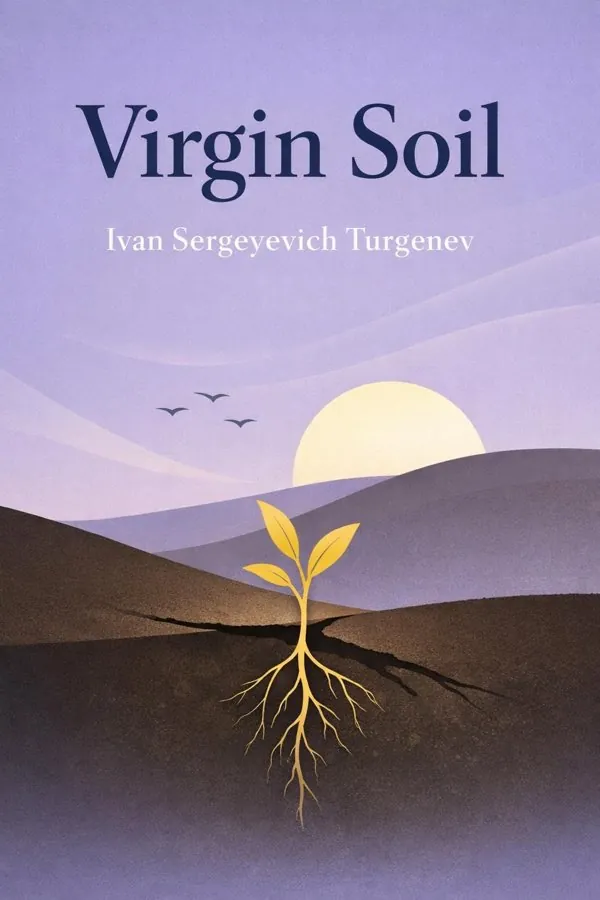
Virgin Soil: Summary & Key Insights
 10 min9 chaptersAudio available
Key Takeaways from Virgin Soil
Real social change often creates confusion before it creates clarity.
A person can passionately believe in a cause and still be tragically unsuited to embody it.
Nothing exposes hypocrisy faster than the arrival of someone who takes ideals seriously.
Moral seriousness can take more than one form.
It is easy to love “the people” in theory; it is much harder to know actual people in their complexity.
What Is Virgin Soil About?
Virgin Soil by Ivan Sergeyevich Turgenev is a classics book spanning 5 pages. Virgin Soil, first published in 1877, is Ivan Sergeyevich Turgenev’s searching portrait of a generation that wants to change society but does not fully understand the people it hopes to save. Set in Russia after the emancipation of the serfs, the novel follows young idealists, disillusioned aristocrats, and practical reformers as they wrestle with populism, class guilt, political duty, and personal love. At the center stands Nezhdanov, a gifted but divided young man whose longing for meaning pulls him toward revolutionary activism even as his temperament resists slogans and performance. Around him, Turgenev assembles a remarkable cast to test competing visions of service, sacrifice, and realism. What makes Virgin Soil enduring is not simply its political setting, but its moral honesty. Turgenev refuses to romanticize either radical enthusiasm or liberal respectability. Instead, he asks a harder question: what does genuine service to others actually require? As one of the great Russian novelists of the 19th century, and a keen observer of ideological conflict in works like Fathers and Sons, Turgenev brings psychological depth and social insight to a novel that still feels strikingly modern.
This FizzRead summary covers all 9 key chapters of Virgin Soil in approximately 10 minutes, distilling the most important ideas, arguments, and takeaways from Ivan Sergeyevich Turgenev's work. Also available as an audio summary and Key Quotes Podcast.
Virgin Soil
Virgin Soil, first published in 1877, is Ivan Sergeyevich Turgenev’s searching portrait of a generation that wants to change society but does not fully understand the people it hopes to save. Set in Russia after the emancipation of the serfs, the novel follows young idealists, disillusioned aristocrats, and practical reformers as they wrestle with populism, class guilt, political duty, and personal love. At the center stands Nezhdanov, a gifted but divided young man whose longing for meaning pulls him toward revolutionary activism even as his temperament resists slogans and performance. Around him, Turgenev assembles a remarkable cast to test competing visions of service, sacrifice, and realism. What makes Virgin Soil enduring is not simply its political setting, but its moral honesty. Turgenev refuses to romanticize either radical enthusiasm or liberal respectability. Instead, he asks a harder question: what does genuine service to others actually require? As one of the great Russian novelists of the 19th century, and a keen observer of ideological conflict in works like Fathers and Sons, Turgenev brings psychological depth and social insight to a novel that still feels strikingly modern.
Who Should Read Virgin Soil?
This book is perfect for anyone interested in classics and looking to gain actionable insights in a short read. Whether you're a student, professional, or lifelong learner, the key ideas from Virgin Soil by Ivan Sergeyevich Turgenev will help you think differently.
- ✓Readers who enjoy classics and want practical takeaways
- ✓Professionals looking to apply new ideas to their work and life
- ✓Anyone who wants the core insights of Virgin Soil in just 10 minutes
Want the full summary?
Get instant access to this book summary and 100K+ more with Fizz Moment.
Get Free SummaryAvailable on App Store • Free to download
Key Chapters
Real social change often creates confusion before it creates clarity. That is the atmosphere of Virgin Soil. Turgenev sets the novel in the Russia of the 1870s, when the emancipation of the serfs had already taken place, but the promised moral and political renewal had not arrived. The old order had been shaken, yet no stable new order had replaced it. This left a vacuum that young educated Russians rushed to fill. Many of them felt ashamed of privilege and eager to dedicate themselves to the peasantry, whom they imagined as the moral center of the nation. But their zeal was mixed with uncertainty. They had theories, not relationships; ideals, not experience.
Turgenev’s brilliance lies in showing that historical transition is not merely structural. It is emotional. A whole generation feels unmoored. The educated classes can no longer fully believe in inherited authority, but they also cannot easily build credible alternatives. This produces the peculiar energy of the novel: everyone is seeking a path, yet few understand the terrain. The title itself points to this condition. “Virgin soil” suggests land not yet cultivated, but also minds and institutions not yet prepared for what reformers want to plant.
This insight remains highly relevant. In any period of rapid change, whether political, technological, or cultural, people are tempted to mistake disruption for direction. A company after reorganization, a society after reform, or a movement after a moral awakening may feel full of possibility, but possibility is not strategy. Good intentions do not erase confusion.
Turgenev invites readers to look beneath slogans and ask what kind of groundwork must precede lasting change. The actionable takeaway: when entering a changing environment, spend as much energy understanding conditions as announcing solutions.
A person can passionately believe in a cause and still be tragically unsuited to embody it. Nezhdanov, one of Turgenev’s most complex protagonists, represents this painful mismatch. He is intelligent, sensitive, eloquent, and morally serious. He despises empty privilege and wants a life of purpose. Yet he is also divided against himself. He is drawn to revolutionary populism not because he possesses stable conviction, but because he is tormented by the need to justify his existence. His politics emerge partly from conscience and partly from self-reproach.
This makes Nezhdanov far more than a political type. He is a study in inward fragmentation. He performs confidence, but inwardly doubts; he seeks action, but tends toward reflection; he admires commitment, but lacks emotional steadiness. Turgenev does not mock him. On the contrary, he treats him with deep sympathy. But that sympathy is inseparable from realism. Nezhdanov cannot simply will himself into effectiveness. His temperament matters. Character is not an obstacle external to ideology; it determines whether ideology can be lived at all.
Modern readers can recognize this pattern in activists, leaders, and professionals who commit to demanding causes without reckoning with their own psychological limits. Someone may care deeply about education reform, public service, or climate advocacy, yet burn out quickly if they are motivated mainly by guilt, comparison, or the need to appear morally significant. Noble goals cannot compensate forever for internal instability.
Nezhdanov teaches that self-knowledge is a political and ethical necessity. If you do not understand your motives, your cause may become another stage for inner conflict. The actionable takeaway: before committing yourself to a mission, examine whether your desire comes from grounded conviction or from unresolved personal distress.
Nothing exposes hypocrisy faster than the arrival of someone who takes ideals seriously. When Nezhdanov enters the household of Boris Sipyagin as tutor to his son, he steps into a world of polished liberalism. Sipyagin and his circle speak the language of reform, progress, and enlightened opinion. They appear cultivated, civilized, and sympathetic to modern ideas. Yet Turgenev gradually reveals that much of this liberalism is performative. It decorates status rather than risks comfort.
The Sipyagin household is not villainous in a melodramatic sense. That is precisely Turgenev’s point. Its danger lies in self-satisfaction. These are people who can discuss reform elegantly while remaining deeply attached to hierarchy, vanity, and social position. They want to be seen as advanced without paying the price of transformation. Nezhdanov, despite his own weaknesses, senses the hollowness. He is both dependent on this environment and alienated by it.
This dynamic appears in every age. Institutions often absorb the language of change long before they accept its consequences. A business may celebrate inclusion while preserving exclusionary habits. A university may praise innovation while punishing true dissent. A family may value honesty as an ideal while resisting any honest conversation that threatens its routines. Turgenev shows how language can become a substitute for courage.
The lesson is not that reform-minded people are always hypocrites. It is that social elegance can hide moral evasion. Respectable opinion often feels safer than principled action, especially when action might disrupt prestige. Nezhdanov’s discomfort helps readers distinguish between sympathy and solidarity, between progressive style and ethical commitment.
The actionable takeaway: when assessing people or institutions, look beyond the vocabulary they use and ask what costs they are actually willing to bear for the values they profess.
Moral seriousness can take more than one form. In Virgin Soil, Marianna and Solomin offer two of the novel’s most important alternatives to posturing and confusion. Marianna possesses courage, emotional clarity, and a fierce willingness to break with convention. She is not content to admire change from a protected distance; she wants to live differently. Her sympathy for the oppressed is genuine, and she is prepared to sacrifice comfort for conviction. Yet she is not merely a symbol of rebellion. Turgenev gives her depth by linking her strength to disciplined feeling rather than theatrical radicalism.
Solomin, by contrast, embodies practical intelligence. He is steady, observant, competent, and quietly committed to useful work. He does not speak in grand abstractions, and he is skeptical of romantic political gestures. Unlike many of the novel’s ideological figures, he understands systems, labor, and the actual conditions in which ordinary people live. If Marianna represents passionate sincerity, Solomin represents durable effectiveness.
Together, these characters dramatize a central tension in reform movements: should one lead with emotional conviction or practical method? Turgenev’s answer is subtle. He respects conviction, but he suggests that conviction must be joined to discipline and realism. Marianna’s energy matters because it is not empty. Solomin’s steadiness matters because it does not collapse into apathy. They show that genuine service needs both heart and structure.
This has obvious contemporary applications. A nonprofit, community project, or social campaign needs inspired people who care deeply, but it also needs organizers who can manage resources, earn trust, and deliver results. Passion without method burns out. Method without passion becomes bureaucratic.
The actionable takeaway: if you want to contribute to change, identify whether your strength is courage, competence, or both, and intentionally partner with people who complement what you lack.
It is easy to love “the people” in theory; it is much harder to know actual people in their complexity. This is one of Turgenev’s sharpest insights in Virgin Soil. The young populists of the novel imagine the peasantry as the natural ally of their moral and political hopes. They believe that if educated youth simply go to the villages, speak plainly, and share the people’s burdens, authentic transformation will follow. But the encounter with reality proves far more difficult. The peasants do not automatically recognize these outsiders as friends, teachers, or fellow sufferers. Suspicion, habit, distance, and misunderstanding intervene.
Turgenev does not ridicule the desire to serve the people. He questions the illusions attached to that desire. The populists often project meaning onto the peasantry rather than listening to them. They approach with symbolic expectations, wanting redemption, legitimacy, and emotional confirmation. But rural life is not a stage for educated self-purification. It is a concrete world with its own rhythms, fears, priorities, and forms of intelligence.
This mismatch is timeless. Professionals designing policies for neighborhoods they have never lived in, founders building products for users they barely understand, or advocates speaking on behalf of communities they seldom consult all repeat some version of this error. Idealization can be as patronizing as contempt if it denies the autonomy and complexity of others.
Turgenev insists that good intentions do not guarantee connection. Trust is slow. Experience matters. Reformers must learn the difference between speaking for others and learning from them. The novel’s social realism challenges any movement built on projections instead of relationships.
The actionable takeaway: if you hope to help a group beyond your own experience, replace assumptions with sustained listening, and let real contact revise your theories before you ask others to trust your plans.
Some failures arise not from cowardice but from mistaking drama for effectiveness. In Virgin Soil, Turgenev repeatedly exposes the weakness of political action driven by symbols, moods, and heroic self-image. The revolutionary underground attracts people who are hungry for significance, but hunger for significance can distort judgment. Plans become vague, rhetoric grows inflated, and danger itself begins to feel like proof of moral worth. What is missing is often the unglamorous labor needed to make change real: patience, organization, local credibility, and knowledge of consequences.
Turgenev is not writing a defense of passivity. He understands why young people are drawn to boldness in a stagnant society. But he also sees how easily intensity becomes self-referential. Instead of asking, “Will this help?” characters may ask, “Does this prove my devotion?” That shift is fatal. Political action then serves identity before it serves people. The result is confusion, wasted sacrifice, and harm borne by those with the least power.
This idea applies far beyond 19th-century Russia. In modern workplaces, movements, and public life, people still overvalue visible disruption and undervalue sustained competence. A manager may announce sweeping reforms with no implementation plan. An activist may prize viral attention over coalition-building. A founder may pursue bold launches before fixing basic operations. In each case, spectacle displaces stewardship.
Turgenev’s warning is especially important for morally ambitious readers. It is tempting to think that urgency excuses vagueness. Yet urgency often makes clarity even more necessary. Courage matters, but courage without method can become another kind of vanity.
The actionable takeaway: before joining or launching a bold initiative, ask three concrete questions: who benefits, what is the plan, and how will success be measured beyond emotional excitement.
Political convictions are tested most honestly not in speeches, but in intimate relationships. Virgin Soil is not only a social novel; it is also a novel of emotional allegiance. Turgenev shows that love, friendship, and loyalty are not distractions from public life. They reveal character more clearly than ideology does. Nezhdanov’s relationships, especially with Marianna, expose the gap between what he wants to be and what he can sustain. Marianna’s affections are tied to moral seriousness, not sentimental fantasy. Solomin’s presence introduces another model of care: quieter, steadier, and less theatrical than the emotional storms around him.
The novel suggests that personal bonds can either deepen moral life or expose its fragility. A person who speaks nobly about humanity may still fail the individuals nearest to him. Conversely, someone who seems politically unremarkable may practice forms of responsibility that are socially transformative in a more durable way. Turgenev refuses the easy split between the public and private self. How one handles dependence, affection, honesty, and sacrifice is part of the same moral reality as one’s politics.
This matters today because many people compartmentalize values. They may advocate justice publicly while behaving carelessly in relationships, or excuse emotional unreliability as the price of higher purpose. Turgenev rejects that excuse. Ideals that cannot survive everyday obligations may be less mature than they appear.
Practical life constantly poses these tests: Do you keep promises when no audience is watching? Do you tell the truth kindly? Do you choose people only when they confirm your self-image, or do you honor their independent needs? Private ethics shape public credibility.
The actionable takeaway: evaluate your deepest values by your closest relationships, because sustained responsibility to real people is one of the surest measures of moral seriousness.
Not all sacrifice is fruitful, but even failed sacrifice can reveal painful truth. As Virgin Soil moves toward its conclusion, Turgenev does not reward idealism with triumph. Instead, he traces the emotional and moral consequences of disillusionment. Nezhdanov’s fate is especially significant because it embodies the tragedy of a person who longs to give himself to a cause but cannot reconcile conviction, temperament, and reality. His suffering is not meaningless in a literary sense, but it is devastatingly human. Turgenev will not pretend that purity of intention guarantees survival or fulfillment.
Yet the novel is not wholly despairing. Through figures like Solomin and Marianna, Turgenev suggests that renewal remains possible, though on humbler terms than revolutionary fantasy promises. Life continues. Work continues. Moral purpose can survive the collapse of illusions if it is rebuilt on steadier ground. This is one of the novel’s deepest contributions: it distinguishes between the death of a fantasy and the death of value itself. When romantic extremity fails, meaningful action need not disappear. It may simply become quieter, more local, and more mature.
Many readers encounter this lesson after personal disappointment. A career dream fails, a movement disappoints, a leader proves flawed, or one’s younger self appears naive. The temptation is to conclude that all aspiration was foolish. Turgenev offers a wiser alternative. Disillusionment can be destructive, but it can also cleanse ambition of vanity and force us toward more honest forms of service.
The actionable takeaway: when a cherished ideal collapses, do not ask only what was lost; ask what illusion has been removed and what steadier form of purpose can now be built in its place.
The most valuable critics are often those who understand what attracts people to error. Turgenev’s achievement in Virgin Soil lies in his refusal to flatten anyone into a simple target. He critiques liberals, radicals, bureaucrats, and dreamers, yet he treats even misguided figures with a remarkable degree of psychological sympathy. He knows that people rarely adopt ideologies for purely abstract reasons. They seek dignity, belonging, moral justification, relief from guilt, or a language for suffering. Because he understands this, his criticism cuts deeper than satire would.
This makes the novel unusually modern. Turgenev shows that ideas are never merely ideas. They are entangled with temperament, vanity, loneliness, social aspiration, and fear. A movement may contain both noble moral energy and serious delusion. A cautious reformer may be partly wise and partly self-protective. A radical may be both brave and self-dramatizing. Such complexity resists the comforting habit of assigning all virtue to one camp and all blindness to another.
For readers today, this is a crucial habit of mind. Polarized environments encourage quick moral sorting. We prefer allies who seem pure and opponents who seem obviously corrupt. Turgenev insists that human beings are mixed, and that moral clarity requires seeing the mixture rather than denying it. This does not mean abandoning judgment. It means grounding judgment in understanding rather than caricature.
In practical terms, this can improve leadership, civic life, and personal relationships. Better decisions emerge when we ask not just what people believe, but what needs, fears, and incentives make those beliefs persuasive.
The actionable takeaway: when confronting an ideology you dislike, try first to understand the human longing inside it; only then will your criticism be both fairer and more effective.
All Chapters in Virgin Soil
About the Author
Ivan Sergeyevich Turgenev (1818–1883) was a Russian novelist, short story writer, poet, and playwright, widely regarded as one of the greatest prose stylists of the 19th century. Born into a wealthy landowning family, he drew deeply on his experience of Russian provincial life, the gentry, and the peasantry. His works often explore social reform, generational conflict, and the emotional costs of ideological change. Turgenev gained early fame with A Sportsman’s Sketches, which influenced attitudes toward serfdom, and later secured his place in world literature with novels such as Fathers and Sons, Rudin, and Home of the Gentry. Compared with some of his Russian contemporaries, his writing is noted for its elegance, restraint, psychological subtlety, and humane intelligence. Virgin Soil reflects his late-career engagement with populism and the moral crisis of post-emancipation Russia.
Get This Summary in Your Preferred Format
Read or listen to the Virgin Soil summary by Ivan Sergeyevich Turgenev anytime, anywhere. FizzRead offers multiple formats so you can learn on your terms — all free.
Available formats: App · Audio · PDF · EPUB — All included free with FizzRead
Download Virgin Soil PDF and EPUB Summary
Key Quotes from Virgin Soil
“Real social change often creates confusion before it creates clarity.”
“A person can passionately believe in a cause and still be tragically unsuited to embody it.”
“Nothing exposes hypocrisy faster than the arrival of someone who takes ideals seriously.”
“Moral seriousness can take more than one form.”
“It is easy to love “the people” in theory; it is much harder to know actual people in their complexity.”
Frequently Asked Questions about Virgin Soil
Virgin Soil by Ivan Sergeyevich Turgenev is a classics book that explores key ideas across 9 chapters. Virgin Soil, first published in 1877, is Ivan Sergeyevich Turgenev’s searching portrait of a generation that wants to change society but does not fully understand the people it hopes to save. Set in Russia after the emancipation of the serfs, the novel follows young idealists, disillusioned aristocrats, and practical reformers as they wrestle with populism, class guilt, political duty, and personal love. At the center stands Nezhdanov, a gifted but divided young man whose longing for meaning pulls him toward revolutionary activism even as his temperament resists slogans and performance. Around him, Turgenev assembles a remarkable cast to test competing visions of service, sacrifice, and realism. What makes Virgin Soil enduring is not simply its political setting, but its moral honesty. Turgenev refuses to romanticize either radical enthusiasm or liberal respectability. Instead, he asks a harder question: what does genuine service to others actually require? As one of the great Russian novelists of the 19th century, and a keen observer of ideological conflict in works like Fathers and Sons, Turgenev brings psychological depth and social insight to a novel that still feels strikingly modern.
More by Ivan Sergeyevich Turgenev

You Might Also Like




Browse by Category
Ready to read Virgin Soil?
Get the full summary and 100K+ more books with Fizz Moment.