
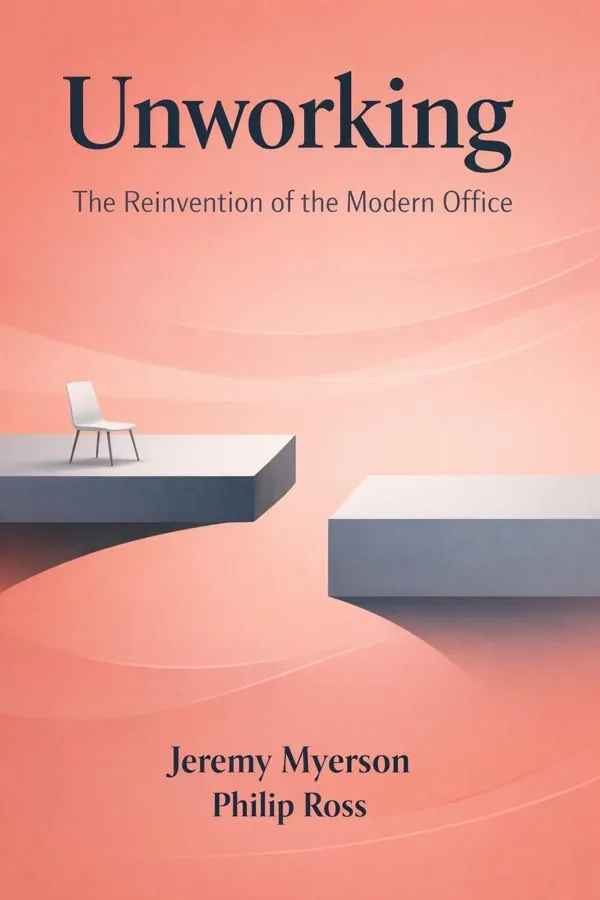
Unworking: The Reinvention of the Modern Office: Summary & Key Insights
by Jeremy Myerson, Philip Ross
 10 min6 chaptersAudio available
What Is Unworking: The Reinvention of the Modern Office About?
Unworking: The Reinvention of the Modern Office by Jeremy Myerson, Philip Ross is a organization book spanning 6 pages. Unworking: The Reinvention of the Modern Office examines how the traditional concept of the office is being dismantled and reimagined in response to technological, cultural, and social change. Jeremy Myerson and Philip Ross explore the evolution of workspaces, the rise of hybrid and remote work, and the future of collaboration, creativity, and productivity in a post-pandemic world. The book offers a panoramic view of the office and advances a manifesto for 'unworking'—unlearning old habits and assumptions about work.
This FizzRead summary covers all 6 key chapters of Unworking: The Reinvention of the Modern Office in approximately 10 minutes, distilling the most important ideas, arguments, and takeaways from Jeremy Myerson, Philip Ross's work. Also available as an audio summary and Key Quotes Podcast.
Unworking: The Reinvention of the Modern Office
Unworking: The Reinvention of the Modern Office examines how the traditional concept of the office is being dismantled and reimagined in response to technological, cultural, and social change. Jeremy Myerson and Philip Ross explore the evolution of workspaces, the rise of hybrid and remote work, and the future of collaboration, creativity, and productivity in a post-pandemic world. The book offers a panoramic view of the office and advances a manifesto for 'unworking'—unlearning old habits and assumptions about work.
Who Should Read Unworking: The Reinvention of the Modern Office?
This book is perfect for anyone interested in organization and looking to gain actionable insights in a short read. Whether you're a student, professional, or lifelong learner, the key ideas from Unworking: The Reinvention of the Modern Office by Jeremy Myerson, Philip Ross will help you think differently.
- ✓Readers who enjoy organization and want practical takeaways
- ✓Professionals looking to apply new ideas to their work and life
- ✓Anyone who wants the core insights of Unworking: The Reinvention of the Modern Office in just 10 minutes
Want the full summary?
Get instant access to this book summary and 100K+ more with Fizz Moment.
Get Free SummaryAvailable on App Store • Free to download
Key Chapters
Myerson and Ross start by taking us back in time, tracing the genealogy of the office. The earliest offices borrowed their logic from factories: rows of clerks processing information as if it were a mechanized product. The 20th century brought towering corporate structures and compartmentalized hierarchies, each designed to assert control and optimize efficiency. The authors dissect these spaces from the perspective of design philosophy, showing how architecture mirrored the era’s managerial mindset.
From the corporate cathedral of the early 1900s to the open-plan offices of the 1960s and the cubicles of the 1980s, every innovation attempted to solve a problem yet introduced new constraints. The cubicle promised privacy but killed spontaneity; open plans encouraged visibility but generated distraction. Myerson, drawing on decades of design research, emphasizes that the office has always been a reflection of power structures—who gets the corner office, who occupies the desk clusters, and who moves freely.
By the early 2000s, with technology untethering people from physical desks, the old model began to crack. Ross, who has long studied the intersection of work and technology, explains that the office’s evolutionary path reveals one central lesson: efficiency-driven environments rarely produce creativity. *Unworking* insists that to design for the future, we must stop designing for the past. This historical overview sets the foundation for everything that follows, leading us toward a broader institutional unlearning—a willingness to discard the office as a container for routine and imagine it as a catalyst for ideas and well-being.
Technology, as Myerson and Ross argue, is the key agent of 'unworking'. Digital connectivity shattered the notion of work being tied to a single location. Cloud computing, mobile devices, and collaboration platforms dissolved physical boundaries, allowing employees to contribute wherever they are. But this liberation came with its own tension—namely, the need to recalibrate how presence and accountability are defined.
The authors illuminate how the digital transformation made three things possible: agility, democratization, and autonomy. Agility arises from the capacity to co-create across time zones, turning asynchronous communication into global teamwork. Democratization stems from the flattening of hierarchies when ideas can emerge in virtual spaces without spatial privilege. Autonomy flows from the ability to choose where, when, and how to work.
More importantly, Myerson and Ross caution against assuming that technology alone will liberate us. Tools become meaningful only when guided by cultural intent. They show examples of firms that invested heavily in digital infrastructure but failed to nurture trust and creative freedom, thereby reproducing old managerial patterns online. The real revolution, they argue, is not technological adaptation but cultural transformation—an understanding that digital work needs emotional intelligence as much as software integration.
This chapter transitions smoothly into discussions of hybrid models, where technological interfaces enable fluid patterns of engagement. Ross captures the nuance: the future is not about virtual replacing physical, but about harmonizing both. The office must become a place for intentional gatherings, human exchange, and collective moments—supported, not dominated, by technology. In short, *Unworking* reframes technology not as a disruptor but as an enabler of rehumanized workplaces.
+ 4 more chapters — available in the FizzRead app
All Chapters in Unworking: The Reinvention of the Modern Office
About the Authors
Jeremy Myerson is a design researcher and writer specializing in workplace innovation and design. Philip Ross is a futurist and founder of UnGroup, focusing on the future of work and workplace transformation.
Get This Summary in Your Preferred Format
Read or listen to the Unworking: The Reinvention of the Modern Office summary by Jeremy Myerson, Philip Ross anytime, anywhere. FizzRead offers multiple formats so you can learn on your terms — all free.
Available formats: App · Audio · PDF · EPUB — All included free with FizzRead
Download Unworking: The Reinvention of the Modern Office PDF and EPUB Summary
Key Quotes from Unworking: The Reinvention of the Modern Office
“Myerson and Ross start by taking us back in time, tracing the genealogy of the office.”
“Technology, as Myerson and Ross argue, is the key agent of 'unworking'.”
Frequently Asked Questions about Unworking: The Reinvention of the Modern Office
Unworking: The Reinvention of the Modern Office by Jeremy Myerson, Philip Ross is a organization book that explores key ideas across 6 chapters. Unworking: The Reinvention of the Modern Office examines how the traditional concept of the office is being dismantled and reimagined in response to technological, cultural, and social change. Jeremy Myerson and Philip Ross explore the evolution of workspaces, the rise of hybrid and remote work, and the future of collaboration, creativity, and productivity in a post-pandemic world. The book offers a panoramic view of the office and advances a manifesto for 'unworking'—unlearning old habits and assumptions about work.
You Might Also Like
A Guide to the Project Management Body of Knowledge (PMBOK® Guide)
Project Management Institute
10 min
Organizational Behavior
Stephen P. Robbins
10 min
Accelerate: The Science of Lean Software and DevOps – Building and Scaling High Performing Technology Organizations
Nicole Forsgren, Jez Humble, Gene Kim
10 min
Awakening Compassion at Work: The Quiet Power That Elevates People and Organizations
Monica C. Worline, Jane E. Dutton
10 min
Building an Inclusive Organization: Leveraging the Power of a Diverse Workforce
Stephen Frost
10 min
Collaborative Intelligence: Thinking with People Who Think Differently
Dawna Markova, Angie McArthur
10 minBrowse by Category
Ready to read Unworking: The Reinvention of the Modern Office?
Get the full summary and 100K+ more books with Fizz Moment.