
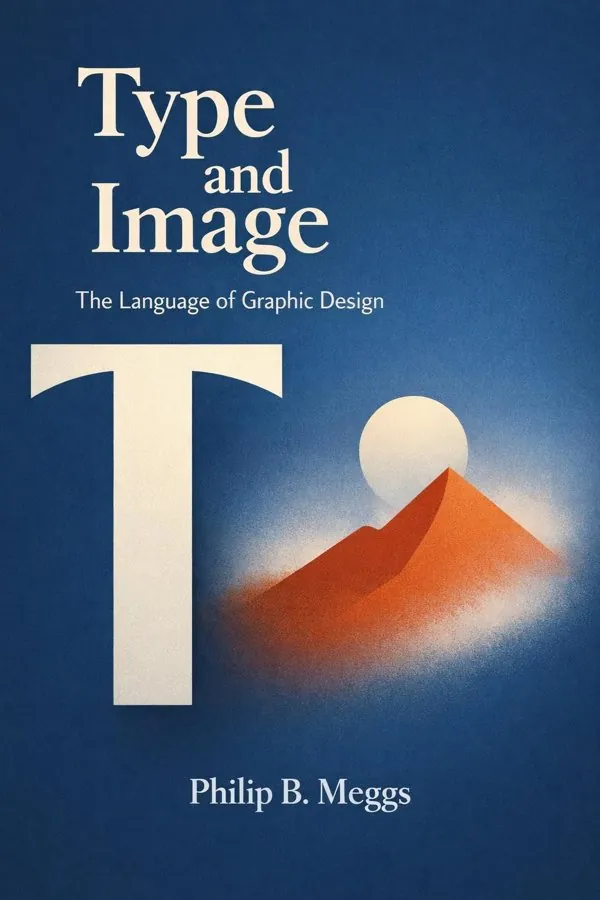
Type and Image: The Language of Graphic Design: Summary & Key Insights
 10 min5 chaptersAudio available
What Is Type and Image: The Language of Graphic Design About?
Type and Image: The Language of Graphic Design by Philip B. Meggs is a design book spanning 5 pages. A comprehensive exploration of the relationship between typography and imagery in graphic design, this book examines how type and image interact to communicate ideas effectively. Through numerous examples and analyses, Meggs provides insight into the visual language of design and its role in shaping modern communication.
This FizzRead summary covers all 5 key chapters of Type and Image: The Language of Graphic Design in approximately 10 minutes, distilling the most important ideas, arguments, and takeaways from Philip B. Meggs's work. Also available as an audio summary and Key Quotes Podcast.
Type and Image: The Language of Graphic Design
A comprehensive exploration of the relationship between typography and imagery in graphic design, this book examines how type and image interact to communicate ideas effectively. Through numerous examples and analyses, Meggs provides insight into the visual language of design and its role in shaping modern communication.
Who Should Read Type and Image: The Language of Graphic Design?
This book is perfect for anyone interested in design and looking to gain actionable insights in a short read. Whether you're a student, professional, or lifelong learner, the key ideas from Type and Image: The Language of Graphic Design by Philip B. Meggs will help you think differently.
- ✓Readers who enjoy design and want practical takeaways
- ✓Professionals looking to apply new ideas to their work and life
- ✓Anyone who wants the core insights of Type and Image: The Language of Graphic Design in just 10 minutes
Want the full summary?
Get instant access to this book summary and 100K+ more with Fizz Moment.
Get Free SummaryAvailable on App Store • Free to download
Key Chapters
Understanding how we arrived at our modern visual language requires looking back to when type and image first emerged as separate yet interdependent tools of communication. Early manuscripts fused word and image in illuminated pages where letterforms and decoration formed a single visual statement. With the invention of movable type, typography gained its own life, giving permanence and reproducibility to text, yet at the cost of separating the expressive unity once possible in the manuscript tradition.
During the Renaissance, type design became a discipline in itself. Designers like Aldus Manutius and Claude Garamond refined letterforms until they became aesthetic objects, balancing readability and beauty. In contrast, pictorial imagery expanded through engraving and illustration, enabling complex storytelling alongside textual exposition. For centuries, print design oscillated between these two poles—text as information and image as expression—but it was not until the industrial age that these boundaries began to blur again.
The rise of advertising, posters, and mass communication in the nineteenth century compelled designers to rethink how words and pictures might interact to seize attention and compress meaning. Designers like Jules Chéret and Henri de Toulouse-Lautrec reintroduced a synthesis that was both artistic and communicative. Typography began to adopt the dynamism of image; type placement, scale, and rhythm became part of the visual message. This historical tension—between typography’s rational order and image’s emotional expressiveness—forms the foundation of all modern design thinking.
By understanding this continuum, a designer learns that every typographic decision carries historical resonance. To use Bodoni is not simply to select a font—it is to echo the Enlightenment’s faith in rational beauty. To distort type in collage can invoke the avant-garde challenge of Futurist rebellion. History gives us these layers of meaning, and with them, the responsibility to apply them thoughtfully.
Typography has always been a medium of both clarity and personality. While traditional typographic thought emphasized legibility, modern design revealed that meaning lies not only in what words say, but in how they look. When I examine the evolution of typographic form, I see a continuous expansion of its expressive potential—from static geometry to kinetic voice.
In the early twentieth century, modernism introduced a radical notion: type could itself be visual form, freed from ornamentation. The Bauhaus taught that typography must serve the collective purpose of clarity, while artists like El Lissitzky and Moholy-Nagy explored how spatial arrangement could create new visual syntax. By these experiments, typography became architecture for thought. It could whisper through minimalist restraint, or shout through structure and space.
Later, postmodernism reintroduced complexity, ambiguity, and emotion. Designers such as Wolfgang Weingart or Katherine McCoy treated typography as visual poetry—something to be felt before it was read. They explored layering, distortion, and semantic play, merging form with content until boundaries disappeared. This shift did not abandon legibility but expanded what legibility could mean in a culture of visual saturation.
As digital technology emerged, typography gained new dimensions of motion and interaction. Type could respond, move, and evolve—its shapes no longer bound by ink or paper. In *Type and Image*, I wanted to illustrate that this freedom does not erase design’s discipline. The point is not to make type louder, but to enable it to speak more precisely. True typographic design balances expression and clarity, message and medium. The key lies in understanding that every stroke carries voice, and every composition reveals intent.
+ 3 more chapters — available in the FizzRead app
All Chapters in Type and Image: The Language of Graphic Design
About the Author
Philip B. Meggs (1942–2002) was an influential American graphic designer, historian, and educator. He authored several seminal works on graphic design history and theory, including 'A History of Graphic Design', and served as a professor at Virginia Commonwealth University.
Get This Summary in Your Preferred Format
Read or listen to the Type and Image: The Language of Graphic Design summary by Philip B. Meggs anytime, anywhere. FizzRead offers multiple formats so you can learn on your terms — all free.
Available formats: App · Audio · PDF · EPUB — All included free with FizzRead
Download Type and Image: The Language of Graphic Design PDF and EPUB Summary
Key Quotes from Type and Image: The Language of Graphic Design
“Understanding how we arrived at our modern visual language requires looking back to when type and image first emerged as separate yet interdependent tools of communication.”
“Typography has always been a medium of both clarity and personality.”
Frequently Asked Questions about Type and Image: The Language of Graphic Design
Type and Image: The Language of Graphic Design by Philip B. Meggs is a design book that explores key ideas across 5 chapters. A comprehensive exploration of the relationship between typography and imagery in graphic design, this book examines how type and image interact to communicate ideas effectively. Through numerous examples and analyses, Meggs provides insight into the visual language of design and its role in shaping modern communication.
You Might Also Like
The Design of Everyday Things
Don Norman
10 min
The Better Angels of Our Nature
Steven Pinker
10 min
A Designer's Art
Paul Rand
10 min
Architects' Sketchbooks
Various Editors
10 min
Architectural Graphic Standards
The American Institute of Architects
10 min
Design Is Storytelling
Ellen Lupton
10 minBrowse by Category
Ready to read Type and Image: The Language of Graphic Design?
Get the full summary and 100K+ more books with Fizz Moment.