
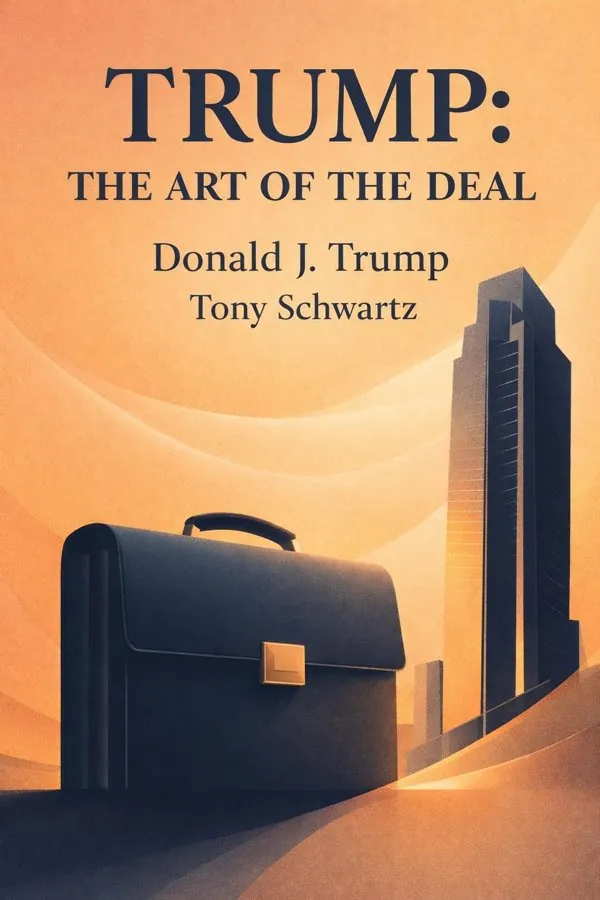
Trump: The Art of the Deal: Summary & Key Insights
by Donald J. Trump, Tony Schwartz
 10 min9 chaptersAudio available
Key Takeaways from Trump: The Art of the Deal
The truest measure of an entrepreneur is not a mission statement but a calendar.
Business instincts are rarely born in boardrooms; they are usually learned through close observation long before success arrives.
Breakthrough projects often begin with modest footholds.
In competitive markets, a product is rarely just a product; it is an experience, a symbol, and a claim about status.
Most major opportunities look uncomfortable before they look obvious.
What Is Trump: The Art of the Deal About?
Trump: The Art of the Deal by Donald J. Trump, Tony Schwartz is a entrepreneurship book spanning 12 pages. Trump: The Art of the Deal is part memoir, part business playbook, and part portrait of 1980s American ambition. Written by Donald J. Trump with journalist Tony Schwartz, the book follows Trump through a series of high-profile real estate, branding, and entertainment ventures while distilling the principles he believes drive successful deal-making. Rather than presenting entrepreneurship as a neat formula, it depicts business as a fast-moving arena shaped by timing, perception, leverage, persistence, and appetite for risk. That mix is what made the book influential far beyond real estate circles. The book matters because it captures a style of entrepreneurship built on bold vision, aggressive negotiation, and media-savvy positioning. Readers see not only the mechanics of deals but also the performance behind them: how attention is created, how confidence is projected, and how obstacles are reframed as opportunities. Trump writes from the authority of a developer who built his public identity through major New York projects, while Schwartz contributes the narrative structure and clarity that make the lessons accessible. Whether you admire, question, or simply want to understand this approach to business, the book remains a revealing case study in entrepreneurial thinking, personal branding, and the psychology of ambition.
This FizzRead summary covers all 9 key chapters of Trump: The Art of the Deal in approximately 10 minutes, distilling the most important ideas, arguments, and takeaways from Donald J. Trump, Tony Schwartz's work. Also available as an audio summary and Key Quotes Podcast.
Trump: The Art of the Deal
Trump: The Art of the Deal is part memoir, part business playbook, and part portrait of 1980s American ambition. Written by Donald J. Trump with journalist Tony Schwartz, the book follows Trump through a series of high-profile real estate, branding, and entertainment ventures while distilling the principles he believes drive successful deal-making. Rather than presenting entrepreneurship as a neat formula, it depicts business as a fast-moving arena shaped by timing, perception, leverage, persistence, and appetite for risk. That mix is what made the book influential far beyond real estate circles.
The book matters because it captures a style of entrepreneurship built on bold vision, aggressive negotiation, and media-savvy positioning. Readers see not only the mechanics of deals but also the performance behind them: how attention is created, how confidence is projected, and how obstacles are reframed as opportunities. Trump writes from the authority of a developer who built his public identity through major New York projects, while Schwartz contributes the narrative structure and clarity that make the lessons accessible. Whether you admire, question, or simply want to understand this approach to business, the book remains a revealing case study in entrepreneurial thinking, personal branding, and the psychology of ambition.
Who Should Read Trump: The Art of the Deal?
This book is perfect for anyone interested in entrepreneurship and looking to gain actionable insights in a short read. Whether you're a student, professional, or lifelong learner, the key ideas from Trump: The Art of the Deal by Donald J. Trump, Tony Schwartz will help you think differently.
- ✓Readers who enjoy entrepreneurship and want practical takeaways
- ✓Professionals looking to apply new ideas to their work and life
- ✓Anyone who wants the core insights of Trump: The Art of the Deal in just 10 minutes
Want the full summary?
Get instant access to this book summary and 100K+ more with Fizz Moment.
Get Free SummaryAvailable on App Store • Free to download
Key Chapters
The truest measure of an entrepreneur is not a mission statement but a calendar. One of the book’s most effective moves is to begin with a week in Trump’s life, showing a world driven by calls, site visits, negotiations, press interactions, legal issues, and constant decisions. The point is clear: major business results are usually built in the middle of pressure, interruption, and uncertainty, not in ideal working conditions.
This opening matters because it reframes entrepreneurship as an energy game as much as a strategy game. Trump presents himself as someone who moves rapidly from one issue to another without losing momentum. A construction delay, a financing problem, a public relations opportunity, and a negotiation with city officials all exist at once. That pace requires prioritization, emotional stamina, and the ability to make imperfect decisions quickly.
For readers, the practical lesson is not to imitate the exact lifestyle but to understand the operational reality of building ambitious projects. Founders, managers, and creators often underestimate how much leadership is simply staying mentally present across many moving parts. A growing business may demand hiring in the morning, solving a customer complaint at noon, revising a budget in the afternoon, and pitching a partner by evening.
A useful application is to audit your own week. Where does your time actually go? Which activities create momentum, and which merely create busyness? If your schedule does not reflect your biggest goals, your goals are not leading your business. Actionable takeaway: design your week around high-leverage decisions, not low-value activity, and build routines that help you perform under constant change.
Business instincts are rarely born in boardrooms; they are usually learned through close observation long before success arrives. In The Art of the Deal, Trump credits many of his foundational lessons to his father, Fred Trump, a disciplined builder of middle-income housing in Brooklyn and Queens. From him came practical education in cost control, construction realities, tenant issues, financing discipline, and the value of understanding what people actually need.
This influence is important because it balances the larger-than-life public image with a grounded apprenticeship in the economics of real estate. Fred Trump’s world was not glamorous. It involved margins, maintenance, government programs, and neighborhood demand. That background taught Donald Trump that deals are not won by vision alone. They are won by knowing numbers, reading people accurately, and recognizing value where others see something ordinary.
For entrepreneurs, this idea applies well beyond property development. Every industry has a “back end” most outsiders ignore: supply chains, customer service, invoicing, compliance, product defects, vendor relationships. Those who understand that hidden machinery often outperform those who focus only on branding or growth narratives. Ambition without operational literacy creates fragile businesses.
A practical example: a startup founder who spends time in customer support learns recurring pain points that no dashboard fully captures. A restaurant owner who understands food costs deeply can make bold expansion decisions with more confidence. Big opportunities usually rest on small disciplines.
Actionable takeaway: identify the unglamorous fundamentals of your field and master them. Learn from operators, not just visionaries. The stronger your understanding of the basics, the bolder and smarter your future deals can become.
Breakthrough projects often begin with modest footholds. Before the headline-making towers and casinos, Trump’s earlier projects taught him how to assemble deals, work with public agencies, and reposition underused assets. The book shows that giant wins are rarely isolated flashes of genius; they are usually built on smaller experiences that sharpen judgment and credibility.
One early landmark was the Commodore Hotel deal, which became the Grand Hyatt. The project illustrated several themes central to the book: finding distressed or overlooked assets, seeing potential others miss, securing political and financial support, and creating a narrative of renewal around a project. It was not only a real estate play but also a reputational leap. A successful visible project can become a platform for future opportunities because it changes how banks, partners, and the public perceive you.
Entrepreneurs in any field can apply this logic. A consultant may begin with one difficult client that becomes a case study. A software founder may start with a niche product that proves capability before entering a larger market. A retailer may use one flagship location to validate brand positioning before scaling.
The deeper lesson is to treat early projects as strategic signals, not just immediate revenue sources. Ask: if this works, what story will it allow others to tell about me and my business? Sometimes the right first win is one that expands trust and visibility, even more than short-term profit.
Actionable takeaway: choose projects that do double duty. Aim for work that solves today’s problem while also building tomorrow’s credibility, network, and negotiating power.
In competitive markets, a product is rarely just a product; it is an experience, a symbol, and a claim about status. Trump Tower represents this principle more than any other project in the book. It was not described simply as a building but as a statement: luxury, spectacle, location, and identity fused into one development. The lesson is that successful ventures often command premium attention because they tell a compelling story about who they are for and why they matter.
The development of Trump Tower demonstrates how entrepreneurship can combine design, marketing, timing, and customer psychology. The physical elements mattered, of course, but so did the image surrounding them. Trump understood that buyers were not only purchasing square footage; they were buying aspiration, exclusivity, and visibility. In that sense, the project functioned as both asset and advertisement.
This idea applies broadly. A brand can use packaging, user experience, location, partnerships, and storytelling to create perceived value that exceeds the basic function of the product. Think of a boutique hotel that sells atmosphere as much as accommodation, or a software tool that positions itself as the premium choice for elite teams, not just a set of features.
Still, branding without substance collapses quickly. The book suggests that image works best when attached to a real, differentiated offering. To build a strong market position, entrepreneurs need both execution and theater: something excellent to sell and a memorable way to frame it.
Actionable takeaway: ask what emotional and symbolic value your business creates beyond utility. Then design your product, message, and customer experience so that all three communicate the same identity clearly and consistently.
Most major opportunities look uncomfortable before they look obvious. The Atlantic City casino ventures in the book highlight Trump’s willingness to pursue scale in industries where complexity, financing pressure, regulation, and competition were all intense. Whether readers see these moves as bold or excessive, they illustrate a defining entrepreneurial truth: growth often requires taking positions that lesser players avoid.
What makes these chapters useful is not simply their size but their structure. Trump emphasizes leverage, debt, location, licensing, political navigation, and timing. He seeks to control assets whose visibility and revenue potential can justify aggressive moves. The implicit argument is that calculated risk can create asymmetric upside, especially when a deal is structured to attract attention, customers, and investors simultaneously.
For entrepreneurs, the practical lesson is not “borrow heavily and go bigger.” It is to understand leverage in all its forms. Capital is one form, but so are brand, partnerships, distribution, scarcity, and expertise. A small company might use strategic alliances instead of large budgets. A creator might use audience trust as leverage to launch products without traditional advertising.
The caution is equally important. Leverage magnifies weakness as easily as strength. Ambition without margin for error can create fragile success. Before committing to a large opportunity, ask what assumptions must hold true, where the pressure points are, and what happens if momentum slows.
Actionable takeaway: pursue opportunities that can multiply your impact, but map the downside with brutal honesty. Use leverage deliberately, not emotionally, and make sure your risk exposure matches your actual capacity to absorb setbacks.
Attention is not a side effect in business; sometimes it is one of the assets being built. Throughout the book, Trump treats media coverage as a tool that can shape demand, strengthen negotiating position, and enhance brand value. He understands that in real estate and entertainment especially, public perception influences everything from customer interest to lender confidence.
This is one of the book’s most enduring insights. Many entrepreneurs think publicity begins after success, but the book suggests it can help create success by making people care, speculate, and pay attention. A well-placed story, a bold announcement, or a recognizable personal brand can amplify opportunities that might otherwise remain invisible. Trump’s approach is unapologetically promotional: if people are going to talk, give them something memorable to talk about.
In today’s environment, this lesson is even more relevant. Founders use podcasts, social media, newsletters, interviews, and thought leadership to attract customers, talent, and partners. A startup with less funding than competitors can still win attention through strong narrative positioning. A local business can become a destination by creating a distinctive public identity.
But there is a difference between visibility and credibility. Publicity works when it directs people toward something compelling. Empty hype may generate short-term curiosity, but sustained reputation depends on delivery. The strongest personal brands are supported by proof, consistency, and results.
Actionable takeaway: treat communication as part of strategy, not decoration. Define the story you want the market to associate with your business, then use media, content, and public positioning to reinforce it repeatedly while making sure your operations can support the promise.
A strong negotiator does more than demand favorable terms; they create circumstances in which favorable terms become possible. The Art of the Deal presents negotiation as a mix of preparation, confidence, flexibility, and controlled pressure. Trump repeatedly stresses knowing what you want, understanding the other side’s incentives, and maintaining alternatives so you are never trapped by a single outcome.
One recurring principle is that leverage often comes from options. If you appear desperate, your bargaining power disappears. If you can walk away, delay, or propose another structure, the conversation changes. Trump also highlights the importance of aiming high, using momentum, and staying unpredictable enough that others cannot easily box you in.
This can be applied in everyday settings. A job candidate with multiple opportunities negotiates differently from one who needs an immediate yes. A supplier discussion improves when you know competing offers. A freelancer who clearly defines scope, deadlines, and revision policies protects both income and relationship quality.
Good negotiation also requires listening. The best deals are often built by uncovering the hidden motives behind stated positions. One party may care less about price than timing, prestige, certainty, or public credit. When you understand those deeper interests, you can structure agreements more creatively.
Actionable takeaway: before any important negotiation, write down your ideal outcome, minimum acceptable outcome, alternatives, and the other side’s likely motivations. Then negotiate from prepared flexibility rather than emotional urgency. The person with clarity and options usually has the edge.
Some opportunities come not from creating something new but from fixing what others failed to fix. The Wollman Rink project is one of the clearest examples in the book. A public skating rink in Central Park had become a symbol of bureaucratic inefficiency after years of delays and overspending. Trump stepped in, reframed the job as a straightforward execution challenge, and used speed and decisiveness to complete it successfully.
This episode matters because it shows the power of visible competence. When a leader solves an obvious, frustrating problem that everyone recognizes, the result builds trust far beyond the immediate project. It signals that this person can cut through confusion, coordinate teams, and produce outcomes where institutions have stumbled. In branding terms, execution itself becomes marketing.
The lesson applies widely. A software company that fixes an industry pain point competitors have ignored can gain loyal customers quickly. A consultant who untangles a failing process inside a client organization becomes more valuable than someone who simply offers ideas. A small business that reliably delivers in a market known for poor service can stand out dramatically.
The key is to look for high-frustration, high-visibility problems. These are often neglected because they seem messy, political, or unglamorous. But solving them can create disproportionate credibility. It is easier to earn trust when people can clearly compare the before and after.
Actionable takeaway: seek one stubborn, visible problem in your market that others have normalized. Solve it faster or better than expected, document the result, and use that proof to strengthen your reputation, pricing power, and future opportunities.
All Chapters in Trump: The Art of the Deal
About the Authors
Donald J. Trump is an American businessman, real estate developer, media figure, and politician. Before entering politics, he became widely known through high-profile Manhattan developments, hotel and casino projects, and a personal brand built around luxury, ambition, and publicity. His business career made him one of the most recognizable public figures in the United States, and he later served as the 45th president of the United States. Tony Schwartz is an American journalist, author, and commentator known for writing on business, performance, leadership, and human behavior. As Trump’s co-author on The Art of the Deal, Schwartz helped shape the book’s fast-paced narrative and accessible presentation of business principles. Together, they produced one of the most influential and widely discussed business memoirs of the 1980s.
Get This Summary in Your Preferred Format
Read or listen to the Trump: The Art of the Deal summary by Donald J. Trump, Tony Schwartz anytime, anywhere. FizzRead offers multiple formats so you can learn on your terms — all free.
Available formats: App · Audio · PDF · EPUB — All included free with FizzRead
Download Trump: The Art of the Deal PDF and EPUB Summary
Key Quotes from Trump: The Art of the Deal
“The truest measure of an entrepreneur is not a mission statement but a calendar.”
“Business instincts are rarely born in boardrooms; they are usually learned through close observation long before success arrives.”
“Breakthrough projects often begin with modest footholds.”
“In competitive markets, a product is rarely just a product; it is an experience, a symbol, and a claim about status.”
“Most major opportunities look uncomfortable before they look obvious.”
Frequently Asked Questions about Trump: The Art of the Deal
Trump: The Art of the Deal by Donald J. Trump, Tony Schwartz is a entrepreneurship book that explores key ideas across 9 chapters. Trump: The Art of the Deal is part memoir, part business playbook, and part portrait of 1980s American ambition. Written by Donald J. Trump with journalist Tony Schwartz, the book follows Trump through a series of high-profile real estate, branding, and entertainment ventures while distilling the principles he believes drive successful deal-making. Rather than presenting entrepreneurship as a neat formula, it depicts business as a fast-moving arena shaped by timing, perception, leverage, persistence, and appetite for risk. That mix is what made the book influential far beyond real estate circles. The book matters because it captures a style of entrepreneurship built on bold vision, aggressive negotiation, and media-savvy positioning. Readers see not only the mechanics of deals but also the performance behind them: how attention is created, how confidence is projected, and how obstacles are reframed as opportunities. Trump writes from the authority of a developer who built his public identity through major New York projects, while Schwartz contributes the narrative structure and clarity that make the lessons accessible. Whether you admire, question, or simply want to understand this approach to business, the book remains a revealing case study in entrepreneurial thinking, personal branding, and the psychology of ambition.
You Might Also Like
Lean Analytics
Alistair Croll, Benjamin Yoskovitz
10 min
21 Days To A Big Idea: Creating Breakthrough Business Concepts
Bryan Mattimore
10 min
Sam Walton: Made in America: My Story
Sam Walton
10 min
10x Is Easier Than 2x: How World-Class Entrepreneurs Achieve More by Doing Less
Dan Sullivan, Benjamin Hardy
10 min
12 Months to $1 Million: How to Pick a Winning Product, Build a Real Business, and Become a Seven-Figure Entrepreneur
Ryan Daniel Moran
10 min
24 Assets: Create a Digital, Scalable, Valuable Business
Daniel Priestley
10 minBrowse by Category
Ready to read Trump: The Art of the Deal?
Get the full summary and 100K+ more books with Fizz Moment.