
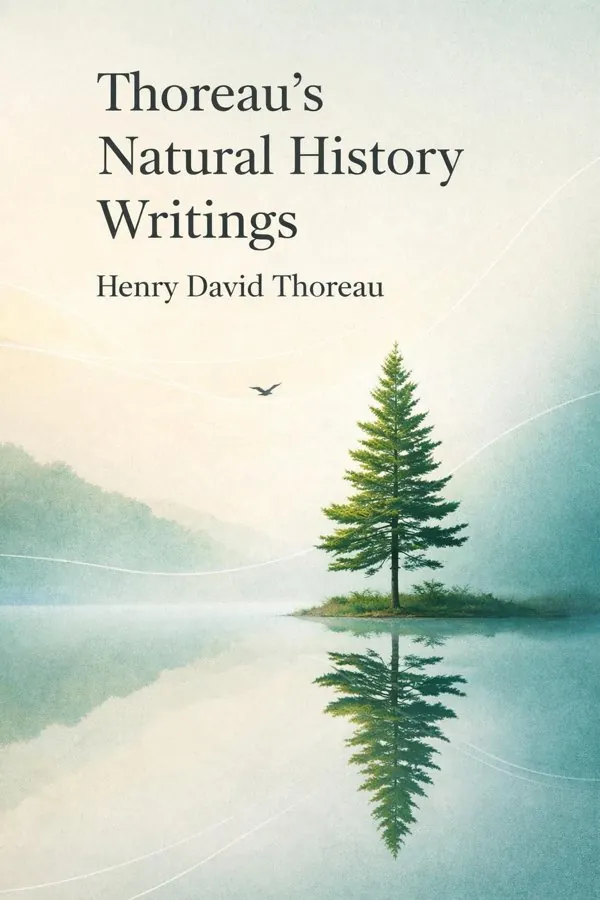
Thoreau’s Natural History Writings: Summary & Key Insights
 10 min9 chaptersAudio available
What Is Thoreau’s Natural History Writings About?
Thoreau’s Natural History Writings by Henry David Thoreau is a classics book spanning 9 pages. This collection gathers Henry David Thoreau’s writings on nature, including selections from his journals, essays, and books such as 'Walden' and 'The Maine Woods'. It reflects his deep observation of the natural world and his philosophical reflections on humanity’s relationship with nature.
This FizzRead summary covers all 9 key chapters of Thoreau’s Natural History Writings in approximately 10 minutes, distilling the most important ideas, arguments, and takeaways from Henry David Thoreau's work. Also available as an audio summary and Key Quotes Podcast.
Thoreau’s Natural History Writings
This collection gathers Henry David Thoreau’s writings on nature, including selections from his journals, essays, and books such as 'Walden' and 'The Maine Woods'. It reflects his deep observation of the natural world and his philosophical reflections on humanity’s relationship with nature.
Who Should Read Thoreau’s Natural History Writings?
This book is perfect for anyone interested in classics and looking to gain actionable insights in a short read. Whether you're a student, professional, or lifelong learner, the key ideas from Thoreau’s Natural History Writings by Henry David Thoreau will help you think differently.
- ✓Readers who enjoy classics and want practical takeaways
- ✓Professionals looking to apply new ideas to their work and life
- ✓Anyone who wants the core insights of Thoreau’s Natural History Writings in just 10 minutes
Want the full summary?
Get instant access to this book summary and 100K+ more with Fizz Moment.
Get Free SummaryAvailable on App Store • Free to download
Key Chapters
My natural philosophy begins not in abstraction but in attention. I have learned that every act of seeing is also an act of devotion. While philosophers build their systems in books, I built mine upon the soil of Concord, where every brook, pebble, and pine tree offered a lesson. Observation for me was the practice of awakening—an attempt to remove the film of habit that clouds most human eyes. I believed that to look carefully at the curve of a maple leaf or the flight of a hawk was to participate in a moment of divine communication.
I do not separate morality from natural history, nor science from poetry. The same sensitivity that makes a person capable of love can make them a capable naturalist. Through patient study, I learned that the natural order reveals laws more enduring than human governments. The growth of an acorn into an oak, the migration of geese, the swelling of buds beneath frost—all remind us of the intelligence woven into creation. My journals became both laboratory and prayer book, a record of what could be seen and what must be felt to be understood.
Close observation cultivates humility. It dispels the arrogant illusion that humanity stands apart from the rest of life. I have known people who speak of conquering nature, but when I lean down to study the veins of a leaf, I see that nature has already structured a wisdom that no army or technology can surpass. Knowledge begins when one is silent long enough to listen to what the earth is already saying.
When I withdrew to Walden Pond, I went not to escape society but to rediscover it in a purer form. I built my cabin with my own hands, cultivating beans and thoughts alike. Solitude was not loneliness but liberation. In the quiet hours, as mist rose from the pond, I felt a sense of companionship with the rhythm of nature itself. The distinction between my breath and the exhalation of the forest dissolved.
At Walden, simplicity unveiled abundance. In discarding excess, I gained clarity; in relinquishing hurry, I gained time. The pond became a mirror to the soul—its thawing in spring mirrored resurrection, its stillness reflected peace, and its freezing reminded me of the necessary inward silence of winter. Life simplifies itself in proportion to our willingness to notice. The cycles of nature became my teacher: to grow, to rest, to renew. I saw that civilization’s noise distracts the mind, while solitude restores it to harmony with the eternal pulse of the earth.
To live deliberately meant aligning daily life with these natural cycles. When dawn came, I rose not for duty but for participation. The sun rising over Walden was not an external phenomenon; it was the world’s consciousness awakening within me. The lessons of the pond have never faded: that solitude is fertile when it connects us to all life, and that simplicity is not deprivation but the discovery of what truly suffices.
+ 7 more chapters — available in the FizzRead app
All Chapters in Thoreau’s Natural History Writings
About the Author
Henry David Thoreau (1817–1862) was an American essayist, poet, and philosopher best known for his book 'Walden' and his essay 'Civil Disobedience'. A leading transcendentalist, Thoreau’s work explores natural history, simple living, and individual conscience.
Get This Summary in Your Preferred Format
Read or listen to the Thoreau’s Natural History Writings summary by Henry David Thoreau anytime, anywhere. FizzRead offers multiple formats so you can learn on your terms — all free.
Available formats: App · Audio · PDF · EPUB — All included free with FizzRead
Download Thoreau’s Natural History Writings PDF and EPUB Summary
Key Quotes from Thoreau’s Natural History Writings
“My natural philosophy begins not in abstraction but in attention.”
“When I withdrew to Walden Pond, I went not to escape society but to rediscover it in a purer form.”
Frequently Asked Questions about Thoreau’s Natural History Writings
Thoreau’s Natural History Writings by Henry David Thoreau is a classics book that explores key ideas across 9 chapters. This collection gathers Henry David Thoreau’s writings on nature, including selections from his journals, essays, and books such as 'Walden' and 'The Maine Woods'. It reflects his deep observation of the natural world and his philosophical reflections on humanity’s relationship with nature.
More by Henry David Thoreau
You Might Also Like



Browse by Category
Ready to read Thoreau’s Natural History Writings?
Get the full summary and 100K+ more books with Fizz Moment.