
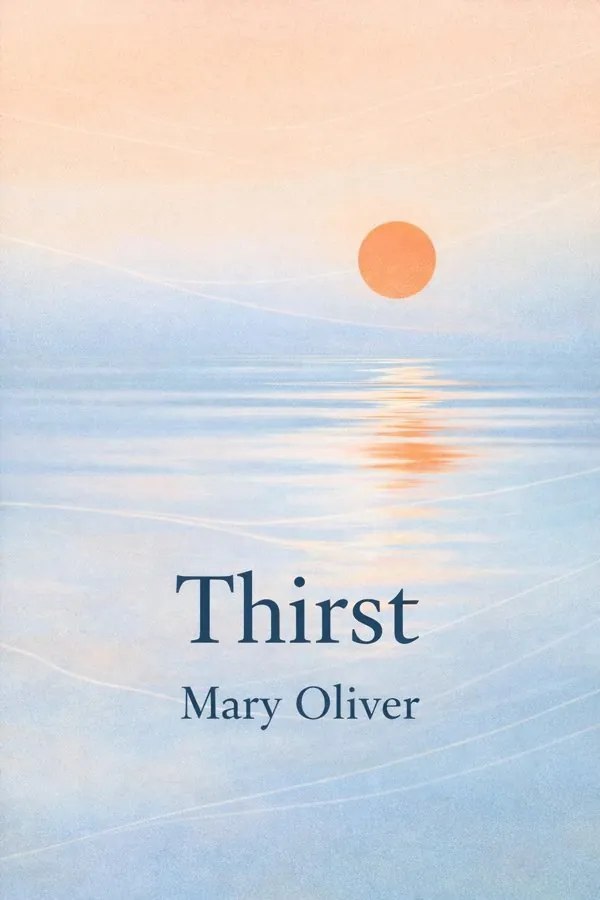
Thirst: Summary & Key Insights
by Mary Oliver
 10 min8 chaptersAudio available
Key Takeaways from Thirst
Loss does not always announce itself with spectacle; often, it changes everything while leaving the visible world untouched.
What if loneliness is not only deprivation, but also a doorway to a more attentive life?
The most honest spiritual language often emerges not from confidence, but from need.
The awareness of death can shrink life in fear, or enlarge it in seriousness.
Gratitude is most convincing when it appears alongside sorrow rather than instead of it.
What Is Thirst About?
Thirst by Mary Oliver is a classics book spanning 5 pages. Mary Oliver’s Thirst is a luminous collection of poems written in the aftermath of devastating personal loss. Published after the death of her longtime partner, photographer Molly Malone Cook, the book moves through grief, solitude, prayer, and wonder with the quiet intensity that defines Oliver’s work. Rather than offering abstract philosophy, Thirst traces the emotional and spiritual reality of mourning as it unfolds in ordinary days, natural landscapes, and inward questions that have no easy answers. The result is both intimate and universal: a record of sorrow, but also a testimony to endurance, attention, and praise. What makes Thirst matter is the way Oliver transforms private grief into a deeper meditation on how to live. Her poems do not deny pain, yet they also refuse despair as the final word. Through fields, rivers, birds, memory, and moments of prayerful openness, she discovers that loss can sharpen one’s awareness of beauty, mystery, and gratitude. Oliver writes with unusual authority not because she explains suffering away, but because she stays with it honestly. As a Pulitzer Prize-winning poet celebrated for her clear language and profound engagement with nature, she offers here one of her most vulnerable and spiritually searching books.
This FizzRead summary covers all 8 key chapters of Thirst in approximately 10 minutes, distilling the most important ideas, arguments, and takeaways from Mary Oliver's work. Also available as an audio summary and Key Quotes Podcast.
Thirst
Mary Oliver’s Thirst is a luminous collection of poems written in the aftermath of devastating personal loss. Published after the death of her longtime partner, photographer Molly Malone Cook, the book moves through grief, solitude, prayer, and wonder with the quiet intensity that defines Oliver’s work. Rather than offering abstract philosophy, Thirst traces the emotional and spiritual reality of mourning as it unfolds in ordinary days, natural landscapes, and inward questions that have no easy answers. The result is both intimate and universal: a record of sorrow, but also a testimony to endurance, attention, and praise.
What makes Thirst matter is the way Oliver transforms private grief into a deeper meditation on how to live. Her poems do not deny pain, yet they also refuse despair as the final word. Through fields, rivers, birds, memory, and moments of prayerful openness, she discovers that loss can sharpen one’s awareness of beauty, mystery, and gratitude. Oliver writes with unusual authority not because she explains suffering away, but because she stays with it honestly. As a Pulitzer Prize-winning poet celebrated for her clear language and profound engagement with nature, she offers here one of her most vulnerable and spiritually searching books.
Who Should Read Thirst?
This book is perfect for anyone interested in classics and looking to gain actionable insights in a short read. Whether you're a student, professional, or lifelong learner, the key ideas from Thirst by Mary Oliver will help you think differently.
- ✓Readers who enjoy classics and want practical takeaways
- ✓Professionals looking to apply new ideas to their work and life
- ✓Anyone who wants the core insights of Thirst in just 10 minutes
Want the full summary?
Get instant access to this book summary and 100K+ more with Fizz Moment.
Get Free SummaryAvailable on App Store • Free to download
Key Chapters
Loss does not always announce itself with spectacle; often, it changes everything while leaving the visible world untouched. One of the deepest truths in Thirst is that grief alters perception before it alters circumstance. The trees still stand, the rivers still move, and the morning still arrives, yet the mourner inhabits a different reality. Oliver captures this strange condition with extraordinary precision. After the death of her beloved partner, the silence she encounters is not merely external. It is a silence that enters the self, unsettling habits of thought, memory, and identity.
In these opening movements of the collection, grief is not treated as a problem to solve. It is a terrain to cross. Oliver resists sentimental consolation and instead honors the confusion, numbness, and ache that follow bereavement. This honesty matters because many people expect grief to progress neatly or to soften quickly. Thirst suggests the opposite: mourning is irregular, full of pauses, returns, and unanswerable moments.
The poems also show that naming sorrow is itself a meaningful act. By putting absence into language, Oliver creates a form sturdy enough to hold pain without reducing it. Readers can apply this insight in practical ways: journaling after a loss, walking familiar places and noticing what feels changed, or allowing memory to surface without forcing closure. The lesson is not to escape grief but to witness it carefully.
Actionable takeaway: When life is altered by loss, stop asking when you will feel normal again and begin observing how grief is reshaping your inner world, one honest moment at a time.
What if loneliness is not only deprivation, but also a doorway to a more attentive life? In Thirst, Oliver turns solitude into a serious spiritual and emotional practice. After loss, she finds herself alone in ways that are painful and unfamiliar. Yet as she spends time in woods, fields, and near water, that solitude begins to shift. Nature is no longer simply scenery for human feeling. It becomes a presence that steadies, instructs, and accompanies.
Oliver’s poems suggest that wilderness consoles not by erasing sorrow, but by placing it within a larger order. The natural world continues its patterns: birds feed, rivers travel, grass grows, light changes. This continuity does not diminish grief, but it can soften the isolating illusion that one’s suffering exists outside the fabric of life. Solitude, then, becomes less a sentence and more a condition in which perception deepens.
This idea has practical force. Many people respond to pain by filling every empty hour with noise, tasks, or social distraction. Oliver proposes another possibility: make room for quiet encounters with the nonhuman world. A solitary walk, ten minutes of sitting under a tree, or regular attention to seasonal change can become forms of restoration. These practices work not because they provide easy comfort, but because they return us to what is enduring and real.
Oliver also reminds us that solitude need not mean emotional withdrawal. It can be a place where grief ripens into awareness, and awareness into companionship with the living world.
Actionable takeaway: Set aside regular, undistracted time in nature and let solitude become observation rather than abandonment.
The most honest spiritual language often emerges not from confidence, but from need. A central thread in Thirst is Oliver’s engagement with faith, doubt, and prayer. She does not write as a doctrinal teacher or as someone interested in theological system-building. Instead, she writes from the fragile border where longing meets uncertainty. Her poems ask questions of God, address mystery directly, and hold reverence and skepticism in the same breath.
This is one of the collection’s great strengths. Oliver refuses to pretend that suffering automatically produces clarity. Grief can make prayer feel urgent, awkward, angry, or bare. In Thirst, prayer is less about polished belief than about turning toward what one cannot fully understand. Sometimes that turn is expressed through praise; sometimes through bewilderment; sometimes through a simple willingness to remain open.
For modern readers, especially those who feel alienated from formal religion, this approach can be deeply freeing. Oliver shows that spiritual life does not require certainty before it begins. A person can pray through questions, silence, and even resistance. In practical terms, this might mean keeping a notebook of spiritual questions, reading a poem aloud as a form of devotion, or beginning a daily ritual of gratitude without needing to define every metaphysical conviction behind it.
Her work makes room for a faith that is lived rather than declared. It is faith as attentiveness, receptivity, and humility before existence.
Actionable takeaway: If certainty feels out of reach, let your spiritual practice begin with honest questions and a few quiet minutes of daily openness.
The awareness of death can shrink life in fear, or enlarge it in seriousness. In Thirst, Oliver chooses the second path. Mortality is present throughout the collection, not only because of personal bereavement, but because death is understood as part of the broader rhythm of existence. Animals die, seasons pass, bodies age, and beloved lives end. Yet Oliver does not approach this reality with cold detachment. She looks at it directly and asks what kind of life such knowledge should inspire.
Her answer is subtle but powerful: because life is finite, attention becomes sacred. To notice the shape of a bird in flight, the movement of water, the persistence of memory, or the gift of another day is not trivial. It is a form of honoring what cannot last forever. Mortality gives urgency to wonder.
This perspective has practical relevance beyond poetry. Many people avoid thinking about death until crisis forces the issue. Oliver suggests that a wiser approach is to let mortality clarify priorities now. Which relationships deserve more presence? What beauty have you become too hurried to notice? What work or conversation have you postponed as if time were guaranteed? By holding death in awareness without obsession, we may become less distracted and more grateful.
Thirst does not romanticize death. It acknowledges pain and irrevocability. But it also insists that transience is part of what makes life precious rather than meaningless.
Actionable takeaway: Use the fact of mortality to revise one daily habit, one neglected relationship, or one postponed act of appreciation while time is still yours.
Gratitude is most convincing when it appears alongside sorrow rather than instead of it. One of the most moving developments in Thirst is Oliver’s gradual turn toward thankfulness. This is not forced positivity, and it is not denial. The poems do not claim that loss is somehow good. Instead, they reveal that gratitude can coexist with heartbreak, memory, and emptiness. In fact, the very intensity of grief often reflects the depth of what was once given.
Oliver’s gratitude is rooted in attention. She remembers love, notices beauty, and continues to receive the world even while mourning. A patch of sunlight, a birdcall, a remembered gesture, or the sheer continuation of morning becomes worthy of praise. This spiritual posture allows her to move toward renewal without betraying the dead or erasing the wound.
For readers, this is a practical and humane model. In difficult periods, gratitude exercises can feel superficial if they are detached from reality. Oliver offers a more mature alternative: do not search for silver linings; search for what remains worthy of reverence. This might mean writing down one remembered kindness from someone you miss, acknowledging the body’s ability to keep going, or noticing one beautiful detail during a hard day. Such practices do not eliminate pain, but they widen the emotional field so pain is not the only thing present.
In Thirst, gratitude becomes a form of spiritual resilience. It is how the soul stays permeable to life after being broken open.
Actionable takeaway: Each day, name one specific thing you still love or receive, especially when sorrow makes that effort feel difficult.
Sometimes the world speaks most clearly when it says nothing in human words. Throughout Thirst, Oliver reads nature not as decoration, but as a living text full of pattern, presence, and instruction. Birds, grass, rivers, light, weather, and animals are not symbols imposed from outside; they are encountered as realities that carry their own intelligence. By paying attention to them, Oliver discovers forms of meaning that bypass argument and enter the body directly.
This is one reason her poetry feels spiritually charged even when it remains grounded in concrete detail. A bird lifting into the air is never only a bird, yet it is always fully itself. Oliver does not exploit nature for metaphor so much as allow it to reveal kinship, impermanence, and beauty. The world becomes legible to the attentive mind.
In practical life, this way of seeing can counter the flattening effects of speed and digital overstimulation. When people move too quickly, everything becomes functional: trees are landscaping, weather is inconvenience, and animals are background. Oliver invites a return to patient observation. Watch one place over time. Learn the names of local birds. Notice how afternoon light changes in a certain season. Such practices cultivate humility and awaken a richer sense of belonging.
Nature may not answer every personal question, but it can reframe them. It reminds us that life is relational, cyclical, and larger than our private drama.
Actionable takeaway: Choose one recurring element of the natural world near you and observe it consistently for two weeks, treating it as a source of attention rather than scenery.
The dead leave, but love does not vanish with them. In Thirst, memory is not presented as a weak substitute for physical presence. It is an active force that keeps relationship alive in altered form. Oliver writes from the aftermath of a profound shared life, and her poems show how the beloved remains woven into perception, thought, and feeling. Memory is painful because it testifies to absence, yet it is also sustaining because it keeps affection from becoming unreal.
This distinction matters. Many people fear that moving forward after a loss means abandoning the one who died. Oliver proposes another path: continue living with the beloved as part of your inner life. Memory can be a form of fidelity rather than a failure to let go. A place once shared, a phrase once spoken, or a habit learned from the loved one can continue to shape daily life.
Practically, this insight can help mourners create healthier bonds with memory. Instead of suppressing reminders, one might create rituals of remembrance: revisiting a meaningful place, cooking a shared meal, keeping a small object visible, or speaking the person’s name. These acts can transform memory from random ambush into chosen presence.
Oliver’s poems suggest that love is not annulled by death. Its expression changes, but its reality persists. The mourner learns to carry relationship differently, not to erase it.
Actionable takeaway: Create one intentional ritual that keeps a loved one’s memory integrated into your life in a way that feels honest, gentle, and sustaining.
Depth does not require obscurity. One of Mary Oliver’s enduring achievements, and a key lesson of Thirst, is her ability to speak about grief, God, and wonder in language that feels clear, direct, and unforced. She does not rely on intellectual complexity to create seriousness. Instead, she trusts precise observation, emotional honesty, and clean phrasing. This stylistic choice is not merely aesthetic; it reflects a philosophy. The sacred, Oliver suggests, is available in ordinary speech because it is present in ordinary life.
This accessibility is especially important in a book dealing with pain and spirituality. Dense abstraction can distance readers from their own experience. Oliver’s plainspoken voice invites participation. Readers do not feel lectured or excluded; they feel addressed. The poem becomes less a performance and more a meeting place between writer and reader.
There is practical value here for anyone trying to process difficult emotions. People often think they need the perfect vocabulary to speak about grief, faith, or longing. Oliver demonstrates that sincerity matters more than rhetorical display. A simple sentence in a journal, a direct conversation with a friend, or a quiet spoken prayer can carry genuine depth. Clarity can itself be an act of courage.
Her example also challenges the assumption that seriousness must be solemn or inaccessible. In Oliver’s hands, clear language becomes a vessel for awe.
Actionable takeaway: When writing or speaking about something deeply important, choose the truest simple words you can find instead of hiding behind complexity.
All Chapters in Thirst
About the Author
Mary Oliver was an American poet celebrated for her luminous, accessible language and her deep attentiveness to the natural world. Born in 1935 in Maple Heights, Ohio, she became one of the most beloved poetic voices of her generation, known for writing about birds, rivers, trees, solitude, mortality, and the sacred dimensions of ordinary life. Her work earned major literary honors, including the Pulitzer Prize and the National Book Award. Oliver spent much of her life observing nature closely and transforming those observations into poems of clarity, wonder, and spiritual reflection. She was also profoundly shaped by her long partnership with photographer Molly Malone Cook. In collections such as Thirst, Oliver brought together personal grief, contemplative faith, and gratitude, confirming her reputation as a poet who could make profound truths feel intimate and alive.
Get This Summary in Your Preferred Format
Read or listen to the Thirst summary by Mary Oliver anytime, anywhere. FizzRead offers multiple formats so you can learn on your terms — all free.
Available formats: App · Audio · PDF · EPUB — All included free with FizzRead
Download Thirst PDF and EPUB Summary
Key Quotes from Thirst
“Loss does not always announce itself with spectacle; often, it changes everything while leaving the visible world untouched.”
“What if loneliness is not only deprivation, but also a doorway to a more attentive life?”
“The most honest spiritual language often emerges not from confidence, but from need.”
“The awareness of death can shrink life in fear, or enlarge it in seriousness.”
“Gratitude is most convincing when it appears alongside sorrow rather than instead of it.”
Frequently Asked Questions about Thirst
Thirst by Mary Oliver is a classics book that explores key ideas across 8 chapters. Mary Oliver’s Thirst is a luminous collection of poems written in the aftermath of devastating personal loss. Published after the death of her longtime partner, photographer Molly Malone Cook, the book moves through grief, solitude, prayer, and wonder with the quiet intensity that defines Oliver’s work. Rather than offering abstract philosophy, Thirst traces the emotional and spiritual reality of mourning as it unfolds in ordinary days, natural landscapes, and inward questions that have no easy answers. The result is both intimate and universal: a record of sorrow, but also a testimony to endurance, attention, and praise. What makes Thirst matter is the way Oliver transforms private grief into a deeper meditation on how to live. Her poems do not deny pain, yet they also refuse despair as the final word. Through fields, rivers, birds, memory, and moments of prayerful openness, she discovers that loss can sharpen one’s awareness of beauty, mystery, and gratitude. Oliver writes with unusual authority not because she explains suffering away, but because she stays with it honestly. As a Pulitzer Prize-winning poet celebrated for her clear language and profound engagement with nature, she offers here one of her most vulnerable and spiritually searching books.
You Might Also Like



Browse by Category
Ready to read Thirst?
Get the full summary and 100K+ more books with Fizz Moment.