
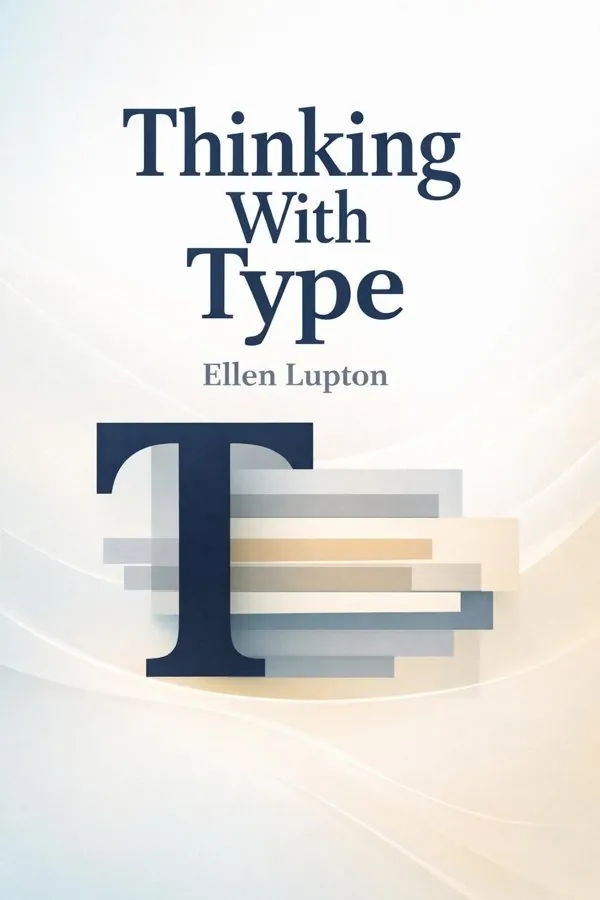
Thinking With Type: A Critical Guide for Designers, Writers, Editors, & Students: Summary & Key Insights
by Ellen Lupton
 10 min8 chaptersAudio available
What Is Thinking With Type: A Critical Guide for Designers, Writers, Editors, & Students About?
Thinking With Type: A Critical Guide for Designers, Writers, Editors, & Students by Ellen Lupton is a design book spanning 8 pages. Thinking With Type is a foundational guide to typography, exploring how letters, words, and text function visually and conceptually in design. Ellen Lupton introduces the principles of typographic design, covering typefaces, grids, hierarchy, and composition, while illustrating how typography shapes communication in print and digital media.
This FizzRead summary covers all 8 key chapters of Thinking With Type: A Critical Guide for Designers, Writers, Editors, & Students in approximately 10 minutes, distilling the most important ideas, arguments, and takeaways from Ellen Lupton's work. Also available as an audio summary and Key Quotes Podcast.
Thinking With Type: A Critical Guide for Designers, Writers, Editors, & Students
Thinking With Type is a foundational guide to typography, exploring how letters, words, and text function visually and conceptually in design. Ellen Lupton introduces the principles of typographic design, covering typefaces, grids, hierarchy, and composition, while illustrating how typography shapes communication in print and digital media.
Who Should Read Thinking With Type: A Critical Guide for Designers, Writers, Editors, & Students?
This book is perfect for anyone interested in design and looking to gain actionable insights in a short read. Whether you're a student, professional, or lifelong learner, the key ideas from Thinking With Type: A Critical Guide for Designers, Writers, Editors, & Students by Ellen Lupton will help you think differently.
- ✓Readers who enjoy design and want practical takeaways
- ✓Professionals looking to apply new ideas to their work and life
- ✓Anyone who wants the core insights of Thinking With Type: A Critical Guide for Designers, Writers, Editors, & Students in just 10 minutes
Want the full summary?
Get instant access to this book summary and 100K+ more with Fizz Moment.
Get Free SummaryAvailable on App Store • Free to download
Key Chapters
A letter is a piece of architecture—a small structure devised for repetition, variation, and connection. In *Thinking With Type*, I begin by focusing on the anatomy of letters because understanding their design is fundamental to everything that follows. Typefaces are not just random stylistic inventions; they are deeply rooted in the history of writing systems and in the hands of past scribes and printers.
Each letterform carries a particular balance between thick and thin strokes, curves and corners, serifs and open terminals. The anatomy of a letter—its cap height, x-height, baseline, ascender, and descender—creates a rhythm when we see letters in sequence. This rhythm defines the tone of a page. The proportions of letters in a typeface express its personality: the tight geometry of Helvetica conveys modern precision, while the flowing serifs of Garamond evoke a Renaissance grace.
To think typographically is to see letters not only as carriers of linguistic meaning but also as visual elements. Every curve is deliberate; every contrast between line thickness and white space shapes perception. Designers must learn to read letters in this visual sense—to study their internal relations, to recognize the craftsmanship that makes them both functional and expressive.
When I design or select a typeface, I ask how the letters will behave under different conditions: in large display, in continuous reading, on screen or on paper. Each medium reshapes how letters appear and perform. Good designers are sensitive to these nuances, adapting letterforms to preserve clarity while maintaining character.
Typography carries history within its forms. In this part of the book, I explore how typefaces evolved—how centuries of design gave rise to categories like serif, sans serif, script, and display. Understanding classification is not about memorizing rules; it’s about recognizing the relationship between style and message.
Serif typefaces, with their small finishing strokes, grew from the chisel marks inscribed on stone and the humanist handwriting of early printers. They tend to feel authoritative and literary, well suited for books and extended reading. Sans serifs, in contrast, emerged with modernity—clean, efficient, without ornament, embodying the industrial age’s desire for clarity and progress. Scripts channel the intimacy of handwriting, while display faces are designed to shout a message, to capture attention rather than sustain reading.
Each class has its expressive potential. Choosing type is never neutral; every choice situates text within cultural and historical context. In teaching typography, I remind students that they are not just selecting fonts—they are selecting voices. A classical serif whispers tradition, while a geometric sans serif speaks precision and neutrality. These associations are not fixed, but they help designers align typographic form with the tone of communication.
Classification also reminds us that typography evolves. New digital faces reinterpret historical models for contemporary screens, merging old aesthetics with new functionality. To think critically with type is to perceive continuity within change—to see every typeface both as a product of its time and as part of an ongoing conversation about design and meaning.
+ 6 more chapters — available in the FizzRead app
All Chapters in Thinking With Type: A Critical Guide for Designers, Writers, Editors, & Students
About the Author
Ellen Lupton is an American designer, writer, curator, and educator known for her influential work in graphic design and typography. She serves as Senior Curator of Contemporary Design at Cooper Hewitt, Smithsonian Design Museum, and teaches at the Maryland Institute College of Art (MICA).
Get This Summary in Your Preferred Format
Read or listen to the Thinking With Type: A Critical Guide for Designers, Writers, Editors, & Students summary by Ellen Lupton anytime, anywhere. FizzRead offers multiple formats so you can learn on your terms — all free.
Available formats: App · Audio · PDF · EPUB — All included free with FizzRead
Download Thinking With Type: A Critical Guide for Designers, Writers, Editors, & Students PDF and EPUB Summary
Key Quotes from Thinking With Type: A Critical Guide for Designers, Writers, Editors, & Students
“A letter is a piece of architecture—a small structure devised for repetition, variation, and connection.”
“Typography carries history within its forms.”
Frequently Asked Questions about Thinking With Type: A Critical Guide for Designers, Writers, Editors, & Students
Thinking With Type: A Critical Guide for Designers, Writers, Editors, & Students by Ellen Lupton is a design book that explores key ideas across 8 chapters. Thinking With Type is a foundational guide to typography, exploring how letters, words, and text function visually and conceptually in design. Ellen Lupton introduces the principles of typographic design, covering typefaces, grids, hierarchy, and composition, while illustrating how typography shapes communication in print and digital media.
More by Ellen Lupton
You Might Also Like
The Design of Everyday Things
Don Norman
10 min
The Better Angels of Our Nature
Steven Pinker
10 min
A Designer's Art
Paul Rand
10 min
Architects' Sketchbooks
Various Editors
10 min
Architectural Graphic Standards
The American Institute of Architects
10 min
Design Is Storytelling
Ellen Lupton
10 minBrowse by Category
Ready to read Thinking With Type: A Critical Guide for Designers, Writers, Editors, & Students?
Get the full summary and 100K+ more books with Fizz Moment.