
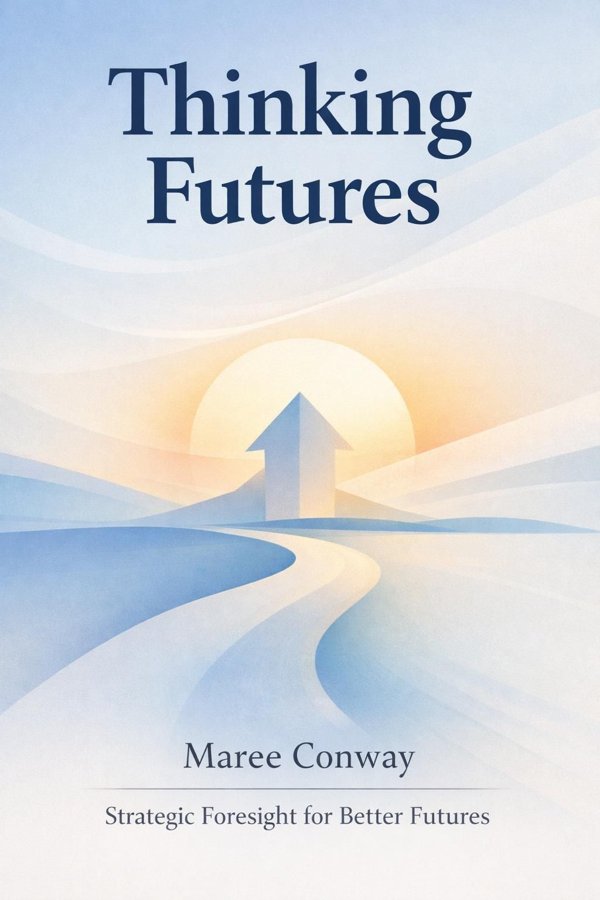
Thinking Futures: Strategic Foresight for Better Futures: Summary & Key Insights
by Maree Conway
 10 min9 chaptersAudio available
Key Takeaways from Thinking Futures: Strategic Foresight for Better Futures
The future usually surprises organizations not because change was invisible, but because leaders were not looking with the right mindset.
One of the most important distinctions in the book is that forecasting and foresight are not interchangeable.
Big shifts rarely come from one cause alone.
The future often arrives quietly before it becomes impossible to ignore.
Organizations become fragile when they plan for only one future.
What Is Thinking Futures: Strategic Foresight for Better Futures About?
Thinking Futures: Strategic Foresight for Better Futures by Maree Conway is a strategy book spanning 9 pages. Thinking Futures: Strategic Foresight for Better Futures is a practical and thought-provoking guide to one of the most important leadership capabilities of our time: learning to think beyond the immediate horizon. In this book, Australian futurist Maree Conway shows that foresight is not about predicting a single correct future. It is about building the discipline to notice change early, understand uncertainty more intelligently, and make wiser choices in the present. Rather than treating the future as something that simply happens, Conway invites readers to see it as something that can be explored, debated, and influenced. What makes the book especially valuable is its balance of mindset and method. Conway explains how organizations can move from reactive planning to long-term strategic thinking through environmental scanning, systems thinking, scenario development, and reflective practice. Drawing on her work in futures education, consulting, and public-sector strategy, she offers a grounded approach that is both accessible to newcomers and useful for experienced leaders. For anyone trying to lead through complexity, disruption, or social change, this book offers a clear framework for thinking more expansively and acting more deliberately.
This FizzRead summary covers all 9 key chapters of Thinking Futures: Strategic Foresight for Better Futures in approximately 10 minutes, distilling the most important ideas, arguments, and takeaways from Maree Conway's work. Also available as an audio summary and Key Quotes Podcast.
Thinking Futures: Strategic Foresight for Better Futures
Thinking Futures: Strategic Foresight for Better Futures is a practical and thought-provoking guide to one of the most important leadership capabilities of our time: learning to think beyond the immediate horizon. In this book, Australian futurist Maree Conway shows that foresight is not about predicting a single correct future. It is about building the discipline to notice change early, understand uncertainty more intelligently, and make wiser choices in the present. Rather than treating the future as something that simply happens, Conway invites readers to see it as something that can be explored, debated, and influenced.
What makes the book especially valuable is its balance of mindset and method. Conway explains how organizations can move from reactive planning to long-term strategic thinking through environmental scanning, systems thinking, scenario development, and reflective practice. Drawing on her work in futures education, consulting, and public-sector strategy, she offers a grounded approach that is both accessible to newcomers and useful for experienced leaders. For anyone trying to lead through complexity, disruption, or social change, this book offers a clear framework for thinking more expansively and acting more deliberately.
Who Should Read Thinking Futures: Strategic Foresight for Better Futures?
This book is perfect for anyone interested in strategy and looking to gain actionable insights in a short read. Whether you're a student, professional, or lifelong learner, the key ideas from Thinking Futures: Strategic Foresight for Better Futures by Maree Conway will help you think differently.
- ✓Readers who enjoy strategy and want practical takeaways
- ✓Professionals looking to apply new ideas to their work and life
- ✓Anyone who wants the core insights of Thinking Futures: Strategic Foresight for Better Futures in just 10 minutes
Want the full summary?
Get instant access to this book summary and 100K+ more with Fizz Moment.
Get Free SummaryAvailable on App Store • Free to download
Key Chapters
The future usually surprises organizations not because change was invisible, but because leaders were not looking with the right mindset. Maree Conway argues that strategic foresight starts long before any formal tool or workshop. It begins with a deliberate shift in how we think about time, change, and responsibility. Most organizations are conditioned to focus on short-term targets, immediate risks, and operational efficiency. That habit creates a narrow field of vision. Thinking futures means stepping back from urgency and learning to ask what longer-term developments may be emerging beneath the surface.
Conway emphasizes that a foresight mindset is exploratory rather than predictive. Instead of asking, "What will happen?" the better question is, "What might happen, and what would that mean for us?" This subtle change opens up a wider space for curiosity, imagination, and preparedness. It encourages people to challenge assumptions, revisit inherited beliefs, and become more comfortable with ambiguity.
In practice, this might look like a school system questioning whether current teaching models still fit a world of AI and lifelong learning, or a local government considering how climate migration could reshape housing and infrastructure needs over the next two decades. The mindset matters because without it, even the best foresight methods become mechanical exercises.
Conway's deeper point is that foresight is not a specialist activity reserved for futurists. It is a capability that can be cultivated across teams and institutions. When leaders normalize questions about long-term change, they create a culture that is less reactive and more resilient.
Actionable takeaway: Start every strategic discussion by adding one futures question: "What assumptions are we making about the future, and what if they are wrong?"
One of the most important distinctions in the book is that forecasting and foresight are not interchangeable. Forecasting extends known patterns forward. Foresight explores uncertainty, disruption, and alternative possibilities. Conway does not dismiss forecasting; data trends, projections, and models all have value. But she warns that relying on them alone can create false confidence, especially in fast-changing environments where past patterns no longer hold.
Forecasting works best when systems are relatively stable and variables are known. For example, a retailer may forecast seasonal demand using historical sales data. But when consumer expectations shift rapidly, supply chains fragment, or a new technology reshapes purchasing behavior, straight-line projections become less useful. Foresight addresses this gap by considering multiple plausible futures rather than a single expected one.
Conway encourages readers to move from certainty-seeking to possibility-mapping. This means identifying signals of change, examining critical uncertainties, and asking how different combinations of forces might produce very different outcomes. A university, for instance, might build scenarios around demographic shifts, digital credentials, public trust, and funding volatility instead of assuming that current enrollment models will continue.
The practical value is strategic flexibility. When organizations consider several plausible futures, they are less likely to be blindsided and more likely to spot robust actions that make sense across multiple conditions. Foresight does not eliminate uncertainty. It improves an organization's capacity to navigate it intelligently.
Actionable takeaway: Pair every forecast in your planning process with at least two alternative futures that challenge the core assumptions behind that forecast.
Big shifts rarely come from one cause alone. They emerge from interconnected forces that reinforce, constrain, or destabilize one another. Conway highlights systems thinking as essential to strategic foresight because organizations often misread change when they isolate issues instead of seeing relationships. A trend is never just a trend. It sits inside a larger web of technology, policy, culture, economics, environment, and human behavior.
Systems thinking helps readers move beyond simple cause-and-effect reasoning. Instead of asking only what is changing, Conway asks us to explore how different drivers interact and what unintended consequences may follow. For example, the rise of remote work is not only a workplace trend. It affects transport systems, commercial real estate, regional migration, digital infrastructure, social cohesion, and mental health. Looking at one piece in isolation leads to shallow strategy.
This perspective is especially useful in public policy, education, healthcare, and sustainability, where actions in one area often create ripple effects elsewhere. A health department introducing digital health services may improve access for some groups while deepening exclusion for those with low digital literacy. A company accelerating automation may raise efficiency while undermining workforce trust and community employment.
Conway's message is that foresight requires pattern recognition at a systemic level. By mapping feedback loops, dependencies, stakeholders, and second-order effects, leaders can make more informed decisions and avoid solving one problem by creating another. Systems thinking also expands empathy because it reveals who is affected, who benefits, and who may be left behind.
Actionable takeaway: When evaluating a strategic issue, map at least five connected domains it touches and ask what second-order consequences could emerge in each.
The future often arrives quietly before it becomes impossible to ignore. Conway treats environmental scanning as one of the foundational practices of foresight because change usually appears first as scattered signals, anomalies, and emerging patterns. These early indicators may look insignificant on their own, but together they can point to deeper transformation.
Environmental scanning is the disciplined habit of observing developments across social, technological, economic, environmental, political, and cultural domains. Conway encourages readers to scan broadly rather than only within their sector. Many organizations miss disruption because they watch competitors closely but ignore adjacent fields where major changes are taking shape. A bank that monitors financial regulation but ignores shifts in digital identity, trust in institutions, or generational attitudes to ownership may be caught off guard.
The value of scanning is not just collecting information. It is interpreting what signals might mean. For instance, rising interest in four-day workweeks, AI copilots, and skills-based hiring may collectively indicate a deeper redefinition of work rather than isolated HR experiments. Similarly, changes in climate policy, insurance pricing, and population movement may signal a structural shift in where communities can thrive.
Conway also implies that scanning should be social, not solitary. Teams with diverse backgrounds often notice different signals and interpret them differently, which leads to richer insight. Organizations can create regular scanning forums, shared repositories, or quarterly futures reviews to turn scattered observations into strategic conversation.
Actionable takeaway: Build a simple monthly scanning practice by collecting ten signals from outside your immediate industry and discussing what larger patterns they may represent.
Organizations become fragile when they plan for only one future. Conway presents scenario planning as a powerful way to stretch strategic imagination and prepare for uncertainty. Scenarios are not predictions or preferred outcomes. They are structured stories about different plausible futures that help decision-makers test assumptions, explore risks, and identify opportunities.
The strength of scenarios lies in their ability to make uncertainty concrete. Abstract concerns such as political instability, technological disruption, social fragmentation, or climate stress become easier to discuss when translated into vivid, coherent narratives. A public agency, for example, may create scenarios in which civic trust improves, erodes, polarizes, or decentralizes. Each future would demand different policy responses, partnerships, and communication strategies.
Conway's approach encourages readers to use scenarios not as one-off exercises but as strategic tools. Leaders can test current plans against different futures and ask which actions are robust across all of them. They can also identify early warning signals that suggest one scenario may be becoming more likely. This turns scenario work into an ongoing capability rather than a workshop output.
Scenarios are especially helpful when an organization faces multiple interacting uncertainties. A manufacturer may need to think about trade policy, supply chain resilience, decarbonization pressure, labor shortages, and AI-enabled production all at once. The scenario process creates space to explore combinations of these forces without pretending certainty exists.
Actionable takeaway: Develop three to four plausible future scenarios around your biggest strategic uncertainty, then test whether your current strategy would still work in each one.
Foresight has little value if it remains an interesting conversation disconnected from budgets, priorities, and action. Conway insists that strategic foresight should be integrated into decision-making, not parked on the sidelines as a separate innovation activity. The real test of foresight is whether it changes what an organization notices, funds, measures, and prepares for.
This integration can happen in several ways. Foresight can inform strategic planning cycles, risk management, policy design, investment choices, capability building, and governance reviews. For example, if a nonprofit identifies demographic aging and digital exclusion as long-term issues, that insight should shape service design, staffing, partnerships, and advocacy. If a business sees clear signals that regulation around sustainability reporting will tighten, it should begin developing systems and competencies before compliance becomes urgent.
Conway also highlights that integrating foresight requires reframing strategy itself. Traditional strategy often assumes a relatively stable environment and seeks competitive position within it. Foresight-informed strategy accepts fluid conditions and focuses on resilience, adaptability, and intentional shaping of preferred outcomes. That means strategy becomes less about defending a static plan and more about continuously adjusting direction while keeping purpose clear.
To make this practical, organizations need processes that connect futures insights to executive decision forums. Otherwise foresight remains intellectually interesting but institutionally weak. Leaders should ask what implications emerging changes have for today's resource allocation and which no-regret moves deserve action now.
Actionable takeaway: After any foresight exercise, identify three decisions that should change in the next six months and assign clear owners for acting on them.
Many organizations adopt foresight tools without changing the culture that makes short-term thinking dominant. Conway argues that the human and cultural dimensions of foresight are often underestimated. Methods matter, but people interpret evidence through habits, power structures, incentives, and emotional comfort zones. If a culture punishes questioning, rewards certainty, or treats ambiguity as weakness, foresight will struggle to take root.
A futures-oriented culture values curiosity, reflection, dialogue, and constructive challenge. It makes room for dissenting views and unusual questions. Instead of asking teams to defend current assumptions, it invites them to surface hidden assumptions and test them. This is especially important in leadership environments where success in the present can create blindness about the future. Organizations that have been rewarded for doing things one way often become least willing to imagine that the context is shifting.
Conway's emphasis on culture also recognizes that foresight is emotional work. Exploring uncertain futures can trigger anxiety, defensiveness, or skepticism. People may resist because scenarios feel threatening or because long-term thinking seems disconnected from daily pressures. Good foresight practice therefore requires facilitation, trust, and inclusive conversation, not just technical analysis.
Examples include creating cross-functional futures discussions, rotating staff into scanning roles, rewarding learning rather than certainty, and encouraging leaders to model openness about not having all the answers. Over time, these behaviors build a culture where anticipation becomes normal instead of exceptional.
Actionable takeaway: Assess your team culture by asking whether people feel safe raising uncomfortable future possibilities, then change one meeting norm to encourage deeper questioning.
Foresight becomes meaningful when it is built into organizational capability rather than depending on one enthusiastic champion. Conway emphasizes that futures thinking is a skill set that can be taught, practiced, and embedded. Without this investment, organizations may run an inspiring scenario exercise and then quickly revert to business as usual.
Building foresight capacity involves more than training people in tools. It means developing routines, roles, language, and leadership support that keep long-term thinking alive. Staff need opportunities to practice scanning, analysis, and sense-making. Leaders need to understand how to use futures insights in planning and governance. Teams need shared frameworks so that conversations about uncertainty become more rigorous and less vague.
A university might establish a futures working group, integrate scanning into annual planning, and train department heads in scenario thinking. A city government could create horizon scanning dashboards, community consultation on emerging issues, and cross-agency workshops on long-term resilience. In both cases, the goal is to normalize foresight as part of how the institution learns.
Conway also suggests that capacity building supports strategic independence. Organizations with internal foresight capability are less dependent on external experts and better able to continuously interpret change in their own context. This matters because futures work is not a one-time answer but an ongoing practice of noticing, interpreting, experimenting, and adapting.
Actionable takeaway: Choose one recurring organizational process, such as quarterly planning or risk review, and embed a simple foresight step so the capability develops through repetition.
Not all futures are equally desirable, and not all strategic choices are ethically neutral. Conway makes an important move beyond adaptation by arguing that foresight should help organizations shape preferred futures, not merely survive whatever comes. This introduces questions of values, responsibility, inclusion, and leadership. If the future is partly shaped by today's decisions, then strategy is also a moral act.
This perspective matters because many technological or economic changes are discussed as if they are inevitable. Conway challenges that fatalism. She invites leaders to ask who benefits from a future, who bears the cost, and whose voices are missing when choices are made. A company adopting automation, for example, should not only ask how much efficiency it gains, but also what kind of employment future it is helping create. A government planning smart-city systems should ask how surveillance, access, privacy, and democratic accountability will be handled.
Ethical foresight widens the frame from competitiveness to stewardship. It encourages organizations to articulate the future they want to contribute to and to align strategy with that aspiration. This does not mean becoming idealistic at the expense of realism. It means recognizing that every plan embeds assumptions about people, power, and possibility.
Leadership, in Conway's view, is therefore not about controlling the future but about convening meaningful dialogue, making responsible choices under uncertainty, and sustaining a long-term public purpose. Preferred futures are created through participation, reflection, and intentional action.
Actionable takeaway: Define one principle your organization wants to protect in the future, such as inclusion, dignity, or sustainability, and use it as a filter for strategic choices.
All Chapters in Thinking Futures: Strategic Foresight for Better Futures
About the Author
Maree Conway is an Australian futurist, researcher, educator, and consultant specializing in strategic foresight and futures thinking. She is the founder of Thinking Futures, a consultancy that helps organizations strengthen their ability to anticipate change, navigate uncertainty, and build long-term strategic capacity. Conway has worked with public-sector agencies, educational institutions, and leadership teams across a range of contexts, focusing on practical approaches to environmental scanning, scenario planning, and futures literacy. She is known for translating foresight from an abstract concept into a usable organizational discipline. Through her writing, teaching, and consulting, Conway has become a respected voice in helping leaders move beyond short-term planning and engage more deliberately with the futures they are helping create.
Get This Summary in Your Preferred Format
Read or listen to the Thinking Futures: Strategic Foresight for Better Futures summary by Maree Conway anytime, anywhere. FizzRead offers multiple formats so you can learn on your terms — all free.
Available formats: App · Audio · PDF · EPUB — All included free with FizzRead
Download Thinking Futures: Strategic Foresight for Better Futures PDF and EPUB Summary
Key Quotes from Thinking Futures: Strategic Foresight for Better Futures
“The future usually surprises organizations not because change was invisible, but because leaders were not looking with the right mindset.”
“One of the most important distinctions in the book is that forecasting and foresight are not interchangeable.”
“Big shifts rarely come from one cause alone.”
“The future often arrives quietly before it becomes impossible to ignore.”
“Organizations become fragile when they plan for only one future.”
Frequently Asked Questions about Thinking Futures: Strategic Foresight for Better Futures
Thinking Futures: Strategic Foresight for Better Futures by Maree Conway is a strategy book that explores key ideas across 9 chapters. Thinking Futures: Strategic Foresight for Better Futures is a practical and thought-provoking guide to one of the most important leadership capabilities of our time: learning to think beyond the immediate horizon. In this book, Australian futurist Maree Conway shows that foresight is not about predicting a single correct future. It is about building the discipline to notice change early, understand uncertainty more intelligently, and make wiser choices in the present. Rather than treating the future as something that simply happens, Conway invites readers to see it as something that can be explored, debated, and influenced. What makes the book especially valuable is its balance of mindset and method. Conway explains how organizations can move from reactive planning to long-term strategic thinking through environmental scanning, systems thinking, scenario development, and reflective practice. Drawing on her work in futures education, consulting, and public-sector strategy, she offers a grounded approach that is both accessible to newcomers and useful for experienced leaders. For anyone trying to lead through complexity, disruption, or social change, this book offers a clear framework for thinking more expansively and acting more deliberately.
You Might Also Like
Mastery
Robert Greene
10 min
Cut Costs Not Corners: A Practical Guide to Staying Competitive and Improving Profits
Colin Barrow
10 min
Good Strategy/Bad Strategy: The Difference and Why It Matters
Richard P. Rumelt
10 min
On Grand Strategy
John Lewis Gaddis
10 min
The Six Disciplines of Digital Transformation
George Westerman
10 min
7 Powers: The Foundations of Business Strategy
Hamilton Helmer
10 minBrowse by Category
Ready to read Thinking Futures: Strategic Foresight for Better Futures?
Get the full summary and 100K+ more books with Fizz Moment.