
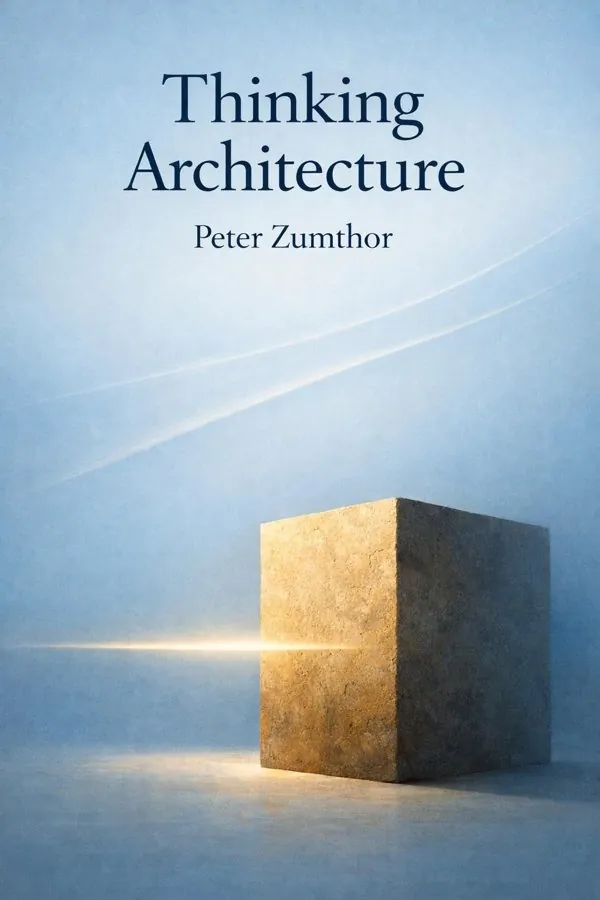
Thinking Architecture: Summary & Key Insights
 10 min10 chaptersAudio available
Key Takeaways from Thinking Architecture
The most moving buildings often feel familiar before we fully understand why.
We feel a building before we analyze it.
Materials are not neutral building components; they carry character, memory, and expressive force.
A beautiful concept means little if it is poorly made.
A building gains strength when it belongs to its place rather than merely occupying it.
What Is Thinking Architecture About?
Thinking Architecture by Peter Zumthor is a design book spanning 10 pages. In "Thinking Architecture," Peter Zumthor offers a quiet but powerful meditation on what makes buildings matter. Rather than presenting a technical manual or a theory-heavy manifesto, he reflects on architecture as a lived, sensory, and emotional art. Through short, concentrated essays, Zumthor explores how memory, atmosphere, materials, craftsmanship, and place shape the experience of built space. He argues that great architecture is not merely seen; it is felt through light, sound, texture, proportion, temperature, and the subtle moods a building creates. What makes the book enduringly important is its resistance to superficial design trends. Zumthor asks architects to create buildings with depth, presence, and honesty—works that belong to their site and enrich daily life. His ideas matter not only to architects, but also to designers, artists, and anyone interested in how environments affect human feeling. Zumthor writes with unusual authority. One of the world’s most respected architects and winner of the Pritzker Prize, he is known for works such as Therme Vals and Kunsthaus Bregenz, buildings celebrated for their extraordinary atmosphere and material precision. This book is both a philosophy of design and a lesson in attention.
This FizzRead summary covers all 10 key chapters of Thinking Architecture in approximately 10 minutes, distilling the most important ideas, arguments, and takeaways from Peter Zumthor's work. Also available as an audio summary and Key Quotes Podcast.
Thinking Architecture
In "Thinking Architecture," Peter Zumthor offers a quiet but powerful meditation on what makes buildings matter. Rather than presenting a technical manual or a theory-heavy manifesto, he reflects on architecture as a lived, sensory, and emotional art. Through short, concentrated essays, Zumthor explores how memory, atmosphere, materials, craftsmanship, and place shape the experience of built space. He argues that great architecture is not merely seen; it is felt through light, sound, texture, proportion, temperature, and the subtle moods a building creates.
What makes the book enduringly important is its resistance to superficial design trends. Zumthor asks architects to create buildings with depth, presence, and honesty—works that belong to their site and enrich daily life. His ideas matter not only to architects, but also to designers, artists, and anyone interested in how environments affect human feeling.
Zumthor writes with unusual authority. One of the world’s most respected architects and winner of the Pritzker Prize, he is known for works such as Therme Vals and Kunsthaus Bregenz, buildings celebrated for their extraordinary atmosphere and material precision. This book is both a philosophy of design and a lesson in attention.
Who Should Read Thinking Architecture?
This book is perfect for anyone interested in design and looking to gain actionable insights in a short read. Whether you're a student, professional, or lifelong learner, the key ideas from Thinking Architecture by Peter Zumthor will help you think differently.
- ✓Readers who enjoy design and want practical takeaways
- ✓Professionals looking to apply new ideas to their work and life
- ✓Anyone who wants the core insights of Thinking Architecture in just 10 minutes
Want the full summary?
Get instant access to this book summary and 100K+ more with Fizz Moment.
Get Free SummaryAvailable on App Store • Free to download
Key Chapters
The most moving buildings often feel familiar before we fully understand why. Zumthor suggests that architecture draws its emotional power from memory—private memories, collective memories, and sensory impressions stored over a lifetime. A door handle, the smell of stone after rain, the echo of a stairwell, or the warmth of afternoon light on wood can all awaken feelings that connect us to a place. Architecture, in this sense, is never only new; it speaks through layers of remembered experience.
For Zumthor, design begins not with abstract style but with lived impressions. He recalls ordinary environments—homes, workshops, streets, rural buildings—and treats them as a deep reservoir of architectural knowledge. These memories are not copied literally. Instead, they help the architect recognize what gives a place dignity, intimacy, calm, or gravity. A successful building can therefore resonate because it reactivates something humanly recognizable, even if the form itself is contemporary.
This idea has practical consequences. A school might be designed to feel reassuring rather than institutional by using natural light, soft acoustics, and tactile materials that recall domestic comfort. A memorial might evoke reflection through silence, shadow, and durable surfaces that suggest permanence. Even a café can feel meaningful if it uses proportions, textures, and transitions that support memory-making rather than visual novelty alone.
Zumthor’s point is not nostalgia. He does not ask us to romanticize the past, but to understand that architecture becomes powerful when it engages the memory-rich way people actually inhabit the world. Designers who ignore this create impressive images but weak experiences. Actionable takeaway: before starting any design, list five sensory memories of spaces that deeply affected you, and use them to guide mood, material, and spatial decisions.
We feel a building before we analyze it. This is one of Zumthor’s central convictions: atmosphere is the immediate emotional quality of a place, and it determines whether architecture touches us or leaves us cold. Atmosphere cannot be reduced to decoration or style. It emerges from the total composition of light, scale, sound, materials, temperature, proportion, and human movement. It is the difference between a room that calms us and one that makes us uneasy.
Zumthor treats atmosphere as a serious design objective, not a vague artistic afterthought. He asks what kind of mood a building should radiate the moment someone enters. Should it feel solemn, intimate, festive, protective, contemplative, public, or domestic? Once that emotional aim is clear, every design decision can support it. Light becomes more than illumination; it becomes a way to shape feeling. Materials become more than surfaces; they become instruments of mood.
Consider a library. If the goal is concentration and reverence, the architect may use filtered daylight, acoustically absorbent surfaces, deep thresholds, and stable materials such as wood or stone. If the goal is openness and social exchange, transparent edges, visible circulation, and brighter public zones may create a different atmosphere. In both cases, atmosphere is not accidental; it is designed through relationships among elements.
What makes Zumthor’s thinking so valuable is that it reconnects architecture to human perception. People do not experience buildings as diagrams. They experience them with their bodies and emotions. When atmosphere is neglected, a project may satisfy program and budget yet still feel lifeless. Actionable takeaway: define the intended emotional atmosphere of a project in one sentence before drawing plans, and test every design choice against that mood.
Materials are not neutral building components; they carry character, memory, and expressive force. Zumthor insists that architects must understand materials not only technically but sensorially and poetically. Stone can feel weighty, cool, and timeless. Timber can feel warm, intimate, and alive. Concrete can be harsh or serene depending on its finish, mass, and light. Brass, glass, plaster, and fabric each shape how a building is perceived and inhabited.
For Zumthor, good design does not force materials to pretend to be something else. He values honesty: wood should be allowed to read as wood, stone as stone, metal as metal. This does not mean materials must be used primitively, but that their inherent qualities should guide the design language. When materials are chosen for image alone, spaces can feel shallow. When chosen for their genuine capacities—texture, aging, density, reflectivity, smell, temperature—they contribute to architectural depth.
This is especially important in details. The way a handrail meets a wall, the thickness of a window frame, or the sound a floor makes underfoot all influence how authentic a building feels. In Zumthor’s work, materials are orchestrated carefully so that they form a coherent sensory world. A spa built from layered stone, for example, feels grounded and elemental because material, structure, and atmosphere align.
Designers in any field can apply this lesson. A retail interior can use fewer materials but select them with greater care so that the brand feels real rather than staged. A home renovation can prioritize materials that age gracefully and reward touch. The goal is not luxury for its own sake, but presence. Actionable takeaway: choose materials by asking how they will look, feel, sound, smell, and age over ten years—not just how they photograph on opening day.
A beautiful concept means little if it is poorly made. Zumthor places extraordinary value on craftsmanship because architecture ultimately becomes real through construction. Drawings and models may express intention, but the completed building communicates through joints, surfaces, tolerances, and the care embedded in every detail. Craft is not simply about technical competence; it is about giving physical form to thought with precision and respect.
This emphasis reflects Zumthor’s own formation. Trained first as a cabinetmaker, he developed a deep appreciation for the intelligence of making. In his view, architects should not treat construction as a secondary phase delegated entirely to others. They must understand how materials are assembled, how details weather, and how labor shapes the final quality of space. A room can feel calm and complete when details are resolved with discipline; it can feel anxious or cheap when edges, seams, and transitions are careless.
Craftsmanship also builds trust. Users may not consciously analyze a joint or a finish, but they sense when a place has been made with integrity. A public building with well-crafted stairs, durable handrails, and carefully set stone invites confidence and respect. A house with well-proportioned windows and precisely fitted woodwork feels settled and inhabitable. In contrast, sloppy execution weakens atmosphere and undermines meaning.
Zumthor’s argument pushes against a culture of speed and spectacle. Architecture should not be valued solely for concept or image; it should be judged by its embodied reality. This lesson extends beyond architecture to product design, interiors, and digital experiences: quality emerges when intention and execution align. Actionable takeaway: during design development, identify the five details users will touch or notice most often, and refine them obsessively because they will define the project’s felt quality.
A building gains strength when it belongs to its place rather than merely occupying it. Zumthor argues that architecture must respond to context in a deep sense—not just through zoning compliance or superficial references, but through a sensitive reading of landscape, climate, history, local culture, and neighboring structures. Context is what allows a project to feel rooted instead of transplanted.
For Zumthor, this means asking fundamental questions: What is already here? What rhythms, scales, materials, and silences define this site? What kind of life unfolds around it? A mountain village, an industrial edge, an urban square, and a lakeside meadow each demand a different architectural attitude. The architect’s task is not to impose a signature but to discover a form that intensifies the identity of the place.
This does not require mimicry. A contemporary building can still be fully of its place if it responds thoughtfully to topography, weather, views, and cultural memory. A museum in a historic district might use modern forms yet echo the area’s massing and material gravity. A rural retreat might frame the landscape, use local stone, and respond to seasonal light rather than chase fashionable geometry. The result is architecture that feels inevitable rather than arbitrary.
Contextual thinking also improves usability and sustainability. Buildings that respond to orientation, wind, and local conditions often perform better and age more gracefully. But Zumthor’s deeper point is existential: people long for places that feel anchored. In an era of global sameness, context offers resistance to placeless design. Actionable takeaway: before designing, spend time on site without sketching, observing sounds, light, weather, and human patterns so the project begins from the character of the place itself.
Strong architecture rarely emerges from haste. Zumthor presents design as a patient process of searching, sensing, testing, and clarifying. Rather than starting from a predetermined style, he allows a project to develop slowly through questions: What kind of building wants to exist here? What atmosphere should it create? What materials and forms can give that atmosphere reality? Design, in this view, is less about instant invention and more about disciplined listening.
This approach stands in contrast to image-driven practice. Zumthor does not reject creativity, but he mistrusts arbitrary gestures detached from use, place, and experience. He values sketches, models, references, and technical studies because they help the architect move from vague intuition to precise form. The process includes doubt. Many possibilities must be considered and discarded before the project reveals its proper order.
The practical lesson is that good design is iterative and embodied. A room’s proportions may need to be tested through models. The feel of a material may need to be assessed in real light. A circulation sequence may only become convincing after multiple revisions. Instead of rushing to finalize a striking concept, the designer refines relationships until the project acquires coherence.
This method applies broadly. Interior designers can prototype transitions between spaces before fixing finishes. Product designers can test how weight, texture, and grip influence emotional response. Writers and artists can benefit from the same principle: form becomes stronger when allowed to mature through attentive revision.
Zumthor’s process is humble because it recognizes that architecture is discovered as much as invented. Actionable takeaway: build extra time into creative work for observation and iteration, and ask at each stage not "Is this original?" but "Does this truly fit the place, purpose, and experience I want to create?"
Some buildings do not demand attention, yet they stay with us for years. Zumthor values this quality of silence and presence: architecture that is self-possessed, calm, and deeply there. Such buildings do not shout through spectacle or excessive formal drama. Instead, they create an atmosphere of concentration. Their power comes from proportion, material clarity, and emotional restraint.
Silence in architecture is not emptiness. It is the absence of noise—visual noise, conceptual noise, and unnecessary complication. A silent building gives people room to project their own thoughts, memories, and feelings into it. This is why sacred spaces, memorials, baths, chapels, and certain homes can feel so profound. They do not overwhelm us with messages; they create conditions for attention.
Presence, meanwhile, refers to a building’s undeniable reality. A structure with presence feels grounded, coherent, and complete. It does not rely on explanation to justify itself. You sense its weight, balance, and atmosphere immediately. This can occur in monumental architecture, but also in modest buildings if they are composed with care. A small stone shelter, a simple wooden room, or a quiet courtyard can possess extraordinary presence.
In practical terms, this idea encourages designers to edit aggressively. Not every space needs a dramatic gesture. Not every surface needs stimulation. In workplaces, hospitality interiors, and homes, reducing visual clutter can heighten calm and usability. The goal is not sterile minimalism, but meaningful restraint.
Zumthor reminds us that architecture serves human attention. In a distracted age, spaces that foster stillness are increasingly valuable. Actionable takeaway: review any design and remove at least one element that exists only to attract attention, keeping what strengthens clarity, calm, and spatial dignity.
Architecture loses its force when it becomes an exercise in fashionable appearance. Zumthor argues for authenticity: buildings should arise from real needs, real materials, real places, and a sincere design intention. Authentic architecture does not imitate historical forms for comfort, nor does it chase novelty for relevance. It seeks truth in the relationship between purpose, construction, and expression.
This is a moral as well as aesthetic position. When a building pretends—through fake materials, borrowed symbolism, or empty formal gestures—it may impress briefly but rarely endures. Authenticity creates trust. Users feel when a space has been shaped by genuine care rather than branding or stylistic posturing. This is why many modest buildings can feel more convincing than expensive but theatrical ones.
Zumthor’s own work demonstrates that authenticity is not a single look. It can produce severe, soft, dark, luminous, monumental, or intimate architecture. What unites these outcomes is coherence. The building means what it is. A chapel may express contemplation through simple geometry and tactile surfaces. A thermal bath may evoke elemental ritual through stone, water, and shadow. In each case, the architecture’s language grows from the experience it aims to host.
For practitioners, authenticity requires difficult choices. It may mean simplifying a concept, using fewer materials, rejecting decorative excess, or resisting client pressure for trend-driven features that weaken the whole. In personal spaces, it may mean choosing what genuinely supports life over what merely signals taste.
Zumthor’s message is liberating: architecture does not need to be louder to be better. It needs to be truer. Actionable takeaway: when evaluating a design, ask of every major element, "Is this here because it is necessary and meaningful, or because it helps create an image?" Then keep only what passes the test.
Architectural ideas only prove themselves when built. Zumthor uses examples from his own practice to show how his principles become tangible in real projects. These works are not presented as self-promotion, but as demonstrations that atmosphere, materials, context, and construction are inseparable. A project succeeds when its concept survives contact with reality and becomes a compelling lived experience.
Take Therme Vals, perhaps his most famous building. Its power comes not from a striking façade alone, but from the orchestration of stone, water, light, temperature, and movement. Visitors do not simply view the architecture; they inhabit a sequence of sensory conditions. Likewise, Kunsthaus Bregenz explores how glass, structure, and daylight can shape a museum atmosphere that is both precise and ethereal. In each case, the building becomes a complete world rather than a collection of isolated design moves.
These examples illustrate a broader lesson: architectural quality emerges through integration. It is not enough to have a good plan, beautiful materials, or contextual sensitivity separately. The strongest projects align all of these into one consistent experience. Built work also teaches humility. Details that seemed minor in drawings can dominate the actual experience. Conversely, subtle choices in proportion or light can produce unexpectedly powerful effects.
For readers, Zumthor’s projects function as case studies in design integrity. They show what happens when an architect follows ideas all the way through—from concept to material to atmosphere. Actionable takeaway: study built projects not just through photographs, but through plans, sections, material choices, and user experience, asking how each decision contributes to one unified architectural feeling.
Every building shapes life, whether intentionally or not. Zumthor therefore sees architecture as an ethical practice, not just an artistic one. Architects influence how people gather, rest, work, remember, heal, and move through the world. Because buildings are public in their effects—even private buildings affect neighborhoods, streets, and landscapes—the architect has a responsibility to create environments that enrich rather than diminish human experience.
This responsibility begins with respect for users. Architecture should not treat people as spectators of an architect’s ego. It should support bodily comfort, emotional well-being, clarity of use, and dignity in everyday rituals. A school should help students feel safe and focused. A hospital should reduce fear where possible through light, order, and humane materials. A house should support both intimacy and freedom. A civic building should embody openness and seriousness.
Responsibility also extends to culture and environment. Poorly conceived construction can damage landscapes, erase local identity, and produce disposable buildings with short lifespans. Zumthor advocates for architecture that lasts—not only physically, but emotionally and culturally. A well-made, context-sensitive building becomes part of a community’s memory. A careless one becomes visual and environmental waste.
This idea gives the book its moral center. Architecture matters because it enters people’s lives directly. The profession is not justified by novelty alone, but by its contribution to the quality of the world. Readers outside architecture can draw the same lesson for any creative field: what we make should serve life, not merely attention.
Actionable takeaway: evaluate any project by asking how it will affect people’s daily experience five, ten, and twenty years from now, and prioritize choices that create lasting dignity, usefulness, and care.
All Chapters in Thinking Architecture
About the Author
Peter Zumthor is a Swiss architect celebrated for his deeply atmospheric and materially precise buildings. Born in Basel in 1943, he first trained as a cabinetmaker, an experience that shaped his lifelong respect for craftsmanship, detail, and the tactile qualities of materials. He later studied design and architecture in Basel and New York before establishing his own practice in Haldenstein, Switzerland. Zumthor became internationally known for projects such as Therme Vals, Kunsthaus Bregenz, the Swiss Pavilion at Expo 2000, and the Bruder Klaus Field Chapel. His work is marked by restraint, sensory richness, and a profound sensitivity to context and human experience. In 2009, he received the Pritzker Architecture Prize, recognizing his unique contribution to contemporary architecture and his uncompromising pursuit of authenticity, presence, and beauty in built form.
Get This Summary in Your Preferred Format
Read or listen to the Thinking Architecture summary by Peter Zumthor anytime, anywhere. FizzRead offers multiple formats so you can learn on your terms — all free.
Available formats: App · Audio · PDF · EPUB — All included free with FizzRead
Download Thinking Architecture PDF and EPUB Summary
Key Quotes from Thinking Architecture
“The most moving buildings often feel familiar before we fully understand why.”
“We feel a building before we analyze it.”
“Materials are not neutral building components; they carry character, memory, and expressive force.”
“A beautiful concept means little if it is poorly made.”
“A building gains strength when it belongs to its place rather than merely occupying it.”
Frequently Asked Questions about Thinking Architecture
Thinking Architecture by Peter Zumthor is a design book that explores key ideas across 10 chapters. In "Thinking Architecture," Peter Zumthor offers a quiet but powerful meditation on what makes buildings matter. Rather than presenting a technical manual or a theory-heavy manifesto, he reflects on architecture as a lived, sensory, and emotional art. Through short, concentrated essays, Zumthor explores how memory, atmosphere, materials, craftsmanship, and place shape the experience of built space. He argues that great architecture is not merely seen; it is felt through light, sound, texture, proportion, temperature, and the subtle moods a building creates. What makes the book enduringly important is its resistance to superficial design trends. Zumthor asks architects to create buildings with depth, presence, and honesty—works that belong to their site and enrich daily life. His ideas matter not only to architects, but also to designers, artists, and anyone interested in how environments affect human feeling. Zumthor writes with unusual authority. One of the world’s most respected architects and winner of the Pritzker Prize, he is known for works such as Therme Vals and Kunsthaus Bregenz, buildings celebrated for their extraordinary atmosphere and material precision. This book is both a philosophy of design and a lesson in attention.
You Might Also Like

The Design of Everyday Things
Don Norman
10 min
The Better Angels of Our Nature
Steven Pinker
10 min
A Designer's Art
Paul Rand
10 min
Architects' Sketchbooks
Various Editors
10 min
Architectural Graphic Standards
The American Institute of Architects
10 min
Design Is Storytelling
Ellen Lupton
10 minBrowse by Category
Ready to read Thinking Architecture?
Get the full summary and 100K+ more books with Fizz Moment.