
The Wonderful Wizard of Oz: Summary & Key Insights
 10 min9 chaptersAudio available
Key Takeaways from The Wonderful Wizard of Oz
Sometimes the stories that change us begin in the dullest places imaginable.
What we think we lack often draws us toward the very people who help us discover it.
A meaningful life is rarely a leap; more often, it is a road.
Compassion is often dismissed as softness, yet in Oz it repeatedly becomes a form of strength.
Power often depends less on truth than on appearance.
What Is The Wonderful Wizard of Oz About?
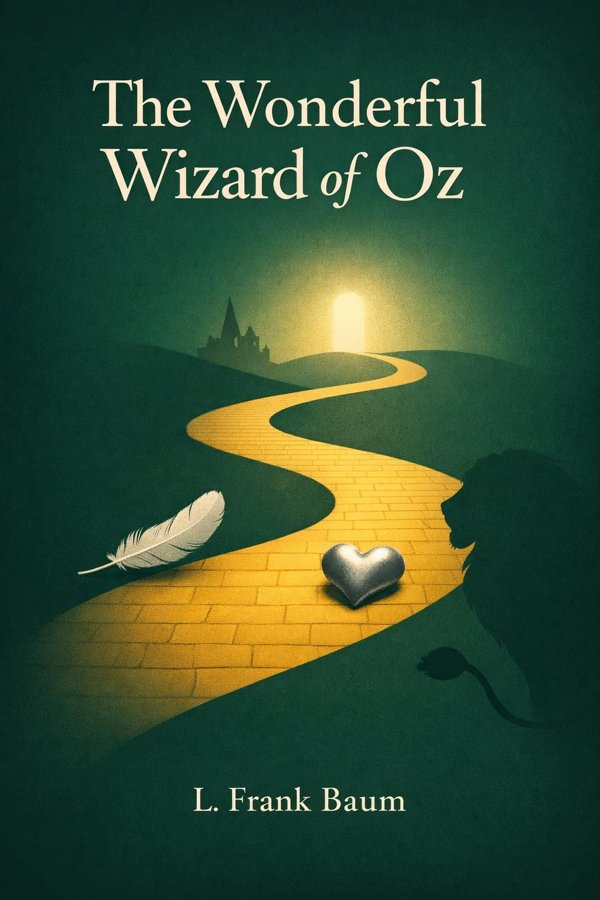
The Wonderful Wizard of Oz by L. Frank Baum is a classics book spanning 4 pages. The Wonderful Wizard of Oz is far more than a beloved children’s adventure. First published in 1900, L. Frank Baum’s novel begins with a simple premise: a Kansas girl named Dorothy is swept by a cyclone into the dazzling Land of Oz and must find her way home. Yet from that premise grows one of the most enduring stories in American literature. Along the Yellow Brick Road, Dorothy is joined by the Scarecrow, who longs for a brain; the Tin Woodman, who wants a heart; and the Cowardly Lion, who seeks courage. Together they travel toward the Emerald City, hoping the great Wizard can grant their wishes. What makes the book matter is its layered wisdom beneath the fantasy. Baum created a distinctly American fairy tale—less interested in royal destiny than in character, loyalty, and practical goodness. The novel speaks to children through wonder and to adults through its insight: people often possess the very qualities they believe they lack. Baum’s authority comes from his gift for building a world that feels playful, strange, and emotionally true. More than a century later, Oz still captivates because it turns a magical journey into a timeless lesson about self-belief, friendship, and home.
This FizzRead summary covers all 9 key chapters of The Wonderful Wizard of Oz in approximately 10 minutes, distilling the most important ideas, arguments, and takeaways from L. Frank Baum's work. Also available as an audio summary and Key Quotes Podcast.
The Wonderful Wizard of Oz
The Wonderful Wizard of Oz is far more than a beloved children’s adventure. First published in 1900, L. Frank Baum’s novel begins with a simple premise: a Kansas girl named Dorothy is swept by a cyclone into the dazzling Land of Oz and must find her way home. Yet from that premise grows one of the most enduring stories in American literature. Along the Yellow Brick Road, Dorothy is joined by the Scarecrow, who longs for a brain; the Tin Woodman, who wants a heart; and the Cowardly Lion, who seeks courage. Together they travel toward the Emerald City, hoping the great Wizard can grant their wishes.
What makes the book matter is its layered wisdom beneath the fantasy. Baum created a distinctly American fairy tale—less interested in royal destiny than in character, loyalty, and practical goodness. The novel speaks to children through wonder and to adults through its insight: people often possess the very qualities they believe they lack. Baum’s authority comes from his gift for building a world that feels playful, strange, and emotionally true. More than a century later, Oz still captivates because it turns a magical journey into a timeless lesson about self-belief, friendship, and home.
Who Should Read The Wonderful Wizard of Oz?
This book is perfect for anyone interested in classics and looking to gain actionable insights in a short read. Whether you're a student, professional, or lifelong learner, the key ideas from The Wonderful Wizard of Oz by L. Frank Baum will help you think differently.
- ✓Readers who enjoy classics and want practical takeaways
- ✓Professionals looking to apply new ideas to their work and life
- ✓Anyone who wants the core insights of The Wonderful Wizard of Oz in just 10 minutes
Want the full summary?
Get instant access to this book summary and 100K+ more with Fizz Moment.
Get Free SummaryAvailable on App Store • Free to download
Key Chapters
Sometimes the stories that change us begin in the dullest places imaginable. Dorothy’s life in Kansas is defined by grayness: gray prairie, gray sky, gray house, and the worn expressions of Aunt Em and Uncle Henry. Baum deliberately starts here because contrast is the engine of wonder. The cyclone does not simply move Dorothy from one location to another; it transports her from emotional scarcity into imaginative abundance. Oz is full of color, oddity, and possibility, but its power depends on the quiet deprivation of the world Dorothy leaves behind.
This shift also captures a deeper truth about human life. We often do not recognize what we need until our routines are broken. A sudden change—a move, a loss, a new opportunity, or an unexpected crisis—can feel like being lifted by a cyclone. At first it is disorienting. Yet disruption can reveal hidden strengths and open paths that ordinary life keeps closed. Dorothy does not choose adventure, but once it arrives, she meets it with steadiness, curiosity, and responsibility.
Baum also frames Dorothy as an ordinary child, not a chosen heroine marked by prophecy or noble birth. That matters. Her importance comes from character, not status. She is brave because she keeps going, kind because she helps others, and memorable because she remains emotionally grounded amid marvels. In that way, Kansas is not just a place she leaves. It is the source of her realism and resilience.
In everyday life, we can read this opening as a reminder not to dismiss plain beginnings. A person from a modest background, a quiet season, or a seemingly limited life may still be on the edge of transformation. The unfamiliar may arrive without warning, but we can respond with Dorothy’s practical courage.
Actionable takeaway: When life suddenly changes, ask not only “Why is this happening?” but also “What strength might this change be revealing in me?”
What we think we lack often draws us toward the very people who help us discover it. As Dorothy follows the Yellow Brick Road, she gathers companions who seem incomplete: the Scarecrow wants brains, the Tin Woodman wants a heart, and the Cowardly Lion wants courage. On the surface, each joins the journey to obtain a missing trait. But Baum structures the story so that their actions repeatedly prove the opposite. The Scarecrow solves problems, the Tin Woodman shows tenderness and moral feeling, and the Lion acts bravely despite fear.
Their companionship is essential because identity becomes clearer in relationship. Alone, people can remain trapped in false ideas about themselves. We call ourselves not smart enough, not lovable enough, not bold enough. But in the presence of others, our capacities emerge naturally. Dorothy needs these friends for practical reasons, yet they need her because she gives their strengths a place to appear. The road itself becomes a testing ground where hidden qualities become visible.
This idea applies widely. A student who doubts their intelligence may flourish when asked to help explain a concept to others. A person who feels emotionally distant may discover their heart through caregiving or friendship. Someone who believes they are timid may act with surprising bravery when protecting a child, speaking for a friend, or facing a difficult truth. We do not always develop confidence through introspection alone; often we develop it through shared purpose.
Baum’s genius lies in making these lessons feel light rather than preachy. The companions are charming, funny, and vividly distinct, but together they form a larger picture of human incompleteness—and human potential. Their desires are sincere, yet the journey itself becomes the answer.
Actionable takeaway: Pay attention to the roles you naturally play for others—problem-solver, comforter, encourager—because those roles may reveal strengths you have been underestimating in yourself.
A meaningful life is rarely a leap; more often, it is a road. The Yellow Brick Road is one of literature’s most memorable images because it symbolizes direction without certainty. Dorothy and her friends know where they hope to go—the Emerald City—but they do not know exactly what they will face along the way. The road offers guidance, not guarantees. That distinction matters. Growth usually works the same way.
In Oz, progress is made through one step after another: meeting strangers, crossing obstacles, making mistakes, receiving help, and continuing forward. The road is not magical because it removes difficulty. It is magical because it gives wandering hearts a line to follow. For Dorothy, who wants to return home, and for her companions, who seek transformation, the road creates movement when confusion might otherwise lead to despair.
This makes the Yellow Brick Road a powerful metaphor for practical life. We often delay action because we want complete clarity before beginning. We want certainty about our career, our relationships, our purpose, or our next big decision. But many of the most important outcomes in life are reached not by knowing everything in advance, but by committing to a worthwhile path and learning while walking it. A new job, a health habit, a creative project, or a spiritual practice may begin with only partial understanding. The key is to keep moving.
Baum also reminds us that roads are shared. Dorothy’s path becomes meaningful partly because others join it. Advice, collaboration, encouragement, and even disagreement shape the journey. The destination matters, but the road changes the travelers before they ever arrive.
Actionable takeaway: Instead of waiting for perfect certainty, choose one clear next step toward what matters to you, and let progress come through motion rather than overthinking.
Compassion is often dismissed as softness, yet in Oz it repeatedly becomes a form of strength. Dorothy survives not because she is the most powerful figure in the story, but because she acts with decency and concern for others. She frees the Scarecrow, listens to the Tin Woodman, welcomes the Lion, and generally responds to the strange world around her with openness rather than suspicion. These choices build a network of loyalty that protects and sustains her.
Baum shows that kindness has practical consequences. Dorothy’s companions do not merely admire her; they commit themselves to her. Their devotion grows from how she treats them. In many stories, heroes win by domination, superior force, or clever manipulation. Dorothy wins allies through goodwill. Even in a fantasy filled with witches, winged monkeys, and enchanted cities, one of the deepest powers is simple humane behavior.
This lesson has clear applications beyond literature. In workplaces, communities, and families, people who consistently show respect and care often create trust that carries them through difficulty. A manager who listens sincerely may gain deeper loyalty than one who rules through fear. A student who includes others may form friendships that provide support later. A person facing hardship may discover that kindness shown in ordinary times returns as help when they need it most. Compassion does not guarantee safety, but it often creates resilience through relationship.
Baum does not portray kindness as naive. Dorothy still faces danger, deception, and hardship. Yet her moral instinct remains intact. She does not become cynical simply because the world is unpredictable. That steadiness is part of her quiet heroism.
Actionable takeaway: In your next interaction, choose one deliberate act of kindness—listening carefully, offering help, or expressing gratitude—and notice how often small decency creates stronger bonds than force ever could.
One of the wisest truths in Oz is that courage is not the absence of fear. The Cowardly Lion believes he is deficient because he feels afraid. But throughout the journey, he repeatedly acts despite fear—protecting his companions, facing danger, and pressing forward into uncertainty. Baum dismantles a common misunderstanding: bravery does not belong only to those who feel calm. It belongs to those who act rightly while still trembling.
This distinction is powerful because fear often convinces people they are incapable. Someone preparing for a difficult conversation may feel panic and conclude they lack confidence. A person starting a business, changing careers, standing on a stage, or setting a boundary may interpret fear as a sign to retreat. The Lion’s story offers another interpretation. Fear is not proof of weakness; it may simply be the emotional cost of caring about the outcome.
Baum’s portrait remains compassionate rather than harsh. The Lion is not mocked for his fear alone. Instead, readers see how self-judgment can distort identity. He has accepted a false definition of courage and therefore misses the evidence of his own actions. Many people do the same. They compare their inner feelings to other people’s outer appearances and assume they are uniquely afraid. In reality, many seemingly bold individuals are also frightened; they have simply learned to move anyway.
In practical terms, this lesson applies in daily acts more than dramatic heroics. Courage can be apologizing sincerely, admitting uncertainty, asking for help, applying for an opportunity, leaving a harmful situation, or defending someone vulnerable. These are not fearless actions. They are meaningful precisely because fear is present.
Actionable takeaway: The next time fear appears, do not ask “How do I get rid of this feeling?” Ask instead, “What small brave action can I take while feeling it?”
To have a heart is not merely to feel; it is to care in a way that shapes action. The Tin Woodman longs for a heart because he believes this will make him fully human. Yet Baum shows that he is already deeply compassionate. He is moved by suffering, careful with others, and morally sensitive. His desire is understandable, but unnecessary in the literal sense. The evidence of his heart is everywhere in how he lives.
This idea broadens the meaning of emotion. Many people assume that having a heart means dramatic sentiment or visible tenderness. Baum suggests something richer: real-heartedness appears in responsibility, gentleness, empathy, and ethical concern. The Tin Woodman’s humanity is revealed not through speeches about love, but through how seriously he takes the well-being of others.
This lesson matters in ordinary life because people often underrate quiet forms of care. A parent working long hours to provide stability, a friend checking in consistently, a nurse tending patiently to difficult cases, or a colleague making sure no one is left out may not appear grandly emotional. Yet these actions reveal heart more convincingly than intense words alone. In fact, some of the most caring people are not expressive in conventional ways; they show love through reliability and consideration.
Baum also hints that self-concept can become distorted when people define worth too narrowly. The Tin Woodman equates heart with possession of a symbolic object, rather than recognition of lived compassion. We do something similar when we reduce ourselves to labels: not creative enough, not caring enough, not successful enough. We overlook what our conduct already proves.
Actionable takeaway: Identify one recurring way you already show care—through time, attention, protection, or service—and honor it as real evidence of heart rather than dismissing it because it looks ordinary.
We often understand the value of home only after leaving it. Dorothy’s central desire is simple and unwavering: she wants to return to Kansas. This longing anchors the novel emotionally. Even in a land filled with marvels, she does not forget where she belongs. Baum’s treatment of home is more nuanced than nostalgia alone. Kansas is not idealized as perfect or enchanting. It is harsh, plain, and often joyless. Yet it is hers. Home becomes meaningful not because it is dazzling, but because it holds love, memory, and identity.
This distinction gives the story its emotional maturity. Home is not necessarily the most beautiful place, nor the easiest. It is the place where one’s life is rooted. For Dorothy, the wonders of Oz cannot replace the human bonds waiting in Kansas. The novel therefore resists the fantasy that excitement alone can satisfy the heart. Adventure is transformative, but belonging answers a different need.
In modern life, this theme resonates strongly. Home may be a family, a language, a neighborhood, a set of rituals, or a community where one is known. For some, home is cherished; for others, it is complicated and mixed with pain. Even then, the search for home remains powerful. People often spend years trying to create the sense of safety, recognition, and connection that Dorothy instinctively seeks.
Baum’s message is not that we should avoid distant worlds or new experiences. Rather, it is that exploration matters most when it deepens our understanding of what truly nourishes us. Sometimes we must leave to recognize what cannot be replaced.
Actionable takeaway: Take time to name what “home” means for you—specific people, values, memories, or practices—so you can protect and prioritize what gives your life real belonging.
Many quests end with a gift, but Oz suggests a more surprising ending: the treasure is often self-recognition. By the close of the story, Dorothy’s companions receive symbolic confirmations of what they already possessed. The Scarecrow gets a brain, the Tin Woodman a heart, the Lion courage, and Dorothy ultimately discovers the means to return home. Yet Baum carefully builds the narrative so that readers understand the deeper truth. The external objects matter less than the internal capacities already demonstrated.
This is not a cheap trick or a simplistic slogan. Baum is not saying that people need no help, guidance, or validation. The companions genuinely benefit from the journey, and the symbols they receive carry emotional significance. What he is saying is that growth often consists less in acquiring a brand-new self than in recognizing, trusting, and organizing strengths that were present but unclaimed.
This idea has enduring practical value. People frequently seek credentials, praise, status, or permission before believing in their own abilities. A diploma may help, but intelligence existed before it. A leadership title may formalize influence, but courage and judgment often appear long before the promotion. Public approval can be encouraging, yet a person’s deepest capacities are usually built through action, not applause. The external sign is useful; the internal reality is decisive.
The ending of Oz therefore leaves readers with hope rather than dependence. The world contains wonder, assistance, and mystery, but one need not wait passively to be transformed by others. Dorothy and her friends become who they are by journeying, helping one another, enduring tests, and learning to see themselves more truthfully.
Actionable takeaway: Make a list of three qualities you believe you need more of, then write down concrete evidence of how you already display each one in small but real ways.
All Chapters in The Wonderful Wizard of Oz
About the Author
L. Frank Baum, born Lyman Frank Baum in 1856, was an American author, editor, and playwright best known for The Wonderful Wizard of Oz. Before becoming famous as a novelist, he worked in a variety of professions, including newspaper publishing, acting, and retail, experiences that helped shape his lively, theatrical imagination. Published in 1900, The Wonderful Wizard of Oz became an immediate success and led Baum to write many more books set in Oz, establishing one of the first great fantasy worlds in American literature. He aimed to create a new kind of fairy tale for American children—one filled with wonder, but free from excessive moralizing and old European conventions. Baum died in 1919, but his stories continue to influence literature, theater, and popular culture around the world.
Get This Summary in Your Preferred Format
Read or listen to the The Wonderful Wizard of Oz summary by L. Frank Baum anytime, anywhere. FizzRead offers multiple formats so you can learn on your terms — all free.
Available formats: App · Audio · PDF · EPUB — All included free with FizzRead
Download The Wonderful Wizard of Oz PDF and EPUB Summary
Key Quotes from The Wonderful Wizard of Oz
“Sometimes the stories that change us begin in the dullest places imaginable.”
“What we think we lack often draws us toward the very people who help us discover it.”
“A meaningful life is rarely a leap; more often, it is a road.”
“Compassion is often dismissed as softness, yet in Oz it repeatedly becomes a form of strength.”
“Power often depends less on truth than on appearance.”
Frequently Asked Questions about The Wonderful Wizard of Oz
The Wonderful Wizard of Oz by L. Frank Baum is a classics book that explores key ideas across 9 chapters. The Wonderful Wizard of Oz is far more than a beloved children’s adventure. First published in 1900, L. Frank Baum’s novel begins with a simple premise: a Kansas girl named Dorothy is swept by a cyclone into the dazzling Land of Oz and must find her way home. Yet from that premise grows one of the most enduring stories in American literature. Along the Yellow Brick Road, Dorothy is joined by the Scarecrow, who longs for a brain; the Tin Woodman, who wants a heart; and the Cowardly Lion, who seeks courage. Together they travel toward the Emerald City, hoping the great Wizard can grant their wishes. What makes the book matter is its layered wisdom beneath the fantasy. Baum created a distinctly American fairy tale—less interested in royal destiny than in character, loyalty, and practical goodness. The novel speaks to children through wonder and to adults through its insight: people often possess the very qualities they believe they lack. Baum’s authority comes from his gift for building a world that feels playful, strange, and emotionally true. More than a century later, Oz still captivates because it turns a magical journey into a timeless lesson about self-belief, friendship, and home.
You Might Also Like




Browse by Category
Ready to read The Wonderful Wizard of Oz?
Get the full summary and 100K+ more books with Fizz Moment.