
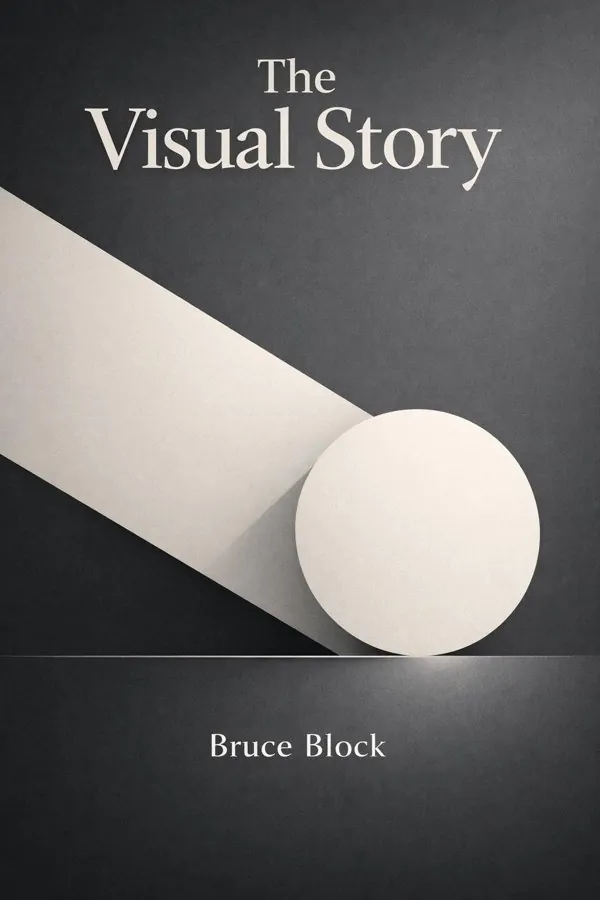
The Visual Story: Creating the Visual Structure of Film, TV and Digital Media: Summary & Key Insights
by Bruce Block
 10 min10 chaptersAudio available
What Is The Visual Story: Creating the Visual Structure of Film, TV and Digital Media About?
The Visual Story: Creating the Visual Structure of Film, TV and Digital Media by Bruce Block is a design book spanning 10 pages. The Visual Story es una guía fundamental para comprender cómo los elementos visuales —espacio, línea, forma, tono, color, movimiento y ritmo— pueden organizarse para construir una narrativa visual coherente. Bruce Block ofrece un enfoque sistemático para diseñar la estructura visual de películas, televisión y medios digitales, mostrando cómo cada decisión estética contribuye al significado y la emoción de la historia.
This FizzRead summary covers all 10 key chapters of The Visual Story: Creating the Visual Structure of Film, TV and Digital Media in approximately 10 minutes, distilling the most important ideas, arguments, and takeaways from Bruce Block's work. Also available as an audio summary and Key Quotes Podcast.
The Visual Story: Creating the Visual Structure of Film, TV and Digital Media
The Visual Story es una guía fundamental para comprender cómo los elementos visuales —espacio, línea, forma, tono, color, movimiento y ritmo— pueden organizarse para construir una narrativa visual coherente. Bruce Block ofrece un enfoque sistemático para diseñar la estructura visual de películas, televisión y medios digitales, mostrando cómo cada decisión estética contribuye al significado y la emoción de la historia.
Who Should Read The Visual Story: Creating the Visual Structure of Film, TV and Digital Media?
This book is perfect for anyone interested in design and looking to gain actionable insights in a short read. Whether you're a student, professional, or lifelong learner, the key ideas from The Visual Story: Creating the Visual Structure of Film, TV and Digital Media by Bruce Block will help you think differently.
- ✓Readers who enjoy design and want practical takeaways
- ✓Professionals looking to apply new ideas to their work and life
- ✓Anyone who wants the core insights of The Visual Story: Creating the Visual Structure of Film, TV and Digital Media in just 10 minutes
Want the full summary?
Get instant access to this book summary and 100K+ more with Fizz Moment.
Get Free SummaryAvailable on App Store • Free to download
Key Chapters
Every story has a structure—a series of events that create meaning over time. Similarly, every visual story has a visual structure—a series of visual choices organized across the duration of the film. When I refer to visual structure, I’m talking about the arrangement and control of visual components to support the story’s emotional journey.
This concept matters because visuals are not random embellishments. They are part of the storytelling grammar. Just as a sentence can be built from syntax, a film’s visual composition is an organized system of cues. The audience may not consciously analyze it, but they feel its effects. A darkening color palette can suggest a descent into danger; shifting from deep space to flat space can express confinement; slowing rhythm through image repetition can portray lethargy or grief. The structure gives coherence and unity to these evolving visual events.
A film structured visually maintains constant communication with its narrative. If the story rises in tension, the visuals can parallel that through higher contrast or kinetic movement. If the story releases into calm, visual affinity—similarity among visual components—can bring unity and rest. Without that correlation, the film feels disjointed, like music played out of tune with its melody.
So, we start by viewing every visual decision as part of a larger design. Composition, color, space—all these are pieces of one framework that can be adjusted with precision. Your goal as a visual storyteller is not only to create beautiful images, but to make those images serve the story’s rhythm, emotion, and meaning.
Space is the foundation of visual perception. In moving images, space is not just an empty field—it’s a dynamic environment of depth, volume, and orientation. In my framework, I describe three types of space: deep, flat, and limited.
Deep space uses perspective and overlapping planes to create depth. It invites the viewer into a world that feels open and dimensional. Imagine the sweeping valleys in a Western or the endless corridors in a sci-fi epic—each offers a sense of immersion and possibility. Deep space energizes the frame and suggests freedom or complexity.
Flat space, by contrast, compresses that depth. It eliminates perspective and emphasizes the two-dimensional surface of the screen. This can make images feel claustrophobic, graphic, or emotionally suppressed. When characters are trapped or emotionally distanced, flat space can reinforce that sense of isolation. It offers control and stylization, as seen in many modern compositions that highlight geometry and graphic tension.
Limited space bridges the two. Here, depth exists but doesn’t extend infinitely. It can be used to create intimate confinement or emotional focus—a room where every surface counts, where the viewer feels both presence and restriction.
By organizing space, you control how the audience feels within the frame. Too often, filmmakers treat shot composition only as aesthetic pleasure, but really, it’s psychological engineering. The choice between deep and flat space shifts how the viewer reads the story’s emotional stakes. As the visual architect of your film, you manipulate space deliberately so that every environment amplifies the story’s intent.
+ 8 more chapters — available in the FizzRead app
All Chapters in The Visual Story: Creating the Visual Structure of Film, TV and Digital Media
About the Author
Bruce Block es productor, diseñador visual y profesor en la Escuela de Cine de la Universidad del Sur de California. Ha trabajado en numerosas producciones cinematográficas y es reconocido por su experiencia en la teoría de la estructura visual aplicada al cine y los medios audiovisuales.
Get This Summary in Your Preferred Format
Read or listen to the The Visual Story: Creating the Visual Structure of Film, TV and Digital Media summary by Bruce Block anytime, anywhere. FizzRead offers multiple formats so you can learn on your terms — all free.
Available formats: App · Audio · PDF · EPUB — All included free with FizzRead
Download The Visual Story: Creating the Visual Structure of Film, TV and Digital Media PDF and EPUB Summary
Key Quotes from The Visual Story: Creating the Visual Structure of Film, TV and Digital Media
“Every story has a structure—a series of events that create meaning over time.”
“Space is the foundation of visual perception.”
Frequently Asked Questions about The Visual Story: Creating the Visual Structure of Film, TV and Digital Media
The Visual Story: Creating the Visual Structure of Film, TV and Digital Media by Bruce Block is a design book that explores key ideas across 10 chapters. The Visual Story es una guía fundamental para comprender cómo los elementos visuales —espacio, línea, forma, tono, color, movimiento y ritmo— pueden organizarse para construir una narrativa visual coherente. Bruce Block ofrece un enfoque sistemático para diseñar la estructura visual de películas, televisión y medios digitales, mostrando cómo cada decisión estética contribuye al significado y la emoción de la historia.
You Might Also Like
The Design of Everyday Things
Don Norman
10 min
The Better Angels of Our Nature
Steven Pinker
10 min
A Designer's Art
Paul Rand
10 min
Architects' Sketchbooks
Various Editors
10 min
Architectural Graphic Standards
The American Institute of Architects
10 min
Design Is Storytelling
Ellen Lupton
10 minBrowse by Category
Ready to read The Visual Story: Creating the Visual Structure of Film, TV and Digital Media?
Get the full summary and 100K+ more books with Fizz Moment.