
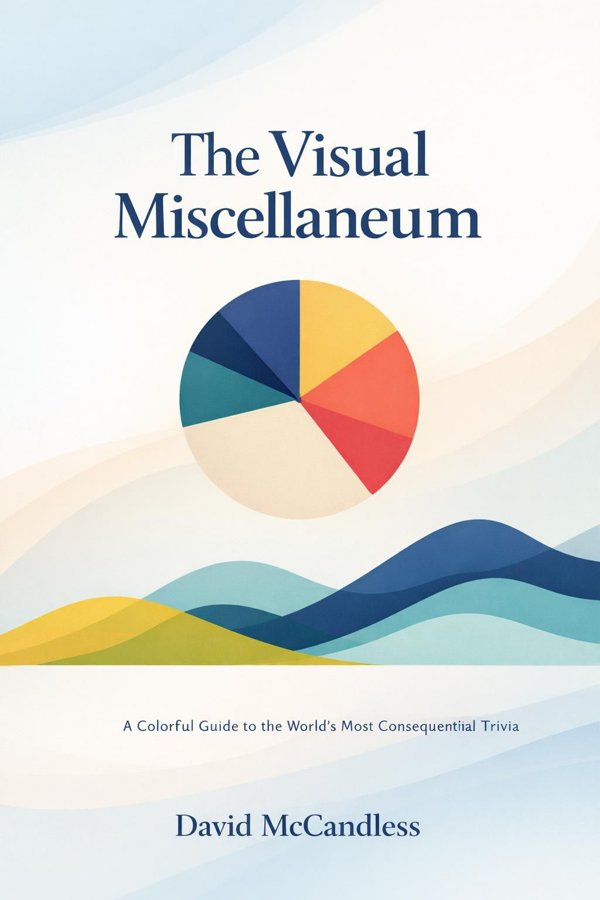
The Visual Miscellaneum: A Colorful Guide to the World's Most Consequential Trivia: Summary & Key Insights
 10 min4 chaptersAudio available
What Is The Visual Miscellaneum: A Colorful Guide to the World's Most Consequential Trivia About?
The Visual Miscellaneum: A Colorful Guide to the World's Most Consequential Trivia by David McCandless is a design book spanning 4 pages. The Visual Miscellaneum is an innovative collection of infographics and visualizations that transform complex data into engaging, colorful, and accessible graphics. Covering topics from politics and pop culture to science and technology, the book demonstrates how information design can reveal surprising patterns and insights about the world.
This FizzRead summary covers all 4 key chapters of The Visual Miscellaneum: A Colorful Guide to the World's Most Consequential Trivia in approximately 10 minutes, distilling the most important ideas, arguments, and takeaways from David McCandless's work. Also available as an audio summary and Key Quotes Podcast.
The Visual Miscellaneum: A Colorful Guide to the World's Most Consequential Trivia
The Visual Miscellaneum is an innovative collection of infographics and visualizations that transform complex data into engaging, colorful, and accessible graphics. Covering topics from politics and pop culture to science and technology, the book demonstrates how information design can reveal surprising patterns and insights about the world.
Who Should Read The Visual Miscellaneum: A Colorful Guide to the World's Most Consequential Trivia?
This book is perfect for anyone interested in design and looking to gain actionable insights in a short read. Whether you're a student, professional, or lifelong learner, the key ideas from The Visual Miscellaneum: A Colorful Guide to the World's Most Consequential Trivia by David McCandless will help you think differently.
- ✓Readers who enjoy design and want practical takeaways
- ✓Professionals looking to apply new ideas to their work and life
- ✓Anyone who wants the core insights of The Visual Miscellaneum: A Colorful Guide to the World's Most Consequential Trivia in just 10 minutes
Want the full summary?
Get instant access to this book summary and 100K+ more with Fizz Moment.
Get Free SummaryAvailable on App Store • Free to download
Key Chapters
At the heart of *The Visual Miscellaneum* lies a simple premise: the way we present information shapes the way we understand it. I approach data not as a scientist collecting figures, but as a storyteller sculpting form from raw material. Every dataset carries a potential narrative. My task is to find its shape.
When designing an infographic, I begin not with software or color palettes, but with questions. What is this data really saying? Where are the tensions? The harmonies? Once those are identified, visuals become the grammar through which meaning unfolds. A spiral may represent the expansion of knowledge across centuries; a color gradient might trace emotional affinities or ideological extremes. In these patterns, complexity loses its intimidation and gains delight.
People sometimes assume that data visualization is about simplification. I disagree—it’s about revelation. Good visualization doesn’t flatten reality; it opens dimensions within it. When I compare world religions by the number of adherents, or political systems by stability over time, I’m inviting readers to sense relationships that otherwise stay buried in spreadsheets and reports. The images are windows—each pane offering a glimpse into the structure of the unseen.
Through color, proportion, and placement, these stories become immersive. They speak to our intuition before our intellect kicks in. That is the power of visual thinking: it reunites analysis with emotion. In an era where data floods every conversation, learning to see rather than just read information is an essential literacy. This, ultimately, is what the book teaches—not merely knowledge of the topics it displays, but a way of perceiving the hidden harmony of the informational world.
Humanity is a tapestry of differences and connections, and so much of *The Visual Miscellaneum* is devoted to making that tapestry visible. In one series, I explore global demographics, charting population density, age distribution, and migration flows. Patterns emerge quickly: nations rise and fall in demographic momentum, cities sprawl like galaxies, and society’s energy moves along the lines of youth, opportunity, and ideology.
Politics follows closely behind demographics. To visualize political systems, I map ideologies on color-coded axes, allowing libertarianism, socialism, conservatism, and liberalism to occupy shifting spaces in relation to one another. The aim is not judgment but empathy through understanding—seeing that behind every stance is a landscape of history and values. Visualizing conflict and diplomacy, for instance, reveals not just statistics of wars but emotional geographies of loss and hope.
Culture, meanwhile, displays its fingerprint in trends: the rise and fall of musical genres, the migration of cinematic themes, the popularity arcs of technologies and memes. By mapping time against influence, patterns of collective imagination reveal themselves. What fascinates me most is how cultural data mirrors human psychology. A sudden spike in dystopian films often coincides with economic uncertainty; the global appetite for superheroes rises as collective optimism wavers. Culture, in this way, becomes a mirror that data faithfully reflects when designed clearly.
What ties all these visual narratives together is a conviction that information is a story best told through sight. When you see the world arranged this way, divisions soften. Political ideologies that felt incompatible appear adjacent on a color scale. Population crises turn from faceless numbers to organic forms with rhythm and proportion. The eye teaches compassion by dissolving abstraction.
+ 2 more chapters — available in the FizzRead app
All Chapters in The Visual Miscellaneum: A Colorful Guide to the World's Most Consequential Trivia
About the Author
David McCandless is a British data journalist, information designer, and author known for his creative visualizations that make complex data understandable and beautiful. He is the founder of the website Information Is Beautiful and a leading figure in the field of data visualization.
Get This Summary in Your Preferred Format
Read or listen to the The Visual Miscellaneum: A Colorful Guide to the World's Most Consequential Trivia summary by David McCandless anytime, anywhere. FizzRead offers multiple formats so you can learn on your terms — all free.
Available formats: App · Audio · PDF · EPUB — All included free with FizzRead
Download The Visual Miscellaneum: A Colorful Guide to the World's Most Consequential Trivia PDF and EPUB Summary
Key Quotes from The Visual Miscellaneum: A Colorful Guide to the World's Most Consequential Trivia
“At the heart of *The Visual Miscellaneum* lies a simple premise: the way we present information shapes the way we understand it.”
“Humanity is a tapestry of differences and connections, and so much of *The Visual Miscellaneum* is devoted to making that tapestry visible.”
Frequently Asked Questions about The Visual Miscellaneum: A Colorful Guide to the World's Most Consequential Trivia
The Visual Miscellaneum: A Colorful Guide to the World's Most Consequential Trivia by David McCandless is a design book that explores key ideas across 4 chapters. The Visual Miscellaneum is an innovative collection of infographics and visualizations that transform complex data into engaging, colorful, and accessible graphics. Covering topics from politics and pop culture to science and technology, the book demonstrates how information design can reveal surprising patterns and insights about the world.
More by David McCandless
You Might Also Like

The Design of Everyday Things
Don Norman
10 min
The Better Angels of Our Nature
Steven Pinker
10 min
A Designer's Art
Paul Rand
10 min
Architects' Sketchbooks
Various Editors
10 min
Architectural Graphic Standards
The American Institute of Architects
10 min
Design Is Storytelling
Ellen Lupton
10 minBrowse by Category
Ready to read The Visual Miscellaneum: A Colorful Guide to the World's Most Consequential Trivia?
Get the full summary and 100K+ more books with Fizz Moment.