
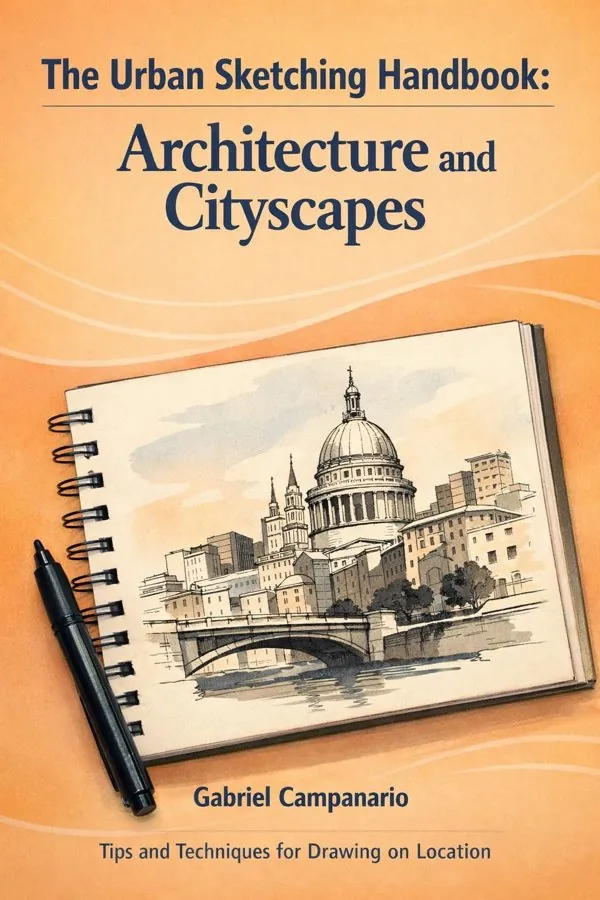
The Urban Sketching Handbook: Architecture and Cityscapes: Tips and Techniques for Drawing on Location: Summary & Key Insights
 10 min8 chaptersAudio available
What Is The Urban Sketching Handbook: Architecture and Cityscapes: Tips and Techniques for Drawing on Location About?
The Urban Sketching Handbook: Architecture and Cityscapes: Tips and Techniques for Drawing on Location by Gabriel Campanario is a design book spanning 8 pages. Este libro ofrece una guía práctica para dibujar arquitectura y paisajes urbanos en el lugar. Gabriel Campanario, fundador del movimiento Urban Sketchers, comparte técnicas esenciales para capturar la esencia de las ciudades mediante el dibujo directo, abordando perspectiva, composición y observación visual.
This FizzRead summary covers all 8 key chapters of The Urban Sketching Handbook: Architecture and Cityscapes: Tips and Techniques for Drawing on Location in approximately 10 minutes, distilling the most important ideas, arguments, and takeaways from Gabriel Campanario's work. Also available as an audio summary and Key Quotes Podcast.
The Urban Sketching Handbook: Architecture and Cityscapes: Tips and Techniques for Drawing on Location
Este libro ofrece una guía práctica para dibujar arquitectura y paisajes urbanos en el lugar. Gabriel Campanario, fundador del movimiento Urban Sketchers, comparte técnicas esenciales para capturar la esencia de las ciudades mediante el dibujo directo, abordando perspectiva, composición y observación visual.
Who Should Read The Urban Sketching Handbook: Architecture and Cityscapes: Tips and Techniques for Drawing on Location?
This book is perfect for anyone interested in design and looking to gain actionable insights in a short read. Whether you're a student, professional, or lifelong learner, the key ideas from The Urban Sketching Handbook: Architecture and Cityscapes: Tips and Techniques for Drawing on Location by Gabriel Campanario will help you think differently.
- ✓Readers who enjoy design and want practical takeaways
- ✓Professionals looking to apply new ideas to their work and life
- ✓Anyone who wants the core insights of The Urban Sketching Handbook: Architecture and Cityscapes: Tips and Techniques for Drawing on Location in just 10 minutes
Want the full summary?
Get instant access to this book summary and 100K+ more with Fizz Moment.
Get Free SummaryAvailable on App Store • Free to download
Key Chapters
Let’s begin with the foundation—your materials. Urban sketching thrives on mobility and spontaneity; the best tools are those that travel easily and let you draw freely wherever you are. I always recommend a compact sketchbook with good-quality paper, a few versatile pens, and perhaps a small watercolor set. These aren’t arbitrary choices. Each item serves a purpose. A sturdy sketchbook allows you to stand while drawing. Waterproof ink permits you to overlay washes without smudging. Watercolors provide a fast, expressive way to suggest atmosphere.
In the field, portability is everything. A shoulder bag or small toolkit ensures you’re always ready to capture a fleeting moment—an unexpected beam of light across a building façade, or the sudden appearance of pedestrians rushing by. I emphasize that your tools shouldn’t intimidate you; they should encourage experimentation. Simplicity fosters consistency. The fewer variables you juggle, the more attention you can give to observing and interpreting the city in front of you.
I also talk about mindset here. Your materials are extensions of your hand and eyes; they should support your way of seeing, not constrain it. As you grow more comfortable, you’ll find your own mix—perhaps a brush pen for bold shadows, or a pencil for gentle architectural contours. What matters is that you feel confident that no matter where you find yourself—leaning against a lamppost, sitting on a café terrace—you’re ready to draw.
Perspective is the skeleton of any architectural sketch. Without it, your buildings lose their grounding; with it, they acquire solidity and depth. In this section, I guide you through one-point, two-point, and three-point perspective, not as abstract geometrical systems but as live, street-level tools. The key is always to observe before constructing. Notice how the lines of the sidewalk converge, how window frames align toward a vanishing point. Every detail whispers clues about spatial relationships.
When sketching on location, don’t be daunted by complexity. Focus on the horizon line—it’s the viewer’s eye level. From there, you can build your drawing outward, using intuitive measurements. Architecture, after all, is rhythm and repetition. The spacing of columns, the rise of windows, the slope of a roof—all can be understood as patterns in perspective.
I often tell sketchers: accuracy comes from mindful observation, not rigid plotting. Resist the urge to draw what you think a building should look like; instead, draw what your eyes see, correcting as you go. This is where practice transforms perception. The more you sketch different spaces—wide boulevards, narrow alleys, grand cathedrals—the more natural perspective becomes, until it feels like second nature.
And this knowledge does more than strengthen your drawings. It deepens your connection with the built environment. Once you truly grasp perspective, you don’t just walk through the city—you see its invisible geometry. You start to appreciate how an architect’s vision and the urban grid come together in living harmony.
+ 6 more chapters — available in the FizzRead app
All Chapters in The Urban Sketching Handbook: Architecture and Cityscapes: Tips and Techniques for Drawing on Location
About the Author
Gabriel Campanario es un ilustrador y periodista español radicado en Seattle. Fundador del movimiento internacional Urban Sketchers, ha trabajado como artista y columnista en The Seattle Times y es autor de varios libros sobre dibujo urbano.
Get This Summary in Your Preferred Format
Read or listen to the The Urban Sketching Handbook: Architecture and Cityscapes: Tips and Techniques for Drawing on Location summary by Gabriel Campanario anytime, anywhere. FizzRead offers multiple formats so you can learn on your terms — all free.
Available formats: App · Audio · PDF · EPUB — All included free with FizzRead
Download The Urban Sketching Handbook: Architecture and Cityscapes: Tips and Techniques for Drawing on Location PDF and EPUB Summary
Key Quotes from The Urban Sketching Handbook: Architecture and Cityscapes: Tips and Techniques for Drawing on Location
“Let’s begin with the foundation—your materials.”
“Perspective is the skeleton of any architectural sketch.”
Frequently Asked Questions about The Urban Sketching Handbook: Architecture and Cityscapes: Tips and Techniques for Drawing on Location
The Urban Sketching Handbook: Architecture and Cityscapes: Tips and Techniques for Drawing on Location by Gabriel Campanario is a design book that explores key ideas across 8 chapters. Este libro ofrece una guía práctica para dibujar arquitectura y paisajes urbanos en el lugar. Gabriel Campanario, fundador del movimiento Urban Sketchers, comparte técnicas esenciales para capturar la esencia de las ciudades mediante el dibujo directo, abordando perspectiva, composición y observación visual.
More by Gabriel Campanario
You Might Also Like

The Design of Everyday Things
Don Norman
10 min
The Better Angels of Our Nature
Steven Pinker
10 min
A Designer's Art
Paul Rand
10 min
Architects' Sketchbooks
Various Editors
10 min
Architectural Graphic Standards
The American Institute of Architects
10 min
Design Is Storytelling
Ellen Lupton
10 minBrowse by Category
Ready to read The Urban Sketching Handbook: Architecture and Cityscapes: Tips and Techniques for Drawing on Location?
Get the full summary and 100K+ more books with Fizz Moment.