
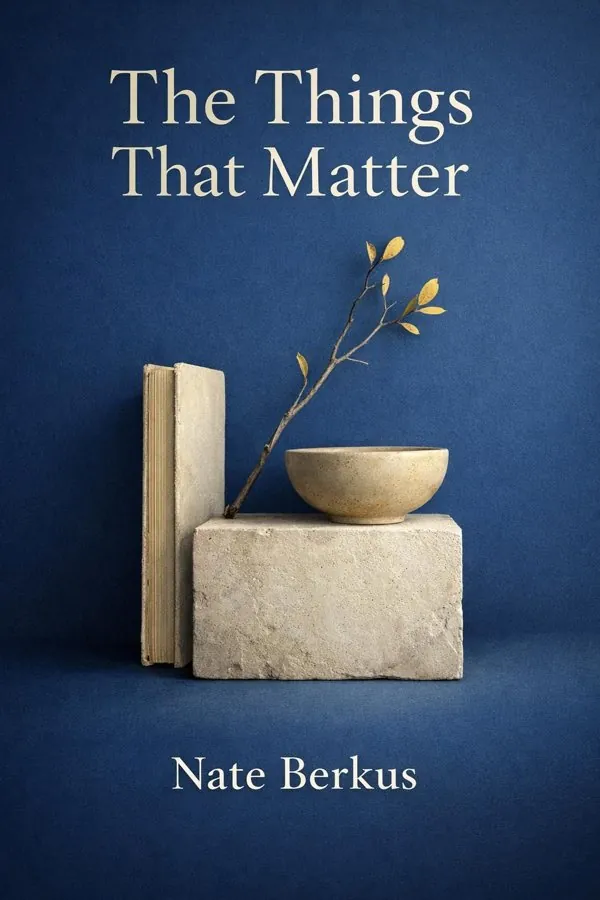
The Things That Matter: Summary & Key Insights
by Nate Berkus
 10 min10 chaptersAudio available
Key Takeaways from The Things That Matter
Our relationship with home does not begin when we buy furniture; it begins when we first learn what objects mean.
A home becomes powerful when it stores memory in visible form.
A room is never just a room; it is a story told through color, texture, objects, and arrangement.
The most compelling homes are not the most formal; they are the most honest.
Good design is not about imposing taste; it is about uncovering someone else’s truth.
What Is The Things That Matter About?
The Things That Matter by Nate Berkus is a design book spanning 11 pages. The Things That Matter is far more than a decorating book. In this deeply personal work, celebrated interior designer Nate Berkus argues that our homes are emotional biographies, shaped not just by taste but by memory, grief, identity, and love. Through essays, personal reflections, and richly visual examples from his own homes and the homes of friends and clients, Berkus shows that the objects we live with are never merely decorative. They hold stories, preserve connections, and help us make meaning out of our lives. What makes this book especially powerful is Berkus’s ability to connect design with vulnerability. He writes not only as a professional with a trained eye, but as someone who has experienced profound loss and understands how spaces can help us heal and begin again. His authority comes from years of design expertise, but the heart of the book lies in his emotional honesty. For anyone who has ever wondered why certain objects are impossible to throw away, why some rooms feel deeply comforting, or how to create a home that actually reflects who they are, this book offers both insight and guidance.
This FizzRead summary covers all 10 key chapters of The Things That Matter in approximately 10 minutes, distilling the most important ideas, arguments, and takeaways from Nate Berkus's work. Also available as an audio summary and Key Quotes Podcast.
The Things That Matter
The Things That Matter is far more than a decorating book. In this deeply personal work, celebrated interior designer Nate Berkus argues that our homes are emotional biographies, shaped not just by taste but by memory, grief, identity, and love. Through essays, personal reflections, and richly visual examples from his own homes and the homes of friends and clients, Berkus shows that the objects we live with are never merely decorative. They hold stories, preserve connections, and help us make meaning out of our lives. What makes this book especially powerful is Berkus’s ability to connect design with vulnerability. He writes not only as a professional with a trained eye, but as someone who has experienced profound loss and understands how spaces can help us heal and begin again. His authority comes from years of design expertise, but the heart of the book lies in his emotional honesty. For anyone who has ever wondered why certain objects are impossible to throw away, why some rooms feel deeply comforting, or how to create a home that actually reflects who they are, this book offers both insight and guidance.
Who Should Read The Things That Matter?
This book is perfect for anyone interested in design and looking to gain actionable insights in a short read. Whether you're a student, professional, or lifelong learner, the key ideas from The Things That Matter by Nate Berkus will help you think differently.
- ✓Readers who enjoy design and want practical takeaways
- ✓Professionals looking to apply new ideas to their work and life
- ✓Anyone who wants the core insights of The Things That Matter in just 10 minutes
Want the full summary?
Get instant access to this book summary and 100K+ more with Fizz Moment.
Get Free SummaryAvailable on App Store • Free to download
Key Chapters
Our relationship with home does not begin when we buy furniture; it begins when we first learn what objects mean. Berkus reflects on his early influences and shows how childhood environments quietly train our sense of beauty, comfort, and attachment. Growing up with a decorator mother, he was exposed to the idea that rooms were not accidental. Every chair, lamp, fabric, and heirloom carried feeling and intention. More importantly, the objects in his family were not treated as disposable items but as markers of continuity. They linked generations, memories, and ways of living.
This idea matters because many people assume taste is something reserved for professionals or developed through expensive shopping. Berkus suggests the opposite. Personal style often starts with what we absorbed in our earliest spaces: the table where family gathered, the quilt passed down through relatives, the scent and warmth of a familiar room. When we understand those influences, we gain access to our authentic preferences instead of copying trends.
In practical terms, this means asking yourself what kinds of spaces felt meaningful when you were young. Did you love cluttered rooms filled with books and history, or simple calm rooms with light and air? What objects from your childhood still carry emotional weight? Even recreating one small detail, such as a certain lamp glow or wooden texture, can reconnect you to that original sense of home.
Actionable takeaway: Make a list of five objects, rooms, or sensory details from childhood that still stay with you, and use them as clues to define your real design language.
A home becomes powerful when it stores memory in visible form. One of Berkus’s central ideas is that the objects we keep are not random possessions; they are memory containers. A framed photograph, a chipped ceramic bowl, a travel souvenir, or a chair inherited from someone we loved can anchor us to moments that would otherwise fade. These items turn space into narrative. They remind us where we have been, who mattered, and what we have survived.
Berkus’s reflections are especially compelling because he does not treat sentimental objects as clutter or sentimentality as weakness. Instead, he shows that emotional resonance is often what gives a room its soul. A beautiful room without memory may impress, but a room layered with meaningful objects can comfort, stabilize, and deepen our sense of self. This is why some homes feel instantly alive while others feel staged.
Practically, this concept encourages more intentional editing. Instead of displaying things because they are expensive or fashionable, display what helps you remember. A collection of old letters in a box, black-and-white family portraits, a stone from a meaningful trip, or books marked with your life stages can all become emotional architecture. Even ordinary objects can gain importance when arranged with care and attention.
The key is not to keep everything. It is to preserve what truly carries emotional charge and give it a visible place in your life. When objects are chosen for their story, your home becomes less about decoration and more about continuity.
Actionable takeaway: Walk through your home and identify three items that hold deep personal memories; move them to places where you will actually see and appreciate them daily.
A room is never just a room; it is a story told through color, texture, objects, and arrangement. Berkus believes design is most meaningful when it expresses identity rather than performance. Instead of asking whether a space looks polished enough, he asks whether it says something true about the person living there. This reframes design from a cosmetic exercise into a narrative one.
That idea has practical implications. If design is storytelling, then every choice communicates. Minimalism may tell a story of calm and discipline. Layered vintage pieces may tell a story of curiosity and depth. Family photographs, travel artifacts, collected books, handmade pieces, and inherited furniture all become narrative details. Berkus encourages readers to move away from generic ideas of "good taste" and toward spaces that reveal values, history, and aspirations.
This is also why copying a showroom or trend rarely leads to satisfaction. A trend might make a room look current, but if it does not connect to your life, it will eventually feel hollow. Berkus’s approach suggests that the most memorable interiors are not the most perfect ones but the most personal. The room should reflect the people inside it, including their contradictions and evolution.
To apply this, think of your home as if it were introducing you before you speak. What would it say? Does it communicate warmth, creativity, heritage, discipline, adventure, tenderness? Are there objects in your space that do not belong to your story at all?
Actionable takeaway: Choose one room and write a one-sentence statement about the story you want it to tell, then remove or add items so the room aligns with that message.
The most compelling homes are not the most formal; they are the most honest. Berkus emphasizes that personal spaces should be shaped around how people truly live, not around an imaginary ideal of perfection. A beautiful home that cannot accommodate morning coffee, family routines, work, grief, celebration, and rest is not fully successful. Real design begins when aesthetics and daily life support each other.
This matters because many people treat certain rooms as untouchable or design according to outside expectations. The result is often a space that looks right but feels wrong. Berkus pushes readers to ask better questions: Where do you naturally drop your bag? Where do conversations happen? What corner helps you feel safe? Where do children gather? Which light makes you exhale at the end of the day? A home becomes personal when it honors those realities.
Practical examples can be simple. A living room should invite the way you actually sit, not force uncomfortable postures. A bedside table should hold what you truly use. A kitchen should display the bowls, trays, and objects that support your rituals. Even layout choices, such as moving a chair closer to a window or creating a reading corner from unused space, can make a room feel more aligned with who you are.
Berkus’s larger point is that authenticity creates beauty. When a home reflects real habits and emotional needs, it becomes more functional and more moving at once.
Actionable takeaway: Observe one room for a week and note how you actually use it, then make one design change that supports your real behavior instead of your imagined lifestyle.
Good design is not about imposing taste; it is about uncovering someone else’s truth. In his client stories, Berkus reveals that the best designers function partly as translators. Their job is not simply to select attractive objects but to listen closely enough to understand what a client values, fears, remembers, and wants to feel at home. This makes design an empathetic practice.
What distinguishes Berkus’s perspective is his insistence that homes should not become monuments to the designer’s ego. A successful room should feel like the client at their best, not like a magazine spread wearing someone else’s identity. That requires asking questions beyond style preferences. What objects have stayed with you through multiple moves? What places do you return to in memory? What atmosphere helps you feel most grounded? The answers often reveal the emotional blueprint of a home.
For readers who are not designers, this insight still matters. It encourages more thoughtful conversations with partners, family members, or roommates about shared space. Instead of debating paint colors in isolation, talk about desired feelings: calm, warmth, creativity, openness, privacy. These deeper conversations lead to better choices.
This approach also explains why meaningful design often takes time. People are layered, and a truly personal home must reflect those layers. Listening, observing, and refining create spaces with staying power.
Actionable takeaway: Before changing a shared space, ask everyone involved to name three words they want the room to feel like, then use those words as the filter for every design decision.
After loss, the space around us changes meaning. Berkus writes with unusual depth about grief and renewal, showing how homes can become places of mourning, remembrance, and eventual reentry into life. Objects associated with loved ones can hurt to see, yet removing them too quickly can feel like a second loss. Design, in this context, becomes part of emotional recovery. It helps us decide what to preserve, what to transform, and how to continue living while honoring what has been lost.
This is one of the book’s most important contributions because it expands design beyond taste and function into the territory of healing. Berkus suggests that we do not move on by erasing memory. We move forward by integrating it. A room can hold grief without becoming frozen. A photograph can remain visible. A beloved object can be repositioned in a way that feels intentional rather than accidental. New pieces can enter the home not as replacements, but as signs that life is still unfolding.
Anyone who has gone through divorce, bereavement, relocation, or major transition can recognize this challenge. Sometimes changing a paint color, rearranging furniture, or introducing new textiles is not superficial at all. It is a way of making space for the next chapter.
The process should be gentle. Keep what carries love. Edit what creates paralysis. Allow the home to evolve at the pace your emotions can handle.
Actionable takeaway: If you are moving through a season of loss, choose one meaningful object to honor visibly and one area of your home to refresh as a signal that healing and memory can coexist.
We do not experience rooms only with our eyes; we feel them through surfaces, weight, warmth, and contrast. Berkus pays close attention to material and texture because they shape emotional atmosphere as much as color or layout. Linen softens a room. Worn leather adds history. Marble can bring quiet elegance. Old wood introduces warmth and age. These tactile qualities help explain why some spaces feel rich and grounded even when they are visually restrained.
This idea is especially useful for people who think good design requires more stuff. Berkus shows that depth often comes not from quantity but from the interplay of materials. A neutral room can feel flat if every surface is smooth and similar, yet the same palette can become compelling when layered with wool, stone, metal, velvet, glass, and reclaimed wood. Texture creates complexity without chaos.
Material choices also communicate values. Handmade ceramics suggest intimacy and craftsmanship. Patinated metals imply time and use. Natural fibers often make spaces feel calmer and more human. Even budget-friendly homes can gain sophistication through thoughtful texture mixing rather than expensive statement pieces.
To apply this, examine any room that feels unfinished. It may not need more decoration; it may need more contrast. Add a woven basket beside a glossy table, a soft throw over structured upholstery, or an aged wood stool near sleek cabinetry. The goal is to make the room feel inhabited and dimensional.
Actionable takeaway: Pick one room and add two new textures, such as woven, matte, rough, soft, or aged materials, to create more warmth and sensory richness.
Collecting becomes meaningful when it reflects discernment rather than accumulation. Berkus clearly loves objects, but he does not advocate filling a home indiscriminately. Instead, he treats collecting as curation: the thoughtful gathering of pieces that resonate personally and work together to tell a layered story. The difference between clutter and collection lies in intention.
This is an important distinction in a culture that encourages constant buying. A well-curated home is not built through impulse shopping alone. It grows over time through observation, restraint, and emotional clarity. Berkus values objects with history, craftsmanship, memory, and uniqueness. A humble flea-market find can matter more than a costly new item if it carries soul.
For everyday readers, this means learning to ask better questions before bringing something home. Do I love this object, or do I simply admire it? Does it connect to my life, my travels, my family, or my values? Will it still matter once the excitement of purchase fades? A home gains power when every object has earned its place.
Editing is part of the process too. Not everything deserves display, and not every collection needs to be large. A shelf of meaningful ceramics, a stack of favorite art books, or a few framed family artifacts can have stronger impact than dozens of unrelated decorative items.
Actionable takeaway: Start one intentional collection based on genuine meaning, not trend, and remove three decorative items that do not contribute to your home’s story.
The most interesting homes often reflect a life that has been lived beyond one zip code. Berkus highlights cultural and travel influences as powerful sources of design inspiration, not because they make a space look worldly, but because they connect us to experiences that changed us. A textile from Morocco, pottery from Mexico, a carved wooden object from Thailand, or a market find from Paris can carry atmosphere, memory, and perspective into everyday life.
What matters, however, is not collecting foreign objects for status. Berkus’s deeper point is that travel sharpens attention. It teaches us to notice proportion, craft, aging, color, ritual, and beauty in unfamiliar forms. Those observations can reshape our taste even if we bring home nothing. A love of plaster walls, low lighting, handwoven fabrics, courtyard plants, or informal dining may all emerge from lived experience elsewhere.
This principle applies locally as well. Cultural curiosity can begin with museums, neighborhood markets, artisans, historic buildings, and inherited traditions. The goal is to allow your home to be enriched by real encounters rather than generic imitation. When influence is personal and respectful, it deepens rather than flattens style.
A home informed by travel often feels more layered because it includes reminders of wonder, learning, and movement. These pieces make the space feel connected to a bigger world.
Actionable takeaway: Choose one object, pattern, or material from a meaningful place or cultural experience in your life and integrate it into your home in a way that honors its story.
The ultimate lesson in The Things That Matter is that beauty without authenticity is forgettable. Berkus repeatedly returns to the balance between visual elegance and emotional truth. A room can be refined, polished, and photographable, yet still feel empty if it has no connection to the people who live there. Conversely, a room with imperfect objects, layered history, and emotional honesty can feel profoundly beautiful because it is real.
This idea challenges both design perfectionism and consumerism. It says that the goal is not to achieve a flawless interior but to create an environment where beauty and identity reinforce each other. Berkus’s own lessons learned point toward maturity: trust what you love, let spaces evolve, value what carries meaning, and understand that home is never finished in a static sense. It changes as you change.
This is liberating for readers who feel intimidated by design. You do not need a huge budget, a fixed style label, or a pristine house. You need attentiveness. Notice what calms you, what energizes you, what reminds you of love, and what no longer belongs. Then shape your surroundings accordingly.
Authentic beauty also invites generosity. It allows guests to feel the human presence in a home rather than the pressure of performance. That kind of beauty is lasting because it comes from coherence between inner life and outer space.
Actionable takeaway: Choose one design decision this month based entirely on personal meaning rather than trend, approval, or resale value, and let that choice become the standard for future changes.
All Chapters in The Things That Matter
About the Author
Nate Berkus is an American interior designer, author, and television personality celebrated for his warm, accessible, and emotionally intelligent approach to design. He rose to national prominence through his appearances on The Oprah Winfrey Show, where he introduced millions of viewers to the idea that good design should reflect the lives and stories of the people who inhabit a space. Berkus later built a successful interior design firm, launched home collections, and became a recognized voice in books, television, and lifestyle media. His work stands out for combining refinement with authenticity, encouraging people to see their homes not as showcases of perfection but as personal narratives. Through his writing and design practice, Berkus has helped redefine interior design as both an aesthetic and deeply human art.
Get This Summary in Your Preferred Format
Read or listen to the The Things That Matter summary by Nate Berkus anytime, anywhere. FizzRead offers multiple formats so you can learn on your terms — all free.
Available formats: App · Audio · PDF · EPUB — All included free with FizzRead
Download The Things That Matter PDF and EPUB Summary
Key Quotes from The Things That Matter
“Our relationship with home does not begin when we buy furniture; it begins when we first learn what objects mean.”
“A home becomes powerful when it stores memory in visible form.”
“A room is never just a room; it is a story told through color, texture, objects, and arrangement.”
“The most compelling homes are not the most formal; they are the most honest.”
“Good design is not about imposing taste; it is about uncovering someone else’s truth.”
Frequently Asked Questions about The Things That Matter
The Things That Matter by Nate Berkus is a design book that explores key ideas across 10 chapters. The Things That Matter is far more than a decorating book. In this deeply personal work, celebrated interior designer Nate Berkus argues that our homes are emotional biographies, shaped not just by taste but by memory, grief, identity, and love. Through essays, personal reflections, and richly visual examples from his own homes and the homes of friends and clients, Berkus shows that the objects we live with are never merely decorative. They hold stories, preserve connections, and help us make meaning out of our lives. What makes this book especially powerful is Berkus’s ability to connect design with vulnerability. He writes not only as a professional with a trained eye, but as someone who has experienced profound loss and understands how spaces can help us heal and begin again. His authority comes from years of design expertise, but the heart of the book lies in his emotional honesty. For anyone who has ever wondered why certain objects are impossible to throw away, why some rooms feel deeply comforting, or how to create a home that actually reflects who they are, this book offers both insight and guidance.
You Might Also Like
The Design of Everyday Things
Don Norman
10 min
The Better Angels of Our Nature
Steven Pinker
10 min
A Designer's Art
Paul Rand
10 min
Architects' Sketchbooks
Various Editors
10 min
Architectural Graphic Standards
The American Institute of Architects
10 min
Design Is Storytelling
Ellen Lupton
10 minBrowse by Category
Ready to read The Things That Matter?
Get the full summary and 100K+ more books with Fizz Moment.