
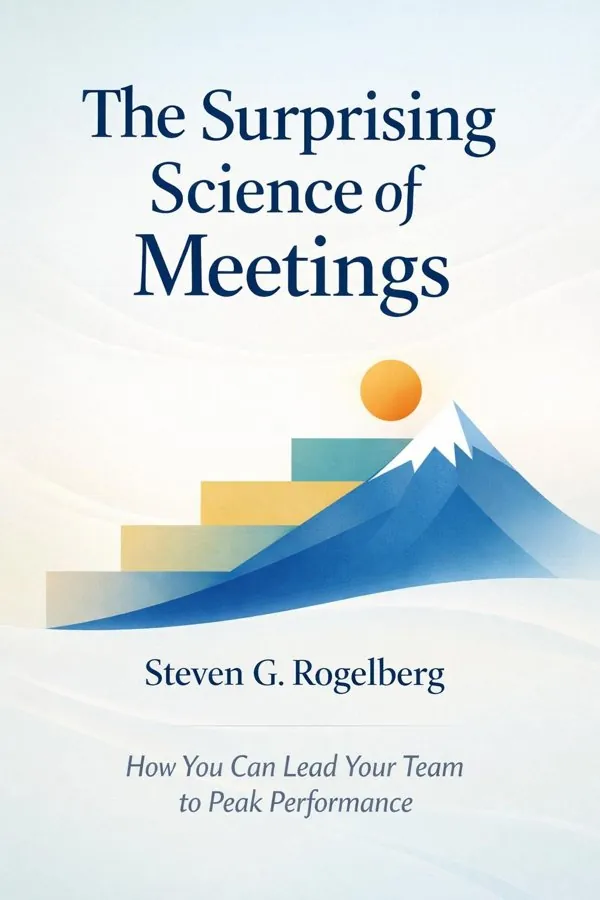
The Surprising Science of Meetings: How You Can Lead Your Team to Peak Performance: Summary & Key Insights
 10 min9 chaptersAudio available
What Is The Surprising Science of Meetings: How You Can Lead Your Team to Peak Performance About?
The Surprising Science of Meetings: How You Can Lead Your Team to Peak Performance by Steven G. Rogelberg is a organization book spanning 9 pages. Drawing on decades of research in organizational psychology, Steven G. Rogelberg reveals why most meetings fail and how leaders can transform them into productive, engaging, and energizing experiences. The book offers evidence-based strategies to improve meeting effectiveness, participation, and satisfaction, helping teams achieve better collaboration and performance.
This FizzRead summary covers all 9 key chapters of The Surprising Science of Meetings: How You Can Lead Your Team to Peak Performance in approximately 10 minutes, distilling the most important ideas, arguments, and takeaways from Steven G. Rogelberg's work. Also available as an audio summary and Key Quotes Podcast.
The Surprising Science of Meetings: How You Can Lead Your Team to Peak Performance
Drawing on decades of research in organizational psychology, Steven G. Rogelberg reveals why most meetings fail and how leaders can transform them into productive, engaging, and energizing experiences. The book offers evidence-based strategies to improve meeting effectiveness, participation, and satisfaction, helping teams achieve better collaboration and performance.
Who Should Read The Surprising Science of Meetings: How You Can Lead Your Team to Peak Performance?
This book is perfect for anyone interested in organization and looking to gain actionable insights in a short read. Whether you're a student, professional, or lifelong learner, the key ideas from The Surprising Science of Meetings: How You Can Lead Your Team to Peak Performance by Steven G. Rogelberg will help you think differently.
- ✓Readers who enjoy organization and want practical takeaways
- ✓Professionals looking to apply new ideas to their work and life
- ✓Anyone who wants the core insights of The Surprising Science of Meetings: How You Can Lead Your Team to Peak Performance in just 10 minutes
Want the full summary?
Get instant access to this book summary and 100K+ more with Fizz Moment.
Get Free SummaryAvailable on App Store • Free to download
Key Chapters
Before we can fix meetings, we must first understand them. Every day, tens of millions of meetings occur around the world. Despite this overwhelming presence, meetings remain one of the least studied elements of organizational life—at least until researchers began to explore them systematically. What they found was both enlightening and humbling.
Most professionals spend between thirty to fifty percent of their workweek in meetings, and senior managers often spend far more. Yet surveys repeatedly reveal that nearly half of that time feels wasted. What’s fascinating, however, is that even amid this dissatisfaction, people recognize the necessity of meetings. Employees don’t long for a world without meetings—they long for better meetings.
Science tells us that the average meeting size has grown, while agenda clarity has often declined. Electronic calendars make it easier than ever to schedule gatherings, yet they also create an illusion of convenience. Clicking “accept” becomes habitual, and attendance multiplies beyond what is functionally necessary. Through controlled studies, we now know that smaller, purpose-driven meetings produce more engagement, higher decision quality, and greater satisfaction.
The data also reveal a critical insight: people judge meeting quality not by the outcome alone but by how the meeting feels—whether their voices are heard, whether time is respected, and whether the process seems fair. This emotional component is not a soft add-on; it’s a core driver of performance. Teams that feel psychologically safe in meetings tend to innovate more, adapt faster, and execute decisions more effectively.
Understanding these findings is liberating. They tell us that meeting misery isn’t inevitable—it arises from specific, fixable practices. The science gives us a map to shift from frustration to effectiveness, from disengagement to collaboration.
If we’re to repair meetings, we must first recognize why they go wrong. Across organizations of every size, dysfunctional meetings share familiar symptoms: unclear purpose, poor facilitation, weak preparation, and lack of engagement. Sometimes they exist out of tradition—recurring sessions that no one questions, where agendas have become rote exercises detached from real needs.
One of the most harmful misconceptions is that a meeting equals progress. Leaders often schedule gatherings as placeholders for action rather than mechanisms for it. Without a well-defined purpose—whether to decide, brainstorm, or align—a meeting becomes little more than a ritual of information dumping. Preparation is another chronic weakness: how often do participants show up without having read materials or considered key questions? That absence of forethought transforms meetings into catch-up sessions rather than accelerators.
Then there’s the problem of participation. Too often, a few dominant voices monopolize the air while quieter members disengage. This phenomenon, known as the 'airtime imbalance,' breeds dissatisfaction and stifles creativity. Psychological research shows that diverse input improves decisions, but only when leaders deliberately design an environment of equity and inclusion.
Identifying these issues matters because awareness leads to agency. The simple act of reflecting—asking your team what’s working in your meetings and what isn’t—creates the foundation for change. Meetings may be a collective activity, but improving them begins with individual intention and responsibility.
+ 7 more chapters — available in the FizzRead app
All Chapters in The Surprising Science of Meetings: How You Can Lead Your Team to Peak Performance
About the Author
Steven G. Rogelberg is a professor of organizational science, management, and psychology at the University of North Carolina at Charlotte. He is an expert in workplace dynamics and leadership, with extensive research on meetings, employee engagement, and organizational effectiveness.
Get This Summary in Your Preferred Format
Read or listen to the The Surprising Science of Meetings: How You Can Lead Your Team to Peak Performance summary by Steven G. Rogelberg anytime, anywhere. FizzRead offers multiple formats so you can learn on your terms — all free.
Available formats: App · Audio · PDF · EPUB — All included free with FizzRead
Download The Surprising Science of Meetings: How You Can Lead Your Team to Peak Performance PDF and EPUB Summary
Key Quotes from The Surprising Science of Meetings: How You Can Lead Your Team to Peak Performance
“Before we can fix meetings, we must first understand them.”
“If we’re to repair meetings, we must first recognize why they go wrong.”
Frequently Asked Questions about The Surprising Science of Meetings: How You Can Lead Your Team to Peak Performance
The Surprising Science of Meetings: How You Can Lead Your Team to Peak Performance by Steven G. Rogelberg is a organization book that explores key ideas across 9 chapters. Drawing on decades of research in organizational psychology, Steven G. Rogelberg reveals why most meetings fail and how leaders can transform them into productive, engaging, and energizing experiences. The book offers evidence-based strategies to improve meeting effectiveness, participation, and satisfaction, helping teams achieve better collaboration and performance.
You Might Also Like

A Guide to the Project Management Body of Knowledge (PMBOK® Guide)
Project Management Institute
10 min
Organizational Behavior
Stephen P. Robbins
10 min
Accelerate: The Science of Lean Software and DevOps – Building and Scaling High Performing Technology Organizations
Nicole Forsgren, Jez Humble, Gene Kim
10 min
Awakening Compassion at Work: The Quiet Power That Elevates People and Organizations
Monica C. Worline, Jane E. Dutton
10 min
Building an Inclusive Organization: Leveraging the Power of a Diverse Workforce
Stephen Frost
10 min
Collaborative Intelligence: Thinking with People Who Think Differently
Dawna Markova, Angie McArthur
10 minBrowse by Category
Ready to read The Surprising Science of Meetings: How You Can Lead Your Team to Peak Performance?
Get the full summary and 100K+ more books with Fizz Moment.