
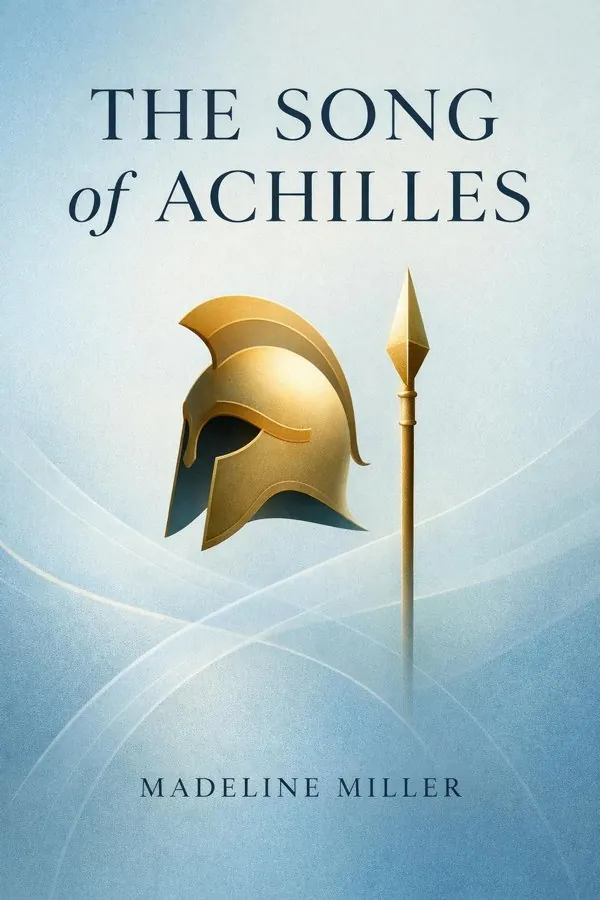
The Song of Achilles: Summary & Key Insights
 10 min9 chaptersAudio available
Key Takeaways from The Song of Achilles
Some of the most powerful stories begin not with greatness, but with exclusion.
A legend becomes truly compelling only when we glimpse the person trapped inside it.
The deepest bonds are rarely built through dramatic declarations alone; they are formed through repeated acts of attention.
Peace can be as transformative as conflict, but literature often forgets this.
One of the novel’s most haunting insights is that knowing the future does not free a person; it can trap them inside expectation.
What Is The Song of Achilles About?
The Song of Achilles by Madeline Miller is a classics book spanning 4 pages. Madeline Miller’s The Song of Achilles is a luminous retelling of one of the oldest stories in Western literature, but it feels startlingly intimate and new. Drawing on Homer’s Iliad and wider Greek myth, Miller shifts the center of the tale away from battlefield legend and into the private life of Patroclus, the exiled prince who becomes Achilles’ closest companion, beloved, and witness. Through Patroclus’ voice, the novel traces their bond from awkward boyhood to deep devotion, then follows them into the brutal machinery of the Trojan War, where love collides with prophecy, pride, and the hunger for immortality. What makes the book matter is not only its romance, but its moral vision. Miller asks what glory costs, who pays for heroic ambition, and whether tenderness can survive in a world organized around violence. Her authority comes from both scholarship and artistry: trained as a classicist, she knows the ancient sources deeply, yet writes with emotional clarity and lyrical force. The result is a novel that honors myth while restoring its human pulse, turning familiar legends into a meditation on love, fate, grief, and the fragile dignity of being remembered truly.
This FizzRead summary covers all 9 key chapters of The Song of Achilles in approximately 10 minutes, distilling the most important ideas, arguments, and takeaways from Madeline Miller's work. Also available as an audio summary and Key Quotes Podcast.
The Song of Achilles
Madeline Miller’s The Song of Achilles is a luminous retelling of one of the oldest stories in Western literature, but it feels startlingly intimate and new. Drawing on Homer’s Iliad and wider Greek myth, Miller shifts the center of the tale away from battlefield legend and into the private life of Patroclus, the exiled prince who becomes Achilles’ closest companion, beloved, and witness. Through Patroclus’ voice, the novel traces their bond from awkward boyhood to deep devotion, then follows them into the brutal machinery of the Trojan War, where love collides with prophecy, pride, and the hunger for immortality.
What makes the book matter is not only its romance, but its moral vision. Miller asks what glory costs, who pays for heroic ambition, and whether tenderness can survive in a world organized around violence. Her authority comes from both scholarship and artistry: trained as a classicist, she knows the ancient sources deeply, yet writes with emotional clarity and lyrical force. The result is a novel that honors myth while restoring its human pulse, turning familiar legends into a meditation on love, fate, grief, and the fragile dignity of being remembered truly.
Who Should Read The Song of Achilles?
This book is perfect for anyone interested in classics and looking to gain actionable insights in a short read. Whether you're a student, professional, or lifelong learner, the key ideas from The Song of Achilles by Madeline Miller will help you think differently.
- ✓Readers who enjoy classics and want practical takeaways
- ✓Professionals looking to apply new ideas to their work and life
- ✓Anyone who wants the core insights of The Song of Achilles in just 10 minutes
Want the full summary?
Get instant access to this book summary and 100K+ more with Fizz Moment.
Get Free SummaryAvailable on App Store • Free to download
Key Chapters
Some of the most powerful stories begin not with greatness, but with exclusion. Patroclus enters The Song of Achilles as a boy who is defined by what he lacks: beauty, strength, confidence, rank, and the easy approval of his father. After a childhood accident leads to another boy’s death, he is exiled from his home and sent to the court of King Peleus. In mythic terms, he is almost an afterthought beside the radiant Achilles. Yet this is precisely Miller’s point. By placing an ordinary, uncertain boy at the center of an epic world, she transforms the story from a tale about distant heroes into one about perception, loyalty, and emotional truth.
Patroclus’ awkwardness is not a weakness in the novel’s design; it is the lens that lets readers question the values around him. Through his eyes, courtly beauty, athletic competition, and martial expectation lose some of their glamour. He notices what the heroic code overlooks: humiliation, fear, loneliness, and the small gestures that reveal character. This makes his eventual connection with Achilles feel earned rather than inevitable. Patroclus is not admired by the world, but he learns to see and love someone whom the world only worships.
In practical terms, this opening arc offers a useful lesson about identity. Many people assume they must become more impressive before their lives gain meaning. Miller argues the opposite: significance often begins in attention, not status. Patroclus matters because he learns to observe honestly, love faithfully, and resist false measures of worth.
Actionable takeaway: When you feel overshadowed by louder or more celebrated people, focus on developing depth of character and clarity of perception. Being overlooked can become the very thing that teaches you to see what others miss.
A legend becomes truly compelling only when we glimpse the person trapped inside it. Achilles is introduced as dazzling, gifted, and almost supernaturally beautiful—the son of the sea goddess Thetis and the mortal king Peleus, a boy destined for extraordinary fame. Yet Miller resists turning him into a marble statue. Through Patroclus’ growing closeness to him, Achilles emerges not merely as a future warrior, but as a young person full of warmth, curiosity, vanity, kindness, appetite, and fear.
This humanization is one of the novel’s greatest achievements. Achilles plays music, jokes, sulks, loves, and seeks approval. He can be generous and selfish, innocent and proud. His legendary gifts do not free him from human pressure; they intensify it. Everyone around him wants something from him: his mother wants divine greatness, kings want military victory, bards want a name to sing, and prophecy wants fulfillment. Even before Troy, Achilles lives under the crushing burden of being told who he must become.
This matters because it reshapes how we think about exceptional people. Talent is often romanticized as freedom, but Miller suggests it can also become a prison. The more gifted Achilles is, the less room he seems to have to choose an ordinary life. Patroclus’ love matters because it offers Achilles something almost no one else does: a relationship in which he is valued not as a symbol, but as a person.
In modern life, this insight applies far beyond mythology. High achievers, public figures, and even capable people within families can become trapped by expectation. Others see performance; very few see the self beneath it. Miller invites readers to ask whether admiration without understanding is just another form of loneliness.
Actionable takeaway: If someone in your life seems impressive or destined for success, make space to know the person beneath the role. Genuine care begins when we stop loving people for what they represent and start loving them for who they are.
The deepest bonds are rarely built through dramatic declarations alone; they are formed through repeated acts of attention. The relationship between Patroclus and Achilles develops gradually, beginning in shared silence, private companionship, and the steady comfort of being chosen. What makes their love convincing is that Miller allows it to unfold through ordinary rhythms: meals, walks, lessons, conversations, music, and mutual refuge from the demands of the world. Their connection is not a sudden plot twist but a pattern of recognition.
This slow development gives emotional weight to everything that follows. Patroclus sees Achilles before the world fully claims him, and Achilles sees Patroclus when almost no one else does. Their intimacy is rooted in contrast: one is famous before he has earned anything; the other is disregarded before he has had a chance to become anyone. Together, they create a private reality in which reputation matters less than presence. That is why the novel’s romance feels both tender and tragic. It is not simply desire that binds them, but shared life.
Miller also shows that love is not the erasure of difference. Achilles remains ambitious, luminous, and increasingly entangled with destiny. Patroclus remains grounded, skeptical of heroic posturing, and emotionally attuned to suffering. Their closeness does not make them identical; it gives each a place where difference can be held safely. This is an important corrective to idealized romance. Real love does not require sameness. It requires witness, trust, and the willingness to keep choosing one another amid external pressure.
Readers can apply this insight by rethinking what sustains meaningful relationships. Grand gestures matter far less than consistency. The people who transform our lives are often those who remember us accurately and make room for our unguarded selves.
Actionable takeaway: Strengthen your closest relationships through small, repeatable acts of attention—listening carefully, showing up consistently, and creating shared rituals that build trust over time.
Peace can be as transformative as conflict, but literature often forgets this. The years Achilles and Patroclus spend with the centaur Chiron form the emotional center of The Song of Achilles because they reveal what life might look like outside the brutal demands of kings, war, and prophecy. On the mountain, the boys learn healing, music, hunting, and the patterns of the natural world. The lessons matter not only for what they teach, but for what they refuse: competition, vanity, and the obsession with glory.
Chiron’s world offers an alternate education. Instead of training Achilles solely to become the greatest fighter of his age, it broadens his humanity. Patroclus, too, flourishes there, especially through learning medicine and care. These studies become crucial later, but their immediate significance is moral. They show that skill can serve life rather than destroy it. In a story moving toward war, the mountain becomes a sanctuary of possibility—a vision of who these characters are when they are not being shaped by other people’s ambitions.
This section also deepens the contrast between fame and fulfillment. Achilles is happy there, even though little on the mountain contributes to the public reputation he is meant to build. The implication is subtle but powerful: people do not always feel most alive in the places where they are most celebrated. Sometimes they feel most whole where no one is watching.
Modern readers can recognize this tension in their own lives. Many are pushed toward visible success while quietly longing for slower, more nourishing forms of growth. Chiron’s tutelage suggests that craftsmanship, contemplation, and care are not detours from a meaningful life—they may be its foundation.
Actionable takeaway: Create a “mountain” in your own life—a space, routine, or practice where you develop skills that nourish you rather than merely impress others. What restores your humanity is often what prepares you best for hardship.
One of the novel’s most haunting insights is that knowing the future does not free a person; it can trap them inside expectation. Achilles grows up under the shadow of prophecy: he can either live a long, obscure life or die young and win eternal glory at Troy. This knowledge shapes not only his choices, but everyone’s treatment of him. Fate is never presented as a simple supernatural fact. It functions socially, psychologically, and emotionally. Once a story about your destiny hardens around you, it becomes difficult to imagine yourself outside it.
Miller handles prophecy not as cheap suspense, but as a force that narrows human possibility. Achilles is constantly asked to value remembrance over lived experience. The future promised to him sounds magnificent in songs, yet devastating in human terms. Patroclus understands this more clearly than most. He sees that glory, however immortal, cannot hold a hand, heal a wound, or preserve a shared life. The novel’s tension comes partly from this mismatch: public culture glorifies destiny, while private love values presence.
This dynamic has modern echoes. Many people live under secular forms of prophecy: family expectations, career identities, labels assigned in youth, or narratives about what they are “meant” to become. These stories can motivate, but they can also suffocate. When ambition becomes destiny, alternatives start to look like failure, even if they might lead to a fuller life.
The novel does not offer an easy escape from fate, but it sharpens our awareness of its cost. It asks whether the stories we inherit are truly ours, and whether admiration from the future is worth the loss of the present. That question reaches well beyond myth.
Actionable takeaway: Examine the “prophecies” in your own life—the expectations or labels that guide your choices. Ask whether they reflect your deepest values or merely the story others find most impressive.
War in The Song of Achilles is not an arena of clean heroism, but a machine that twists virtues into liabilities. Once at Troy, the ideals celebrated in song—honor, valor, renown—begin to reveal their darker reality. Campaigns drag on for years. Captives are traded as trophies. Men argue over prestige while others suffer and die. Through Patroclus’ perspective, the famous Trojan War becomes less a glorious contest than a prolonged spectacle of ego, grief, and dehumanization.
This is where Miller’s retelling most sharply challenges traditional heroics. Achilles’ martial brilliance is real, but so is the moral corrosion around it. Agamemnon’s arrogance, the rivalry among commanders, and the treatment of women as spoils expose the violence embedded in the heroic system. Patroclus increasingly stands apart because he responds not to abstract honor, but to concrete suffering. He notices the wounded, the displaced, the frightened, and the powerless. His compassion does not make him less courageous; it makes him morally legible in a world that has lost perspective.
The war chapters also show how institutions can normalize behavior that would seem monstrous in intimate life. People who might be decent in private become cruel when prestige, tribe, and narrative justify their actions. That insight remains painfully relevant. Whether in politics, workplaces, online culture, or literal warfare, systems often reward aggression, posturing, and loyalty to image over responsibility to people.
By refusing to romanticize Troy, Miller invites readers to reconsider what strength means. The book suggests that preserving tenderness amid violence may require greater courage than winning admiration through force. Patroclus’ ethics become a quiet counterargument to the entire heroic order.
Actionable takeaway: In competitive environments, resist measuring success only by visibility or victory. Pay attention to who is being harmed, ignored, or treated as expendable—and let compassion guide at least one concrete decision.
Pride often disguises itself as principle, and that confusion can be catastrophic. Achilles’ withdrawal from battle after his conflict with Agamemnon is one of the defining turns in the Trojan War, and Miller presents it not as a simple act of justified outrage, but as a morally complicated collapse. Achilles has been insulted and wronged, yet his response allows anger to expand until it outweighs the lives of those around him. His refusal becomes a test of identity: is he protecting his dignity, or preserving a grand image of himself at any cost?
This is one of the novel’s most unsettling truths. Even people capable of deep love can become enthralled by wounded pride. Achilles loves Patroclus, but he is also attached to a vision of himself that must not be diminished. That attachment makes him vulnerable to paralysis. The tragedy is not that he feels anger—anger can be valid—but that he begins to treat suffering as secondary to the maintenance of symbolic honor.
Patroclus serves as the moral counterweight here. He understands that real life keeps unfolding while great men defend abstractions. Soldiers bleed, friends perish, and grief multiplies. The longer Achilles remains captive to rage, the more the novel asks readers to confront a difficult question: what are we willing to sacrifice in order to feel vindicated?
This idea applies far beyond epic conflict. In marriages, workplaces, friendships, and public life, people often hold onto resentment because surrendering it feels like weakness. Yet prolonged pride can quietly destroy the very relationships and values we claim to protect. Miller shows how emotional absolutism hardens into tragedy.
Actionable takeaway: When you feel deeply wronged, ask not only whether your anger is justified, but what it is costing. Choose one step—conversation, compromise, apology, or boundary—that protects your dignity without letting pride consume what matters most.
Sometimes a single loss reveals what all prior choices were building toward. Patroclus’ death is the emotional and moral rupture of The Song of Achilles. It is not simply a plot event that advances the myth toward its known conclusion; it is the moment when love, war, identity, and fate collide irreversibly. Patroclus enters battle trying to save lives, to break the paralysis caused by Achilles’ pride, and to stop further destruction. His motives are rooted in care rather than self-glory, which makes the consequences even more devastating.
After his death, everything in the novel changes meaning. Achilles’ fame no longer appears merely brilliant; it becomes inseparable from irreparable loss. Revenge, once framed by heroic tradition as noble, is exposed as grief in armor. The machinery of prophecy continues, but it now feels emptied of grandeur. What remains is mourning. Miller’s genius lies in showing that the death of one beloved person can reorganize an entire moral universe. The war continues, songs will be sung, names will be remembered—but none of that compensates for the intimate absence at the story’s center.
This section speaks to a universal human truth: we often understand the value of a relationship most fully when it is threatened or gone. It also reminds readers that acts motivated by love can still end in catastrophe, not because they are meaningless, but because human life is fragile and history is merciless.
In practical terms, the lesson is not to avoid loving deeply out of fear of loss. It is to recognize that love gives life its weight, even when it cannot protect us from suffering. What matters most is rarely what history rewards.
Actionable takeaway: Do not postpone expressions of loyalty, gratitude, or affection. Say what matters now, while the people you love are still here to hear it.
The novel’s ending insists that remembrance is not passive; it is an act of justice. After death, what remains contested is not only who lived, but how they will be told. Patroclus’ spirit lingers, unable to rest, because he has been denied proper burial and recognition. Achilles may be destined for immortal fame, but even fame proves incomplete if the story severs him from the one who truly knew him. The final movement of the novel shifts from war and vengeance toward memory, naming, and the restoration of truth.
This is where Miller subtly overturns the heroic tradition she has been inhabiting. Classical glory is built on public song, but public song can distort. It remembers victories and genealogies while flattening private bonds. Thetis, who has long resisted Patroclus and what he means to her son, eventually becomes central to the work of remembrance. In acknowledging Patroclus and joining his name with Achilles’, she grants not only burial rites, but narrative dignity. Love is preserved not through conquest, but through the willingness to speak a fuller truth.
For readers, this ending offers a profound reflection on how we honor the dead and the living. Memory is ethical. The stories we tell about people can either erase what mattered most to them or restore it. This applies in families, friendships, institutions, and culture at large. To remember someone truthfully is to resist reducing them to a role, achievement, failure, or public image.
The conclusion also clarifies the novel’s title. Achilles’ “song” is no longer only the music of glory. It is the shared story that includes tenderness, vulnerability, and love. In that sense, memory becomes the final victory over distortion.
Actionable takeaway: Practice truthful remembrance. When speaking about people—especially those absent or gone—include not just what they achieved, but who they were, whom they loved, and what gave their life meaning.
All Chapters in The Song of Achilles
About the Author
Madeline Miller is an American novelist and classicist known for bringing ancient Greek myths to life through emotionally resonant, beautifully crafted fiction. She studied Latin and Ancient Greek at Brown University, where she developed a deep foundation in classical literature, and she later spent years teaching those subjects. Her scholarly background gives her work unusual depth and fidelity to mythic tradition, while her storytelling makes those old narratives feel vivid and immediate for modern readers. Miller’s debut novel, The Song of Achilles, won the 2012 Orange Prize for Fiction and established her as a major literary voice. She later published Circe, another acclaimed reimagining of Greek myth. Across her work, Miller is celebrated for combining classical learning with lyrical prose, psychological nuance, and a strong interest in overlooked perspectives.
Get This Summary in Your Preferred Format
Read or listen to the The Song of Achilles summary by Madeline Miller anytime, anywhere. FizzRead offers multiple formats so you can learn on your terms — all free.
Available formats: App · Audio · PDF · EPUB — All included free with FizzRead
Download The Song of Achilles PDF and EPUB Summary
Key Quotes from The Song of Achilles
“Some of the most powerful stories begin not with greatness, but with exclusion.”
“A legend becomes truly compelling only when we glimpse the person trapped inside it.”
“The deepest bonds are rarely built through dramatic declarations alone; they are formed through repeated acts of attention.”
“Peace can be as transformative as conflict, but literature often forgets this.”
“One of the novel’s most haunting insights is that knowing the future does not free a person; it can trap them inside expectation.”
Frequently Asked Questions about The Song of Achilles
The Song of Achilles by Madeline Miller is a classics book that explores key ideas across 9 chapters. Madeline Miller’s The Song of Achilles is a luminous retelling of one of the oldest stories in Western literature, but it feels startlingly intimate and new. Drawing on Homer’s Iliad and wider Greek myth, Miller shifts the center of the tale away from battlefield legend and into the private life of Patroclus, the exiled prince who becomes Achilles’ closest companion, beloved, and witness. Through Patroclus’ voice, the novel traces their bond from awkward boyhood to deep devotion, then follows them into the brutal machinery of the Trojan War, where love collides with prophecy, pride, and the hunger for immortality. What makes the book matter is not only its romance, but its moral vision. Miller asks what glory costs, who pays for heroic ambition, and whether tenderness can survive in a world organized around violence. Her authority comes from both scholarship and artistry: trained as a classicist, she knows the ancient sources deeply, yet writes with emotional clarity and lyrical force. The result is a novel that honors myth while restoring its human pulse, turning familiar legends into a meditation on love, fate, grief, and the fragile dignity of being remembered truly.
You Might Also Like






Browse by Category
Ready to read The Song of Achilles?
Get the full summary and 100K+ more books with Fizz Moment.