
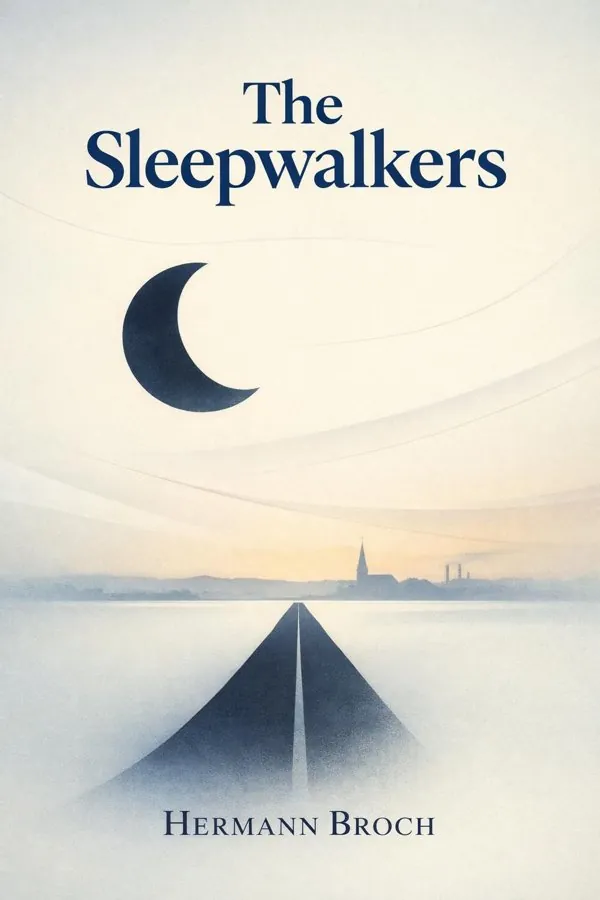
The Sleepwalkers: A Trilogy: Summary & Key Insights
 10 min8 chaptersAudio available
What Is The Sleepwalkers: A Trilogy About?
The Sleepwalkers: A Trilogy by Hermann Broch is a classics book spanning 8 pages. The Sleepwalkers is a trilogy of novels by Austrian writer Hermann Broch, originally published between 1931 and 1932. It consists of three parts: Pasenow or The Romantic (1888), Esch or The Anarchist (1903), and Huguenau or The Realist (1918). The work explores the moral and spiritual disintegration of European society from the late 19th century to the end of World War I and is considered one of the most significant achievements of literary modernism.
This FizzRead summary covers all 8 key chapters of The Sleepwalkers: A Trilogy in approximately 10 minutes, distilling the most important ideas, arguments, and takeaways from Hermann Broch's work. Also available as an audio summary and Key Quotes Podcast.
The Sleepwalkers: A Trilogy
The Sleepwalkers is a trilogy of novels by Austrian writer Hermann Broch, originally published between 1931 and 1932. It consists of three parts: Pasenow or The Romantic (1888), Esch or The Anarchist (1903), and Huguenau or The Realist (1918). The work explores the moral and spiritual disintegration of European society from the late 19th century to the end of World War I and is considered one of the most significant achievements of literary modernism.
Who Should Read The Sleepwalkers: A Trilogy?
This book is perfect for anyone interested in classics and looking to gain actionable insights in a short read. Whether you're a student, professional, or lifelong learner, the key ideas from The Sleepwalkers: A Trilogy by Hermann Broch will help you think differently.
- ✓Readers who enjoy classics and want practical takeaways
- ✓Professionals looking to apply new ideas to their work and life
- ✓Anyone who wants the core insights of The Sleepwalkers: A Trilogy in just 10 minutes
Want the full summary?
Get instant access to this book summary and 100K+ more with Fizz Moment.
Get Free SummaryAvailable on App Store • Free to download
Key Chapters
Joachim von Pasenow stands at the center of the first novel, an officer and gentleman of that Prussian world that held honor as its supreme virtue. When I imagined him, I saw a man bound by form — a man for whom the uniform, the gesture, even the manner of addressing a superior, constituted not habit but ontology. His identity depended on the continuation of a world governed by rules, hierarchy, and ceremony. But already around him, Europe was shifting. The industrial revolution, the liberal bourgeois spirit, the new tempo of urban life — all these forces were eroding the foundations upon which Pasenow’s romantic code was built.
Pasenow’s story is one of confusion between dream and duty. He believes himself faithful, noble, protective of the woman he loves; yet, in truth, his emotions are imprisoned within the same social apparatus that defines his sense of honor. His affair with Ruzena, a woman from a more spontaneous and sensual sphere, exposes the hollowness of his ideals — ideals that cannot adapt to human passion. For Pasenow, love must be clothed in ritual; naked feeling is intolerable. He covers his vulnerability with his uniform, as Europe covers its uncertainty with rhetoric of tradition.
Within Pasenow, I dramatized the last flicker of Romanticism, the belief that meaning resides in form. But forms can survive only as long as their underlying faith remains; once the faith dissolves, those forms become shells. Thus, Pasenow’s life is a metaphor for Europe at the end of the 19th century: proud, disciplined, faithful to appearances, yet rotten from within. He sees the world changing — he senses that the uniform is no longer enough — but he cannot abandon it. His tragedy is not that he loves too little, but that he loves wrongly; he loves the idea of order, not the essence of being.
In writing Pasenow’s inner conflicts, I sought to express what it feels like to live on the edge of historical transition. He perceives modernity as a threat, but in that fear lies fascination. The Romantic lives by symbols; when the symbol loses power, his world collapses. For Joachim, family honor and military decorum are not optional codes but sacred boundaries that define reality. Yet, around him, industrialists, merchants, and journalists live by other values — profit, success, individual freedom. The gulf between these worlds is vast, and Pasenow feels it without fully comprehending its cause.
His struggle reveals a deeper moral conflict: the battle between spiritual continuity and temporal change. Romanticism insists that truth lies in the eternal — that order, beauty, and virtue are reflections of a higher metaphysical harmony. Modernity denies this, replacing transcendence with utility. Pasenow’s paralysis, his inability to surrender to life’s immediacy, tells us what it means when form no longer has substance.
In his hesitations and his rituals, we see the death of an age that believed in meaning through tradition. The Romantic cannot survive the modern; his gestures become absurd once their cosmology fades. He becomes a sleepwalker, moving through time with eyes closed, unaware that the floor beneath him has disappeared. I wanted the reader to feel this fading — not as an external event, but as an internal exhaustion of belief.
+ 6 more chapters — available in the FizzRead app
All Chapters in The Sleepwalkers: A Trilogy
About the Author
Hermann Broch (1886–1951) was an Austrian novelist and essayist regarded as one of the foremost figures of literary modernism. His works, including The Sleepwalkers and The Death of Virgil, combine philosophical reflection with narrative form and examine the spiritual condition of Western civilization in the 20th century.
Get This Summary in Your Preferred Format
Read or listen to the The Sleepwalkers: A Trilogy summary by Hermann Broch anytime, anywhere. FizzRead offers multiple formats so you can learn on your terms — all free.
Available formats: App · Audio · PDF · EPUB — All included free with FizzRead
Download The Sleepwalkers: A Trilogy PDF and EPUB Summary
Key Quotes from The Sleepwalkers: A Trilogy
“Joachim von Pasenow stands at the center of the first novel, an officer and gentleman of that Prussian world that held honor as its supreme virtue.”
“In writing Pasenow’s inner conflicts, I sought to express what it feels like to live on the edge of historical transition.”
Frequently Asked Questions about The Sleepwalkers: A Trilogy
The Sleepwalkers: A Trilogy by Hermann Broch is a classics book that explores key ideas across 8 chapters. The Sleepwalkers is a trilogy of novels by Austrian writer Hermann Broch, originally published between 1931 and 1932. It consists of three parts: Pasenow or The Romantic (1888), Esch or The Anarchist (1903), and Huguenau or The Realist (1918). The work explores the moral and spiritual disintegration of European society from the late 19th century to the end of World War I and is considered one of the most significant achievements of literary modernism.
You Might Also Like
Browse by Category
Ready to read The Sleepwalkers: A Trilogy?
Get the full summary and 100K+ more books with Fizz Moment.