
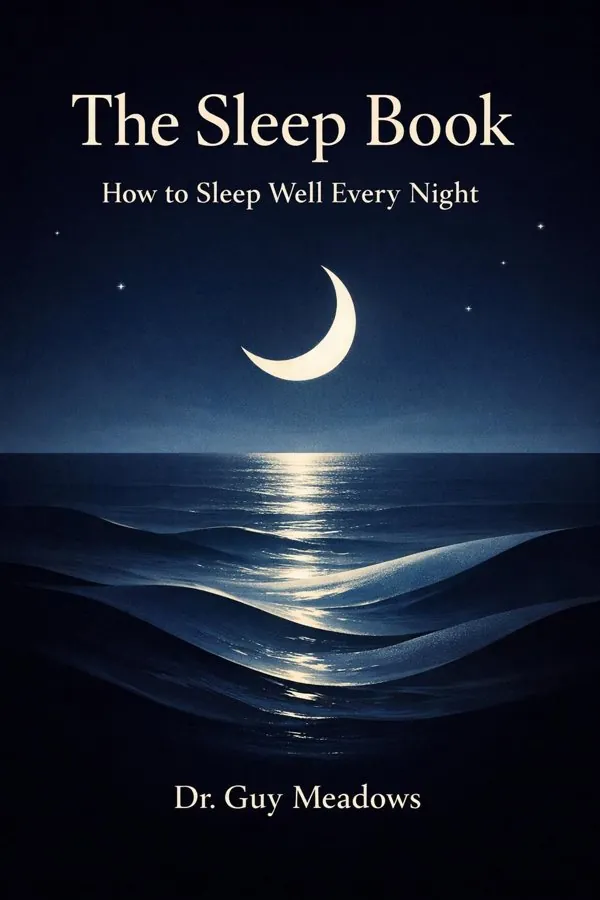
The Sleep Book: How to Sleep Well Every Night: Summary & Key Insights
 10 min8 chaptersAudio available
What Is The Sleep Book: How to Sleep Well Every Night About?
The Sleep Book: How to Sleep Well Every Night by Dr. Guy Meadows is a sleep book spanning 8 pages. The Sleep Book offers a five-week plan developed by Dr. Guy Meadows to help readers overcome insomnia and sleep problems through mindfulness and Acceptance and Commitment Therapy (ACT) techniques. It provides practical guidance for achieving restful sleep without relying on medication or rigid sleep routines.
This FizzRead summary covers all 8 key chapters of The Sleep Book: How to Sleep Well Every Night in approximately 10 minutes, distilling the most important ideas, arguments, and takeaways from Dr. Guy Meadows's work. Also available as an audio summary and Key Quotes Podcast.
The Sleep Book: How to Sleep Well Every Night
The Sleep Book offers a five-week plan developed by Dr. Guy Meadows to help readers overcome insomnia and sleep problems through mindfulness and Acceptance and Commitment Therapy (ACT) techniques. It provides practical guidance for achieving restful sleep without relying on medication or rigid sleep routines.
Who Should Read The Sleep Book: How to Sleep Well Every Night?
This book is perfect for anyone interested in sleep and looking to gain actionable insights in a short read. Whether you're a student, professional, or lifelong learner, the key ideas from The Sleep Book: How to Sleep Well Every Night by Dr. Guy Meadows will help you think differently.
- ✓Readers who enjoy sleep and want practical takeaways
- ✓Professionals looking to apply new ideas to their work and life
- ✓Anyone who wants the core insights of The Sleep Book: How to Sleep Well Every Night in just 10 minutes
Want the full summary?
Get instant access to this book summary and 100K+ more with Fizz Moment.
Get Free SummaryAvailable on App Store • Free to download
Key Chapters
Sleep is one of the most natural processes the body performs, and yet modern culture has made it the site of relentless effort and control. In the opening chapters, I explain how most people misunderstand insomnia. It’s not simply a matter of insufficient sleep hygiene or a misfiring body system. Insomnia is a learned struggle—a psychological tug-of-war between wakefulness and the desire to escape it.
The biology of sleep is beautifully self-regulating. Our bodies come equipped with circadian rhythms, hormonal cues, and restorative needs that prompt sleep without conscious effort. However, when anxiety enters the picture—often triggered by stress or by a bad night’s rest—the mind begins to interfere. You start to *try* to sleep. You lie in bed scanning for signs of tiredness, monitoring your thoughts, checking the clock, evaluating your performance. That evaluation itself activates stress hormones, keeping the body alert. It becomes a vicious circle: the more you try to force rest, the more restless you become.
Culture exacerbates this misunderstanding. Advice columns treat insomnia as a mechanical failure, selling one-size-fits-all solutions. Yet none of these speak to the emotional and cognitive habits underlying chronic sleeplessness. The truth is that insomnia thrives on resistance. When you fear wakefulness, you teach your brain that nighttime is dangerous. Anxiety spikes, the sympathetic nervous system activates, and rest retreats further into the distance. Sleep, paradoxically, happens only when you stop needing it so desperately.
This realization forms the foundation of my approach. You don’t need to fix sleep—you need to stop fighting it. Acceptance doesn’t mean liking insomnia; it means acknowledging its presence without raising the drawbridge. Once you learn to make space for wakefulness, the body naturally resets. That’s the starting point of genuine healing.
To understand chronic insomnia, we must look at the moment it ceases to be a temporary inconvenience and becomes an entrenched problem. Usually it begins with a stressful event—a job change, a relationship issue, or an illness. One or two bad nights follow, and anxiety creeps in. The mind whispers: ‘What if this keeps happening?’ You begin to monitor, strategize, and exert control. At first it feels reasonable—adjust bedtime, minimize light, take supplements—but beneath these actions is an attitude of resistance.
Each attempt to control sleep reinforces the message that wakefulness is intolerable. That message turns the night into a testing ground. The bed ceases to be a refuge and becomes a place of performance anxiety. Thoughts spiral: ‘I must sleep or I’ll lose focus tomorrow.’ Your sympathetic nervous system interprets that thought as threat, releasing adrenaline—the very opposite of what sleep requires. In effect, you’ve trained your mind to associate the bed with anxiety, not rest.
Over time, this control-seeking behavior conditions your body to remain vigilant during the hours meant for restoration. A single bad week becomes months, then years. The emotional pain of sleeplessness morphs into identity—I’m an insomniac. But insomnia is not who you are. It’s a habit of fear, developed through repeated attempts to escape discomfort. The key to recovery lies in seeing that the struggle itself is the problem. In ACT, we call this experiential avoidance: the urge to suppress or avoid unpleasant internal experiences. The first step to freedom is noticing that urge and choosing not to act on it.
Through stories and examples, I guide you to notice how the mind perpetuates control. You’ll learn to recognize the subtle commands—‘Try harder,’ ‘Calm down,’ ‘Switch off’—that masquerade as help but actually sustain vigilance. Healing begins when you stop obeying those commands and start observing them from a place of quiet curiosity.
+ 6 more chapters — available in the FizzRead app
All Chapters in The Sleep Book: How to Sleep Well Every Night
About the Author
Dr. Guy Meadows is a sleep specialist and co-founder of The Sleep School in London. He is known for his pioneering work in using Acceptance and Commitment Therapy (ACT) to treat insomnia and has helped thousands of people improve their sleep through his clinical practice and educational programs.
Get This Summary in Your Preferred Format
Read or listen to the The Sleep Book: How to Sleep Well Every Night summary by Dr. Guy Meadows anytime, anywhere. FizzRead offers multiple formats so you can learn on your terms — all free.
Available formats: App · Audio · PDF · EPUB — All included free with FizzRead
Download The Sleep Book: How to Sleep Well Every Night PDF and EPUB Summary
Key Quotes from The Sleep Book: How to Sleep Well Every Night
“Sleep is one of the most natural processes the body performs, and yet modern culture has made it the site of relentless effort and control.”
“To understand chronic insomnia, we must look at the moment it ceases to be a temporary inconvenience and becomes an entrenched problem.”
Frequently Asked Questions about The Sleep Book: How to Sleep Well Every Night
The Sleep Book: How to Sleep Well Every Night by Dr. Guy Meadows is a sleep book that explores key ideas across 8 chapters. The Sleep Book offers a five-week plan developed by Dr. Guy Meadows to help readers overcome insomnia and sleep problems through mindfulness and Acceptance and Commitment Therapy (ACT) techniques. It provides practical guidance for achieving restful sleep without relying on medication or rigid sleep routines.
You Might Also Like
Browse by Category
Ready to read The Sleep Book: How to Sleep Well Every Night?
Get the full summary and 100K+ more books with Fizz Moment.