
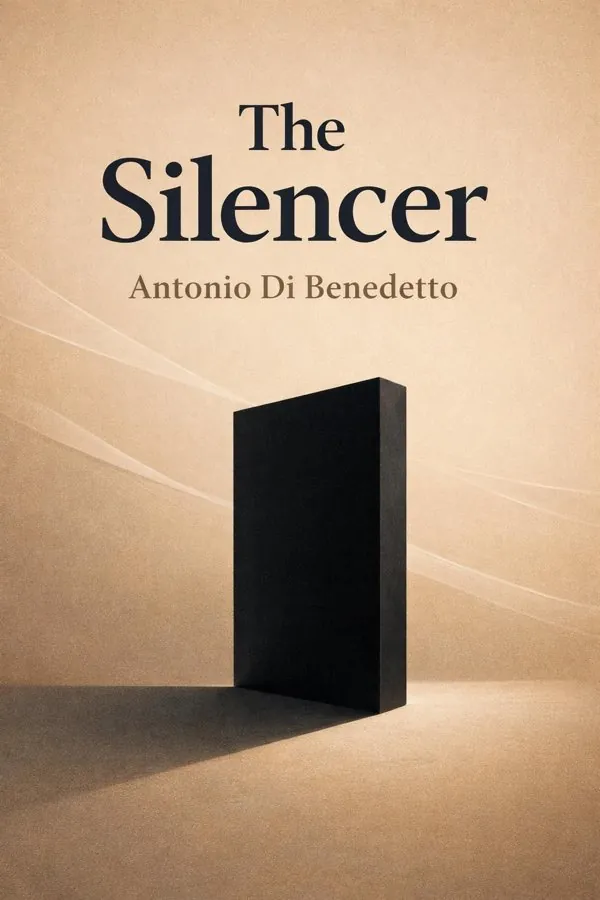
The Silencer: Summary & Key Insights
 10 min9 chaptersAudio available
Key Takeaways from The Silencer
What unsettles us most is often not catastrophe, but repetition.
The desire for peace can become dangerous when it hardens into the demand for perfection.
We often imagine our distress comes from outside us, but the novel insists that the external trigger is only half the story.
To perceive too intensely can be another way of becoming separated from life.
When reality feels intrusive, withdrawal can seem like a cure.
What Is The Silencer About?
The Silencer by Antonio Di Benedetto is a classics book spanning 6 pages. Originally published in 1964, The Silencer is one of Antonio Di Benedetto’s most haunting and distinctive novels, a work that turns an apparently minor irritation—the presence of noise—into a profound existential crisis. Set in a provincial Argentine environment, the book follows an unnamed man whose discomfort with everyday sound gradually becomes an all-consuming obsession. What begins as sensitivity to traffic, voices, machinery, and domestic disturbance evolves into a desperate search for perfect silence, and with it, a fantasy of control, purity, and escape from the demands of reality itself. Di Benedetto transforms this simple premise into a startling meditation on alienation, perception, and the fragility of the self. Like Zama, this novel explores the gap between inner life and outer world, but it does so through a tighter, more claustrophobic psychological lens. Di Benedetto’s authority comes not from grand declarations but from his precision: he understood solitude, incommunication, and mental estrangement with unusual depth. The Silencer remains a major work of twentieth-century Argentine literature because it reveals how easily ordinary discomfort can become a prison of consciousness.
This FizzRead summary covers all 9 key chapters of The Silencer in approximately 10 minutes, distilling the most important ideas, arguments, and takeaways from Antonio Di Benedetto's work. Also available as an audio summary and Key Quotes Podcast.
The Silencer
Originally published in 1964, The Silencer is one of Antonio Di Benedetto’s most haunting and distinctive novels, a work that turns an apparently minor irritation—the presence of noise—into a profound existential crisis. Set in a provincial Argentine environment, the book follows an unnamed man whose discomfort with everyday sound gradually becomes an all-consuming obsession. What begins as sensitivity to traffic, voices, machinery, and domestic disturbance evolves into a desperate search for perfect silence, and with it, a fantasy of control, purity, and escape from the demands of reality itself. Di Benedetto transforms this simple premise into a startling meditation on alienation, perception, and the fragility of the self. Like Zama, this novel explores the gap between inner life and outer world, but it does so through a tighter, more claustrophobic psychological lens. Di Benedetto’s authority comes not from grand declarations but from his precision: he understood solitude, incommunication, and mental estrangement with unusual depth. The Silencer remains a major work of twentieth-century Argentine literature because it reveals how easily ordinary discomfort can become a prison of consciousness.
Who Should Read The Silencer?
This book is perfect for anyone interested in classics and looking to gain actionable insights in a short read. Whether you're a student, professional, or lifelong learner, the key ideas from The Silencer by Antonio Di Benedetto will help you think differently.
- ✓Readers who enjoy classics and want practical takeaways
- ✓Professionals looking to apply new ideas to their work and life
- ✓Anyone who wants the core insights of The Silencer in just 10 minutes
Want the full summary?
Get instant access to this book summary and 100K+ more with Fizz Moment.
Get Free SummaryAvailable on App Store • Free to download
Key Chapters
What unsettles us most is often not catastrophe, but repetition. The protagonist of The Silencer does not begin as a dramatic figure or a heroic sufferer. He is an ordinary man in an ordinary town, moving through a recognizable world of neighbors, traffic, radios, footsteps, construction, voices, and domestic interruption. Yet this common environment does not feel common to him. Sound reaches him not as background but as intrusion, not as atmosphere but as attack. Di Benedetto’s brilliance lies in making the familiar feel unbearable. He shows how everyday life, when filtered through a disturbed or overly sharpened consciousness, can become oppressive.
This opening condition matters because the novel never presents noise as merely technical or physical. Sound becomes a symbol of the social world itself: other people’s presence, unpredictability, and claims on our attention. The protagonist is not just irritated by noise; he is destabilized by the fact that he cannot seal himself off from existence. A passing vehicle, a neighbor’s conversation, a creaking space—each reminds him that he lives among others and cannot fully govern what enters his mind.
Readers can recognize a version of this in modern life. A phone notification, a loud open office, traffic outside an apartment, or the constant hum of digital media can make us feel that our inner life is always under siege. The novel exaggerates this pressure, but it does not invent it.
The practical lesson is to notice when environmental irritation is becoming psychological fixation. Instead of dismissing your discomfort or surrendering to it, identify the sounds or disruptions that most affect you and ask what they symbolize: distraction, lack of control, loneliness, or resentment. Actionable takeaway: for one day, track the moments when noise bothers you most and write down not just what you heard, but what emotion it triggered.
The desire for peace can become dangerous when it hardens into the demand for perfection. At first, the protagonist believes silence is achievable through practical adjustments: closing windows, moving indoors, distancing himself from disturbance, trying to reduce the volume of the world. These are reasonable responses. But the novel carefully shows how each attempt intensifies the obsession rather than resolving it. Once silence becomes an absolute goal, every remaining sound feels intolerable, and even the possibility of noise becomes a threat.
This is one of the book’s central psychological insights. The problem is no longer the world’s actual loudness; it is the mind’s refusal to accept any remainder. In that sense, silence becomes less an acoustic condition than a fantasy of total control. The protagonist does not merely want relief. He wants a state in which nothing can penetrate him, surprise him, or demand a response. That wish is impossible, because to live is to be exposed.
The pattern is familiar beyond the novel. People often begin with a legitimate need—order, rest, privacy, concentration—but then turn that need into a rigid ideal. A person who wants a clean desk may become unable to work unless everything is arranged perfectly. Someone seeking quiet may become anxious before any disturbance even occurs. The search for comfort becomes a form of captivity.
Di Benedetto suggests that what ruins us is not always excess suffering, but inflexibility in the face of imperfection. Actionable takeaway: identify one area where you are waiting for perfect conditions before you can feel calm or begin meaningful work, and deliberately practice tolerating a small degree of disorder.
We often imagine our distress comes from outside us, but the novel insists that the external trigger is only half the story. As the protagonist pursues silence, he discovers a disturbing truth: even when the environment is reduced, unrest remains. Noise is not only something heard with the ears; it is also something produced by attention, memory, anticipation, and fear. The more he listens for disturbance, the more sensitive he becomes to it. Silence itself starts to ring with threat.
This idea gives The Silencer its existential depth. The book is not simply about urban irritation or sensory discomfort. It is about consciousness turning against itself. Once the protagonist becomes fully vigilant, he cannot stop interpreting. Every creak matters, every interval invites expectation, every pause becomes charged. What he cannot quiet is not just the world but his own relation to it. He learns, though too late, that inner noise can outlast external sound.
This dynamic appears in contemporary forms of anxiety. A person trying to sleep may become hyperaware of every tiny sound, but also of their own heartbeat, thoughts, and frustration. Someone craving focus may eliminate distractions only to discover that the louder disturbance is internal rumination. The external environment matters, but attention can amplify discomfort into torment.
The practical application is not to deny external problems, but to see how vigilance feeds them. Sometimes relief comes not from removing every stimulus, but from changing our stance toward sensation. Actionable takeaway: the next time a minor disturbance captures your attention, pause and ask, “Is this sound the problem, or is my monitoring of it the problem?” Then redirect your focus to a chosen task or grounding sensation.
To perceive too intensely can be another way of becoming separated from life. In The Silencer, the protagonist’s sensitivity is not portrayed as noble refinement or artistic superiority. Instead, it gradually estranges him from ordinary human participation. Where others adapt, he recoils. Where others hear background, he hears violation. His sharpened perception does not deepen connection; it dissolves it.
Di Benedetto explores a painful paradox here. We tend to think awareness leads to insight, and often it does. But hyper-awareness can also become self-enclosure. The protagonist does not simply notice more than other people; he becomes imprisoned by his noticing. He loses the ability to inhabit the shared world at a normal scale. Everyday life becomes unlivable because he cannot let it remain partial, unfinished, and mixed. His way of perceiving isolates him from neighbors, routines, and perhaps even from language itself, since sound—the medium of communication—has become hostile.
This theme speaks strongly to modern readers who feel overstimulated, socially withdrawn, or overly analytical. There are moments when perception becomes defensive rather than open. We stop receiving the world and start scanning it for injury. In relationships, this may look like hearing every offhand remark as criticism. At work, it may mean interpreting minor interruptions as intolerable disrespect. The result is not clarity, but distance.
The novel suggests that a livable life requires selective attention and generous interpretation. Not every stimulus deserves equal weight. Not every disturbance is a personal assault. Actionable takeaway: when you feel overwhelmed by what others are doing, choose one recurring irritation this week and practice reframing it as part of shared human life rather than evidence that the world is against you.
When reality feels intrusive, withdrawal can seem like a cure. But Di Benedetto shows how retreat easily becomes a trap. As the protagonist’s intolerance of noise deepens, he increasingly turns away from the social world. Distancing himself appears rational: if sound comes from people, machines, neighborhoods, and daily activity, then less contact should mean less suffering. Yet the more he isolates himself, the less resilient he becomes. Without the rough, ordinary friction of life, his sensitivity sharpens further.
This descent is psychologically accurate. Isolation can reduce immediate stress, but it also removes opportunities for adjustment, perspective, and emotional regulation. The protagonist begins to live in relation to his obsession rather than in relation to other people. His world narrows around avoidance. In such a state, every decision serves one purpose: protect the self from disturbance. But a self organized entirely around defense becomes brittle. Instead of freedom, he builds a private prison.
The novel’s power lies in how recognizable this process is. A person overwhelmed by social noise may cancel plans, avoid public places, work alone, and limit interaction. At first, this can feel restorative. Over time, however, ordinary contact becomes harder to tolerate, and solitude stops being nourishing. It becomes fearful, rigid, and compulsive.
The practical lesson is not that solitude is bad. Di Benedetto values interiority deeply. The danger lies in isolation that serves only avoidance. Healthy solitude enlarges life; unhealthy solitude shrinks it. Actionable takeaway: if you have been withdrawing because the world feels too much, choose one modest form of re-entry—a walk in a public place, a short conversation, or a shared task—and treat it as practice in remaining present rather than as something to endure.
Beneath the protagonist’s hatred of noise lies a deeper hunger: the wish to master existence. The Silencer is not only about sensory disturbance. It is about the painful fact that we do not control the terms of our experience. Sound becomes the perfect symbol for this truth because it crosses boundaries effortlessly. It enters without permission, reminds us of others, and resists ownership. The protagonist’s pursuit of silence is therefore also a revolt against contingency itself.
Di Benedetto links this revolt to an existential problem. Human beings long for coherence, stability, and protected inner space, yet life is porous, unstable, and shared. We cannot stop time, other people, memory, accident, or mortality from reaching us. The dream of absolute silence becomes a dream of absolute sovereignty: a world in which nothing can touch the self unless the self allows it. That dream is both seductive and impossible.
This is why the novel feels so much larger than its plot. In everyday terms, many of us try to create similar zones of total control. We curate routines, minimize uncertainty, reduce contact, filter information, and build systems to avoid frustration. These efforts can be wise up to a point. But when control becomes our highest value, we stop living responsively and start living defensively.
The book’s insight is not that we should embrace chaos, but that meaningful existence requires tolerating permeability. To be alive is to be interrupted. To love, work, think, and participate is to accept friction. Actionable takeaway: identify one daily practice where you are trying to eliminate all unpredictability, and experiment with allowing a small, manageable degree of openness rather than total control.
Some novels tell their story through events; The Silencer tells much of its story through atmosphere. Di Benedetto’s style is spare, tense, and exact, and that precision creates a unique pressure on the reader. The novel does not rely on elaborate melodrama to communicate breakdown. Instead, it narrows our field of experience until we begin to inhabit the protagonist’s constricted awareness. This formal choice matters because it makes the book’s themes felt, not just stated.
The language often mirrors obsession: repetitive attention, compressed thought, heightened sensitivity to tiny details. The result is claustrophobic but purposeful. Readers are drawn into a world where the ordinary is magnified and where mental fixation reshapes reality. Di Benedetto uses restraint to create intensity. By refusing excess explanation, he leaves space for unease to grow.
This is one reason the novel is considered such an important work of Argentine and Latin American modern literature. It shows how style can become philosophy. The prose itself performs alienation, incommunication, and estrangement. The reader does not simply learn that the protagonist is trapped; the reader experiences the narrowing conditions of that trap.
There is a broader lesson here for how we read and how we live. Form influences understanding. The structure of our environment—whether a room, a schedule, a digital feed, or a sentence—shapes our state of mind. Paying attention to form can help us understand why some experiences calm us while others intensify us. Actionable takeaway: notice one medium you use daily—news, social media, music, workspace, or reading—and ask how its form affects your mental state, not just the information it contains.
When a single obsession takes over consciousness, the self begins to shrink around it. In the later movement of The Silencer, the protagonist’s quest for silence no longer appears as a preference or a quirk. It has become the organizing principle of his identity. This is the tragic culmination of the novel: he is no longer a man who wants silence, but a man made by wanting it. The distinction is crucial. Desire has ceased to be one part of his life and has instead consumed all other meanings.
Di Benedetto presents this collapse with haunting ambiguity. The “final silence” suggested by the novel is not simply acoustic relief. It carries associations of emptiness, dissolution, and perhaps death—not necessarily only physical death, but the death of shared life, dialogue, spontaneity, and selfhood as relation. The protagonist’s attempt to escape disturbance leads him toward a silence so absolute that it risks becoming indistinguishable from nonbeing.
This ending gives the novel its lasting force. It warns that the elimination of discomfort, if pursued without limit, may also eliminate vitality. A life purged of interruption can become a life purged of connection. We may achieve less pain, but also less presence.
In everyday terms, this applies whenever we organize life around avoiding what unsettles us. If we remove every challenge, every demand, every unpredictable other, we may also remove growth, affection, and meaning. Actionable takeaway: ask yourself whether one of your strongest habits is protecting your life or narrowing it, and choose one act this week that favors engagement over avoidance.
A book about noise written in 1964 feels uncannily contemporary because modern life has only intensified the problem Di Benedetto identified. Today, noise is not just physical. It is informational, emotional, and digital. Notifications, endless commentary, algorithmic feeds, open-plan workspaces, constant availability, and urban density create a world in which mental silence feels both necessary and nearly impossible. The protagonist’s struggle may be extreme, but his desire is familiar: he wants room to think, to exist privately, to recover an inner boundary.
What makes the novel especially modern, however, is that it does not offer a simplistic solution. It does not say that reducing stimulation automatically saves us. Nor does it celebrate busyness or adaptation. Instead, it asks a harder question: how do we remain open to life without being destroyed by its constant claims? That question is as urgent now as ever.
The Silencer also speaks to contemporary discussions of burnout, sensory overload, anxiety, and the politics of attention. Many readers will recognize the temptation to fantasize about total disconnection. But Di Benedetto reminds us that complete escape is neither possible nor healthy. The challenge is to cultivate interior steadiness without confusing it with domination over the world.
That is why the book still matters. It is not merely a period piece of existential fiction; it is a searching diagnosis of overstimulated consciousness. Actionable takeaway: create one intentional boundary in your day—such as a phone-free hour, a silent walk, or uninterrupted reading time—not to chase perfect silence, but to practice a more humane relationship with attention.
All Chapters in The Silencer
About the Author
Antonio Di Benedetto (1922–1986) was an Argentine novelist, short story writer, and journalist whose work is now recognized as one of the great achievements of twentieth-century Latin American literature. Born in Mendoza, he developed a distinctive style marked by austerity, psychological precision, and deep engagement with themes of solitude, waiting, alienation, and failed communication. He is best known for a trio of major novels: Zama, The Silencer, and The Suicides. Although he remained less globally famous than some of the Boom-era writers, his reputation has steadily grown because of the originality and intensity of his fiction. During Argentina’s military dictatorship, Di Benedetto was imprisoned and later went into exile in Spain. Those experiences further underscored the sense of displacement and estrangement that had long shaped his literary vision.
Get This Summary in Your Preferred Format
Read or listen to the The Silencer summary by Antonio Di Benedetto anytime, anywhere. FizzRead offers multiple formats so you can learn on your terms — all free.
Available formats: App · Audio · PDF · EPUB — All included free with FizzRead
Download The Silencer PDF and EPUB Summary
Key Quotes from The Silencer
“What unsettles us most is often not catastrophe, but repetition.”
“The desire for peace can become dangerous when it hardens into the demand for perfection.”
“We often imagine our distress comes from outside us, but the novel insists that the external trigger is only half the story.”
“To perceive too intensely can be another way of becoming separated from life.”
“When reality feels intrusive, withdrawal can seem like a cure.”
Frequently Asked Questions about The Silencer
The Silencer by Antonio Di Benedetto is a classics book that explores key ideas across 9 chapters. Originally published in 1964, The Silencer is one of Antonio Di Benedetto’s most haunting and distinctive novels, a work that turns an apparently minor irritation—the presence of noise—into a profound existential crisis. Set in a provincial Argentine environment, the book follows an unnamed man whose discomfort with everyday sound gradually becomes an all-consuming obsession. What begins as sensitivity to traffic, voices, machinery, and domestic disturbance evolves into a desperate search for perfect silence, and with it, a fantasy of control, purity, and escape from the demands of reality itself. Di Benedetto transforms this simple premise into a startling meditation on alienation, perception, and the fragility of the self. Like Zama, this novel explores the gap between inner life and outer world, but it does so through a tighter, more claustrophobic psychological lens. Di Benedetto’s authority comes not from grand declarations but from his precision: he understood solitude, incommunication, and mental estrangement with unusual depth. The Silencer remains a major work of twentieth-century Argentine literature because it reveals how easily ordinary discomfort can become a prison of consciousness.
More by Antonio Di Benedetto

You Might Also Like






Browse by Category
Ready to read The Silencer?
Get the full summary and 100K+ more books with Fizz Moment.