
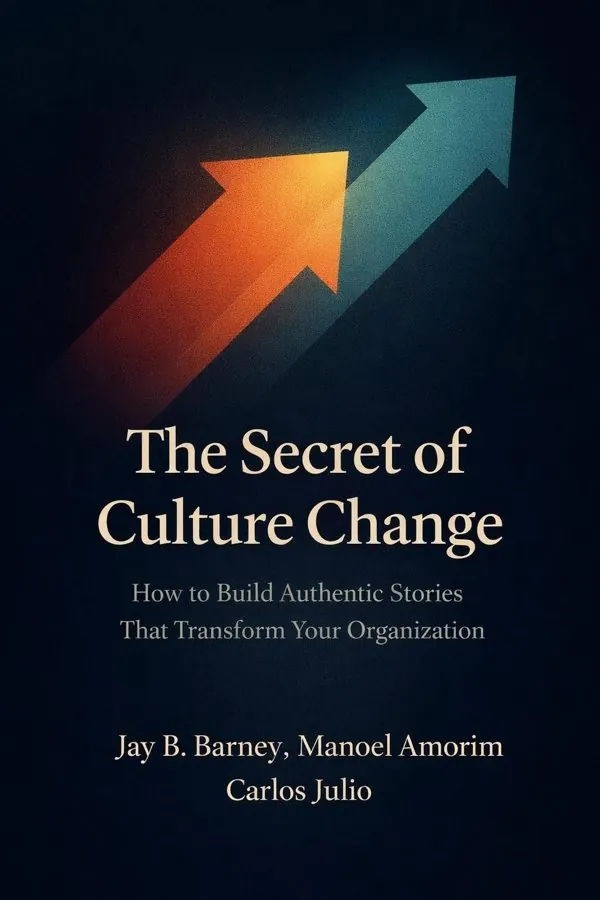
The Secret of Culture Change: How to Build Authentic Stories That Transform Your Organization: Summary & Key Insights
by Jay B. Barney, Manoel Amorim, Carlos Julio
 10 min9 chaptersAudio available
Key Takeaways from The Secret of Culture Change: How to Build Authentic Stories That Transform Your Organization
A company’s culture is not first visible in its values statement; it is visible in the stories employees tell when leaders are not in the room.
The most common culture mistake is believing that communication campaigns can substitute for credibility.
People do not commit to stories because they are polished; they commit because they feel true.
Culture change becomes practical when leaders stop asking, “How do we motivate people?
Values have little power when they are merely chosen; they matter when they are recognized as already present in the organization’s best moments.
What Is The Secret of Culture Change: How to Build Authentic Stories That Transform Your Organization About?
The Secret of Culture Change: How to Build Authentic Stories That Transform Your Organization by Jay B. Barney, Manoel Amorim, Carlos Julio is a organization book spanning 11 pages. Most culture change efforts fail for a simple reason: leaders try to install a new culture from the outside instead of growing it from the inside. In The Secret of Culture Change, Jay B. Barney, Manoel Amorim, and Carlos Julio argue that real transformation happens when organizations create and live authentic stories that connect strategy, values, and daily behavior. Culture is not a poster on the wall or a set of slogans in a town hall. It is the shared narrative people believe about who they are, what matters here, and how success is achieved. What makes this book especially valuable is the combination of academic rigor and practical leadership experience. Barney brings deep expertise in strategy and organizational theory, while Amorim and Julio contribute insights from executive leadership and consulting. Together, they show why so many change initiatives produce only compliance, not commitment, and how storytelling can become a disciplined tool for building trust, alignment, and action. For leaders facing disengagement, post-merger friction, strategic drift, or rapid growth, this book offers a smarter path: change the story people believe, and you can change the culture they create together.
This FizzRead summary covers all 9 key chapters of The Secret of Culture Change: How to Build Authentic Stories That Transform Your Organization in approximately 10 minutes, distilling the most important ideas, arguments, and takeaways from Jay B. Barney, Manoel Amorim, Carlos Julio's work. Also available as an audio summary and Key Quotes Podcast.
The Secret of Culture Change: How to Build Authentic Stories That Transform Your Organization
Most culture change efforts fail for a simple reason: leaders try to install a new culture from the outside instead of growing it from the inside. In The Secret of Culture Change, Jay B. Barney, Manoel Amorim, and Carlos Julio argue that real transformation happens when organizations create and live authentic stories that connect strategy, values, and daily behavior. Culture is not a poster on the wall or a set of slogans in a town hall. It is the shared narrative people believe about who they are, what matters here, and how success is achieved.
What makes this book especially valuable is the combination of academic rigor and practical leadership experience. Barney brings deep expertise in strategy and organizational theory, while Amorim and Julio contribute insights from executive leadership and consulting. Together, they show why so many change initiatives produce only compliance, not commitment, and how storytelling can become a disciplined tool for building trust, alignment, and action. For leaders facing disengagement, post-merger friction, strategic drift, or rapid growth, this book offers a smarter path: change the story people believe, and you can change the culture they create together.
Who Should Read The Secret of Culture Change: How to Build Authentic Stories That Transform Your Organization?
This book is perfect for anyone interested in organization and looking to gain actionable insights in a short read. Whether you're a student, professional, or lifelong learner, the key ideas from The Secret of Culture Change: How to Build Authentic Stories That Transform Your Organization by Jay B. Barney, Manoel Amorim, Carlos Julio will help you think differently.
- ✓Readers who enjoy organization and want practical takeaways
- ✓Professionals looking to apply new ideas to their work and life
- ✓Anyone who wants the core insights of The Secret of Culture Change: How to Build Authentic Stories That Transform Your Organization in just 10 minutes
Want the full summary?
Get instant access to this book summary and 100K+ more with Fizz Moment.
Get Free SummaryAvailable on App Store • Free to download
Key Chapters
The most common culture mistake is believing that communication campaigns can substitute for credibility. Organizations often launch change through new slogans, values rollouts, training modules, incentive systems, or rebranding efforts. These actions may create visibility, but they rarely create belief. The authors show that traditional culture programs often fail because they attempt to impose desired behaviors without changing the underlying story employees use to interpret organizational reality.
When workers have seen previous initiatives come and go, they become skilled at detecting symbolic action. A leadership team may announce a commitment to empowerment, for example, while continuing to centralize every important decision. It may celebrate innovation publicly while punishing failed experiments privately. In these situations, people do not resist change because they are cynical by nature; they resist because the new message conflicts with the evidence of daily life.
The book emphasizes that compliance is not transformation. You can force attendance at workshops, require managers to use new language, and tie bonuses to target behaviors, but if employees do not believe the change reflects how the organization truly works, the effort fades. Worse, failed programs can deepen distrust by proving that leadership says one thing and does another.
A better approach is to start with narrative consistency. If leaders want accountability, customer focus, or collaboration to become cultural realities, they must create and reinforce stories in which these qualities are visibly rewarded and meaningfully connected to strategy. Employees change when a new story becomes more plausible than the old one.
Actionable takeaway: Before launching a culture initiative, test whether leadership behavior, systems, and decisions already support the story you want employees to believe.
People do not commit to stories because they are polished; they commit because they feel true. The book’s central argument is that authentic storytelling is the engine of durable culture change. Authentic stories are not invented propaganda or exaggerated myths designed to manipulate emotion. They are narratives rooted in real events, real values, and real choices that reveal what the organization stands for under pressure.
This distinction is crucial. In many companies, leaders try to “craft a narrative” as if culture were a branding exercise. But employees quickly recognize when stories are staged, borrowed from another company, or disconnected from experience. An authentic story, by contrast, usually emerges from actual moments of sacrifice, service, ingenuity, resilience, or integrity. For example, a customer service company might build its culture not around generic claims of caring, but around specific stories of employees who went beyond procedure to solve meaningful problems.
Authenticity also requires complexity. Real stories often include tension, risk, setbacks, and tradeoffs. When leaders only share triumphs, people hear spin. When they share difficult decisions and explain why values mattered in those moments, trust increases. This makes storytelling not a soft communication skill but a strategic credibility practice.
To apply this, leaders can gather examples from across the organization where people acted in alignment with desired values, especially when doing so required effort or courage. These examples should be concrete, verifiable, and repeated consistently in meetings, onboarding, recognition systems, and strategic communication.
Actionable takeaway: Build culture stories from real decisions and observed behavior, not aspirational language, because authenticity is what turns communication into belief.
Culture change becomes practical when leaders stop asking, “How do we motivate people?” and start asking, “What story would make the new way of working make sense?” The authors provide a framework for transformation built around discovering, shaping, and spreading authentic organizational stories. Rather than treating storytelling as inspiration alone, they present it as a disciplined process linked to strategy and execution.
The process begins with diagnosis. Leaders must understand the current cultural narrative: what employees believe the organization rewards, fears, and prioritizes. Next comes clarification of strategic intent. What future is the company trying to create, and what beliefs and behaviors must support it? Then comes identification of authentic anchors: real moments, symbols, and examples that can connect today’s reality with tomorrow’s aspiration.
From there, leaders shape a compelling narrative arc. This usually includes where the organization has come from, what challenge or opportunity it now faces, why change matters, what values will guide the journey, and what role employees play in making the story real. Importantly, the story must be reinforced through systems. Hiring, promotion, recognition, budgeting, and leadership behavior must all make the narrative visible.
For example, if a manufacturing company wants to shift from cost obsession to quality leadership, the narrative cannot stop at speeches about craftsmanship. It must include stories of quality wins, visible support for process improvement, promotion of managers who elevate standards, and operational choices that prove quality is not negotiable.
Actionable takeaway: Treat culture change as a narrative system—diagnose the old story, define the new one, and align organizational mechanisms so employees can see it being lived.
Values have little power when they are merely chosen; they matter when they are recognized as already present in the organization’s best moments. One of the book’s most useful insights is that leaders should identify core values through discovery as much as declaration. Instead of brainstorming an ideal list of virtues, they should examine the organization’s proudest decisions, strongest relationships, and most meaningful successes to uncover what truly drives it.
This matters because invented values often sound noble but fail to resonate. A company may declare courage, innovation, and empathy, yet employees may not see these traits reflected anywhere in its history or operations. In contrast, when leaders surface values that have genuinely shaped the organization, they create a stronger foundation for cultural renewal. Employees are more likely to believe a story that feels continuous with the organization’s identity rather than one that appears imported by consultants.
The authors suggest paying attention to defining episodes: moments of crisis, customer commitment, strategic pivots, founder decisions, and team achievements. What principles guided action in those moments? Which behaviors produced trust and pride? These patterns reveal values with real cultural weight. Once identified, values should be translated into observable behaviors. “Respect” may mean listening before deciding, giving candid feedback directly, or honoring commitments across functions.
A healthcare provider, for instance, might discover that its deepest value is dignity, visible in stories about patient treatment, not just clinical efficiency. That insight can then shape training, performance expectations, and leadership language.
Actionable takeaway: Derive your cultural values from the organization’s lived history and translate them into specific behaviors employees can recognize and repeat.
Employees learn culture less from what leaders say than from what leaders notice, reward, tolerate, and repeat. The book makes clear that leadership’s role in storytelling is not simply to communicate the message; it is to personify the story. If leaders are inconsistent, culture change will stall no matter how compelling the narrative sounds.
This is because leaders serve as the most visible proof of what the organization really believes. A CEO who speaks about collaboration but publicly humiliates dissenters teaches fear, not teamwork. A senior team that says people matter but cuts development at the first sign of pressure teaches expediency, not commitment. In each case, the formal story collapses under the weight of executive behavior.
The authors emphasize that leaders influence culture through symbolic acts. Who gets time with senior leadership? Which decisions are explained openly? How are mistakes handled? What stories do leaders tell repeatedly? These moments shape interpretation. Especially during uncertainty, employees search leaders for clues about what is genuinely changing and what remains nonnegotiable.
Practical application requires disciplined self-examination. Leaders should ask where their own habits contradict the desired culture. If an organization wants empowerment, are executives still solving every problem themselves? If it wants candor, do leaders respond defensively to bad news? Often, culture change begins with leaders changing their own routines before asking others to change theirs.
Actionable takeaway: Make senior leadership behavior the first proof point of the new culture, because people believe the story they see enacted at the top.
A story becomes culture only when it is repeated through everyday organizational machinery. One of the book’s most practical contributions is the reminder that storytelling is not limited to speeches, videos, or internal branding. The real carriers of culture are systems and rituals: onboarding, performance reviews, team meetings, promotion decisions, recognition programs, budgeting choices, and operational routines.
If these mechanisms contradict the official narrative, the old culture survives. For instance, a company may describe itself as innovative, but if approval processes punish experimentation and performance reviews reward only short-term certainty, employees will quickly learn that innovation is rhetorical. On the other hand, when systems consistently elevate the desired story, culture becomes easier to sustain.
Rituals are especially powerful because they turn values into recurring experience. A weekly customer story in executive meetings can reinforce service orientation. Post-project reviews that focus on learning instead of blame can normalize intelligent risk-taking. Recognition ceremonies that celebrate cross-functional problem solving can strengthen collaboration. These repeated practices create emotional memory and social proof.
The authors also imply that organizations should curate symbols carefully. Office design, leadership accessibility, who speaks at all-hands meetings, and how success is publicly defined all send narrative signals. A strategy of inclusion, for example, must be reflected not just in language but in who is visibly heard and advanced.
Actionable takeaway: Embed your desired culture into hiring, rituals, metrics, and recognition so the organization repeatedly experiences the story, not just hears about it.
Culture change remains fragile when leaders treat it as unmeasurable. The authors argue that while culture is subtle, its effects can and should be assessed. The key is to measure more than sentiment. Effective evaluation tracks whether people believe the new story, whether behavior is shifting, and whether those shifts are improving strategic outcomes.
Belief can be measured through interviews, pulse surveys, and narrative analysis. Do employees understand the organization’s purpose? Can they name examples that demonstrate the stated values? Do they think leaders act consistently with the story? Behavior can be observed through collaboration patterns, decision speed, customer interactions, manager practices, retention of key talent, or the frequency of desired routines such as after-action reviews.
The final layer is business impact. A culture built around customer obsession should eventually influence satisfaction, loyalty, and growth. A culture centered on accountability should affect execution quality and operational reliability. A safety-focused culture should reduce incidents and strengthen reporting discipline. The book’s broader point is that culture work earns strategic legitimacy when linked to real organizational performance.
Measurement also helps leaders identify where the story is not landing. A division may understand the message but lack local role models. A middle-management layer may verbally support change while preserving old incentives. Data allows targeted correction rather than vague encouragement.
Actionable takeaway: Create a culture dashboard that combines narrative trust, observable behavior, and strategic results, so you can tell whether the new story is actually changing how the organization performs.
Culture change is rarely lost in a dramatic moment; it is usually diluted through inconsistency over time. The authors stress that sustaining cultural transformation requires continued alignment between story, strategy, and leadership attention. A compelling narrative may spark movement, but unless it remains connected to decisions and priorities, employees eventually classify it as a temporary campaign.
Sustainability depends on repetition without stagnation. Leaders must keep retelling the core story while updating it with fresh examples, new milestones, and current challenges. This prevents the narrative from becoming stale or ceremonial. At the same time, the strategic logic behind the story must remain visible. Employees should understand not only what the organization values, but why those values matter for competitive success, adaptation, and long-term identity.
This is particularly important during transitions such as rapid growth, mergers, digital transformation, or leadership succession. In these moments, organizations are vulnerable to fragmentation. A strong story provides continuity, but it must be actively translated for new contexts. For example, a founder-led company scaling globally may need to reinterpret its entrepreneurial culture so it remains authentic while becoming more disciplined and less personality-dependent.
The book also suggests that sustainability requires distributed ownership. Culture cannot remain the sole project of the CEO or HR function. Managers at every level must become local storytellers who connect enterprise values to team realities. When they do, the culture becomes resilient enough to survive changing conditions.
Actionable takeaway: Reconnect your culture story to strategy at every major transition and equip managers to keep the narrative alive in everyday decisions.
All Chapters in The Secret of Culture Change: How to Build Authentic Stories That Transform Your Organization
About the Authors
Jay B. Barney is a leading scholar in strategic management and one of the most cited thinkers in the field, especially for his pioneering work on the resource-based view of the firm and sustainable competitive advantage. His research has helped shape how leaders understand the relationship between internal capabilities and long-term performance. Manoel Amorim and Carlos Julio are accomplished business leaders and advisors with extensive experience in organizational culture, leadership, and transformation. Together, the three authors combine rigorous strategic thinking with practical insight from executive practice. That combination gives The Secret of Culture Change both intellectual depth and real-world relevance, making it especially useful for leaders who want culture change to be more than an inspiring idea.
Get This Summary in Your Preferred Format
Read or listen to the The Secret of Culture Change: How to Build Authentic Stories That Transform Your Organization summary by Jay B. Barney, Manoel Amorim, Carlos Julio anytime, anywhere. FizzRead offers multiple formats so you can learn on your terms — all free.
Available formats: App · Audio · PDF · EPUB — All included free with FizzRead
Download The Secret of Culture Change: How to Build Authentic Stories That Transform Your Organization PDF and EPUB Summary
Key Quotes from The Secret of Culture Change: How to Build Authentic Stories That Transform Your Organization
“A company’s culture is not first visible in its values statement; it is visible in the stories employees tell when leaders are not in the room.”
“The most common culture mistake is believing that communication campaigns can substitute for credibility.”
“People do not commit to stories because they are polished; they commit because they feel true.”
“Culture change becomes practical when leaders stop asking, “How do we motivate people?”
“Values have little power when they are merely chosen; they matter when they are recognized as already present in the organization’s best moments.”
Frequently Asked Questions about The Secret of Culture Change: How to Build Authentic Stories That Transform Your Organization
The Secret of Culture Change: How to Build Authentic Stories That Transform Your Organization by Jay B. Barney, Manoel Amorim, Carlos Julio is a organization book that explores key ideas across 9 chapters. Most culture change efforts fail for a simple reason: leaders try to install a new culture from the outside instead of growing it from the inside. In The Secret of Culture Change, Jay B. Barney, Manoel Amorim, and Carlos Julio argue that real transformation happens when organizations create and live authentic stories that connect strategy, values, and daily behavior. Culture is not a poster on the wall or a set of slogans in a town hall. It is the shared narrative people believe about who they are, what matters here, and how success is achieved. What makes this book especially valuable is the combination of academic rigor and practical leadership experience. Barney brings deep expertise in strategy and organizational theory, while Amorim and Julio contribute insights from executive leadership and consulting. Together, they show why so many change initiatives produce only compliance, not commitment, and how storytelling can become a disciplined tool for building trust, alignment, and action. For leaders facing disengagement, post-merger friction, strategic drift, or rapid growth, this book offers a smarter path: change the story people believe, and you can change the culture they create together.
You Might Also Like

A Guide to the Project Management Body of Knowledge (PMBOK® Guide)
Project Management Institute
10 min
Organizational Behavior
Stephen P. Robbins
10 min
Accelerate: The Science of Lean Software and DevOps – Building and Scaling High Performing Technology Organizations
Nicole Forsgren, Jez Humble, Gene Kim
10 min
Awakening Compassion at Work: The Quiet Power That Elevates People and Organizations
Monica C. Worline, Jane E. Dutton
10 min
Building an Inclusive Organization: Leveraging the Power of a Diverse Workforce
Stephen Frost
10 min
Collaborative Intelligence: Thinking with People Who Think Differently
Dawna Markova, Angie McArthur
10 minBrowse by Category
Ready to read The Secret of Culture Change: How to Build Authentic Stories That Transform Your Organization?
Get the full summary and 100K+ more books with Fizz Moment.