
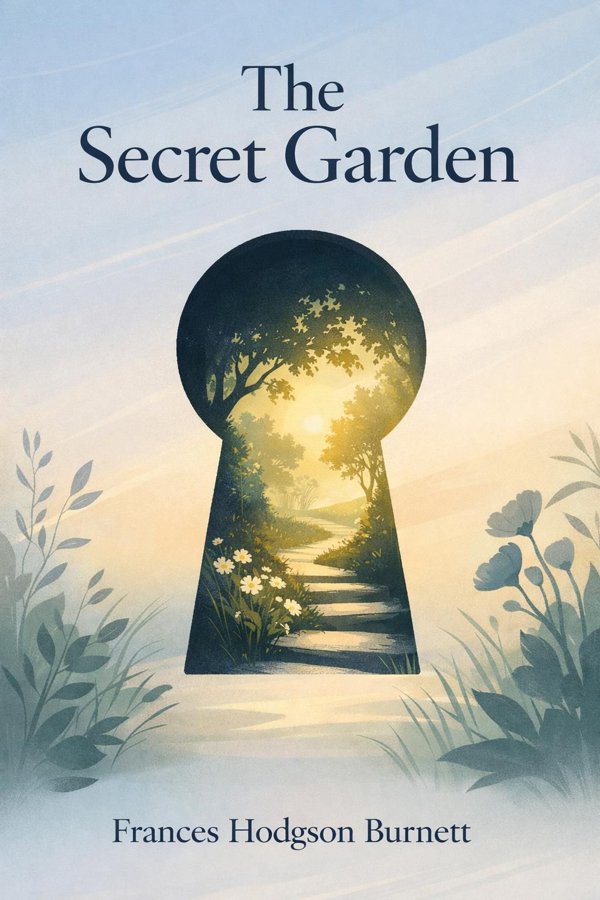
The Secret Garden: Summary & Key Insights
 10 min9 chaptersAudio available
Key Takeaways from The Secret Garden
Transformation often begins not with comfort, but with disruption.
What we lock away does not disappear; it waits.
Sometimes the first cure is not a lecture but a landscape.
Real magic often looks like patience, warmth, and practical care.
People can become imprisoned by stories long before they are trapped by reality.
What Is The Secret Garden About?
The Secret Garden by Frances Hodgson Burnett is a classics book spanning 4 pages. The Secret Garden is one of those rare classics that feels simple on the surface and profound underneath. Frances Hodgson Burnett begins with Mary Lennox, a sour, unwanted child who is orphaned in India and sent to live with her reclusive uncle at Misselthwaite Manor on the Yorkshire moors. In that vast, gloomy house, Mary discovers a hidden garden that has been locked away for years. What follows is not merely a children’s adventure, but a deeply moving story about grief, friendship, nature, and emotional rebirth. What makes the novel endure is its understanding that people, like gardens, can become neglected, hardened, and overrun by sorrow—and can also be restored through care, attention, and hope. Burnett, celebrated for classics such as A Little Princess and Little Lord Fauntleroy, wrote with a rare gift for combining enchantment with psychological truth. In The Secret Garden, she captures how fresh air, meaningful work, companionship, and belief can transform a life. The result is a novel that speaks to children and adults alike, offering both a compelling story and a timeless meditation on healing.
This FizzRead summary covers all 9 key chapters of The Secret Garden in approximately 10 minutes, distilling the most important ideas, arguments, and takeaways from Frances Hodgson Burnett's work. Also available as an audio summary and Key Quotes Podcast.
The Secret Garden
The Secret Garden is one of those rare classics that feels simple on the surface and profound underneath. Frances Hodgson Burnett begins with Mary Lennox, a sour, unwanted child who is orphaned in India and sent to live with her reclusive uncle at Misselthwaite Manor on the Yorkshire moors. In that vast, gloomy house, Mary discovers a hidden garden that has been locked away for years. What follows is not merely a children’s adventure, but a deeply moving story about grief, friendship, nature, and emotional rebirth.
What makes the novel endure is its understanding that people, like gardens, can become neglected, hardened, and overrun by sorrow—and can also be restored through care, attention, and hope. Burnett, celebrated for classics such as A Little Princess and Little Lord Fauntleroy, wrote with a rare gift for combining enchantment with psychological truth. In The Secret Garden, she captures how fresh air, meaningful work, companionship, and belief can transform a life. The result is a novel that speaks to children and adults alike, offering both a compelling story and a timeless meditation on healing.
Who Should Read The Secret Garden?
This book is perfect for anyone interested in classics and looking to gain actionable insights in a short read. Whether you're a student, professional, or lifelong learner, the key ideas from The Secret Garden by Frances Hodgson Burnett will help you think differently.
- ✓Readers who enjoy classics and want practical takeaways
- ✓Professionals looking to apply new ideas to their work and life
- ✓Anyone who wants the core insights of The Secret Garden in just 10 minutes
Want the full summary?
Get instant access to this book summary and 100K+ more with Fizz Moment.
Get Free SummaryAvailable on App Store • Free to download
Key Chapters
Transformation often begins not with comfort, but with disruption. Mary Lennox enters The Secret Garden as a child made harsh by neglect. Born in colonial India to wealthy parents who cared little for her, she has grown spoiled, disagreeable, and emotionally stunted. Servants obey her without affection, and she learns neither gratitude nor empathy. When a cholera outbreak leaves her orphaned, Mary is sent to Yorkshire to live with her uncle, Archibald Craven, in the isolated Misselthwaite Manor. It is a dramatic change: from heat to cold, noise to silence, indulgence to loneliness.
At first, Mary remains unpleasant because she does not know how to be otherwise. Burnett treats this with unusual honesty. Mary is not instantly lovable, and that is precisely why her growth matters. The moors, the brisk air, and the plainspoken kindness of people like Martha begin to shift her perspective. For the first time, Mary must engage with the world rather than command it. She walks, observes, asks questions, and starts to feel curiosity instead of self-absorption.
This early transformation reveals one of the novel’s core truths: children are shaped by their environments, but they are not trapped by them. A cold beginning does not condemn a person to a cold life. Change can start through simple, repeated experiences—more movement, more responsibility, more contact with honest people.
In modern life, Mary’s story reminds us to look beneath difficult behavior. Irritability, entitlement, or withdrawal may hide loneliness and unmet emotional needs. Growth often begins when routines change and healthier influences enter.
Actionable takeaway: When someone seems difficult—including yourself—ask what neglected need may be underneath, then make one small environmental change that supports healthier growth.
Sometimes the first cure is not a lecture but a landscape. One of Burnett’s most enduring ideas is that the natural world can restore the human spirit. Mary arrives at Misselthwaite pale, weak, and joyless. The Yorkshire moors, with their open skies and sharp winds, begin to change her before she fully understands what is happening. She walks outside, breathes deeply, becomes hungry, sleeps better, and slowly grows stronger. Nature does not flatter her or entertain her; it steadies her.
The novel treats gardens, weather, birds, soil, and seasons as active participants in human renewal. The robin leads Mary toward discovery. The changing spring awakens energy in both the land and the children. Burnett suggests that living things respond to care and that people, too, recover when they are brought back into rhythms larger than their private sorrow.
This idea feels especially modern today, when many people live indoors, overstimulated yet disconnected. The Secret Garden offers a surprisingly relevant insight: regular contact with nature can improve mood, perspective, and vitality. You do not need a hidden walled garden to experience this. A small balcony plant, a walk through a park, tending herbs on a windowsill, or simply observing seasonal change can create similar effects.
The book does not romanticize nature as magic detached from effort. Its healing power works alongside movement, attention, and companionship. Mary changes because she participates. She digs, walks, watches, and learns. Nature offers possibility, but a person must enter into relationship with it.
Actionable takeaway: Build a small weekly ritual with nature—walk outside without your phone, care for a plant, or sit in a green space—and notice how your body and mood respond over time.
Real magic often looks like patience, warmth, and practical care. After Mary discovers the garden, its renewal becomes possible because she meets Dickon, Martha’s younger brother. Dickon is one of the novel’s most memorable figures: a boy deeply at ease with animals, weather, and growing things. He moves through the natural world not as a conqueror but as a companion. To Mary, who has known little genuine tenderness, Dickon represents an entirely different way of being—gentle, generous, curious, and alive.
His importance lies not only in his skills but in his spirit. Dickon helps Mary see that nurturing is an active force. You do not restore a garden through wishes alone. You loosen the soil, protect the shoots, plant seeds, and return day after day. The same is true of friendship. Dickon never mocks Mary for what she has been; instead, he gives her a healthier pattern to imitate. Through his presence, she becomes less selfish and more open-hearted.
Burnett’s portrayal of Dickon suggests that healing spreads socially. One emotionally healthy person can change the atmosphere around them. In everyday life, this appears in small ways: a teacher who notices a withdrawn child, a friend who consistently shows up, a colleague who brings calm instead of drama. Nurturing does not need to be grand to be transformative.
Dickon also teaches reverence for slow results. Gardens do not bloom because we demand it. Relationships do not deepen because we insist. Care is repetitive, attentive, and often quiet.
Actionable takeaway: Choose one person, project, or part of yourself to nurture consistently for the next week, and focus on steady care rather than immediate visible results.
People can become imprisoned by stories long before they are trapped by reality. Colin Craven, Archibald’s hidden son, has been raised in fear. Believing himself sickly, crooked, and destined to die young, he lives shut away in a bedroom, surrounded by anxious adults who reinforce his fragility. His tantrums and self-absorption make him, in some ways, a mirror to the earlier Mary. But whereas Mary’s damage comes from neglect, Colin’s comes from overprotection and inherited despair.
When Mary discovers Colin, the novel takes a decisive turn. She does not treat him as a tragic invalid; she challenges him. With Dickon’s help, she draws him into the secret garden, where he begins to test a new identity. Burnett gives this process a language of “magic,” by which she means the mysterious but real force of expectation, attention, and belief. Colin starts to imagine health rather than death. He sits upright, then stands, then walks. His body changes alongside his mind.
Modern readers may rightly avoid taking this idea as a simplistic claim that illness can always be cured by positive thinking. Burnett’s insight is subtler and still valuable: mindset shapes behavior, and behavior shapes outcomes. If we define ourselves entirely by weakness, we often stop attempting growth. If we believe change is possible, we are more likely to practice, persist, and recover what we can.
In practical terms, Colin’s story applies to anyone held back by a limiting self-concept—“I’m bad at relationships,” “I’m not creative,” “I’ll never get stronger.” Progress begins when that inner script is questioned and replaced with action.
Actionable takeaway: Write down one limiting belief you have about yourself, then choose one concrete behavior this week that acts as if a healthier belief might be true.
We become more fully alive in the presence of those who call us beyond ourselves. The Secret Garden is often remembered for its flowers and mystery, but its emotional engine is friendship. Mary changes because she no longer lives entirely inside her own hurt. Martha’s plain honesty, Dickon’s warmth, and eventually Colin’s companionship all create a network of connection that pulls Mary into a richer life.
These friendships are not sentimental or effortless. Mary must learn to listen, share, and cooperate. Colin must stop demanding constant attention and begin caring for others in return. Even their disagreements matter, because they reveal growth. Friendship in Burnett’s world is not merely comfort; it is formation. Good companions challenge distortions, encourage courage, and make joy more accessible.
One reason the children heal together is that they participate in a shared purpose. Restoring the garden gives them something larger than their private suffering. This is a crucial insight. People often recover not only through introspection but through common work—building something, tending something, helping someone. Shared projects create trust and meaning.
In contemporary life, many people are lonely despite being digitally connected. Burnett reminds us that friendship deepens through presence, honesty, routine, and mutual effort. A real friend is not just someone who understands your sadness, but someone who helps you move, act, and grow.
Actionable takeaway: Strengthen one friendship through a shared activity—take a walk, cook together, volunteer, or start a small project—so the relationship grows through doing, not just talking.
Unprocessed grief rarely stays private; it shapes entire households. Archibald Craven’s sorrow after his wife’s death hangs over Misselthwaite Manor like weather. He withdraws from his home, avoids his son, and allows closed rooms and fearful habits to define the estate. Even servants and children live inside the emotional consequences of his loss. Burnett shows how pain, when hidden rather than faced, becomes an atmosphere others must breathe.
This idea runs through the novel in subtle ways. The locked garden, the hidden child, the absent master, and the many whispers in hallways all reveal a family system ruled by avoidance. Colin inherits not only wealth and status, but a legacy of fear. Mary, too, arrives with inherited emotional damage from neglectful parents. Burnett suggests that children often absorb what adults refuse to address.
Yet the book is not fatalistic. Emotional inheritance is real, but it can be interrupted. Mary breaks secrecy by asking questions. Colin breaks isolation by entering the garden. Archibald eventually breaks mourning’s paralysis by returning home. Healing begins when silence is replaced with honest contact.
This insight applies far beyond the novel. Families, workplaces, and communities can all be shaped by unspoken pain. When difficult subjects remain buried—loss, resentment, addiction, shame—they often emerge indirectly through tension, fear, or dysfunction. Naming reality does not instantly solve it, but it changes the conditions for recovery.
Actionable takeaway: Notice one pattern of avoidance in your environment, and start gently interrupting it with a truthful, compassionate question or conversation rather than continued silence.
Lasting change is usually less dramatic than stories make it seem. Although The Secret Garden contains mystery and emotional revelation, much of its healing happens through routine labor. The children dig, weed, plant, tidy, and return day after day. These acts may seem ordinary, but Burnett gives them profound significance. Purposeful work draws attention outward, strengthens the body, and creates visible evidence that effort matters.
For Mary, work is especially transformative because it replaces passivity. In India, she expected others to serve her. In Yorkshire, she learns to participate. The change is moral as well as physical. She becomes less demanding because she discovers satisfaction in doing. Colin, similarly, gains dignity when he moves from being cared for constantly to actively taking part in the life of the garden.
Routine matters because it stabilizes hope. Grand emotional breakthroughs are unpredictable, but small acts can be repeated. Watering a plant, making a bed, writing a page, walking every morning—these practices accumulate. Burnett’s novel quietly argues that restoration is built through habit.
This remains a deeply practical lesson. When people feel overwhelmed, they often wait for motivation or clarity before acting. But action itself can generate energy. A manageable routine creates structure when emotions are chaotic. It proves that life can be tended even when it cannot be fully controlled.
Actionable takeaway: Pick one small daily practice connected to health or meaning—ten minutes of reading, stretching, journaling, or tending a space—and commit to it for seven days to build momentum through repetition.
Sometimes healing is completed only when the absent person comes home. The final movement of The Secret Garden centers on Archibald Craven’s return. Throughout the novel, he has lived in flight from grief, physically wandering and emotionally detached from Misselthwaite and his son. The children’s restoration of the garden prepares the way for something larger: the restoration of family love.
When Archibald returns and sees Colin standing, walking, and transformed, the moment carries emotional force because it resolves years of avoidance. He is confronted not with the fragile, hidden child he feared, but with living proof that love and vitality have survived in his absence. The garden’s renewal and Colin’s recovery draw him back into relationship. Burnett suggests that sorrow may estrange people from life, but wonder can call them back.
This ending is not simply a happy coincidence. It fulfills the novel’s central pattern: neglected things revive when reentered with courage. Archibald must return physically, but also inwardly. He must accept memory without letting it rule him. In that sense, the final reconciliation is the completion of the same process Mary and Colin underwent earlier.
In everyday life, many forms of restoration require return: returning to a family conversation, a neglected home, a creative practice, or a part of oneself abandoned after disappointment. Return can feel vulnerable because it exposes what has been lost, but it also makes renewal possible.
Actionable takeaway: Think of one meaningful place, relationship, or responsibility you have emotionally left behind, and take one concrete step toward returning to it with openness rather than fear.
All Chapters in The Secret Garden
About the Author
Frances Hodgson Burnett (1849–1924) was a British-American novelist and playwright whose fiction became beloved across generations. Born in Manchester, England, she emigrated to the United States with her family after her father’s death and began writing at a young age to help support them. Burnett achieved major success with Little Lord Fauntleroy, A Little Princess, and The Secret Garden, works that remain central to children’s literature. Her writing often focuses on lonely or disadvantaged children who are transformed by kindness, imagination, perseverance, and emotional awakening. Though best known for her work for younger readers, Burnett’s stories carry psychological depth and moral insight that appeal strongly to adults as well. The Secret Garden, in particular, showcases her enduring gift for blending charm, symbolism, and the hopeful possibility of renewal.
Get This Summary in Your Preferred Format
Read or listen to the The Secret Garden summary by Frances Hodgson Burnett anytime, anywhere. FizzRead offers multiple formats so you can learn on your terms — all free.
Available formats: App · Audio · PDF · EPUB — All included free with FizzRead
Download The Secret Garden PDF and EPUB Summary
Key Quotes from The Secret Garden
“Transformation often begins not with comfort, but with disruption.”
“What we lock away does not disappear; it waits.”
“Sometimes the first cure is not a lecture but a landscape.”
“Real magic often looks like patience, warmth, and practical care.”
“People can become imprisoned by stories long before they are trapped by reality.”
Frequently Asked Questions about The Secret Garden
The Secret Garden by Frances Hodgson Burnett is a classics book that explores key ideas across 9 chapters. The Secret Garden is one of those rare classics that feels simple on the surface and profound underneath. Frances Hodgson Burnett begins with Mary Lennox, a sour, unwanted child who is orphaned in India and sent to live with her reclusive uncle at Misselthwaite Manor on the Yorkshire moors. In that vast, gloomy house, Mary discovers a hidden garden that has been locked away for years. What follows is not merely a children’s adventure, but a deeply moving story about grief, friendship, nature, and emotional rebirth. What makes the novel endure is its understanding that people, like gardens, can become neglected, hardened, and overrun by sorrow—and can also be restored through care, attention, and hope. Burnett, celebrated for classics such as A Little Princess and Little Lord Fauntleroy, wrote with a rare gift for combining enchantment with psychological truth. In The Secret Garden, she captures how fresh air, meaningful work, companionship, and belief can transform a life. The result is a novel that speaks to children and adults alike, offering both a compelling story and a timeless meditation on healing.
More by Frances Hodgson Burnett

You Might Also Like





Browse by Category
Ready to read The Secret Garden?
Get the full summary and 100K+ more books with Fizz Moment.