
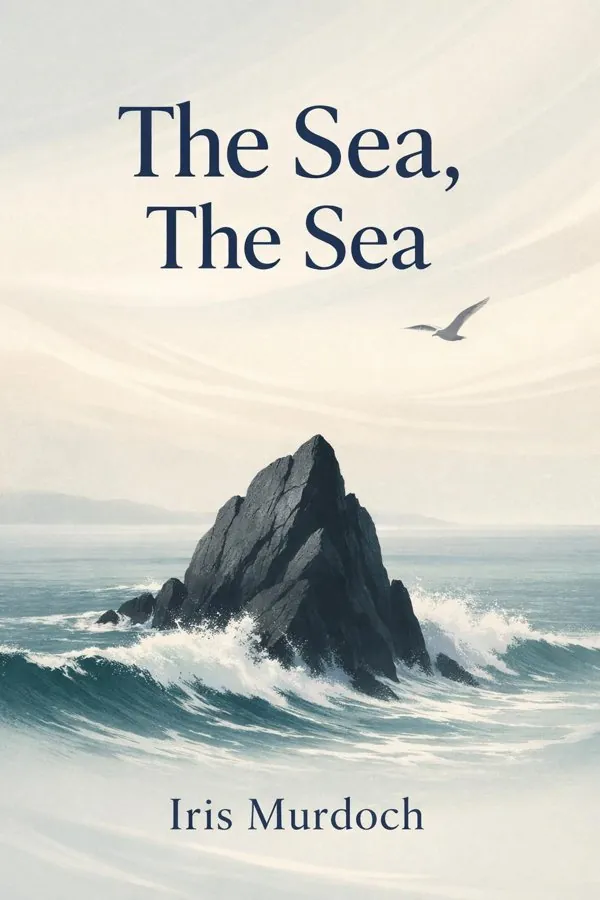
The Sea, The Sea: Summary & Key Insights
by Iris Murdoch
 10 min9 chaptersAudio available
Key Takeaways from The Sea, The Sea
We often imagine that if we could just get away from other people, we would finally become our true selves.
The past becomes most dangerous when we mistake memory for destiny.
Human beings rarely lie to themselves in obvious ways; more often, they build elegant explanations that make selfishness look like sincerity.
Sometimes life interrupts our fantasies not with argument, but with danger.
One of Murdoch’s harshest and most enduring claims is that what we call love is often a disguised form of selfishness.
What Is The Sea, The Sea About?
The Sea, The Sea by Iris Murdoch is a classics book spanning 4 pages. What if the story you tell about your life is the very thing preventing you from seeing it clearly? In The Sea, The Sea, Iris Murdoch transforms a tale of retirement and romantic longing into a profound study of vanity, obsession, memory, and moral blindness. The novel follows Charles Arrowby, a famous, self-satisfied theater director who withdraws to a lonely house by the sea, convinced that isolation will bring serenity and truth. Instead, his solitude becomes a stage on which his fantasies grow larger, especially after he unexpectedly encounters Hartley, the woman he loved in youth and has never fully released in imagination. What begins as a memoir turns into a record of delusion, manipulation, and painful self-revelation. This Booker Prize–winning novel matters because Murdoch does far more than tell a psychological story: she exposes how ego distorts love, how nostalgia rewrites the past, and how difficult genuine goodness can be. Drawing on her background as both a novelist and philosopher, Murdoch creates an unreliable narrator whose elegant self-justifications are as revealing as his actions. The result is a rich classic that is at once darkly funny, unsettling, and morally incisive.
This FizzRead summary covers all 9 key chapters of The Sea, The Sea in approximately 10 minutes, distilling the most important ideas, arguments, and takeaways from Iris Murdoch's work. Also available as an audio summary and Key Quotes Podcast.
The Sea, The Sea
What if the story you tell about your life is the very thing preventing you from seeing it clearly? In The Sea, The Sea, Iris Murdoch transforms a tale of retirement and romantic longing into a profound study of vanity, obsession, memory, and moral blindness. The novel follows Charles Arrowby, a famous, self-satisfied theater director who withdraws to a lonely house by the sea, convinced that isolation will bring serenity and truth. Instead, his solitude becomes a stage on which his fantasies grow larger, especially after he unexpectedly encounters Hartley, the woman he loved in youth and has never fully released in imagination. What begins as a memoir turns into a record of delusion, manipulation, and painful self-revelation.
This Booker Prize–winning novel matters because Murdoch does far more than tell a psychological story: she exposes how ego distorts love, how nostalgia rewrites the past, and how difficult genuine goodness can be. Drawing on her background as both a novelist and philosopher, Murdoch creates an unreliable narrator whose elegant self-justifications are as revealing as his actions. The result is a rich classic that is at once darkly funny, unsettling, and morally incisive.
Who Should Read The Sea, The Sea?
This book is perfect for anyone interested in classics and looking to gain actionable insights in a short read. Whether you're a student, professional, or lifelong learner, the key ideas from The Sea, The Sea by Iris Murdoch will help you think differently.
- ✓Readers who enjoy classics and want practical takeaways
- ✓Professionals looking to apply new ideas to their work and life
- ✓Anyone who wants the core insights of The Sea, The Sea in just 10 minutes
Want the full summary?
Get instant access to this book summary and 100K+ more with Fizz Moment.
Get Free SummaryAvailable on App Store • Free to download
Key Chapters
We often imagine that if we could just get away from other people, we would finally become our true selves. Charles Arrowby begins The Sea, The Sea with exactly this fantasy. Having retired at the height of his success as a celebrated theater director, he moves into a bleak coastal house called Shruff End, determined to live simply, write his memoirs, cook strange meals, swim in the sea, and strip life down to essentials. He presents this decision as a noble rejection of vanity. Yet Murdoch immediately shows that Charles has not escaped performance at all. He has merely changed stages.
His solitude is theatrical from the beginning. He narrates his routines with dramatic self-importance, turning every meal, memory, and inconvenience into a scene in the grand story of Charles. Rather than gaining clarity, he becomes more enclosed within his own interpretations. The absence of an audience does not cure his ego; it intensifies it. Alone, he is freer to believe his own myths.
This is one of Murdoch’s sharpest insights: withdrawal can be restorative, but it can also become a mirror chamber in which self-deception echoes unchecked. Many people experience a version of this today. A retreat, sabbatical, or “digital detox” can help us reset, but if we bring the same unresolved vanity, resentment, or longing with us, silence may amplify those tendencies rather than heal them.
Murdoch is not mocking the desire for peace. She is questioning the assumption that external simplification automatically produces inner wisdom. Charles’s coastal refuge becomes a laboratory for self-absorption, reminding us that introspection without humility can harden into obsession.
Actionable takeaway: When seeking solitude, pair reflection with reality checks—journal honestly, invite trusted feedback, and ask not just “What do I feel?” but “What am I refusing to see?”
The past becomes most dangerous when we mistake memory for destiny. Charles’s orderly plan for retirement collapses when he encounters Hartley, his first love, now an aging woman living nearby with her husband. To Charles, this is not a coincidence but a revelation. He treats the meeting as if fate itself has arranged the restoration of a lost truth. In his mind, Hartley is no ordinary person with a separate life; she is the preserved symbol of what should have been.
Murdoch uses this reunion to expose how nostalgia beautifies and simplifies what was never simple in the first place. Charles does not really meet Hartley as she is. He meets an image he has nourished for decades. The Hartley of his memory is luminous, gentle, and somehow permanently waiting. The actual Hartley is anxious, elusive, ordinary, and deeply uncomfortable with Charles’s intensity. The tragedy is not merely that time has changed them. It is that Charles cannot accept change at all. He wants memory to outrank reality.
This pattern is deeply recognizable. People often revisit former relationships, old ambitions, or childhood identities believing they will recover some pure lost self. A school reunion, a message from an ex, or a return to one’s hometown can stir powerful feelings. But what we often chase is not the past itself, but a fantasy shaped by longing and regret. Murdoch shows how emotionally intoxicating that fantasy can be—and how destructive.
Charles’s fixation on Hartley reveals a crucial moral failure: he interprets her life through his need for meaning. Instead of asking who she is now, he asks how she fits into his story. That move turns love into possession.
Actionable takeaway: When the past resurfaces, pause before declaring it meaningful. Ask, “Am I responding to this person or situation as it is now, or to the version I have preserved in memory?”
Human beings rarely lie to themselves in obvious ways; more often, they build elegant explanations that make selfishness look like sincerity. Charles is a master of this art. Throughout The Sea, The Sea, he insists that his motives are refined, loving, or spiritually serious. He wants peace, not control. He wants Hartley’s happiness, not possession. He wants truth, not drama. But the events of the novel repeatedly reveal that his self-descriptions cannot be trusted.
Murdoch’s genius lies in how she makes readers experience this illusion from the inside. Because Charles narrates the story, we initially move within his justifications. His voice is witty, articulate, and often persuasive. Yet cracks appear everywhere. He minimizes his cruelty, reframes manipulative behavior as devotion, and interprets resistance as misunderstanding. The more earnestly he explains himself, the more plainly we see the distortions. Illusion in the novel is not only romantic; it is ethical. Charles cannot act well because he cannot see clearly.
This has practical force far beyond literature. In everyday life, self-deception often appears as noble language covering less noble impulses: “I’m only helping” may mean “I need to feel needed.” “I’m being honest” may mean “I want to wound.” “I deserve this” may hide entitlement. Murdoch suggests that moral failure often begins not in villainy but in blurred vision.
The novel also shows how illusion spreads socially. Charles’s old friends and rivals arrive carrying their own fantasies, jealousies, and histories. Everyone is interpreting everyone else through private scripts. Reality becomes tangled because each person clings to a preferred story.
Murdoch does not offer easy purification. She suggests that clarity requires discipline, attention, and an ability to decenter the self. That work is uncomfortable precisely because our illusions protect us from shame.
Actionable takeaway: When emotions run high, translate your motives into plain language. Replace “I’m doing this for their good” with a harder question: “What am I getting from this?”
Sometimes life interrupts our fantasies not with argument, but with danger. The sea in Murdoch’s novel is never just scenery. It is beautiful, mysterious, shifting, and occasionally terrifying—a force that reminds Charles that the world does not exist to support his private drama. Strange sightings, difficult tides, and episodes of physical peril puncture the inflated atmosphere of his imagination. These moments matter because they expose how fragile his sense of control really is.
Charles likes to imagine himself as the director of events, even in retirement. But nature is indifferent to his plans. The sea does not validate his emotions, rescue his narrative, or reward his obsession. Instead, it confronts him with scale, unpredictability, and mortality. In a novel dense with psychological maneuvering, these encounters with physical reality act like moral shocks. They remind both Charles and the reader that the world is not merely an extension of consciousness.
Murdoch often links moral awakening to this kind of interruption. We become trapped when everything is filtered through our preferences, grievances, and desires. Reality breaks through when something resists us—another person’s refusal, the body’s limits, a brush with death, the brute fact that events do not obey our interpretation. In Charles’s case, shipwreck-like moments do not instantly transform him, but they weaken the illusion that he is at the center of everything.
This insight applies in everyday life whenever plans collapse. A failed project, illness, an unexpected loss, or even a logistical disaster can feel like an insult to the self. Yet such moments can also restore perspective. They reveal how much of our suffering comes not only from events, but from the assumption that life should conform to our script.
Actionable takeaway: When reality disrupts your plans, resist the urge to immediately force meaning. First ask, “What is this event showing me about the limits of my control?”
One of Murdoch’s harshest and most enduring claims is that what we call love is often a disguised form of selfishness. Charles believes he loves Hartley deeply and faithfully. He sees himself as a man redeemed by constancy, someone whose youthful passion has endured where lesser feelings would have faded. Yet the more intensely he pursues Hartley, the clearer it becomes that his “love” is bound up with ownership, fantasy, and domination.
He does not want Hartley’s freedom; he wants her agreement with his version of reality. He imagines rescuing her, understanding her, and restoring her to her true self, but these impulses all place him at the center. Hartley’s wishes, fears, and judgments become obstacles to overcome. Charles treats her reluctance not as a definitive expression of personhood but as evidence that she is confused, oppressed, or unable to recognize what is best. This is possession masquerading as devotion.
Murdoch’s point is morally unsettling because it reaches beyond obvious abuse. Even in ordinary relationships, people can slide from affection into appropriation. A parent may insist a child follow a path “for your own good.” A friend may demand emotional access in the name of closeness. A romantic partner may confuse intimacy with entitlement. In each case, concern is mixed with the desire to shape another person according to one’s needs.
True love, in Murdoch’s moral vision, involves attention to the reality of another person. It means seeing them as independent, irreducible, and not available for use in our private dramas. This kind of attention is difficult because it requires surrendering control and tolerating disappointment. Charles cannot do this consistently, and his failure drives much of the novel’s pain.
Actionable takeaway: In close relationships, regularly ask, “Am I trying to support this person’s reality, or am I trying to make them fit my emotional needs?”
We usually read unreliable narrators as literary puzzles, but in The Sea, The Sea unreliability is also a moral lesson. Charles does not simply misreport events; he reveals how consciousness itself edits, flatters, and protects the self. He records his days in a voice that is polished, comic, perceptive, and often deeply entertaining. That charm matters. Murdoch wants readers to feel how easy it is to be seduced by intelligence and style, especially when they belong to the person telling the story.
Charles notices many things acutely, but he lacks steady insight into himself. He can describe other people’s absurdities while overlooking his own. He confesses just enough vanity to seem honest, which makes his larger blind spots harder to detect. This dynamic mirrors real life. People often gain credibility by admitting small faults while remaining blind to larger patterns. Self-awareness can become another performance.
Reading Charles carefully trains us to read ourselves carefully. We all narrate our lives, arranging motives and memories into tolerable stories. We explain why we acted as we did, why others misunderstood us, why our mistakes were inevitable, and why our desires are justified. These stories are not always false, but they are rarely complete. Murdoch suggests that ethics begins with suspicion toward one’s own flattering narrative.
This is especially relevant in an age of constant self-presentation. Social media, personal branding, workplace storytelling, and therapeutic language all encourage polished identity management. Charles is a timeless figure because he treats life as a memoir in progress.
The challenge is not to become mute or self-hating, but to cultivate interpretive humility. Our version of events is always partial, especially when pride, desire, or shame is involved.
Actionable takeaway: After a conflict or emotionally charged event, write down your version of what happened—then rewrite it from the other person’s perspective and compare the differences.
One reason Charles’s world becomes chaotic is that other people keep refusing the roles he assigns them. Former lovers, theatrical acquaintances, rivals, and relatives arrive at Shruff End carrying unfinished business and competing interpretations of the past. Charles wants to curate these encounters, but they quickly reveal that his life is not a private artwork under his sole direction. Others remember differently, desire differently, and judge him differently.
Murdoch uses these interruptions to dismantle the fantasy of personal sovereignty. Charles may be the narrator, but he is not the author of everyone else. Each character introduces friction into his self-image. Some expose his vanity. Some challenge his version of old relationships. Some arrive with needs or claims he finds inconvenient. Even when they are absurd, they serve an important function: they bring plurality into a mind that longs for control.
This is one of the novel’s most practical insights. Much of adult frustration comes from trying to make people behave in accordance with narratives we have written for them. We cast someone as the reliable friend, the grateful child, the repentant ex, the supportive colleague, the admirer who finally recognizes our worth. Trouble begins when they improvise. We interpret their independence as betrayal because it disrupts our script.
Murdoch insists that reality is populated by consciousnesses as vivid and stubborn as our own. Moral life therefore requires more than sincerity; it requires accommodation to otherness. That means listening without immediate correction, allowing relationships to be messy, and accepting that other people are not symbols in our personal story.
Charles struggles with this at nearly every turn. The result is both comic and painful, but the lesson is clear: freedom belongs to others too.
Actionable takeaway: Notice where disappointment may actually be script failure. Ask, “What role had I silently assigned this person, and what happens if I let them be more complicated than that?”
Success can make self-knowledge harder, not easier. Before retreating to the sea, Charles was a brilliant man of the theater—admired, influential, and accustomed to shaping people and productions to his will. He enters retirement believing he has laid power aside. But Murdoch shows that habits formed by authority persist long after the title disappears. Charles still expects to direct scenes, read motives, and command emotional attention. His charm and intelligence help him do so, which makes his blindness more dangerous.
This is a subtle but important theme in the novel. Charles is not crude. He is cultivated, articulate, and capable of aesthetic sensitivity. Yet these gifts coexist with profound egotism. Murdoch resists the comforting notion that refinement equals virtue. In fact, Charles’s sophistication often provides better tools for self-justification. Because he is clever, he can make coercion sound romantic and vanity sound philosophical.
The pattern appears everywhere in human institutions. Leaders may assume that competence in one domain grants wisdom in all others. Charismatic people often receive less resistance, which can weaken their capacity for self-correction. The ability to persuade may become the ability to rationalize. Murdoch’s warning is especially relevant in workplaces, creative fields, and public life, where admiration can insulate people from truth.
What Charles lacks is not talent but disciplined attention to reality beyond himself. Power, even informal power, tends to bend the environment toward one’s preferences. Without humility, that bending becomes moral distortion.
Murdoch does not suggest rejecting excellence or influence. She suggests distrusting the fantasy that brilliance exempts a person from ordinary ethical obligations. In some ways, it increases them.
Actionable takeaway: If you occupy a position of influence, build deliberate friction into your life—seek candid feedback, share decision-making, and pay close attention to those who seem uneasy rather than impressed.
The deepest movement in The Sea, The Sea is not toward triumph or romantic fulfillment, but toward the possibility of humility. Charles does not undergo a neat conversion. Murdoch is too psychologically honest for that. His vanity survives, his perceptions remain unstable, and his revelations are incomplete. Yet by the novel’s end, there is at least a weakening of the grandiose self that has governed him. Suffering, resistance, fear, and embarrassment gradually expose the poverty of his fantasies.
This matters because Murdoch’s moral vision is anti-dramatic in the best sense. She does not promise enlightenment through one decisive insight. Instead, she suggests that goodness begins in the difficult practice of unselfing—turning attention away from the glittering, injured, demanding ego and toward reality. Humility here is not self-contempt. It is the recognition that other people are real, that our desires are not sovereign, and that the world exceeds our interpretations.
The sea itself embodies this lesson. It is vast, beautiful, indifferent, and impossible to possess. Charles lives beside it while trying to dominate the tiny human dramas around him. The contrast is almost comic, yet spiritually serious. To behold something larger than oneself can be chastening. Art, nature, love, and loss all have this power when they break the spell of self-importance.
For modern readers, this may be the novel’s most lasting gift. In a culture that rewards display, certainty, and relentless self-assertion, Murdoch offers a counterideal: clearer vision, less vanity, more reverence for reality.
Actionable takeaway: Practice one daily act of unselfing—give full attention to another person, a work of art, or a natural scene without immediately translating it into your preferences, opinions, or personal story.
All Chapters in The Sea, The Sea
About the Author
Iris Murdoch (1919–1999) was an Irish-born British novelist, philosopher, and one of the most distinguished literary figures of the twentieth century. Educated at Somerville College, Oxford, and later at Cambridge, she combined rigorous philosophical inquiry with richly imaginative fiction. Her novels are celebrated for their moral seriousness, psychological depth, and fascination with love, freedom, power, and self-deception. Over the course of her career, she published more than twenty novels, including Under the Net, The Bell, A Fairly Honourable Defeat, The Black Prince, and The Sea, The Sea, which won the Booker Prize in 1978. Murdoch’s background in philosophy, particularly ethics, gave her fiction unusual intellectual force, while her gift for characterization made her work emotionally vivid and enduringly relevant.
Get This Summary in Your Preferred Format
Read or listen to the The Sea, The Sea summary by Iris Murdoch anytime, anywhere. FizzRead offers multiple formats so you can learn on your terms — all free.
Available formats: App · Audio · PDF · EPUB — All included free with FizzRead
Download The Sea, The Sea PDF and EPUB Summary
Key Quotes from The Sea, The Sea
“We often imagine that if we could just get away from other people, we would finally become our true selves.”
“The past becomes most dangerous when we mistake memory for destiny.”
“Human beings rarely lie to themselves in obvious ways; more often, they build elegant explanations that make selfishness look like sincerity.”
“Sometimes life interrupts our fantasies not with argument, but with danger.”
“One of Murdoch’s harshest and most enduring claims is that what we call love is often a disguised form of selfishness.”
Frequently Asked Questions about The Sea, The Sea
The Sea, The Sea by Iris Murdoch is a classics book that explores key ideas across 9 chapters. What if the story you tell about your life is the very thing preventing you from seeing it clearly? In The Sea, The Sea, Iris Murdoch transforms a tale of retirement and romantic longing into a profound study of vanity, obsession, memory, and moral blindness. The novel follows Charles Arrowby, a famous, self-satisfied theater director who withdraws to a lonely house by the sea, convinced that isolation will bring serenity and truth. Instead, his solitude becomes a stage on which his fantasies grow larger, especially after he unexpectedly encounters Hartley, the woman he loved in youth and has never fully released in imagination. What begins as a memoir turns into a record of delusion, manipulation, and painful self-revelation. This Booker Prize–winning novel matters because Murdoch does far more than tell a psychological story: she exposes how ego distorts love, how nostalgia rewrites the past, and how difficult genuine goodness can be. Drawing on her background as both a novelist and philosopher, Murdoch creates an unreliable narrator whose elegant self-justifications are as revealing as his actions. The result is a rich classic that is at once darkly funny, unsettling, and morally incisive.
More by Iris Murdoch


You Might Also Like





Browse by Category
Ready to read The Sea, The Sea?
Get the full summary and 100K+ more books with Fizz Moment.