
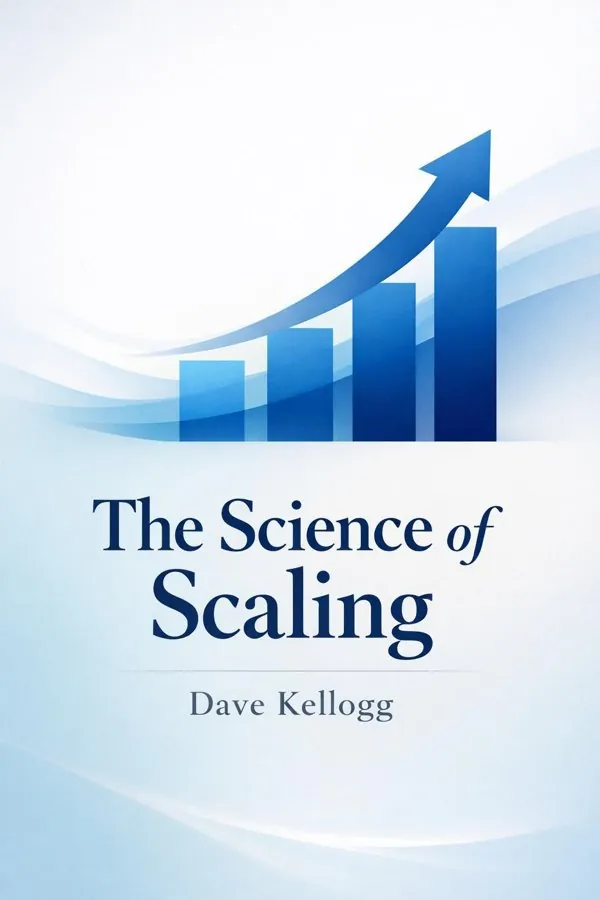
The Science of Scaling: How Founders and Companies Scale Successfully: Summary & Key Insights
by Dave Kellogg
 10 min4 chaptersAudio available
What Is The Science of Scaling: How Founders and Companies Scale Successfully About?
The Science of Scaling: How Founders and Companies Scale Successfully by Dave Kellogg is a entrepreneurship book spanning 4 pages. The Science of Scaling is a practical guide for startup founders and executives on how to grow their companies efficiently and sustainably. Drawing from years of experience as a SaaS executive and investor, Dave Kellogg outlines a data-driven framework for identifying product-market fit, optimizing go-to-market strategies, and avoiding common scaling pitfalls. The book emphasizes the importance of aligning metrics, teams, and processes to achieve predictable growth.
This FizzRead summary covers all 4 key chapters of The Science of Scaling: How Founders and Companies Scale Successfully in approximately 10 minutes, distilling the most important ideas, arguments, and takeaways from Dave Kellogg's work. Also available as an audio summary and Key Quotes Podcast.
The Science of Scaling: How Founders and Companies Scale Successfully
The Science of Scaling is a practical guide for startup founders and executives on how to grow their companies efficiently and sustainably. Drawing from years of experience as a SaaS executive and investor, Dave Kellogg outlines a data-driven framework for identifying product-market fit, optimizing go-to-market strategies, and avoiding common scaling pitfalls. The book emphasizes the importance of aligning metrics, teams, and processes to achieve predictable growth.
Who Should Read The Science of Scaling: How Founders and Companies Scale Successfully?
This book is perfect for anyone interested in entrepreneurship and looking to gain actionable insights in a short read. Whether you're a student, professional, or lifelong learner, the key ideas from The Science of Scaling: How Founders and Companies Scale Successfully by Dave Kellogg will help you think differently.
- ✓Readers who enjoy entrepreneurship and want practical takeaways
- ✓Professionals looking to apply new ideas to their work and life
- ✓Anyone who wants the core insights of The Science of Scaling: How Founders and Companies Scale Successfully in just 10 minutes
Want the full summary?
Get instant access to this book summary and 100K+ more with Fizz Moment.
Get Free SummaryAvailable on App Store • Free to download
Key Chapters
Everything begins with product-market fit. I often describe it as the point where a market visibly pulls your product out of your hands — where demand feels insatiable, and sales conversations shift from persuasion to fulfillment. Too many founders think of product-market fit as a blurry, inspirational moment, something you 'just feel.' That approach leads to dangerous overconfidence. I insist we measure it. We quantify it. Because getting this wrong makes everything else collapse.
To know whether you’ve achieved product-market fit, you must observe certain data signs in your customer behavior. Retention is the first and clearest signal. If customers stick around and continue paying—or even better, expand their usage—you’re onto something. If they leave, you don’t yet have it. Net dollar retention, churn rates, and expansion revenue are not vanity metrics here; they are your truth serum.
Beyond data, product-market fit is about customer energy. When prospects are willing to go through pain to get your product, when early adopters integrate it deeply into their workflows and evangelize it to peers, you can feel the pull. That emotional connection between product and user cannot be faked. Still, data must verify what emotions imply.
In this stage, your company is not about growing fast; it’s about learning deeply. Every dollar should be spent on discovery, not scale. Founders should stay close to customers, refining the product through direct conversations. Many great companies, from Slack to Snowflake, spent years fine-tuning their product before blitzing into growth mode. They resisted the temptation to add salespeople too early. They treated sales as a byproduct of customer love, not a replacement for it.
When your product fits the market, everything changes internally too. Morale lifts. Your team feels momentum. You can finally begin to consider scaling—but only when data says so. Understanding that transition point is what separates a disciplined founder from a gambling one.
Once your product reliably satisfies a real market need, the next challenge is operational: can you sell it consistently? This is where go-to-market fit comes in. The question is no longer 'Does this product work?' but rather 'Can we repeatedly find, win, and retain the right customers at a profitable cost?'
Go-to-market fit requires your sales, marketing, and customer success teams to function like synchronized gears, not separate silos. It’s common to see scaling troubles here because companies often grow their go-to-market teams under the assumption that more people equals more growth. But unless the motion itself is repeatable, scaling just multiplies inefficiency.
To achieve go-to-market fit, I look at three interlocking components: your **ideal customer profile (ICP)**, your **sales motion**, and your **customer journey**. The ICP defines who you win with, the sales motion details how you win, and the customer journey ensures those customers achieve what you promised. When these three are aligned, your business begins to scale predictably.
This is also when the founder must start letting go of direct sales control. Founder-led sales are often powerful because no one sells your vision like you do. But it’s not sustainable. The test of go-to-market fit is whether someone who did not invent your product can sell it successfully using a structured playbook. Until that happens, you haven’t truly achieved scalable sales.
Culturally, this phase is about moving from 'heroic effort' to 'systemic execution.' It’s about documentation, process refinement, and the introduction of metrics discipline. Your sales cycles shorten, conversion rates stabilize, and customer acquisition cost (CAC) becomes predictable. Only then should you pour fuel into the system. Scaling prematurely at this stage—like hiring dozens of reps before the motion works—leads to frustration, wasted capital, and brand damage.
Go-to-market fit is where science fully meets art. It’s where data-driven calibration becomes your best friend. Too many organizations rush through it because the surface metrics—like pipeline growth—look enticing. But you must ask whether that pipeline converts, renews, and expands. That’s the true measure of readiness.
+ 2 more chapters — available in the FizzRead app
All Chapters in The Science of Scaling: How Founders and Companies Scale Successfully
About the Author
Dave Kellogg is a technology executive, investor, and advisor with decades of experience leading and scaling enterprise software companies. He has served as CEO of Host Analytics, CMO of Business Objects, and is a well-known voice in the SaaS community through his blog and speaking engagements on startup growth and metrics.
Get This Summary in Your Preferred Format
Read or listen to the The Science of Scaling: How Founders and Companies Scale Successfully summary by Dave Kellogg anytime, anywhere. FizzRead offers multiple formats so you can learn on your terms — all free.
Available formats: App · Audio · PDF · EPUB — All included free with FizzRead
Download The Science of Scaling: How Founders and Companies Scale Successfully PDF and EPUB Summary
Key Quotes from The Science of Scaling: How Founders and Companies Scale Successfully
“Everything begins with product-market fit.”
“Once your product reliably satisfies a real market need, the next challenge is operational: can you sell it consistently?”
Frequently Asked Questions about The Science of Scaling: How Founders and Companies Scale Successfully
The Science of Scaling: How Founders and Companies Scale Successfully by Dave Kellogg is a entrepreneurship book that explores key ideas across 4 chapters. The Science of Scaling is a practical guide for startup founders and executives on how to grow their companies efficiently and sustainably. Drawing from years of experience as a SaaS executive and investor, Dave Kellogg outlines a data-driven framework for identifying product-market fit, optimizing go-to-market strategies, and avoiding common scaling pitfalls. The book emphasizes the importance of aligning metrics, teams, and processes to achieve predictable growth.
You Might Also Like
Lean Analytics
Alistair Croll, Benjamin Yoskovitz
10 min
21 Days To A Big Idea: Creating Breakthrough Business Concepts
Bryan Mattimore
10 min
Sam Walton: Made in America: My Story
Sam Walton
10 min
10x Is Easier Than 2x: How World-Class Entrepreneurs Achieve More by Doing Less
Dan Sullivan, Benjamin Hardy
10 min
12 Months to $1 Million: How to Pick a Winning Product, Build a Real Business, and Become a Seven-Figure Entrepreneur
Ryan Daniel Moran
10 min
24 Assets: Create a Digital, Scalable, Valuable Business
Daniel Priestley
10 minBrowse by Category
Ready to read The Science of Scaling: How Founders and Companies Scale Successfully?
Get the full summary and 100K+ more books with Fizz Moment.