
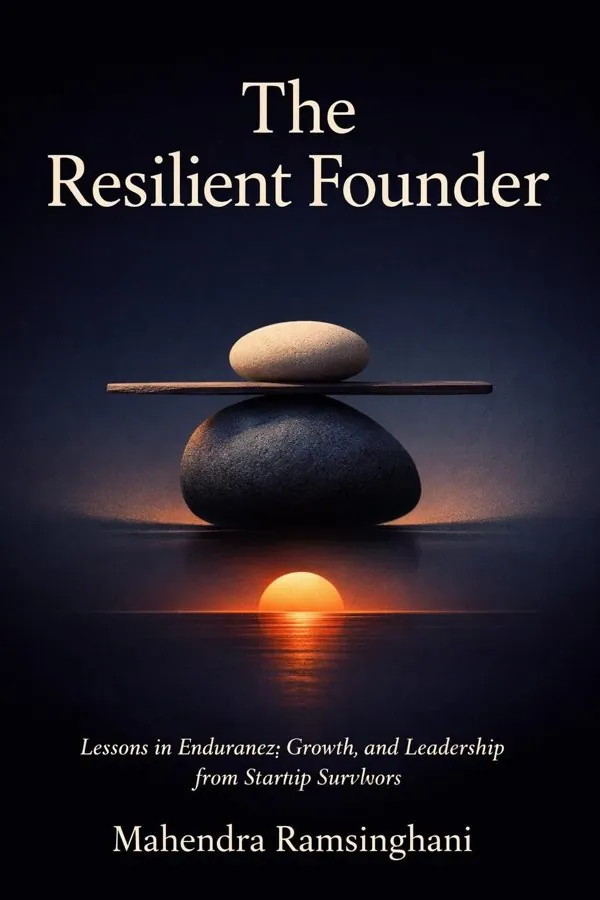
The Resilient Founder: Lessons in Endurance, Growth, and Leadership from Startup Survivors: Summary & Key Insights
 10 min9 chaptersAudio available
Key Takeaways from The Resilient Founder: Lessons in Endurance, Growth, and Leadership from Startup Survivors
A startup can make a person feel invincible and broken within the same week.
Every startup has a business model, but it also has a psychological model hidden inside the founder.
Many people talk about resilience as if some founders simply have it and others do not.
The founder who understands their inner world leads more effectively in the outer one.
Burnout does not arrive as a dramatic breakdown; it often creeps in disguised as dedication.
What Is The Resilient Founder: Lessons in Endurance, Growth, and Leadership from Startup Survivors About?
The Resilient Founder: Lessons in Endurance, Growth, and Leadership from Startup Survivors by Mahendra Ramsinghani is a entrepreneurship book spanning 11 pages. Startup culture often glorifies speed, disruption, and relentless ambition, but it rarely lingers on the emotional cost of building something under extreme uncertainty. In The Resilient Founder, Mahendra Ramsinghani turns attention to the inner life of entrepreneurship: the anxiety behind the pitch, the loneliness behind the vision, and the psychological stamina required to keep going when success is far from guaranteed. Drawing on interviews with founders, investors, and mental health experts, he explores why resilience is not a personality trait reserved for a heroic few, but a set of habits, perspectives, and support systems that can be intentionally developed. What makes this book especially valuable is its refusal to romanticize struggle. Ramsinghani shows that burnout, self-doubt, identity crises, and strained relationships are not side notes in the startup journey; they are central leadership challenges. At the same time, he offers practical ways to navigate them with greater self-awareness and emotional discipline. As an investor, author, and longtime observer of startup ecosystems, Ramsinghani brings both strategic perspective and human empathy, making this an essential read for founders who want to build enduring companies without losing themselves in the process.
This FizzRead summary covers all 9 key chapters of The Resilient Founder: Lessons in Endurance, Growth, and Leadership from Startup Survivors in approximately 10 minutes, distilling the most important ideas, arguments, and takeaways from Mahendra Ramsinghani's work. Also available as an audio summary and Key Quotes Podcast.
The Resilient Founder: Lessons in Endurance, Growth, and Leadership from Startup Survivors
Startup culture often glorifies speed, disruption, and relentless ambition, but it rarely lingers on the emotional cost of building something under extreme uncertainty. In The Resilient Founder, Mahendra Ramsinghani turns attention to the inner life of entrepreneurship: the anxiety behind the pitch, the loneliness behind the vision, and the psychological stamina required to keep going when success is far from guaranteed. Drawing on interviews with founders, investors, and mental health experts, he explores why resilience is not a personality trait reserved for a heroic few, but a set of habits, perspectives, and support systems that can be intentionally developed.
What makes this book especially valuable is its refusal to romanticize struggle. Ramsinghani shows that burnout, self-doubt, identity crises, and strained relationships are not side notes in the startup journey; they are central leadership challenges. At the same time, he offers practical ways to navigate them with greater self-awareness and emotional discipline. As an investor, author, and longtime observer of startup ecosystems, Ramsinghani brings both strategic perspective and human empathy, making this an essential read for founders who want to build enduring companies without losing themselves in the process.
Who Should Read The Resilient Founder: Lessons in Endurance, Growth, and Leadership from Startup Survivors?
This book is perfect for anyone interested in entrepreneurship and looking to gain actionable insights in a short read. Whether you're a student, professional, or lifelong learner, the key ideas from The Resilient Founder: Lessons in Endurance, Growth, and Leadership from Startup Survivors by Mahendra Ramsinghani will help you think differently.
- ✓Readers who enjoy entrepreneurship and want practical takeaways
- ✓Professionals looking to apply new ideas to their work and life
- ✓Anyone who wants the core insights of The Resilient Founder: Lessons in Endurance, Growth, and Leadership from Startup Survivors in just 10 minutes
Want the full summary?
Get instant access to this book summary and 100K+ more with Fizz Moment.
Get Free SummaryAvailable on App Store • Free to download
Key Chapters
A startup can make a person feel invincible and broken within the same week. That is one of the book’s core truths: entrepreneurship is not just a business challenge, but an intense emotional experience shaped by uncertainty, responsibility, and identity. Founders often swing between hope and despair because every product launch, customer loss, fundraising meeting, and hiring decision feels deeply personal. Unlike traditional roles, where success is distributed across a larger system, the founder often experiences the company’s progress as a reflection of personal worth.
Ramsinghani argues that this emotional rollercoaster is not evidence of weakness; it is built into the startup environment. You are making high-stakes decisions with incomplete information, while trying to inspire employees, reassure investors, and preserve confidence in yourself. This creates psychological whiplash. A successful demo can trigger euphoria, while a delayed payment or failed round can produce panic.
The important lesson is not to eliminate emotional swings entirely, but to avoid letting them dictate judgment. Founders who survive do not become emotionless. They learn to create steadiness through routines, trusted advisors, reflective practices, and a longer time horizon. For example, a founder who loses a major client may initially feel catastrophic fear, but a resilient response involves assessing runway, identifying replacement opportunities, and communicating calmly with the team instead of spreading alarm.
An actionable takeaway: when major highs or lows hit, delay irreversible decisions for 24 hours and return to objective metrics before reacting.
Every startup has a business model, but it also has a psychological model hidden inside the founder. Ramsinghani highlights recurring traits among entrepreneurs: perfectionism, control orientation, fear of failure, high achievement drive, and deep personal attachment to the company’s mission. These qualities can fuel extraordinary persistence, yet they can also produce distorted thinking, overwork, poor delegation, and defensive leadership.
A founder who believes every outcome depends entirely on personal effort may build a culture of urgency and excellence. But the same belief can lead to micromanagement, exhaustion, and a team that becomes passive because the founder cannot let go. Likewise, perfectionism may produce a polished product, but it can also delay launches and prevent learning from real users. The point is not that these traits are bad. It is that unexamined strengths often become liabilities under pressure.
The book encourages founders to treat self-understanding as strategic infrastructure. Knowing your triggers matters as much as knowing your market. If criticism makes you overly defensive, you may ignore useful feedback. If uncertainty drives anxiety, you may seek false certainty through premature decisions. Psychological patterns are not abstract ideas; they shape hiring, culture, communication, and risk-taking.
A practical application is to identify one recurring emotional pattern after difficult moments. For example, after investor meetings, do you spiral into self-judgment? After team conflict, do you withdraw? Naming the pattern creates room for better choices. A founder with awareness can pause, ask better questions, and avoid turning personal insecurity into organizational dysfunction.
An actionable takeaway: conduct a weekly self-review focused not only on business decisions, but on emotional triggers, reactions, and leadership patterns.
Many people talk about resilience as if some founders simply have it and others do not. Ramsinghani challenges that myth. Resilience is not magical toughness or permanent optimism. It is the ability to recover, adapt, and continue acting effectively under stress. That ability can be strengthened through mindset, behavior, relationships, and recovery practices.
The book draws on psychological research to show that resilience comes from meaning, perspective, and regulation rather than brute force. Founders become more resilient when they stop interpreting every setback as a verdict on their identity. A failed launch is data. A rejected pitch is feedback. A hard quarter is not proof that the mission is doomed. Resilient founders do not deny pain; they place it in context.
Building resilience also requires capacity. Sleep, exercise, boundaries, and emotional processing may sound basic, but they directly influence decision quality and stress tolerance. A founder who is chronically exhausted becomes more reactive, more pessimistic, and more likely to catastrophize. By contrast, someone who has structured recovery into the week can absorb pressure without collapsing into impulsiveness.
Consider a founder facing repeated investor rejection. One response is to internalize failure and lose momentum. A resilient response is to review the pitch, clarify the story, improve traction signals, and keep moving while leaning on mentors for perspective. The difference is not personality alone; it is a practiced method of recovery.
An actionable takeaway: create a personal resilience system with three elements you can maintain every week, such as exercise, reflective journaling, and one candid conversation with a trusted peer or mentor.
The founder who understands their inner world leads more effectively in the outer one. One of the book’s strongest contributions is its emphasis on self-awareness as a practical leadership skill, not a soft luxury. When founders can identify their fears, motivations, blind spots, and stress responses, they are less likely to project confusion onto the company.
Self-awareness helps founders separate fact from narrative. Imagine a product launch underperforms. A self-unaware leader may assume the team is mediocre, the market is hostile, or disaster is imminent. A self-aware leader notices the surge of disappointment, recognizes the tendency to personalize results, and then returns to evidence. What did users actually do? What assumptions were wrong? What should change next?
This skill also improves communication. Teams can sense when leaders are anxious, avoidant, or defensive. A founder who lacks self-awareness may overcompensate with forced optimism or sudden blame. By contrast, a grounded founder can say, “This is a difficult moment, but here is what we know, what we do not know, and how we will respond.” That kind of emotional clarity builds trust.
Ramsinghani suggests that self-awareness often grows through feedback, coaching, journaling, therapy, or structured reflection. It rarely appears automatically. In practice, this might mean reviewing your behavior after board meetings, examining where conversations triggered you, or asking close colleagues how you show up under stress.
An actionable takeaway: after any high-pressure event, ask yourself three questions: What did I feel, how did I react, and what impact did that reaction have on others?
Burnout does not arrive as a dramatic breakdown; it often creeps in disguised as dedication. Founders are especially vulnerable because startup culture rewards overextension. Long hours, constant availability, and relentless urgency are often treated as proof of commitment. Ramsinghani argues that this mindset is dangerous because burnout does not just reduce energy; it impairs leadership quality, creativity, empathy, and strategic thinking.
A burned-out founder may still appear productive on the surface. Emails get answered. Meetings happen. Deadlines are chased. But beneath that activity, decision-making deteriorates. Patience shrinks. Listening disappears. Problems feel larger than they are. The founder starts operating in survival mode, where every issue seems urgent and there is no room for thoughtful prioritization.
The book encourages founders to recognize burnout as both a personal and organizational risk. If the founder is depleted, the culture often mirrors that depletion. Teams become reactive, communication worsens, and turnover rises. Preventing burnout therefore requires more than self-care slogans. It means designing sustainable ways of working: realistic planning, delegation, protected recovery time, and honest communication about limits.
A practical example is a founder who works late every night and slowly becomes irritable with the team. Instead of treating this as normal startup life, the founder could restructure meetings, reduce low-value commitments, hand off operational tasks, and establish one evening per week fully free from work. Small changes can restore decision quality.
An actionable takeaway: identify your top three energy drains and eliminate, delegate, or redesign at least one of them within the next seven days.
The myth of the lone visionary is one of entrepreneurship’s most damaging stories. Ramsinghani makes clear that resilience is deeply relational. Founders who endure usually have support systems that help them process setbacks, test decisions, and maintain perspective. These systems may include co-founders, spouses, friends, mentors, therapists, peer founder groups, or empathetic investors.
Isolation magnifies distress. When founders feel they must appear strong at all times, they hide fear and uncertainty until those feelings become overwhelming. This often leads to poor choices because they are thinking in a closed loop. A support system breaks that loop. It offers emotional containment, practical advice, and sometimes simply a reminder that difficult phases are survivable.
Relationships also need active maintenance. Startup pressure can strain marriages, friendships, and family ties because the company consumes time, attention, and emotional bandwidth. Ramsinghani emphasizes that founders cannot assume important relationships will survive on autopilot. A neglected support network becomes unavailable exactly when it is most needed.
In practical terms, this might mean scheduling weekly founder peer check-ins, setting protected time with family, or building a small circle of people who are authorized to challenge your thinking honestly. It may also mean seeking professional support when anxiety or exhaustion exceed what informal relationships can carry.
A founder facing a down round, for instance, may gain clarity faster by speaking with a mentor who has lived through one, a partner who helps restore emotional balance, and a peer who can normalize the experience.
An actionable takeaway: map your support network today and identify one missing role, such as mentor, therapist, or peer founder, then take one step to fill it.
Founders often say they embrace failure, but in reality most experience it as grief. Ramsinghani does not minimize that pain. Instead, he argues that the most resilient entrepreneurs learn to metabolize failure without becoming defined by it. Failure is one of the startup world’s harshest teachers because it exposes flawed assumptions, weak execution, and fragile identity all at once.
What matters is the interpretation. If failure becomes a story of personal inadequacy, it narrows future action. The founder becomes more fearful, less creative, and more likely to protect ego instead of pursuing truth. But if failure becomes strategic education, it can produce sharper judgment, better timing, stronger teams, and more realistic expectations.
This is not about simplistic optimism. Some failures are expensive, public, and deeply painful. A company may shut down. A co-founder may leave. Investors may lose confidence. The book’s point is that recovery starts when the founder can ask better questions: What assumptions proved false? What signals did I ignore? What skills was I missing? What would I do differently next time?
Many accomplished founders eventually credit their hardest chapter with teaching them discipline, humility, and clearer thinking. A failed product may reveal that customer discovery was weak. A hiring mistake may show that cultural fit was ignored. A fundraising collapse may expose an incoherent narrative.
An actionable takeaway: after any major setback, conduct a written postmortem with three sections: controllable mistakes, uncontrollable factors, and lessons to apply immediately in the next decision cycle.
A founder’s behavior in difficult moments becomes culture faster than any written value statement. Ramsinghani shows that pressure reveals leadership more clearly than success does. When cash is tight, a launch fails, or the market shifts unexpectedly, teams watch the founder for signals: Should we panic, blame, hide, collaborate, or adapt? The answer is often communicated less by speeches than by tone, presence, and decision patterns.
Leadership under pressure requires emotional regulation and disciplined transparency. Founders do not need to pretend everything is fine, but they do need to prevent their fear from infecting the organization. The best leaders can acknowledge reality without dramatizing it. They frame challenges honestly, preserve dignity in communication, and focus the team on priorities.
This also means making hard calls with clarity. A founder may need to reduce burn, reset goals, replace a senior hire, or change strategy. Teams can handle difficult news better than ambiguity and avoidance. What destroys trust is inconsistency, hidden panic, or sudden decisions that appear disconnected from prior communication.
Ramsinghani also brings in investor and ecosystem perspectives, reminding founders that external stakeholders value steadiness. Investors know startups are chaotic. What they look for is not perfect execution, but a founder who can process bad news, learn quickly, and lead decisively.
An example is a founder facing a missed revenue target. Instead of blaming sales publicly or withdrawing emotionally, the founder gathers the data, explains the gap, clarifies the revised plan, and invites accountability across functions.
An actionable takeaway: in your next crisis update, communicate three things clearly: current reality, immediate priorities, and what remains unchanged about the mission.
A company cannot rely on one resilient founder forever. The final lesson running through the book is that endurance must become cultural, not merely personal. If the organization is built around one person’s stamina, the company remains fragile. Truly durable startups create systems, norms, and relationships that help the whole team handle pressure, setbacks, and change.
A resilient culture combines accountability with psychological safety. People are expected to perform, but they are also encouraged to surface problems early, discuss mistakes honestly, and adapt without shame. In such environments, setbacks become shared learning opportunities rather than hidden failures. This reduces fear and improves problem-solving speed.
Culture is shaped by repeated behavior. If leaders punish bad news, teams will conceal risk. If leaders model reflection, recovery, and honest dialogue, teams will become more adaptive. Ramsinghani suggests that resilience at the organizational level shows up in meeting quality, feedback norms, hiring choices, and how the company responds when plans fail.
For example, after losing a major customer, a fragile culture might hunt for blame and create silence. A resilient culture would analyze what happened, support the team emotionally, update the strategy, and preserve momentum. Similarly, sustainable companies build processes that reduce founder bottlenecks, making the business less dependent on constant crisis heroics.
An actionable takeaway: choose one team ritual that reinforces resilience, such as a weekly lessons-learned review, a no-blame incident postmortem, or a leadership check-in focused on risks, morale, and recovery.
All Chapters in The Resilient Founder: Lessons in Endurance, Growth, and Leadership from Startup Survivors
About the Author
Mahendra Ramsinghani is an investor, author, and educator whose work centers on venture capital, entrepreneurship, and the startup ecosystem. He is known for combining a practical understanding of early-stage company building with a deep interest in the human and psychological realities founders face. Through writing, mentoring, and investing, he has engaged with entrepreneurs across industries and geographies, giving him a broad view of what helps companies and leaders endure. Ramsinghani’s perspective is especially valuable because he looks beyond fundraising and growth metrics to examine resilience, judgment, and emotional health as critical parts of startup success. His work helps founders, investors, and operators better understand the inner demands of building companies in uncertain, high-pressure environments.
Get This Summary in Your Preferred Format
Read or listen to the The Resilient Founder: Lessons in Endurance, Growth, and Leadership from Startup Survivors summary by Mahendra Ramsinghani anytime, anywhere. FizzRead offers multiple formats so you can learn on your terms — all free.
Available formats: App · Audio · PDF · EPUB — All included free with FizzRead
Download The Resilient Founder: Lessons in Endurance, Growth, and Leadership from Startup Survivors PDF and EPUB Summary
Key Quotes from The Resilient Founder: Lessons in Endurance, Growth, and Leadership from Startup Survivors
“A startup can make a person feel invincible and broken within the same week.”
“Every startup has a business model, but it also has a psychological model hidden inside the founder.”
“Many people talk about resilience as if some founders simply have it and others do not.”
“The founder who understands their inner world leads more effectively in the outer one.”
“Burnout does not arrive as a dramatic breakdown; it often creeps in disguised as dedication.”
Frequently Asked Questions about The Resilient Founder: Lessons in Endurance, Growth, and Leadership from Startup Survivors
The Resilient Founder: Lessons in Endurance, Growth, and Leadership from Startup Survivors by Mahendra Ramsinghani is a entrepreneurship book that explores key ideas across 9 chapters. Startup culture often glorifies speed, disruption, and relentless ambition, but it rarely lingers on the emotional cost of building something under extreme uncertainty. In The Resilient Founder, Mahendra Ramsinghani turns attention to the inner life of entrepreneurship: the anxiety behind the pitch, the loneliness behind the vision, and the psychological stamina required to keep going when success is far from guaranteed. Drawing on interviews with founders, investors, and mental health experts, he explores why resilience is not a personality trait reserved for a heroic few, but a set of habits, perspectives, and support systems that can be intentionally developed. What makes this book especially valuable is its refusal to romanticize struggle. Ramsinghani shows that burnout, self-doubt, identity crises, and strained relationships are not side notes in the startup journey; they are central leadership challenges. At the same time, he offers practical ways to navigate them with greater self-awareness and emotional discipline. As an investor, author, and longtime observer of startup ecosystems, Ramsinghani brings both strategic perspective and human empathy, making this an essential read for founders who want to build enduring companies without losing themselves in the process.
More by Mahendra Ramsinghani
You Might Also Like

Lean Analytics
Alistair Croll, Benjamin Yoskovitz
10 min
21 Days To A Big Idea: Creating Breakthrough Business Concepts
Bryan Mattimore
10 min
Sam Walton: Made in America: My Story
Sam Walton
10 min
10x Is Easier Than 2x: How World-Class Entrepreneurs Achieve More by Doing Less
Dan Sullivan, Benjamin Hardy
10 min
12 Months to $1 Million: How to Pick a Winning Product, Build a Real Business, and Become a Seven-Figure Entrepreneur
Ryan Daniel Moran
10 min
24 Assets: Create a Digital, Scalable, Valuable Business
Daniel Priestley
10 minBrowse by Category
Ready to read The Resilient Founder: Lessons in Endurance, Growth, and Leadership from Startup Survivors?
Get the full summary and 100K+ more books with Fizz Moment.