
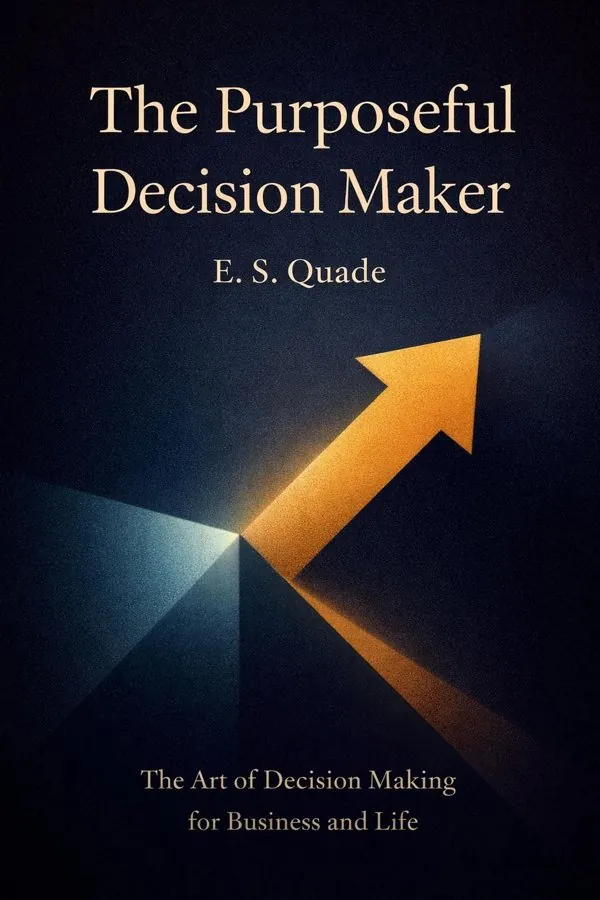
The Purposeful Decision Maker: The Art of Decision Making for Business and Life: Summary & Key Insights
by E. S. Quade
 10 min9 chaptersAudio available
What Is The Purposeful Decision Maker: The Art of Decision Making for Business and Life About?
The Purposeful Decision Maker: The Art of Decision Making for Business and Life by E. S. Quade is a strategy book spanning 9 pages. This book presents a structured approach to decision making, emphasizing the integration of analytical methods with human judgment. It explores how individuals and organizations can make purposeful choices under uncertainty, combining quantitative analysis with qualitative reasoning to achieve better outcomes.
This FizzRead summary covers all 9 key chapters of The Purposeful Decision Maker: The Art of Decision Making for Business and Life in approximately 10 minutes, distilling the most important ideas, arguments, and takeaways from E. S. Quade's work. Also available as an audio summary and Key Quotes Podcast.
The Purposeful Decision Maker: The Art of Decision Making for Business and Life
This book presents a structured approach to decision making, emphasizing the integration of analytical methods with human judgment. It explores how individuals and organizations can make purposeful choices under uncertainty, combining quantitative analysis with qualitative reasoning to achieve better outcomes.
Who Should Read The Purposeful Decision Maker: The Art of Decision Making for Business and Life?
This book is perfect for anyone interested in strategy and looking to gain actionable insights in a short read. Whether you're a student, professional, or lifelong learner, the key ideas from The Purposeful Decision Maker: The Art of Decision Making for Business and Life by E. S. Quade will help you think differently.
- ✓Readers who enjoy strategy and want practical takeaways
- ✓Professionals looking to apply new ideas to their work and life
- ✓Anyone who wants the core insights of The Purposeful Decision Maker: The Art of Decision Making for Business and Life in just 10 minutes
Want the full summary?
Get instant access to this book summary and 100K+ more with Fizz Moment.
Get Free SummaryAvailable on App Store • Free to download
Key Chapters
Every purposeful decision begins not with analysis, but with definition. The greatest source of failure in decision making lies in solving the wrong problem. I have seen countless organizations invest enormous resources analyzing data, modeling systems, and optimizing metrics that did not truly serve their deeper objectives. Before any analysis can help you, you must ask: what problem am I trying to solve, under what conditions, and to what ends?
In my experience, defining a decision problem has three essential dimensions: the objectives, the constraints, and the alternatives. Objectives capture what you are trying to achieve; they are the yardsticks by which decisions are judged. Constraints describe what limits you must respect: resources, time, laws, ethical considerations, and political realities. Alternatives are the feasible courses of action open to you within those boundaries.
When you define objectives, you must look beyond immediate goals to the larger purpose they serve. For example, a business may think its objective is to maximize profit, but perhaps its true purpose is to sustain long-term viability, attract capable people, and contribute to societal needs. Framing objectives too narrowly leads to misguided optimization—and often unanticipated failures.
Constraints, on the other hand, remind you that decisions are never made in a vacuum. No matter how elegant a model looks on paper, if it demands resources you do not have or violates obligations you must uphold, it is not a viable choice. Recognizing constraints forces realism and prioritization.
Alternatives define freedom. Unless you generate diverse options, analysis becomes sterile. It is not the model’s job to generate creativity—it is yours. Purposeful decision making is imaginative: you must not only analyze possibilities but create them.
The interplay between these three—objectives, constraints, alternatives—forms the core of any structured decision framework. Once defined with care, analysis becomes meaningful, because you now know what counts and why.
The notion of rationality lies at the heart of decision science. Yet, as I have often said, perfect rationality is a fiction. The human mind does not compute indefinitely; organizations do not process infinite data. We live in a world of bounded rationality—a term popularized by Herbert Simon but one that I have confronted in real systems time after time.
Purposeful decision making does not assume omniscience. It begins with recognizing our limits and designing processes that mitigate, rather than deny, them. Rationality in the real world means systematic reasoning within constraints of time, information, and cognition.
When organizations make decisions, they do so under multiple pressures—political, cultural, and personal. In one government analysis project I oversaw, two departments each used the same data and models but came to opposing conclusions, simply because their institutional priorities differed. Rational analysis alone could not reconcile them; only purposeful negotiation of objectives could.
My point is that rationality is not a thing you possess; it is an ideal you approximate through structured thinking. Boundaries are natural. The key lies in elevating awareness—knowing the assumptions behind your reasoning, understanding where uncertainty enters, and balancing the rigor of analysis with the humility of judgment. The great danger is not that we are irrational, but that we mistake limited rationality for certainty.
+ 7 more chapters — available in the FizzRead app
All Chapters in The Purposeful Decision Maker: The Art of Decision Making for Business and Life
About the Author
Edward S. Quade was an American mathematician and systems analyst known for his work in operations research and decision theory. He contributed significantly to the development of decision-making methodologies applied in government and industry.
Get This Summary in Your Preferred Format
Read or listen to the The Purposeful Decision Maker: The Art of Decision Making for Business and Life summary by E. S. Quade anytime, anywhere. FizzRead offers multiple formats so you can learn on your terms — all free.
Available formats: App · Audio · PDF · EPUB — All included free with FizzRead
Download The Purposeful Decision Maker: The Art of Decision Making for Business and Life PDF and EPUB Summary
Key Quotes from The Purposeful Decision Maker: The Art of Decision Making for Business and Life
“Every purposeful decision begins not with analysis, but with definition.”
“The notion of rationality lies at the heart of decision science.”
Frequently Asked Questions about The Purposeful Decision Maker: The Art of Decision Making for Business and Life
The Purposeful Decision Maker: The Art of Decision Making for Business and Life by E. S. Quade is a strategy book that explores key ideas across 9 chapters. This book presents a structured approach to decision making, emphasizing the integration of analytical methods with human judgment. It explores how individuals and organizations can make purposeful choices under uncertainty, combining quantitative analysis with qualitative reasoning to achieve better outcomes.
You Might Also Like

Mastery
Robert Greene
10 min
Cut Costs Not Corners: A Practical Guide to Staying Competitive and Improving Profits
Colin Barrow
10 min
Good Strategy/Bad Strategy: The Difference and Why It Matters
Richard P. Rumelt
10 min
On Grand Strategy
John Lewis Gaddis
10 min
The Six Disciplines of Digital Transformation
George Westerman
10 min
7 Powers: The Foundations of Business Strategy
Hamilton Helmer
10 minBrowse by Category
Ready to read The Purposeful Decision Maker: The Art of Decision Making for Business and Life?
Get the full summary and 100K+ more books with Fizz Moment.