
The Puppets of Spelhorst: Summary & Key Insights
 10 min8 chaptersAudio available
Key Takeaways from The Puppets of Spelhorst
Loneliness often reveals itself not as silence, but as a hunger for meaning.
What we call loss is sometimes the beginning of another life.
Stories come alive when someone is willing to believe in them.
We become more fully ourselves when we step into a shared story.
A powerful life is rarely built on fate alone or freedom alone, but on the tension between them.
What Is The Puppets of Spelhorst About?
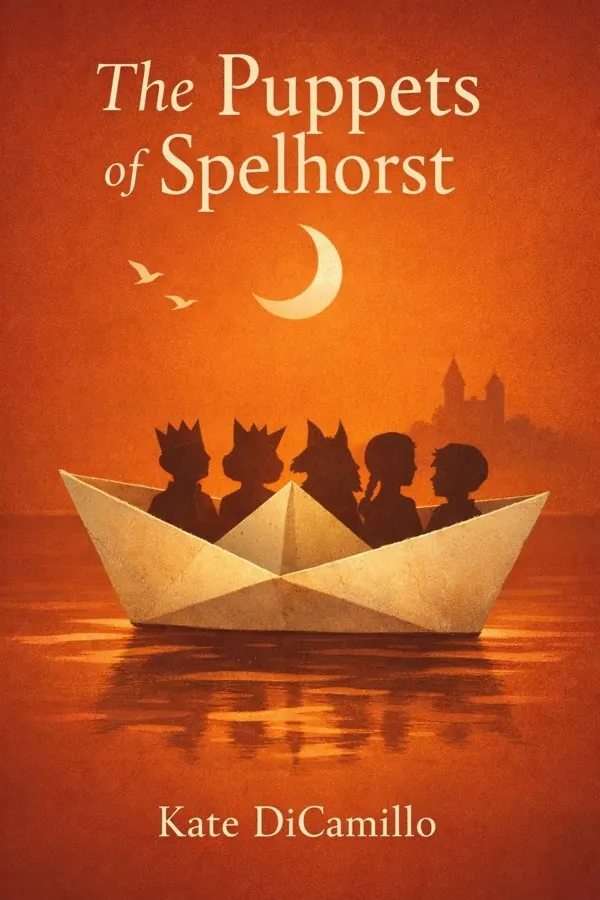
The Puppets of Spelhorst by Kate DiCamillo is a classics book spanning 4 pages. The Puppets of Spelhorst is a luminous, fable-like novel about five handmade puppets—a king, a wolf, a girl, a boy, and an owl—who pass from one life into another, carrying with them longing, mystery, and the possibility of transformation. What begins in the lonely home of an aging sea captain unfolds into a moving meditation on fate, loss, imagination, and the strange ways stories keep living after their makers are gone. Though written for younger readers, the book speaks with unusual clarity to anyone who has ever wondered what purpose survives disappointment or how love can be reborn through art. Kate DiCamillo brings extraordinary authority to this material. One of the most celebrated writers in contemporary children’s literature, she is known for pairing emotional depth with simple, musical prose. Here, she creates a story that feels both old-fashioned and timeless, like a fairy tale whispered across generations. The novel matters because it reminds us that even discarded things—and seemingly forgotten lives—can become sources of wonder. In DiCamillo’s hands, puppets are never just puppets: they are vessels for memory, hope, and human connection.
This FizzRead summary covers all 8 key chapters of The Puppets of Spelhorst in approximately 10 minutes, distilling the most important ideas, arguments, and takeaways from Kate DiCamillo's work. Also available as an audio summary and Key Quotes Podcast.
The Puppets of Spelhorst
The Puppets of Spelhorst is a luminous, fable-like novel about five handmade puppets—a king, a wolf, a girl, a boy, and an owl—who pass from one life into another, carrying with them longing, mystery, and the possibility of transformation. What begins in the lonely home of an aging sea captain unfolds into a moving meditation on fate, loss, imagination, and the strange ways stories keep living after their makers are gone. Though written for younger readers, the book speaks with unusual clarity to anyone who has ever wondered what purpose survives disappointment or how love can be reborn through art.
Kate DiCamillo brings extraordinary authority to this material. One of the most celebrated writers in contemporary children’s literature, she is known for pairing emotional depth with simple, musical prose. Here, she creates a story that feels both old-fashioned and timeless, like a fairy tale whispered across generations. The novel matters because it reminds us that even discarded things—and seemingly forgotten lives—can become sources of wonder. In DiCamillo’s hands, puppets are never just puppets: they are vessels for memory, hope, and human connection.
Who Should Read The Puppets of Spelhorst?
This book is perfect for anyone interested in classics and looking to gain actionable insights in a short read. Whether you're a student, professional, or lifelong learner, the key ideas from The Puppets of Spelhorst by Kate DiCamillo will help you think differently.
- ✓Readers who enjoy classics and want practical takeaways
- ✓Professionals looking to apply new ideas to their work and life
- ✓Anyone who wants the core insights of The Puppets of Spelhorst in just 10 minutes
Want the full summary?
Get instant access to this book summary and 100K+ more with Fizz Moment.
Get Free SummaryAvailable on App Store • Free to download
Key Chapters
Loneliness often reveals itself not as silence, but as a hunger for meaning. At the beginning of The Puppets of Spelhorst, an aging sea captain named Spelhorst lives surrounded by memories rather than purpose. His life once had direction: ships, voyages, weather, command. In retirement, however, he inhabits a grand house filled with absence. Into that emptiness comes a puppet maker and, with him, five extraordinary figures: a king, a wolf, a girl, a boy, and an owl. They are not introduced merely as toys but as objects charged with mystery, each carrying a distinct presence and symbolic weight.
Spelhorst does not fully understand why he is drawn to them. That uncertainty matters. DiCamillo suggests that human beings are often moved by intuitions before they can name them. The puppets stir something dormant in him—perhaps grief, perhaps tenderness, perhaps the desire to witness a story larger than his own fading life. In this way, the puppets become more than possessions. They are catalysts. They awaken imagination where routine has calcified and hint that destiny can arrive in humble forms.
In everyday life, we experience something similar when a book, piece of music, heirloom, or artwork unsettles us without explanation. We feel called toward it before we know why. Rather than dismissing that reaction, DiCamillo invites us to trust it. Meaning does not always appear logically; sometimes it arrives as attraction, curiosity, or wonder.
The five puppets also embody a powerful truth: identity can be both fixed and fluid. They have names and roles, yet their significance changes depending on who encounters them. A child sees play; a lonely man sees mystery; a reader sees metaphor. That layered quality gives the story emotional depth.
Actionable takeaway: Pay attention to the objects, stories, or experiences that unexpectedly move you—they may be pointing toward a need for meaning, connection, or renewal.
What we call loss is sometimes the beginning of another life. After Spelhorst dies, the house is emptied and the puppets are tossed into the anonymous flow of secondhand things. They are bundled into a box, reduced from treasured curiosities to saleable objects. This passage from cherished possession to castoff item could easily feel tragic, and in one sense it is. Yet DiCamillo transforms the moment into a meditation on movement, endurance, and the hidden dignity of things that survive beyond their original owners.
The puppets’ journey through shops and hands reflects a central reality of human life: very little remains fixed. Homes are dismantled, belongings are redistributed, stories are interrupted. But what appears to be decline can also be transfer. The puppets do not lose all meaning when separated from Spelhorst; instead, their meaning evolves. A shopkeeper notices their peculiar charm. Others sense that they possess more than decorative value. They continue onward, gathering possibility with each transition.
This idea has practical resonance beyond the novel. Many people inherit furniture, books, recipes, tools, or family keepsakes whose importance is not immediately obvious. At first they may seem like remnants of someone else’s life. Over time, however, they can become bridges between generations, carrying memory into new contexts. Likewise, personal setbacks—a move, a job loss, a friendship ending—may feel like being boxed up and sent away. Yet those moments often relocate us toward settings where dormant parts of ourselves can be used differently.
DiCamillo treats the puppets with reverence even when the world does not. That contrast teaches readers to resist judging worth by appearance, market value, or temporary neglect. The things and people most easily overlooked may still hold immense narrative power.
Actionable takeaway: When something in your life changes hands, ends, or leaves familiar ground, ask not only what was lost, but also what new story might now become possible.
Stories come alive when someone is willing to believe in them. The novel’s emotional center deepens when the puppets reach Emma and Martha, two children whose imaginative openness allows the objects to become what they were meant to be. Unlike adults who might see old puppets as clutter or curios, Emma and Martha approach them with receptivity. They do not merely possess the puppets—they animate them through attention, invention, and play.
This is one of DiCamillo’s most important insights: imagination is not escapism but a mode of relationship. Through imaginative play, the children enter into conversation with the puppets’ latent identities. A king becomes dignified, a wolf becomes dangerous and compelling, a girl and boy become vulnerable and brave, and the owl becomes watchful wisdom. The children do not erase the puppets’ mystery; they collaborate with it. In doing so, they reveal how art requires participation. A story is completed not by its maker alone, but by those who receive it.
This applies far beyond children’s literature. In classrooms, families, and friendships, imagination allows us to move past surface judgments and see what else might be true. A child with a cardboard box sees a castle; a teacher sees untapped potential in a quiet student; a grieving person finds language for sorrow through a poem. Imagination enlarges reality rather than denying it.
Emma and Martha also model something increasingly rare: sustained attention. They notice, listen, and linger. In a distracted world, that kind of engagement is transformative. It turns consumption into creation. The puppets matter because someone finally takes them seriously enough to play with them deeply.
The scene reminds adults that creativity does not disappear with age; it is often abandoned. To recover it, we may need to practice the children’s posture of curiosity, freedom, and trust.
Actionable takeaway: Set aside time to engage imaginatively with something ordinary—a story, object, memory, or conversation—and ask what richer world might emerge if you truly attended to it.
We become more fully ourselves when we step into a shared story. The culminating performance in The Puppets of Spelhorst is not simply entertainment; it is the moment when scattered threads—craftsmanship, longing, memory, play, and destiny—are drawn together into meaningful form. The puppets, long carried from hand to hand, finally fulfill a visible purpose through performance. Yet the transformation is not theirs alone. The children, the audience, and even the memory of those who once possessed the puppets are altered by the act of storytelling.
DiCamillo presents performance as revelation. What has been hidden in silence becomes clear in motion, voice, and sequence. The puppets had always contained narrative potential, but that potential remained dormant until enacted. This mirrors many aspects of life. Talents become real in use. Compassion becomes visible in action. Beliefs become meaningful when lived. A story on paper is one thing; a story embodied is another.
In practical terms, the novel shows why creative expression matters. A school play can draw shy children into confidence. Family storytelling can turn private memories into communal inheritance. Reading aloud can help a child discover language for feelings they could not previously name. Performance externalizes inner life, making it shareable.
There is also risk in performance. To present something before others is to court imperfection, misunderstanding, or vulnerability. But DiCamillo treats that risk as necessary. Transformation does not happen through control alone; it requires the courage to offer something living and unfinished to the world.
The performance in the novel confirms that stories are not passive objects stored away on shelves. They are dynamic encounters that can reorder relationships and awaken feeling. The puppets’ journey finds its purpose when imagination becomes public and communal.
Actionable takeaway: Don’t keep meaningful ideas or creative impulses entirely private—share them in some embodied form, whether by speaking, writing, performing, or telling a story to someone who needs it.
A powerful life is rarely built on fate alone or freedom alone, but on the tension between them. One of the subtle achievements of The Puppets of Spelhorst is the way it explores destiny without making its characters passive. The puppets seem marked by significance from the start. Their arrival in Spelhorst’s life feels charged. Their survival through change seems unlikely. Their eventual use appears almost destined. And yet none of this unfolds mechanically. People still have to notice, preserve, carry, choose, and perform.
DiCamillo therefore offers a balanced vision of purpose. There may be patterns larger than our understanding, but those patterns are fulfilled through ordinary acts of attention and care. Spelhorst chooses to buy the puppets. The shopkeeper chooses not to ignore them entirely. The children choose to imagine with them. Each decision becomes a hinge on which the story turns. Destiny, in this world, is less like a script imposed from above and more like a possibility waiting for human response.
This idea is highly practical. Many people imagine purpose as something dramatic that should arrive fully formed: a calling, a revelation, a grand breakthrough. More often, purpose emerges in fragments. We feel drawn toward something, but the next step still requires action. A person may feel meant to teach, but must still prepare lessons. Someone may sense they are meant to reconcile with family, but must still make the difficult phone call.
The novel encourages humility as well. We are not always the sole authors of our stories. Circumstances, other people, and invisible histories shape what becomes possible. But neither are we powerless. Our responses matter immensely.
DiCamillo’s message is comforting because it relieves readers of two burdens: the burden of total control and the burden of total helplessness. We participate in meaning; we do not manufacture it alone.
Actionable takeaway: Treat purpose as a collaboration between intuition and action—when something feels meaningful, take one concrete step toward it instead of waiting for certainty.
What is neglected by the world may still be treasured by the heart. Throughout The Puppets of Spelhorst, DiCamillo returns to the status of objects that are nearly forgotten, sold, packed away, or misunderstood. The puppets repeatedly hover on the edge of disposability. Yet the novel refuses to let their apparent insignificance define them. In doing so, it teaches a larger moral lesson about value: worth is not determined by fashion, utility, or public recognition.
This theme works on multiple levels. At the level of plot, it makes the puppets emotionally compelling. Readers sense their vulnerability precisely because they can so easily be overlooked. At the symbolic level, the puppets stand in for many kinds of human experience—old age, grief, memory, handmade art, even people who feel out of step with the world. The story insists that what is old, quiet, or no longer convenient is not therefore empty.
That insight is deeply relevant today. In a culture shaped by speed, novelty, and replacement, we are often encouraged to value only what is efficient and new. DiCamillo offers a corrective. A repaired toy, an inherited table, a faded letter, or a weathered face may carry more soul than something pristine and expensive. Likewise, overlooked people often possess wisdom, tenderness, or creativity that becomes visible only when someone slows down enough to notice.
The book can inspire practical habits of reverence. Instead of discarding items immediately, we might ask where they came from and what stories they contain. Instead of dismissing older relatives as repetitive, we might listen more carefully. Instead of measuring ourselves by visibility or achievement, we might honor quieter forms of significance.
DiCamillo does not sentimentalize neglect; being discarded still hurts. But she shows that abandonment is not the final word. Meaning can be recovered when someone recognizes what others have missed.
Actionable takeaway: Practice honoring one overlooked object or person in your life this week by asking what history, dignity, or hidden beauty you may have failed to see.
A story can travel farther than the person who first held it. One reason The Puppets of Spelhorst feels timeless is that it portrays storytelling as an intergenerational act. The puppets begin with a maker, pass through the life of an old man, survive his death, and find renewal in the imagination of children. Their meaning is never confined to one owner or one age group. Instead, they accumulate significance as they move through different hands.
This movement reflects how stories operate in families and communities. A grandmother’s song may reappear in a grandchild’s memory. A teacher’s favorite tale can shape a student years later. A handmade object can become the center of new rituals long after its maker is gone. DiCamillo’s novel beautifully captures this relay of meaning. What one generation cannot complete, another may continue.
Importantly, storytelling here is not just preservation; it is adaptation. Emma and Martha do not use the puppets exactly as Spelhorst might have imagined. The story changes because the world around it changes. That flexibility is not betrayal—it is survival. Traditions stay alive when they are inhabited afresh, not merely stored untouched.
In practical life, this suggests that we should actively share stories rather than assuming they will endure on their own. Family histories can be told at dinner. Childhood books can be reread aloud. Handmade objects can be given with explanation rather than silently passed along. Even workplaces and schools benefit from narrative continuity: people feel more connected when they understand the stories that shaped the places they inhabit.
DiCamillo shows that storytelling is a form of care. It keeps people and things from vanishing completely. It links the lonely with the young, the dead with the living, and the forgotten with the newly attentive.
Actionable takeaway: Pass one meaningful story, object, or memory to someone younger or newer in your life, and explain why it matters so it can continue living beyond you.
Sometimes the simplest language carries the deepest sorrow and hope. A defining feature of The Puppets of Spelhorst is Kate DiCamillo’s style: spare, musical, and emotionally resonant. She does not overwhelm the reader with elaborate description or heavy explanation. Instead, she relies on rhythm, repetition, and carefully chosen images to create a fairy-tale atmosphere that feels both gentle and piercing. This simplicity is not a lack of complexity; it is a disciplined way of making complexity accessible.
The effect is powerful because it mirrors the emotional logic of childhood while still speaking to adults. Children often grasp big feelings through vivid symbols and concise phrases. Adults, too, can be moved more deeply by a sentence that leaves room for reflection than by one that explains everything. DiCamillo trusts readers to sense significance rather than forcing conclusions upon them.
This style also matches the novel’s themes. The story is about puppets, longing, and imagination—subjects that depend on suggestion as much as statement. Lyrical simplicity allows the book to feel dreamlike without becoming vague. Readers are invited to dwell in mystery while still following a clear narrative arc.
There is a practical lesson here for communication more broadly. Whether we are teaching, leading, parenting, or writing, clarity often matters more than complexity. The goal is not to say the most, but to say what can be felt and remembered. A well-told bedtime story, a sincere apology, or a brief note of encouragement can shape someone more powerfully than a long explanation.
DiCamillo demonstrates that emotional truth does not require ornament. It requires precision, compassion, and trust in the listener.
Actionable takeaway: When trying to express something meaningful, use fewer but more deliberate words—aim for clarity, rhythm, and honesty rather than overexplaining.
All Chapters in The Puppets of Spelhorst
About the Author
Kate DiCamillo is one of the most beloved voices in contemporary children’s literature. Born in Philadelphia and raised in Florida, she has written numerous award-winning books that are celebrated for their emotional intelligence, warmth, and memorable characters. Her best-known works include Because of Winn-Dixie, The Tale of Despereaux, The Miraculous Journey of Edward Tulane, and Flora & Ulysses. DiCamillo has won two Newbery Medals and served as the U.S. National Ambassador for Young People’s Literature, a role that reflected her lifelong commitment to connecting children with books. Her fiction often explores loneliness, hope, forgiveness, and the transformative power of love and storytelling. In The Puppets of Spelhorst, she once again demonstrates her gift for crafting stories that feel intimate, timeless, and quietly profound for readers of all ages.
Get This Summary in Your Preferred Format
Read or listen to the The Puppets of Spelhorst summary by Kate DiCamillo anytime, anywhere. FizzRead offers multiple formats so you can learn on your terms — all free.
Available formats: App · Audio · PDF · EPUB — All included free with FizzRead
Download The Puppets of Spelhorst PDF and EPUB Summary
Key Quotes from The Puppets of Spelhorst
“Loneliness often reveals itself not as silence, but as a hunger for meaning.”
“What we call loss is sometimes the beginning of another life.”
“Stories come alive when someone is willing to believe in them.”
“We become more fully ourselves when we step into a shared story.”
“A powerful life is rarely built on fate alone or freedom alone, but on the tension between them.”
Frequently Asked Questions about The Puppets of Spelhorst
The Puppets of Spelhorst by Kate DiCamillo is a classics book that explores key ideas across 8 chapters. The Puppets of Spelhorst is a luminous, fable-like novel about five handmade puppets—a king, a wolf, a girl, a boy, and an owl—who pass from one life into another, carrying with them longing, mystery, and the possibility of transformation. What begins in the lonely home of an aging sea captain unfolds into a moving meditation on fate, loss, imagination, and the strange ways stories keep living after their makers are gone. Though written for younger readers, the book speaks with unusual clarity to anyone who has ever wondered what purpose survives disappointment or how love can be reborn through art. Kate DiCamillo brings extraordinary authority to this material. One of the most celebrated writers in contemporary children’s literature, she is known for pairing emotional depth with simple, musical prose. Here, she creates a story that feels both old-fashioned and timeless, like a fairy tale whispered across generations. The novel matters because it reminds us that even discarded things—and seemingly forgotten lives—can become sources of wonder. In DiCamillo’s hands, puppets are never just puppets: they are vessels for memory, hope, and human connection.
You Might Also Like






Browse by Category
Ready to read The Puppets of Spelhorst?
Get the full summary and 100K+ more books with Fizz Moment.