
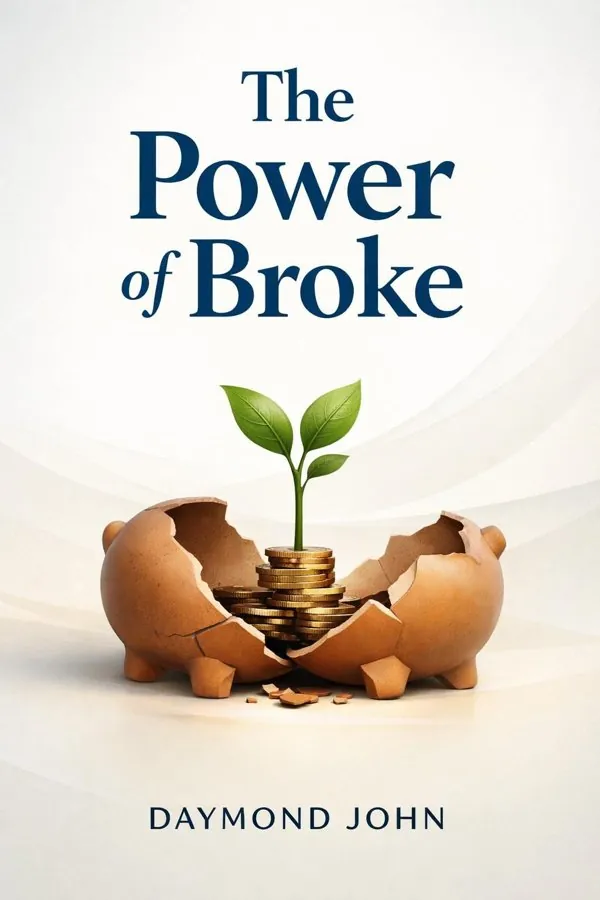
The Power of Broke: How Empty Pockets, a Tight Budget, and a Hunger for Success Can Become Your Greatest Competitive Advantage: Summary & Key Insights
by Daymond John
 10 min9 chaptersAudio available
Key Takeaways from The Power of Broke: How Empty Pockets, a Tight Budget, and a Hunger for Success Can Become Your Greatest Competitive Advantage
Many great businesses do not begin with a perfect plan; they begin with whatever is already within reach.
The most dangerous kind of broke is not financial; it is psychological.
When money is tight, every decision becomes sharper.
Customers can tell when a business is trying too hard to impress and when it genuinely understands them.
A weak network can make every step harder, but a strong one can reduce the need for capital.
What Is The Power of Broke: How Empty Pockets, a Tight Budget, and a Hunger for Success Can Become Your Greatest Competitive Advantage About?
The Power of Broke: How Empty Pockets, a Tight Budget, and a Hunger for Success Can Become Your Greatest Competitive Advantage by Daymond John is a entrepreneurship book spanning 12 pages. Most business advice assumes success begins with capital, connections, or credentials. Daymond John argues the opposite. In The Power of Broke, he shows that limited resources can become a powerful edge because they force focus, discipline, creativity, and urgency. Rather than romanticizing struggle, John explains why entrepreneurs with little money often build sharper ideas, stronger customer awareness, and tougher execution habits than people cushioned by abundance. Drawing from his own journey building FUBU from his mother’s house in Queens, as well as stories from entrepreneurs, entertainers, and founders he has encountered through business and Shark Tank, John illustrates a simple truth: when you cannot buy your way forward, you have to think your way forward. Scarcity becomes a filter. It strips away waste, exposes whether your idea truly resonates, and teaches you to hustle before you scale. This book matters because it reframes one of the biggest excuses in entrepreneurship: “I don’t have enough.” John’s message is that not having enough can be the very condition that helps you win. For aspiring founders, side hustlers, and anyone starting from behind, this is a practical and energizing guide to turning disadvantages into momentum.
This FizzRead summary covers all 9 key chapters of The Power of Broke: How Empty Pockets, a Tight Budget, and a Hunger for Success Can Become Your Greatest Competitive Advantage in approximately 10 minutes, distilling the most important ideas, arguments, and takeaways from Daymond John's work. Also available as an audio summary and Key Quotes Podcast.
The Power of Broke: How Empty Pockets, a Tight Budget, and a Hunger for Success Can Become Your Greatest Competitive Advantage
Most business advice assumes success begins with capital, connections, or credentials. Daymond John argues the opposite. In The Power of Broke, he shows that limited resources can become a powerful edge because they force focus, discipline, creativity, and urgency. Rather than romanticizing struggle, John explains why entrepreneurs with little money often build sharper ideas, stronger customer awareness, and tougher execution habits than people cushioned by abundance.
Drawing from his own journey building FUBU from his mother’s house in Queens, as well as stories from entrepreneurs, entertainers, and founders he has encountered through business and Shark Tank, John illustrates a simple truth: when you cannot buy your way forward, you have to think your way forward. Scarcity becomes a filter. It strips away waste, exposes whether your idea truly resonates, and teaches you to hustle before you scale.
This book matters because it reframes one of the biggest excuses in entrepreneurship: “I don’t have enough.” John’s message is that not having enough can be the very condition that helps you win. For aspiring founders, side hustlers, and anyone starting from behind, this is a practical and energizing guide to turning disadvantages into momentum.
Who Should Read The Power of Broke: How Empty Pockets, a Tight Budget, and a Hunger for Success Can Become Your Greatest Competitive Advantage?
This book is perfect for anyone interested in entrepreneurship and looking to gain actionable insights in a short read. Whether you're a student, professional, or lifelong learner, the key ideas from The Power of Broke: How Empty Pockets, a Tight Budget, and a Hunger for Success Can Become Your Greatest Competitive Advantage by Daymond John will help you think differently.
- ✓Readers who enjoy entrepreneurship and want practical takeaways
- ✓Professionals looking to apply new ideas to their work and life
- ✓Anyone who wants the core insights of The Power of Broke: How Empty Pockets, a Tight Budget, and a Hunger for Success Can Become Your Greatest Competitive Advantage in just 10 minutes
Want the full summary?
Get instant access to this book summary and 100K+ more with Fizz Moment.
Get Free SummaryAvailable on App Store • Free to download
Key Chapters
Many great businesses do not begin with a perfect plan; they begin with whatever is already within reach. Daymond John opens with his own story in Hollis, Queens, where hip-hop culture, neighborhood hustle, and a deep desire to create something of value shaped his entrepreneurial instincts. FUBU did not begin in a gleaming office or with venture backing. It began at home, with his mother’s support, improvised production, and an eye for what his community actually wanted to wear.
This matters because people often underestimate the assets around them when they are focused on what they lack. John’s early advantage was not money. It was proximity to culture, customer insight, and a willingness to test ideas in real life. He understood his audience because he was part of that audience. He also relied on family help, borrowed time, and relentless effort to make each small opportunity count.
For entrepreneurs, the lesson is clear: your first resources are often not financial. They are your environment, your lived experience, your network, and your direct understanding of unmet needs. A home kitchen can become a food business lab. A spare bedroom can become a design studio. A niche community can become your first customer base.
The practical application is to inventory what is already available to you: skills, space, contacts, credibility, and cultural knowledge. Instead of waiting for ideal conditions, build from your immediate circle outward. Actionable takeaway: identify one business asset you already have access to today and use it to test a real offer this week.
The most dangerous kind of broke is not financial; it is psychological. John draws a sharp distinction between being low on money and being low on belief, initiative, and resolve. A person can have very little cash and still be creative, alert, and hungry. Another can have plenty of resources and still be mentally defeated, passive, and dependent on excuses.
This idea reframes scarcity. Financial limitations can be temporary and even useful if they push you to act with precision. Mental poverty is different. It appears when people stop looking for options, stop taking responsibility, and start treating circumstances as final. John’s argument is that the “power of broke” comes alive only when scarcity is paired with determination. Without that mindset, lack becomes paralysis instead of fuel.
In practice, this means entrepreneurs must protect their psychology as carefully as their cash flow. A founder with a small budget may need to knock on doors, send dozens of outreach emails, learn new skills independently, and hear no repeatedly. Those actions are possible only when the person refuses to let temporary setbacks define their identity.
You can apply this by changing the questions you ask. Instead of “Why don’t I have what others have?” ask “What can I do with what I have right now?” Instead of “Who will save this business?” ask “What problem can I solve today?” Actionable takeaway: write down three current constraints, then beside each one list a behavior it can force you to improve, such as sales, creativity, or discipline.
When money is tight, every decision becomes sharper. John argues that scarcity can be a strategic advantage because it removes the illusion that you can spend your way into product-market fit. If you have a limited budget, you cannot afford bloated teams, vague marketing, or unnecessary complexity. You are pushed to simplify, prioritize, and innovate.
This is one of the book’s strongest ideas. Abundance can hide weak thinking. A founder with excess capital may launch too many products, advertise before understanding the customer, or outsource core learning too early. A broke founder has to ask harder questions: What do customers truly value? What is the smallest version of this idea that people will pay for? Which channel brings results without wasted spending?
John shows that creativity often emerges because there is no backup plan. Entrepreneurs improvise packaging, negotiate unusual partnerships, pre-sell before producing, and use storytelling instead of expensive campaigns. Resourcefulness becomes a habit, not a one-time response. This disciplined experimentation often leads to stronger businesses because solutions are built around real constraints.
A simple example is a startup using customer interviews and social media content instead of a costly branding agency. Another is a service provider testing demand through direct outreach before building a full website. Constraint is not comfortable, but it can produce elegant strategy.
Actionable takeaway: choose one area of your business where you have been solving problems with spending, then redesign it as if your budget were cut in half. Ask what simpler, smarter approach would still move you forward.
Customers can tell when a business is trying too hard to impress and when it genuinely understands them. One reason underdog entrepreneurs often break through is that they speak from lived experience rather than from polished distance. John emphasizes that authenticity is not just a branding preference; it is a competitive advantage. If you know your community, share its values, and solve a problem you actually understand, your message lands differently.
FUBU itself became powerful because it was not a corporate imitation of street culture. It came from within the culture. That authenticity created trust and belonging. The same principle appears in the stories John shares about founders who win because they build products rooted in real identity, real need, and real emotional connection.
For entrepreneurs, this means you should not rush to copy the look, language, or tactics of bigger players. Doing so often weakens your edge. Your story, your values, and your closeness to a specific audience may be the reason customers choose you over a larger competitor. Authenticity also improves decision-making. When you know who you serve and why you serve them, you waste less time chasing every trend.
This applies whether you are launching a fashion brand, a coaching business, a food product, or a media platform. Buyers respond to businesses that feel honest, specific, and human.
Actionable takeaway: define your business in one sentence that answers three things clearly: who it serves, what problem it solves, and why you are the right person to solve it. Use that sentence to guide your messaging and product decisions.
A weak network can make every step harder, but a strong one can reduce the need for capital. John repeatedly highlights that relationships, credibility, and mutual value can help entrepreneurs access opportunities they could never afford to purchase outright. Introductions, partnerships, mentorship, distribution help, customer referrals, and media exposure often begin with trust, not transactions.
This does not mean networking in a superficial sense. John’s version of relationship-building is based on service, respect, and consistency. You earn social capital by showing up prepared, delivering on promises, and creating value for others before asking for something in return. Especially when you are broke, your reputation becomes one of your most important assets.
Many founders make the mistake of focusing only on investors when what they really need first is community: early believers, strategic allies, and experienced people willing to offer feedback. A chef may grow faster through local collaborations than through a loan. A product founder may gain traction through retailer relationships before raising money. A freelancer may build a business through referrals long before formal marketing kicks in.
John’s point is that people often fund possibility before banks do. But they do so when they trust the person behind the idea. The broke entrepreneur must therefore become excellent at listening, following up, and demonstrating commitment.
Actionable takeaway: make a list of ten people who could influence your progress, then reach out to three of them this week with a specific, thoughtful message that offers value, asks a smart question, or starts a genuine relationship.
Ideas become more convincing when they are embodied in real stories. John uses entrepreneurs such as Rob Dyrdek, Gigi Butler, and Mo Bridges to show that the power of broke is not theoretical. It appears across industries and personalities, but the pattern is consistent: limited means force unusual commitment, sharper customer awareness, and a willingness to outwork better-funded competitors.
Rob Dyrdek’s path reflects the value of turning personal passion into commercial opportunity through relentless brand-building and strategic thinking. Gigi Butler’s cupcake success illustrates how persistence, small beginnings, and belief in product quality can create momentum even after setbacks and rejections. Mo Bridges shows what can happen when a simple skill, refined with discipline and presented with authenticity, finds the right audience. These stories differ in detail, but they share the same core mechanism: start where you are, validate through action, adapt quickly, and keep going.
Case studies matter because they break the myth that there is only one entrepreneurial blueprint. Some founders are loud and highly visible; others are quiet builders. Some start young; others reinvent themselves later. Some scale through media; others through craft. What unites them is not privilege but resourcefulness under pressure.
As a reader, you should not copy their exact tactics. You should study how they responded to constraints. What did they do when money was short, support was limited, or doors stayed closed? That is where the real lesson lives.
Actionable takeaway: pick one entrepreneur you admire and analyze their early-stage constraints. Then identify one tactic they used that you can adapt, not imitate, in your own situation.
One of the harsh gifts of being broke is that it teaches you to respect the market. When you cannot afford endless development, you must quickly discover whether anyone actually wants what you are offering. John emphasizes that hunger makes entrepreneurs get out from behind the idea and into direct contact with customers. That is where businesses become real.
Too many founders mistake planning for progress. They design logos, build websites, polish pitch decks, and dream about scale before proving demand. Broke entrepreneurs have less room for that kind of self-deception. They need cash flow, feedback, and traction early. As a result, they tend to test, pitch, pre-sell, negotiate, and refine in public.
This principle also appears in John’s Shark Tank perspective. Investors are drawn to founders who demonstrate resourcefulness, traction, and customer validation, not just enthusiasm. A founder who sold 500 units through hustle often looks stronger than one who spent heavily building inventory with no proof of demand. Sales, however small, tell the truth.
The practical application is to think in terms of the minimum sellable version of your offer. If you are launching a course, sell a live pilot first. If you want to open a food business, cater events or run pop-ups before committing to a full location. If you are creating a product, test pre-orders or a small batch.
Actionable takeaway: define the fastest, lowest-cost way to get your offer in front of five real potential customers and do it before making any major new investment.
The people who benefit from being broke are not the ones who avoid fear; they are the ones who move while afraid. John makes it clear that uncertainty, embarrassment, rejection, and failure are not signs that entrepreneurship is going wrong. They are part of the price of entry. Scarcity heightens those emotions because the stakes feel personal and immediate, but it can also build courage through repetition.
When you do not have much room to fail, you learn to fail intelligently. You test smaller. You recover faster. You become less attached to looking perfect and more committed to learning. John’s own journey and the stories he shares reveal that success rarely unfolds as a clean upward line. Deals collapse. Products miss. People say no. Confidence dips. Yet each experience can strengthen judgment if it is processed honestly.
Fear becomes especially dangerous when it disguises itself as preparation. Founders tell themselves they need one more certification, one more meeting, one more revision, one more month. Often what they really need is to make the ask, launch the page, send the proposal, or hear the market’s answer.
A healthy broke mindset does not deny risk. It simply refuses to let discomfort become delay. Courage in business usually looks ordinary: another call, another pitch, another revision, another attempt.
Actionable takeaway: identify the one action you have been postponing because of fear of rejection or failure, then schedule it within the next 48 hours. Momentum grows when courage becomes concrete.
Success can erase the very habits that created it. One of John’s most important warnings is that entrepreneurs must sustain the discipline, alertness, and humility of being broke even after they gain traction. The danger of growth is complacency. Once money begins coming in, businesses can become sloppy, detached from customers, and overconfident in systems that once depended on sharp instinct and relentless effort.
The real power of broke is not only for startup survival; it is a philosophy for long-term competitiveness. It teaches you to stay close to the customer, watch expenses, question assumptions, and keep earning attention instead of assuming it. Companies that preserve this edge continue innovating because they never believe they are entitled to the market. They behave like challengers even when they become leaders.
This applies personally as well. Entrepreneurs who remember what it took to build from nothing often remain more grateful, more focused, and more willing to adapt. Those who lose that mindset can drift into ego, bureaucracy, and comfort. John’s message is that hunger should evolve, not disappear. You may no longer be financially broke, but you should still be mentally agile, operationally disciplined, and emotionally driven.
In practical terms, this means revisiting first principles regularly. Why did customers choose you in the beginning? Where are you now overcomplicating what once worked? Which costs, assumptions, or habits have crept in simply because you can now afford them?
Actionable takeaway: conduct a “still hungry” review of your business by identifying one area where success has made you less efficient or less customer-focused, and reset it to a leaner, more intentional standard.
All Chapters in The Power of Broke: How Empty Pockets, a Tight Budget, and a Hunger for Success Can Become Your Greatest Competitive Advantage
About the Author
Daymond John is an American entrepreneur, investor, author, and television personality best known as the founder of the global fashion brand FUBU. Raised in Queens, New York, he built the company from modest beginnings, turning a small clothing idea into a major cultural and commercial success. John later became a prominent investor on ABC’s Shark Tank, where he earned a reputation for his practical advice on branding, sales, and entrepreneurship. Beyond television, he is the author of several bestselling business books and a widely sought-after speaker on leadership, innovation, and business growth. His work consistently focuses on helping entrepreneurs use resourcefulness, authenticity, and persistence to build successful companies, especially when they are starting with limited means.
Get This Summary in Your Preferred Format
Read or listen to the The Power of Broke: How Empty Pockets, a Tight Budget, and a Hunger for Success Can Become Your Greatest Competitive Advantage summary by Daymond John anytime, anywhere. FizzRead offers multiple formats so you can learn on your terms — all free.
Available formats: App · Audio · PDF · EPUB — All included free with FizzRead
Download The Power of Broke: How Empty Pockets, a Tight Budget, and a Hunger for Success Can Become Your Greatest Competitive Advantage PDF and EPUB Summary
Key Quotes from The Power of Broke: How Empty Pockets, a Tight Budget, and a Hunger for Success Can Become Your Greatest Competitive Advantage
“Many great businesses do not begin with a perfect plan; they begin with whatever is already within reach.”
“The most dangerous kind of broke is not financial; it is psychological.”
“When money is tight, every decision becomes sharper.”
“Customers can tell when a business is trying too hard to impress and when it genuinely understands them.”
“A weak network can make every step harder, but a strong one can reduce the need for capital.”
Frequently Asked Questions about The Power of Broke: How Empty Pockets, a Tight Budget, and a Hunger for Success Can Become Your Greatest Competitive Advantage
The Power of Broke: How Empty Pockets, a Tight Budget, and a Hunger for Success Can Become Your Greatest Competitive Advantage by Daymond John is a entrepreneurship book that explores key ideas across 9 chapters. Most business advice assumes success begins with capital, connections, or credentials. Daymond John argues the opposite. In The Power of Broke, he shows that limited resources can become a powerful edge because they force focus, discipline, creativity, and urgency. Rather than romanticizing struggle, John explains why entrepreneurs with little money often build sharper ideas, stronger customer awareness, and tougher execution habits than people cushioned by abundance. Drawing from his own journey building FUBU from his mother’s house in Queens, as well as stories from entrepreneurs, entertainers, and founders he has encountered through business and Shark Tank, John illustrates a simple truth: when you cannot buy your way forward, you have to think your way forward. Scarcity becomes a filter. It strips away waste, exposes whether your idea truly resonates, and teaches you to hustle before you scale. This book matters because it reframes one of the biggest excuses in entrepreneurship: “I don’t have enough.” John’s message is that not having enough can be the very condition that helps you win. For aspiring founders, side hustlers, and anyone starting from behind, this is a practical and energizing guide to turning disadvantages into momentum.
You Might Also Like
Lean Analytics
Alistair Croll, Benjamin Yoskovitz
10 min
21 Days To A Big Idea: Creating Breakthrough Business Concepts
Bryan Mattimore
10 min
Sam Walton: Made in America: My Story
Sam Walton
10 min
10x Is Easier Than 2x: How World-Class Entrepreneurs Achieve More by Doing Less
Dan Sullivan, Benjamin Hardy
10 min
12 Months to $1 Million: How to Pick a Winning Product, Build a Real Business, and Become a Seven-Figure Entrepreneur
Ryan Daniel Moran
10 min
24 Assets: Create a Digital, Scalable, Valuable Business
Daniel Priestley
10 minBrowse by Category
Ready to read The Power of Broke: How Empty Pockets, a Tight Budget, and a Hunger for Success Can Become Your Greatest Competitive Advantage?
Get the full summary and 100K+ more books with Fizz Moment.