
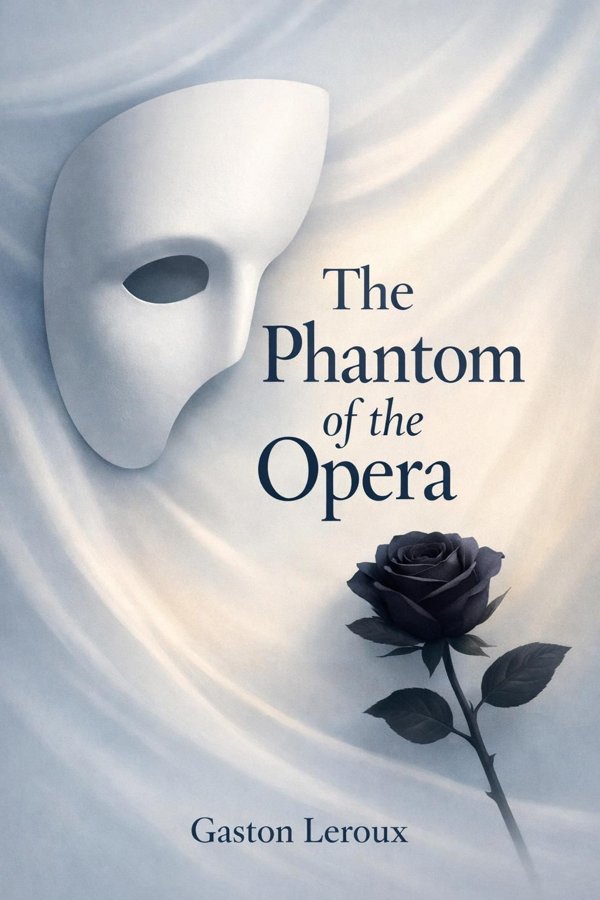
The Phantom of the Opera: Summary & Key Insights
 10 min9 chaptersAudio available
Key Takeaways from The Phantom of the Opera
Every institution has its myths, but some myths reveal deeper truths than facts alone ever could.
People often become most vulnerable when their deepest hopes seem finally within reach.
Love can liberate, but possessiveness turns love into a prison.
Sometimes the most radical act is not punishment, but mercy freely given.
Buildings in great novels are rarely just buildings; they are maps of the human soul.
What Is The Phantom of the Opera About?
The Phantom of the Opera by Gaston Leroux is a classics book spanning 4 pages. What if the most beautiful music you ever heard came from a soul convinced it was unworthy of love? Gaston Leroux’s The Phantom of the Opera is far more than a gothic romance or a ghost story set in a famous theater. It is a dark, emotionally charged novel about longing, genius, fear, and the human need to be seen beyond appearances. Beneath the glittering surface of the Paris Opera House, Leroux builds a world of trapdoors, hidden corridors, superstition, and psychological tension, where art becomes both refuge and weapon. Originally serialized in 1909–1910, the novel combines mystery, melodrama, and investigative storytelling in a way that still feels strikingly modern. At its center are three unforgettable figures: Christine Daaé, the gifted young singer; Raoul, her devoted childhood friend; and Erik, the masked musical genius known as the Phantom, whose brilliance is matched only by his suffering. Leroux, a journalist and master of suspense, brings credibility and urgency to even the novel’s most extravagant events. The result is a classic that endures because it speaks to timeless questions: Can love redeem obsession? Can beauty coexist with terror? And what happens when loneliness turns into control?
This FizzRead summary covers all 9 key chapters of The Phantom of the Opera in approximately 10 minutes, distilling the most important ideas, arguments, and takeaways from Gaston Leroux's work. Also available as an audio summary and Key Quotes Podcast.
The Phantom of the Opera
What if the most beautiful music you ever heard came from a soul convinced it was unworthy of love? Gaston Leroux’s The Phantom of the Opera is far more than a gothic romance or a ghost story set in a famous theater. It is a dark, emotionally charged novel about longing, genius, fear, and the human need to be seen beyond appearances. Beneath the glittering surface of the Paris Opera House, Leroux builds a world of trapdoors, hidden corridors, superstition, and psychological tension, where art becomes both refuge and weapon.
Originally serialized in 1909–1910, the novel combines mystery, melodrama, and investigative storytelling in a way that still feels strikingly modern. At its center are three unforgettable figures: Christine Daaé, the gifted young singer; Raoul, her devoted childhood friend; and Erik, the masked musical genius known as the Phantom, whose brilliance is matched only by his suffering. Leroux, a journalist and master of suspense, brings credibility and urgency to even the novel’s most extravagant events. The result is a classic that endures because it speaks to timeless questions: Can love redeem obsession? Can beauty coexist with terror? And what happens when loneliness turns into control?
Who Should Read The Phantom of the Opera?
This book is perfect for anyone interested in classics and looking to gain actionable insights in a short read. Whether you're a student, professional, or lifelong learner, the key ideas from The Phantom of the Opera by Gaston Leroux will help you think differently.
- ✓Readers who enjoy classics and want practical takeaways
- ✓Professionals looking to apply new ideas to their work and life
- ✓Anyone who wants the core insights of The Phantom of the Opera in just 10 minutes
Want the full summary?
Get instant access to this book summary and 100K+ more with Fizz Moment.
Get Free SummaryAvailable on App Store • Free to download
Key Chapters
Every institution has its myths, but some myths reveal deeper truths than facts alone ever could. The Phantom of the Opera begins with rumors: dancers whisper, managers scoff, and stagehands pass along stories of a ghostly presence haunting the Paris Opera House. Leroux frames the novel like an investigation, collecting testimony, documents, and half-believed legends. This opening matters because it teaches us how fear spreads in communities. Long before Erik fully appears, his power is already real because people believe in him.
The Opera House itself becomes more than a setting. It is a living system of glamour above and darkness below, where grand chandeliers, private boxes, and polished performances rest on secret passageways, hidden rooms, and underground waters. Leroux uses this contrast to show how institutions often hide disorder behind ceremony. The Phantom thrives in that gap. He understands the building better than anyone else, and knowledge becomes control.
In practical terms, this idea applies well beyond fiction. Workplaces, families, and social groups often develop “phantoms” of their own: unspoken fears, unofficial power centers, and persistent rumors that shape behavior. When people avoid direct truth, mystery takes over. The unknown then becomes more powerful than reality.
Leroux also reminds us that stories are never neutral. The way people describe Erik reflects their own anxieties about class, deformity, genius, and punishment. The so-called ghost is partly a man and partly a projection of collective fear.
Actionable takeaway: pay attention to the myths surrounding any group or institution, because recurring rumors often point to hidden power, buried conflict, or truths no one is willing to name openly.
People often become most vulnerable when their deepest hopes seem finally within reach. Christine Daaé is not initially presented as a worldly diva, but as a modest, impressionable young singer whose talent blossoms with almost miraculous speed. Those around her believe she has been touched by something supernatural, and Christine herself comes to believe that an “Angel of Music,” promised by her late father, is guiding her. This belief is tender, spiritual, and psychologically dangerous all at once.
Leroux shows how grief and aspiration can combine to make a person susceptible to manipulation. Christine does not simply want success; she wants meaning, reassurance, and connection to the father she has lost. Erik understands this. By speaking to her through music and mystery, he enters not only her training but her imagination. He positions himself as both teacher and destiny.
This key idea reveals one of the novel’s sharpest insights: influence is strongest when it disguises itself as fulfillment. Christine is not deceived because she is foolish. She is deceived because the illusion speaks directly to her loneliness, talent, and need to believe in something larger than herself.
The lesson is widely applicable. In modern life, charismatic mentors, institutions, and even online voices can gain authority by presenting themselves as the answer to our private wounds. If their guidance flatters our dreams while isolating us from reality, dependence can follow.
Christine’s story is therefore not just romantic or gothic. It is a study in emotional suggestion, artistic formation, and the blurry boundary between inspiration and control.
Actionable takeaway: when guidance feels magical or all-knowing, pause and ask whether it deepens your freedom and discernment, or quietly asks you to surrender both.
Love can liberate, but possessiveness turns love into a prison. Raoul, Vicomte de Chagny, enters the story as Christine’s childhood companion and gradually becomes her emotional counterweight to Erik. Where the Phantom rules through secrecy, intimidation, and spectacle, Raoul offers openness, memory, and ordinary human devotion. Leroux uses this triangle not merely to create suspense, but to contrast two fundamentally different visions of attachment.
Erik loves Christine intensely, but his love is inseparable from ownership. He wants her voice, her presence, her obedience, and ultimately her life organized around his suffering. Because he has been rejected for his appearance and treated as less than human, he craves absolute acceptance. Yet instead of seeking mutual love, he demands it through coercion. This is his descent: his pain is real, but he lets pain justify domination.
Raoul, by contrast, is not flawless. He can be jealous, impulsive, and naive. Still, his love points toward relationship rather than captivity. He wants Christine safe, even when he cannot fully understand her fears or the power Erik exerts over her. Through these two men, Leroux asks a timeless question: how do we distinguish devotion from obsession?
The distinction matters in everyday life. Healthy love allows room for choice, complexity, and independent identity. Unhealthy attachment often presents itself as intensity, exclusivity, or sacrifice, but leaves one person diminished. Erik’s tragedy is that he mistakes emotional extremity for authenticity.
Leroux refuses to trivialize his suffering, yet he also refuses to excuse the harm it produces. That balance gives the novel moral depth.
Actionable takeaway: judge love less by its intensity than by its effects—if it requires fear, secrecy, or surrender of self, it is not love in its healthiest form.
Sometimes the most radical act is not punishment, but mercy freely given. Near the end of the novel, when terror has reached its peak and Erik seems capable of destroying everyone around him, Christine responds in a way neither he nor the reader fully expects: with compassion. Her pity does not deny his crimes, nor does it romanticize his violence. Instead, it acknowledges the humanity buried beneath years of cruelty, isolation, and bitterness.
This moment is the emotional and moral turning point of The Phantom of the Opera. Erik has spent his life treated as a monster, and he has gradually become what others feared. Yet when Christine shows him tenderness without surrendering herself to him, something breaks open. Leroux suggests that even a deeply damaged person may still respond to being recognized as human. Erik’s end is tragic, but it is not empty. Compassion gives him a glimpse of the love he could never force.
This idea matters because the novel avoids easy categories. Erik is not simply villain or victim; he is both. Christine’s response does not erase justice, but it prevents the story from collapsing into revenge. Leroux implies that compassion is most meaningful when extended where it is hardest, though never at the cost of truth.
In practical life, this can apply to conflict, leadership, and personal boundaries. One can recognize another person’s wounds without excusing manipulation or abuse. Compassion becomes transformative when it is clear-eyed rather than naive.
Christine’s mercy changes nothing about what happened, but it changes what the ending means. Instead of concluding in pure horror, the novel closes with a sorrowful recognition of shared humanity.
Actionable takeaway: practice compassion with discernment—see the pain behind harmful behavior when possible, but do not confuse understanding someone with giving them permission to control you.
Talent alone does not save a person; without belonging, it can curdle into bitterness. Erik is one of literature’s most memorable examples of extraordinary ability paired with profound social exile. He is a composer, architect, engineer, illusionist, and strategist of astonishing skill. He can shape sound, space, and fear itself. Yet his gifts do not bring him dignity. Because the world responds first to his face, his genius becomes detached from ordinary human relationship.
Leroux’s portrait of Erik is therefore not simply about monstrosity. It is about what happens when a brilliant person is treated as unacceptable before he can learn trust, reciprocity, or emotional restraint. Rejection does not automatically produce cruelty, but in Erik’s case it feeds humiliation, and humiliation hardens into domination. He wants the world to recognize his greatness, but because he expects rejection, he seeks control instead of connection.
This theme has strong modern relevance. Organizations often praise exceptional performance while neglecting the emotional and ethical development of the gifted. A person who feels unseen may become manipulative, arrogant, or destructive if talent is their only source of identity. Likewise, when societies exclude those who are different, they should not be surprised if alienation generates anger.
Leroux does not say that suffering makes wrongdoing inevitable. Rather, he shows that genius without love, community, or moral grounding can become frighteningly unbalanced. Erik’s tragedy is not just that he is misunderstood, but that he turns his gifts into instruments of revenge and possession.
Readers can apply this insight by asking not only who is talented, but who is integrated, accountable, and emotionally supported. Brilliance needs character to become a blessing.
Actionable takeaway: nurture excellence alongside empathy, community, and accountability, because skill without belonging or moral formation can become harmful to both the gifted person and everyone around them.
Control is most effective when it feels both unbelievable and undeniable. Erik does not dominate the Opera House merely through physical force. He creates an atmosphere in which every event seems charged with supernatural possibility. A mysterious voice, an empty box reserved for the Opera Ghost, sudden accidents, financial demands, disappearing figures, and the infamous falling chandelier all contribute to a regime of fear shaped by theatrical timing. In other words, Erik rules by spectacle.
Leroux understands that power often depends on perception. If people think someone can appear anywhere, hear everything, and punish defiance dramatically, resistance weakens. That is why the managers’ skepticism matters as much as the chorus girls’ fear. Even those who deny the Phantom’s existence are forced to adjust their behavior around him. His power expands because others cannot fully explain him.
This insight extends easily to everyday life. Leaders, influencers, and manipulators often maintain control by exaggerating their reach, cultivating mystique, and making examples of dissenters. Public drama can do the work that direct authority cannot. When people are uncertain, they become easier to govern through symbols and emotional shocks.
The Opera House, being a place of performance, is the perfect setting for this lesson. Erik’s methods are theatrical because theater amplifies emotion. He knows that a single unforgettable incident can shape behavior more effectively than repeated instructions.
Yet Leroux also shows the limits of fear. It can command obedience, but not genuine love. It can silence people, but not heal the hunger beneath control. Erik can stage terror magnificently, but he cannot create the human reciprocity he longs for through intimidation.
Actionable takeaway: when faced with intimidating people or systems, look beyond the spectacle and ask what actual power they hold, because clarity is one of the strongest antidotes to manipulation.
The novel’s most devastating lesson is that no amount of talent, suffering, or desire can compel another person to love you. Erik believes, at some level, that if he is brilliant enough, necessary enough, frightening enough, or pitiable enough, Christine will finally give herself to him. He alternates between seduction, instruction, emotional pleading, and outright coercion. But Leroux makes the truth clear: love freely given is the only love that is real.
This idea gives the novel its enduring emotional force. Erik is not unloved because he lacks feeling; in fact, he feels too much and with too little restraint. His mistake is believing that the intensity of his longing gives him a claim over Christine’s response. He confuses personal depth with entitlement. Christine, however compassionate she becomes, cannot honestly return his love simply because he wants it desperately.
That distinction resonates far beyond the story. In real relationships, people often mistake sacrifice, persistence, or emotional exposure for something that should guarantee reciprocity. But affection cannot be earned like a wage or extracted like a confession. When one person begins to believe they deserve love from a specific individual, danger follows.
Leroux therefore offers a sober vision of romantic ethics. We may sympathize with Erik’s pain while recognizing that love is invalid the moment freedom disappears. Christine’s final acts of kindness are moving precisely because they are chosen, not compelled. The novel defends the dignity of choice even inside a melodrama of extreme emotion.
This is one reason the story still feels modern. It understands that emotional sincerity alone does not make behavior acceptable.
Actionable takeaway: in love and friendship, respect the other person’s freedom as much as your own feelings, because genuine connection can only grow where consent, honesty, and choice remain intact.
All Chapters in The Phantom of the Opera
About the Author
Gaston Leroux (1868–1927) was a French journalist and novelist whose work helped shape modern mystery and suspense fiction. Trained in law, he turned to journalism early in his career and became known for his reporting on crime and court cases, as well as for his international travels. That investigative background gave his fiction a distinctive realism, even when the plots turned bizarre or fantastic. Leroux wrote both detective stories and gothic thrillers, with The Mystery of the Yellow Room and The Phantom of the Opera among his most enduring works. His storytelling combines dramatic pacing, intricate plotting, and vivid settings with a fascination for hidden motives and psychological tension. Today, he is remembered as a master of atmospheric popular fiction whose most famous novel continues to inspire films, stage productions, and literary discussion worldwide.
Get This Summary in Your Preferred Format
Read or listen to the The Phantom of the Opera summary by Gaston Leroux anytime, anywhere. FizzRead offers multiple formats so you can learn on your terms — all free.
Available formats: App · Audio · PDF · EPUB — All included free with FizzRead
Download The Phantom of the Opera PDF and EPUB Summary
Key Quotes from The Phantom of the Opera
“Every institution has its myths, but some myths reveal deeper truths than facts alone ever could.”
“People often become most vulnerable when their deepest hopes seem finally within reach.”
“Love can liberate, but possessiveness turns love into a prison.”
“Sometimes the most radical act is not punishment, but mercy freely given.”
“Buildings in great novels are rarely just buildings; they are maps of the human soul.”
Frequently Asked Questions about The Phantom of the Opera
The Phantom of the Opera by Gaston Leroux is a classics book that explores key ideas across 9 chapters. What if the most beautiful music you ever heard came from a soul convinced it was unworthy of love? Gaston Leroux’s The Phantom of the Opera is far more than a gothic romance or a ghost story set in a famous theater. It is a dark, emotionally charged novel about longing, genius, fear, and the human need to be seen beyond appearances. Beneath the glittering surface of the Paris Opera House, Leroux builds a world of trapdoors, hidden corridors, superstition, and psychological tension, where art becomes both refuge and weapon. Originally serialized in 1909–1910, the novel combines mystery, melodrama, and investigative storytelling in a way that still feels strikingly modern. At its center are three unforgettable figures: Christine Daaé, the gifted young singer; Raoul, her devoted childhood friend; and Erik, the masked musical genius known as the Phantom, whose brilliance is matched only by his suffering. Leroux, a journalist and master of suspense, brings credibility and urgency to even the novel’s most extravagant events. The result is a classic that endures because it speaks to timeless questions: Can love redeem obsession? Can beauty coexist with terror? And what happens when loneliness turns into control?
You Might Also Like






Browse by Category
Ready to read The Phantom of the Opera?
Get the full summary and 100K+ more books with Fizz Moment.