
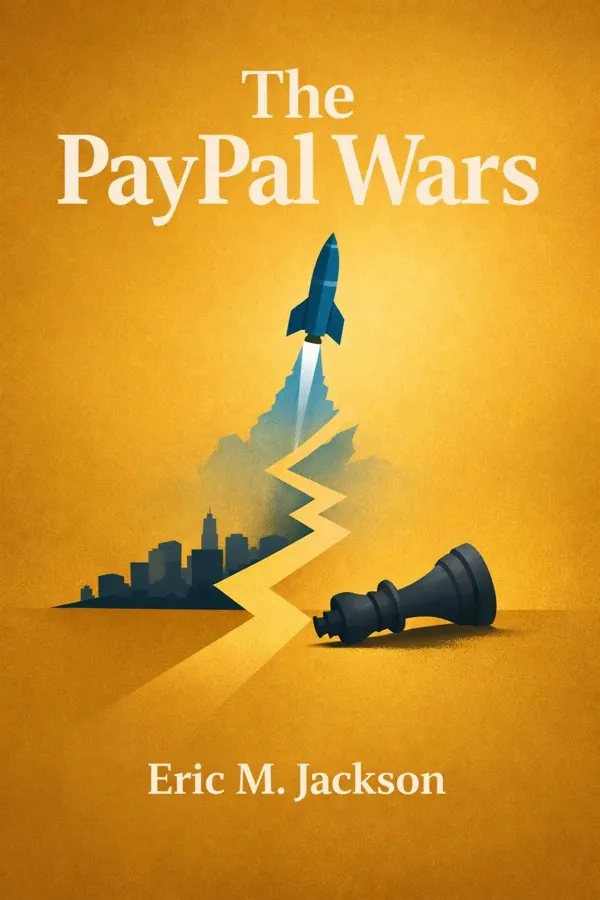
The PayPal Wars: Battles with eBay, the Media, the Mafia, and the Rest of Planet Earth: Summary & Key Insights
 10 min9 chaptersAudio available
Key Takeaways from The PayPal Wars: Battles with eBay, the Media, the Mafia, and the Rest of Planet Earth
Every important startup begins by questioning something most people accept as fixed.
Founders often imagine they can predict exactly how their product will win, but customers usually reveal the real opportunity.
Growth that feels magical usually creates new problems just as quickly as it solves old ones.
A company handling money does not merely face competition; it attracts attack.
Startups are often romanticized as unified teams racing toward a shared dream, but the reality is usually messier.
What Is The PayPal Wars: Battles with eBay, the Media, the Mafia, and the Rest of Planet Earth About?
The PayPal Wars: Battles with eBay, the Media, the Mafia, and the Rest of Planet Earth by Eric M. Jackson is a entrepreneurship book spanning 5 pages. The PayPal Wars is not a polished corporate success story told from a safe distance. It is a gritty, insider account of what it actually felt like to build one of the internet’s most influential companies while under constant pressure from competitors, criminals, skeptical journalists, investors, regulators, and even internal factions. Eric M. Jackson, who served as an early marketing executive at PayPal, recounts the company’s rise from a fragile startup with a radical idea to a platform powerful enough to reshape online commerce. Along the way, he reveals how viral growth, organizational conflict, product improvisation, and relentless execution turned chaos into momentum. What makes the book matter is its realism. PayPal’s path was not linear, and its eventual success was far from inevitable. The company faced fraud at scale, leadership struggles, strategic pivots, and existential threats from larger incumbents. Jackson writes with the credibility of someone who was in the room, helping readers understand not only what happened, but why key decisions mattered. For entrepreneurs, operators, and anyone curious about Silicon Valley, the book offers a vivid case study in how enduring companies are forged through conflict, adaptation, and speed.
This FizzRead summary covers all 9 key chapters of The PayPal Wars: Battles with eBay, the Media, the Mafia, and the Rest of Planet Earth in approximately 10 minutes, distilling the most important ideas, arguments, and takeaways from Eric M. Jackson's work. Also available as an audio summary and Key Quotes Podcast.
The PayPal Wars: Battles with eBay, the Media, the Mafia, and the Rest of Planet Earth
The PayPal Wars is not a polished corporate success story told from a safe distance. It is a gritty, insider account of what it actually felt like to build one of the internet’s most influential companies while under constant pressure from competitors, criminals, skeptical journalists, investors, regulators, and even internal factions. Eric M. Jackson, who served as an early marketing executive at PayPal, recounts the company’s rise from a fragile startup with a radical idea to a platform powerful enough to reshape online commerce. Along the way, he reveals how viral growth, organizational conflict, product improvisation, and relentless execution turned chaos into momentum.
What makes the book matter is its realism. PayPal’s path was not linear, and its eventual success was far from inevitable. The company faced fraud at scale, leadership struggles, strategic pivots, and existential threats from larger incumbents. Jackson writes with the credibility of someone who was in the room, helping readers understand not only what happened, but why key decisions mattered. For entrepreneurs, operators, and anyone curious about Silicon Valley, the book offers a vivid case study in how enduring companies are forged through conflict, adaptation, and speed.
Who Should Read The PayPal Wars: Battles with eBay, the Media, the Mafia, and the Rest of Planet Earth?
This book is perfect for anyone interested in entrepreneurship and looking to gain actionable insights in a short read. Whether you're a student, professional, or lifelong learner, the key ideas from The PayPal Wars: Battles with eBay, the Media, the Mafia, and the Rest of Planet Earth by Eric M. Jackson will help you think differently.
- ✓Readers who enjoy entrepreneurship and want practical takeaways
- ✓Professionals looking to apply new ideas to their work and life
- ✓Anyone who wants the core insights of The PayPal Wars: Battles with eBay, the Media, the Mafia, and the Rest of Planet Earth in just 10 minutes
Want the full summary?
Get instant access to this book summary and 100K+ more with Fizz Moment.
Get Free SummaryAvailable on App Store • Free to download
Key Chapters
Every important startup begins by questioning something most people accept as fixed. PayPal started with a deceptively simple challenge: why should moving money remain slow, expensive, and tied to old banking infrastructure when information was already moving instantly online? In its earliest form, the company was built around the ambition to make money as mobile and frictionless as email. That vision was far ahead of mainstream behavior at the time, because consumers were still uncertain about online trust, internet commerce was young, and digital payments felt abstract.
Jackson shows that PayPal’s founders were not merely trying to create a feature for online shopping. They were trying to solve a foundational internet problem: if people could not move money easily online, many forms of e-commerce would remain clumsy and limited. This broad ambition gave the team a sense of mission, but it also meant they had to educate the market while building the product. The company experimented, pivoted, and refined its use case until it found strong demand among eBay buyers and sellers who desperately needed a simpler payment option.
The lesson is that breakthrough ventures often begin with a large, almost idealistic idea, but they succeed by finding a specific early market where the pain is immediate. PayPal did not conquer all finance at once. It found a practical wedge where users were already frustrated and willing to adopt something better.
Actionable takeaway: Start with a bold vision, but test it against a narrow, urgent customer problem where adoption can happen quickly.
Founders often imagine they can predict exactly how their product will win, but customers usually reveal the real opportunity. One of the most important themes in The PayPal Wars is that PayPal’s early path was not a neat execution of a perfect original plan. The company began with ideas around cryptography and payments between handheld devices, but real traction emerged elsewhere. eBay users, not corporate strategists, effectively showed PayPal what the product was for.
This matters because it highlights a fundamental truth about entrepreneurship: product-market fit is usually discovered, not declared. People using eBay needed an easy way to pay one another across distance, without checks, money orders, or awkward offline coordination. PayPal fit this behavior naturally. The company did not invent the need; it recognized and accelerated it. Once that fit became visible, PayPal could orient product design, customer support, growth tactics, and operations around a real user base with real urgency.
Jackson’s account makes clear that adaptability was not weakness. It was survival. Startups that cling too tightly to their original concept can miss the much bigger opportunity hiding in user behavior. PayPal succeeded because it watched where the energy was, accepted the evidence, and leaned into the market pull.
Modern founders can apply this by paying close attention to where users adopt a product faster than expected, use it in unintended ways, or recommend it organically. These signals often matter more than internal forecasts.
Actionable takeaway: Let actual customer behavior shape strategy, and be willing to pivot toward the use case that creates undeniable demand.
A company handling money does not merely face competition; it attracts attack. One of the most gripping parts of The PayPal Wars is the scale and intensity of the fraud battles PayPal confronted. As the service grew, criminals recognized an opportunity. Stolen credit cards, fake accounts, account takeovers, chargebacks, and organized abuse threatened to overwhelm the company. Fraud was not a side issue managed in the background. It was a daily war that could have destroyed the business.
Jackson’s account shows that many startups underestimate how adversarial success can become. The more value a platform creates, the more determined bad actors become in trying to exploit it. For PayPal, this forced a rapid evolution from a scrappy growth engine into a serious risk-management organization. The company had to build systems, hire people, create rules, and constantly adapt. Security was not just a technical matter; it affected customer trust, losses, margins, public reputation, and the willingness of partners to work with the company.
There is a useful leadership lesson here. Teams often focus on making products easier, faster, and more appealing. But in sensitive industries, resilience matters just as much as convenience. PayPal survived because it learned to fight fraud with urgency, data, and iteration rather than treating abuse as an unfortunate cost of doing business.
Any digital business can learn from this, especially marketplaces, financial platforms, and software products with open access. Abuse prevention should be built into the model early, not bolted on after damage accumulates.
Actionable takeaway: If your business handles value, identity, or transactions, treat fraud prevention as a core product function from day one.
Startups are often romanticized as unified teams racing toward a shared dream, but the reality is usually messier. PayPal’s rise was marked by clashes over product direction, leadership, priorities, and control. Jackson describes a company full of strong personalities, competing ideas, and political tension. These conflicts were not incidental. They influenced hiring, execution speed, strategic focus, and morale.
The key insight is that disagreement inside a startup is not automatically a sign of dysfunction. In fast-changing markets, teams are forced to make high-stakes decisions with incomplete information. People who are deeply committed will often disagree intensely about what matters most. The danger comes when those disagreements become paralyzing, personal, or detached from evidence. PayPal endured boardroom struggles, executive changes, and internal rivalries, yet it still managed to build momentum because the company kept returning to urgent external realities: users, fraud, competition, and survival.
Jackson’s narrative also shows that leadership transitions can be painful but necessary. Different phases of growth require different strengths. Visionary founders may excel at invention, while later-stage operators may be better equipped to impose discipline and scale. This is emotionally difficult but strategically important.
For modern companies, this means building a culture where vigorous debate is allowed, but decision rights are clear and accountability remains intact. A startup does not need perfect harmony; it needs a way to turn conflict into better choices.
Actionable takeaway: Encourage strong debate, but create clear decision-making structures so internal conflict sharpens strategy instead of undermining execution.
Sometimes the platform that fuels your growth can also become your greatest vulnerability. PayPal’s explosive adoption was closely tied to eBay, where buyers and sellers urgently needed a faster, more convenient payment method. This dependence gave PayPal access to a massive user base and a strong, naturally viral distribution channel. At the same time, it created a dangerous strategic reality: if eBay decided to block, imitate, or replace PayPal, the company’s future could be in jeopardy.
Jackson captures this tension vividly. PayPal benefited enormously from the community dynamics of eBay, but it could not fully control the environment in which it was growing. eBay had its own payments ambitions, and the relationship between the two companies was marked by mutual need, suspicion, and conflict. This dynamic forced PayPal to move quickly, deepen user loyalty, and build a brand strong enough that customers would resist alternatives.
The broader lesson applies to every startup that depends on another company’s ecosystem, whether through app stores, search platforms, marketplaces, social networks, or cloud partners. Distribution leverage can accelerate growth dramatically, but platform dependence reduces strategic freedom. The stronger your reliance, the more urgent it becomes to differentiate, diversify, and strengthen direct customer relationships.
A practical example today would be a software company built entirely on one marketplace or API provider. Rapid early growth may conceal the fragility of that dependence until policy changes, fee hikes, or competitive imitation appear.
Actionable takeaway: If a larger platform is driving your growth, use the opportunity wisely but actively reduce dependency before it becomes a strategic trap.
Public perception often trails far behind operational truth. In The PayPal Wars, Jackson describes the frustration of dealing with media coverage that simplified, sensationalized, or misunderstood what was happening inside the company. PayPal was fighting technical crises, fraud attacks, strategic competition, and scaling problems, yet outside observers often framed events through easy storylines: hype, scandal, chaos, or personality conflict.
This matters because young companies are unusually vulnerable to narrative risk. A startup depends on investors, recruits, partners, customers, and regulators, all of whom absorb signals from the broader information environment. If the company’s story is shaped primarily by outsiders who do not understand the nuance, the consequences can be real. Media narratives can affect morale, fundraising, partnerships, and credibility long before the full facts emerge.
Jackson’s account suggests that leaders cannot afford to ignore communications as a secondary concern. Messaging, transparency, and narrative management are part of execution. That does not mean manipulating facts or spinning reality beyond recognition. It means explaining clearly what the company is doing, what challenges it faces, and why its approach matters. Silence leaves a vacuum that others will fill.
Entrepreneurs today face this problem at even greater speed through social media, online commentary, and instant amplification. A single misleading story can spread widely before a company has time to respond.
Actionable takeaway: Treat communication as a strategic capability, and proactively shape your company’s narrative before critics, competitors, or confusion define it for you.
What gets a startup off the ground rarely remains sufficient once it begins to take off. One of the clearest lessons from PayPal’s journey is that scaling is not simply doing more of the same. The company had to keep reinventing its systems, structures, and habits as growth accelerated. Marketing needed to mature. Operations needed discipline. Security needed sophistication. Leadership needed to evolve. Customer support needed to become real infrastructure rather than an afterthought.
Jackson’s story reveals how growth compounds complexity. More users meant more transactions, more support requests, more edge cases, more fraud attempts, more public scrutiny, and more internal stress. A startup can survive improvisation in the earliest days, but at a certain point improvisation alone becomes a liability. The challenge is to introduce process without crushing speed. That balance is difficult, because over-structuring too early can slow learning, while under-structuring too long can create chaos.
The PayPal experience offers a practical blueprint: identify the bottlenecks growth is exposing, then upgrade capabilities one layer at a time. Build systems where recurring pain exists. Strengthen teams around the most mission-critical risks. Accept that the company you are becoming may need different tools than the company you were.
This principle applies far beyond fintech. A growing consumer app, SaaS company, or marketplace all face the same transition from hustle-driven execution to scalable operating discipline.
Actionable takeaway: As growth reveals recurring weaknesses, invest in systems, people, and processes that let the business scale without losing its speed.
A successful acquisition often looks inevitable in hindsight, but at the time it usually feels like one more uncertain decision. PayPal’s eventual sale to eBay represented both validation and compromise. After years of conflict, dependence, rapid growth, and competitive tension, the acquisition formalized a reality the market had already suggested: online auctions and digital payments were deeply linked. The deal gave PayPal scale, stability, and a powerful strategic home.
Jackson presents the sale not as a fairy-tale ending, but as the culmination of hard trade-offs. Going it alone promised independence but carried major risks. Joining eBay reduced uncertainty but also ended the company’s autonomy. This is a central entrepreneurial lesson: exits are not just financial outcomes. They are strategic choices shaped by market timing, competitive position, investor pressure, and the company’s ability to continue winning on its own.
The broader contribution of PayPal’s story is that survival itself created option value. Because the team endured fraud, internal conflict, press hostility, and platform threats, it remained alive long enough to choose among meaningful outcomes. Many startups fail before they ever reach that stage. Persistence, then, is not just inspirational language; it is a practical requirement for strategic freedom.
For founders today, the takeaway is to evaluate acquisition offers in light of mission, market conditions, and operational reality rather than ego alone. Independence is valuable, but so is recognizing when a larger platform can accelerate the mission.
Actionable takeaway: Build your company to preserve strategic options, then evaluate exits based on long-term fit, not just short-term emotion.
All Chapters in The PayPal Wars: Battles with eBay, the Media, the Mafia, and the Rest of Planet Earth
About the Author
Eric M. Jackson is an American entrepreneur, author, and former technology executive best known for his role in PayPal’s early growth. He served as PayPal’s marketing director during the company’s formative years, giving him firsthand exposure to the strategic, operational, and cultural battles that defined one of Silicon Valley’s most influential startups. Drawing on that experience, he wrote The PayPal Wars, an insider narrative of the company’s rise amid intense competition, fraud threats, and internal conflict. Beyond PayPal, Jackson has worked in publishing and business leadership, including serving as CEO of World Ahead Publishing. He has also written and commented on technology, entrepreneurship, politics, and free-market economics, building a reputation as a sharp observer of business and institutional change.
Get This Summary in Your Preferred Format
Read or listen to the The PayPal Wars: Battles with eBay, the Media, the Mafia, and the Rest of Planet Earth summary by Eric M. Jackson anytime, anywhere. FizzRead offers multiple formats so you can learn on your terms — all free.
Available formats: App · Audio · PDF · EPUB — All included free with FizzRead
Download The PayPal Wars: Battles with eBay, the Media, the Mafia, and the Rest of Planet Earth PDF and EPUB Summary
Key Quotes from The PayPal Wars: Battles with eBay, the Media, the Mafia, and the Rest of Planet Earth
“Every important startup begins by questioning something most people accept as fixed.”
“Founders often imagine they can predict exactly how their product will win, but customers usually reveal the real opportunity.”
“Growth that feels magical usually creates new problems just as quickly as it solves old ones.”
“A company handling money does not merely face competition; it attracts attack.”
“Startups are often romanticized as unified teams racing toward a shared dream, but the reality is usually messier.”
Frequently Asked Questions about The PayPal Wars: Battles with eBay, the Media, the Mafia, and the Rest of Planet Earth
The PayPal Wars: Battles with eBay, the Media, the Mafia, and the Rest of Planet Earth by Eric M. Jackson is a entrepreneurship book that explores key ideas across 9 chapters. The PayPal Wars is not a polished corporate success story told from a safe distance. It is a gritty, insider account of what it actually felt like to build one of the internet’s most influential companies while under constant pressure from competitors, criminals, skeptical journalists, investors, regulators, and even internal factions. Eric M. Jackson, who served as an early marketing executive at PayPal, recounts the company’s rise from a fragile startup with a radical idea to a platform powerful enough to reshape online commerce. Along the way, he reveals how viral growth, organizational conflict, product improvisation, and relentless execution turned chaos into momentum. What makes the book matter is its realism. PayPal’s path was not linear, and its eventual success was far from inevitable. The company faced fraud at scale, leadership struggles, strategic pivots, and existential threats from larger incumbents. Jackson writes with the credibility of someone who was in the room, helping readers understand not only what happened, but why key decisions mattered. For entrepreneurs, operators, and anyone curious about Silicon Valley, the book offers a vivid case study in how enduring companies are forged through conflict, adaptation, and speed.
You Might Also Like

Lean Analytics
Alistair Croll, Benjamin Yoskovitz
10 min
21 Days To A Big Idea: Creating Breakthrough Business Concepts
Bryan Mattimore
10 min
Sam Walton: Made in America: My Story
Sam Walton
10 min
10x Is Easier Than 2x: How World-Class Entrepreneurs Achieve More by Doing Less
Dan Sullivan, Benjamin Hardy
10 min
12 Months to $1 Million: How to Pick a Winning Product, Build a Real Business, and Become a Seven-Figure Entrepreneur
Ryan Daniel Moran
10 min
24 Assets: Create a Digital, Scalable, Valuable Business
Daniel Priestley
10 minBrowse by Category
Ready to read The PayPal Wars: Battles with eBay, the Media, the Mafia, and the Rest of Planet Earth?
Get the full summary and 100K+ more books with Fizz Moment.