
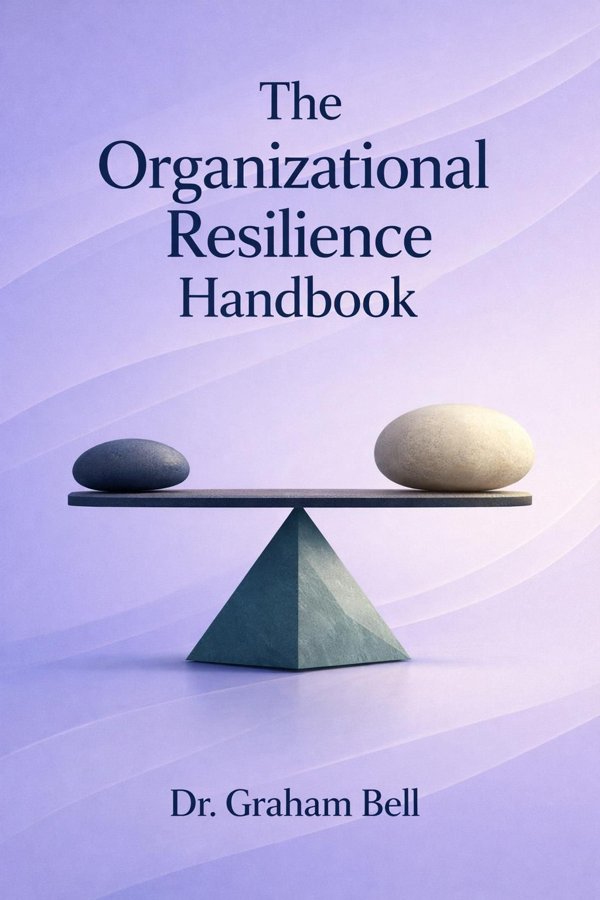
The Organizational Resilience Handbook: A Practical Guide to Building Resilient Organizations: Summary & Key Insights
 10 min5 chaptersAudio available
What Is The Organizational Resilience Handbook: A Practical Guide to Building Resilient Organizations About?
The Organizational Resilience Handbook: A Practical Guide to Building Resilient Organizations by Dr. Graham Bell is a organization book spanning 5 pages. This handbook provides a comprehensive framework for developing organizational resilience, focusing on risk management, adaptive leadership, and strategic continuity. It offers practical tools and case studies to help organizations prepare for, respond to, and recover from disruptions effectively.
This FizzRead summary covers all 5 key chapters of The Organizational Resilience Handbook: A Practical Guide to Building Resilient Organizations in approximately 10 minutes, distilling the most important ideas, arguments, and takeaways from Dr. Graham Bell's work. Also available as an audio summary and Key Quotes Podcast.
The Organizational Resilience Handbook: A Practical Guide to Building Resilient Organizations
This handbook provides a comprehensive framework for developing organizational resilience, focusing on risk management, adaptive leadership, and strategic continuity. It offers practical tools and case studies to help organizations prepare for, respond to, and recover from disruptions effectively.
Who Should Read The Organizational Resilience Handbook: A Practical Guide to Building Resilient Organizations?
This book is perfect for anyone interested in organization and looking to gain actionable insights in a short read. Whether you're a student, professional, or lifelong learner, the key ideas from The Organizational Resilience Handbook: A Practical Guide to Building Resilient Organizations by Dr. Graham Bell will help you think differently.
- ✓Readers who enjoy organization and want practical takeaways
- ✓Professionals looking to apply new ideas to their work and life
- ✓Anyone who wants the core insights of The Organizational Resilience Handbook: A Practical Guide to Building Resilient Organizations in just 10 minutes
Want the full summary?
Get instant access to this book summary and 100K+ more with Fizz Moment.
Get Free SummaryAvailable on App Store • Free to download
Key Chapters
When most organizations begin speaking of resilience, they instinctively default to risk registers and contingency plans. While these are necessary, they are not sufficient. Risk management is about identifying and mitigating known threats; resilience, by contrast, acknowledges the unknowable. As I argue early in the book, resilience assumes discontinuity and prepares you to operate under novel conditions.
In my years advising both public agencies and private corporations, I have seen that those who rely solely on codified risk processes often falter when facing complex disruptions—like a simultaneous cyber-attack and supply chain collapse—because such events exceed the imagined boundaries of their models. Resilient organizations, however, cultivate adaptive capacity across functions. They foster cross-departmental collaboration, flexible governance, and a culture that values continuous learning over procedural adherence.
Here I differentiate resilience from traditional business continuity. Continuity maintains the flow of essential operations, while resilience questions the very production logic, asking: if this breaks, how can we reconfigure our purpose and value in a new context? Resilience turns the focus inward—to the behavioral, cognitive, and cultural enablers that determine how an organization actually navigates turbulence.
I introduce the conceptual framework that shapes this book—the Resilience Triangle—comprising anticipation, adaptation, and evolution. Anticipation means scanning weak signals in the environment, identifying early warnings, and foreseeing potential disruptions. Adaptation refers to agile responses, enabling decision-making that flexes under pressure. Evolution speaks to embedding lessons learned so that the organization transforms structurally rather than merely recovers. Each of these capabilities can be measured, cultivated, and integrated into governance practices.
To illustrate this, consider the example of a financial institution that confronted regulatory upheaval following a regional crisis. Traditional compliance teams could only adjust processes reactively, but their resilient counterparts launched an internal rapid-learning program to identify vulnerabilities, simulated external stressors, then reshaped organizational protocols to distribute decision-making power closer to operational realities. Within weeks, they reduced exposure and increased collaborative capacity—a demonstration that resilience, unlike risk control, thrives on decentralized empowerment and real-time learning.
At the heart of every resilient organization lies a commitment to three enduring principles: adaptability, foresight, and learning capacity. These are not aspirational slogans, but measurable competencies that determine survival. In this chapter, I delve into what each means in living organizational systems.
Adaptability begins with mindset. It depends not on rigid procedures, but on cultivating openness across all levels. The most resilient enterprises I have studied embed adaptive capacity through modular structures—so that when stress arises in one part of the system, others can compensate. Information transparency, trust, and autonomy flow through such systems, enhancing responsiveness.
Foresight is often mistaken for prediction, but true foresight is a disciplined imagination. It involves horizon scanning, scenario exploration, and mapping interdependencies in ways that expose blind spots. In the book, I present practical foresight exercises—pioneered within critical infrastructure organizations—that help leadership teams to think systemically about their environments. They practice anticipation as a collective discipline, much like firefighters rehearse contingency drills, not to forecast the future, but to deepen reflexes for navigating it.
Learning capacity closes the resilience loop. It arises from feedback systems that convert experience into organizational intelligence. I emphasize the role of post-event reviews, error reporting cultures, and psychological safety. Resilient organizations learn faster because they do not punish failure—they interrogate it. As lessons circulate, individual insight becomes institutional memory.
Take, for instance, a utilities provider that was hit by unprecedented storm damage. Its initial weakness lay in siloed communication, but by institutionalizing after-action learning, revising leadership training, and democratizing improvement initiatives, it built adaptive reflexes that later helped it survive an even greater disruption. Resilience matured not through a single plan, but through recursive learning.
Resilience principles, therefore, rest not on technical fixes, but on governance choices—how leaders allocate autonomy, how risks are framed, and how experience is internalized. Through these practices, organizations evolve from brittle structures into adaptive ecosystems.
+ 3 more chapters — available in the FizzRead app
All Chapters in The Organizational Resilience Handbook: A Practical Guide to Building Resilient Organizations
About the Author
Dr. Graham Bell is a consultant and researcher specializing in organizational resilience and risk management. He has advised numerous public and private sector organizations on building adaptive capacity and sustainable performance.
Get This Summary in Your Preferred Format
Read or listen to the The Organizational Resilience Handbook: A Practical Guide to Building Resilient Organizations summary by Dr. Graham Bell anytime, anywhere. FizzRead offers multiple formats so you can learn on your terms — all free.
Available formats: App · Audio · PDF · EPUB — All included free with FizzRead
Download The Organizational Resilience Handbook: A Practical Guide to Building Resilient Organizations PDF and EPUB Summary
Key Quotes from The Organizational Resilience Handbook: A Practical Guide to Building Resilient Organizations
“When most organizations begin speaking of resilience, they instinctively default to risk registers and contingency plans.”
“At the heart of every resilient organization lies a commitment to three enduring principles: adaptability, foresight, and learning capacity.”
Frequently Asked Questions about The Organizational Resilience Handbook: A Practical Guide to Building Resilient Organizations
The Organizational Resilience Handbook: A Practical Guide to Building Resilient Organizations by Dr. Graham Bell is a organization book that explores key ideas across 5 chapters. This handbook provides a comprehensive framework for developing organizational resilience, focusing on risk management, adaptive leadership, and strategic continuity. It offers practical tools and case studies to help organizations prepare for, respond to, and recover from disruptions effectively.
You Might Also Like
A Guide to the Project Management Body of Knowledge (PMBOK® Guide)
Project Management Institute
10 min
Organizational Behavior
Stephen P. Robbins
10 min
Accelerate: The Science of Lean Software and DevOps – Building and Scaling High Performing Technology Organizations
Nicole Forsgren, Jez Humble, Gene Kim
10 min
Awakening Compassion at Work: The Quiet Power That Elevates People and Organizations
Monica C. Worline, Jane E. Dutton
10 min
Building an Inclusive Organization: Leveraging the Power of a Diverse Workforce
Stephen Frost
10 min
Collaborative Intelligence: Thinking with People Who Think Differently
Dawna Markova, Angie McArthur
10 minBrowse by Category
Ready to read The Organizational Resilience Handbook: A Practical Guide to Building Resilient Organizations?
Get the full summary and 100K+ more books with Fizz Moment.