
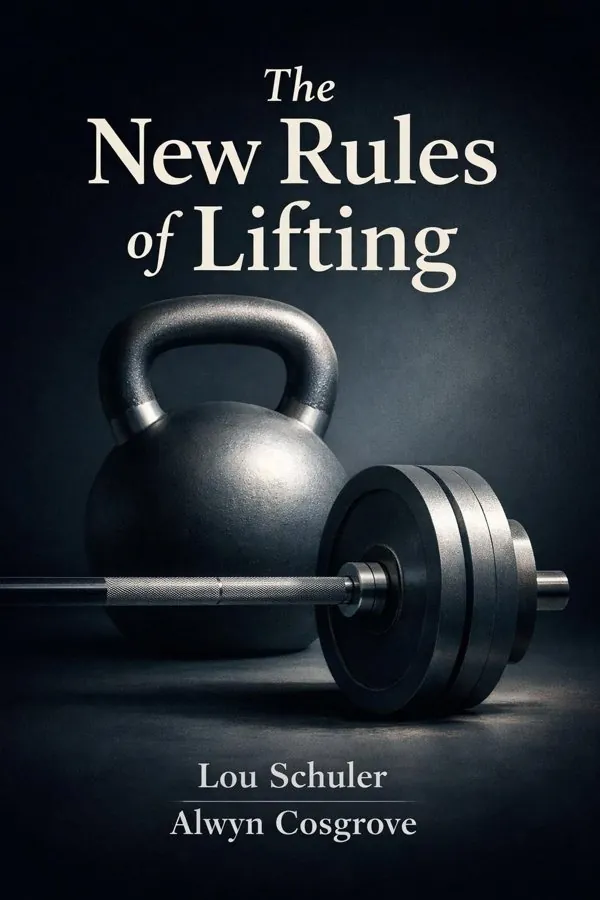
The New Rules of Lifting: Six Basic Moves for Maximum Muscle: Summary & Key Insights
by Lou Schuler, Alwyn Cosgrove
 10 min8 chaptersAudio available
What Is The New Rules of Lifting: Six Basic Moves for Maximum Muscle About?
The New Rules of Lifting: Six Basic Moves for Maximum Muscle by Lou Schuler, Alwyn Cosgrove is a fitness book spanning 8 pages. A comprehensive strength training guide that redefines traditional lifting programs. The book introduces six fundamental movement patterns and provides detailed workout plans for building muscle, improving performance, and achieving balanced fitness. It emphasizes functional strength, progressive overload, and evidence-based training principles.
This FizzRead summary covers all 8 key chapters of The New Rules of Lifting: Six Basic Moves for Maximum Muscle in approximately 10 minutes, distilling the most important ideas, arguments, and takeaways from Lou Schuler, Alwyn Cosgrove's work. Also available as an audio summary and Key Quotes Podcast.
The New Rules of Lifting: Six Basic Moves for Maximum Muscle
A comprehensive strength training guide that redefines traditional lifting programs. The book introduces six fundamental movement patterns and provides detailed workout plans for building muscle, improving performance, and achieving balanced fitness. It emphasizes functional strength, progressive overload, and evidence-based training principles.
Who Should Read The New Rules of Lifting: Six Basic Moves for Maximum Muscle?
This book is perfect for anyone interested in fitness and looking to gain actionable insights in a short read. Whether you're a student, professional, or lifelong learner, the key ideas from The New Rules of Lifting: Six Basic Moves for Maximum Muscle by Lou Schuler, Alwyn Cosgrove will help you think differently.
- ✓Readers who enjoy fitness and want practical takeaways
- ✓Professionals looking to apply new ideas to their work and life
- ✓Anyone who wants the core insights of The New Rules of Lifting: Six Basic Moves for Maximum Muscle in just 10 minutes
Want the full summary?
Get instant access to this book summary and 100K+ more with Fizz Moment.
Get Free SummaryAvailable on App Store • Free to download
Key Chapters
Our starting point is movement. The body was designed to move in six fundamental ways, and these patterns form the cornerstone of all strength training that matters. They are the squat, the hinge or deadlift pattern, the push, the pull, the lunge, and the twist. Every other exercise—whether simple or complex—derives from these.
When you squat, you develop power from the ground up. The squat isn’t just a leg exercise; it’s a demonstration of coordinated strength, posture, and control. The hinge, expressed most purely in the deadlift, connects you with primal power—the ability to lift from the hips, engage your posterior chain, and move safely through the most strength-dependent positions in life and sport. Pushing and pulling refine the upper body, but more importantly, they teach balance—how to drive and decelerate, how to stabilize your shoulder girdle and core as you generate force. Lunging trains control in asymmetry, preparing your body to handle uneven forces and real-world movement challenges. And twisting integrates it all. Rotation is the great connector; it ties together the upper and lower halves of the body, creating the athletic flow that defines functional strength.
In redefining lifting through these six categories, we stop thinking in terms of muscle isolation and start thinking in terms of movement patterns. This shift changes everything: how you structure workouts, assess weaknesses, and even how you feel walking out of the gym. When the body learns to move better, it naturally grows stronger, leaner, and more injury-resistant. That’s functional fitness at its core.
Traditional bodybuilding created impressive physiques, but its functional cost was often overlooked. Having big muscles doesn’t necessarily translate into athletic movement. Functional strength bridges this gap. It’s the strength that lets you lift your kid without straining your back, sprint off the line, or carry heavy bags upstairs. It allows your muscles to cooperate rather than compete.
Functional training develops your kinetic chain—the integrated system of muscles, joints, and connective tissues that communicate during movement. When a chain breaks down, often through overuse of machines or single-joint isolation, you lose efficiency and invite injury. The beauty of functional strength work lies in its universality. The same squat pattern that helps you jump higher will also help you rise from a chair with greater ease decades later.
Throughout this section, we emphasize stability before strength and movement before load. Mastering the correct pattern ensures longevity and continuous progress. In this context, power becomes a byproduct of efficient movement. Once form is solid, load follows naturally. Functional strength training, therefore, is not a luxury—it’s the most direct route to sustained athleticism and lifelong fitness.
+ 6 more chapters — available in the FizzRead app
All Chapters in The New Rules of Lifting: Six Basic Moves for Maximum Muscle
About the Authors
Lou Schuler is an award-winning fitness journalist and author specializing in strength training and nutrition. Alwyn Cosgrove is a renowned strength coach and co-owner of Results Fitness, known for his expertise in program design and athletic conditioning.
Get This Summary in Your Preferred Format
Read or listen to the The New Rules of Lifting: Six Basic Moves for Maximum Muscle summary by Lou Schuler, Alwyn Cosgrove anytime, anywhere. FizzRead offers multiple formats so you can learn on your terms — all free.
Available formats: App · Audio · PDF · EPUB — All included free with FizzRead
Download The New Rules of Lifting: Six Basic Moves for Maximum Muscle PDF and EPUB Summary
Key Quotes from The New Rules of Lifting: Six Basic Moves for Maximum Muscle
“The body was designed to move in six fundamental ways, and these patterns form the cornerstone of all strength training that matters.”
“Traditional bodybuilding created impressive physiques, but its functional cost was often overlooked.”
Frequently Asked Questions about The New Rules of Lifting: Six Basic Moves for Maximum Muscle
The New Rules of Lifting: Six Basic Moves for Maximum Muscle by Lou Schuler, Alwyn Cosgrove is a fitness book that explores key ideas across 8 chapters. A comprehensive strength training guide that redefines traditional lifting programs. The book introduces six fundamental movement patterns and provides detailed workout plans for building muscle, improving performance, and achieving balanced fitness. It emphasizes functional strength, progressive overload, and evidence-based training principles.
You Might Also Like
The Men's Health Handbook: Practical Fitness, Nutrition, and Wellbeing for Men
Men's Health Editors
10 min
30 Ways to Reboot Your Body: A Complete User Manual for Getting the Most Out of the Human Body
Ben Greenfield
10 min
Active Aging: Exercise Plans for Older Adults: Safe Training for Seniors and Aging Populations
Patricia A. Brill
10 min
Becoming a Supple Leopard: The Ultimate Guide to Resolving Pain, Preventing Injury, and Optimizing Athletic Performance
Kelly Starrett
10 min
Bigger Leaner Stronger: The Simple Science of Building the Ultimate Male Body
Michael Matthews
10 min
Body by Science: A Research-Based Program for Strength Training, Bodybuilding, and Complete Fitness in 12 Minutes a Week
Doug McGuff, John Little
10 minBrowse by Category
Ready to read The New Rules of Lifting: Six Basic Moves for Maximum Muscle?
Get the full summary and 100K+ more books with Fizz Moment.