
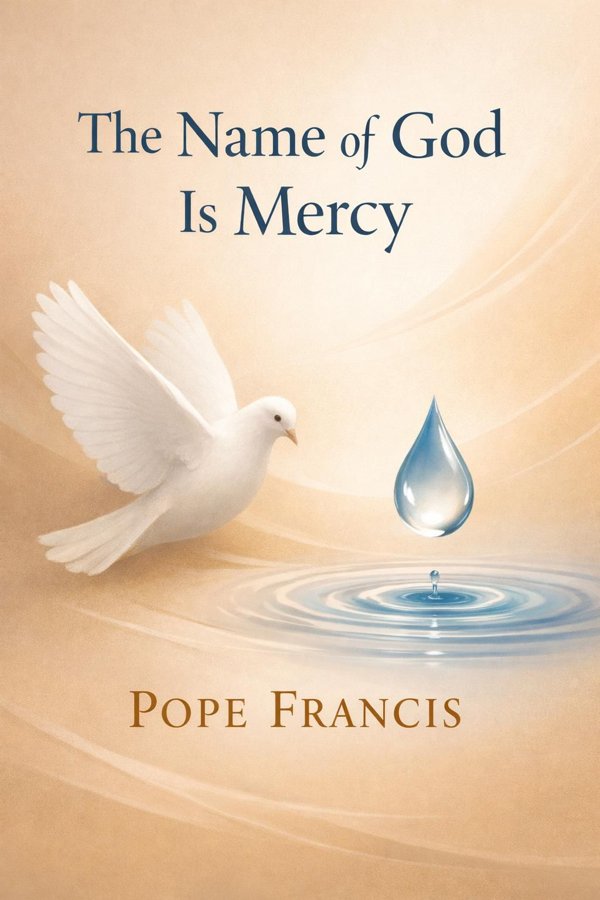
The Name of God Is Mercy: A Conversation with Andrea Tornielli: Summary & Key Insights
by Pope Francis
 10 min6 chaptersAudio available
What Is The Name of God Is Mercy: A Conversation with Andrea Tornielli About?
The Name of God Is Mercy: A Conversation with Andrea Tornielli by Pope Francis is a religion book spanning 6 pages. In this book, Pope Francis reflects on the meaning of mercy as the heart of the Christian message. Through a dialogue with journalist Andrea Tornielli, the Pope shares personal and pastoral experiences, emphasizing the importance of forgiveness, compassion, and acceptance toward all, especially the marginalized.
This FizzRead summary covers all 6 key chapters of The Name of God Is Mercy: A Conversation with Andrea Tornielli in approximately 10 minutes, distilling the most important ideas, arguments, and takeaways from Pope Francis's work. Also available as an audio summary and Key Quotes Podcast.
The Name of God Is Mercy: A Conversation with Andrea Tornielli
In this book, Pope Francis reflects on the meaning of mercy as the heart of the Christian message. Through a dialogue with journalist Andrea Tornielli, the Pope shares personal and pastoral experiences, emphasizing the importance of forgiveness, compassion, and acceptance toward all, especially the marginalized.
Who Should Read The Name of God Is Mercy: A Conversation with Andrea Tornielli?
This book is perfect for anyone interested in religion and looking to gain actionable insights in a short read. Whether you're a student, professional, or lifelong learner, the key ideas from The Name of God Is Mercy: A Conversation with Andrea Tornielli by Pope Francis will help you think differently.
- ✓Readers who enjoy religion and want practical takeaways
- ✓Professionals looking to apply new ideas to their work and life
- ✓Anyone who wants the core insights of The Name of God Is Mercy: A Conversation with Andrea Tornielli in just 10 minutes
Want the full summary?
Get instant access to this book summary and 100K+ more with Fizz Moment.
Get Free SummaryAvailable on App Store • Free to download
Key Chapters
For me, mercy stands at the center of the Gospel. It is not simply one attribute among others; it is the identity of God Himself. When I say 'the name of God is Mercy,' I mean that His essence is love turned toward the sinner, compassion reaching out to those in pain. Too often we imagine God as a judge first, as someone tallying our errors. But the message of the Gospel reverses this image: God’s justice is never detached from mercy. In fact, His justice flows from it. The sinner who opens their heart not only finds forgiveness but an entirely new beginning.
As a priest and confessor, I have seen this truth countless times. People come burdened, afraid, ashamed—and yet, once they experience forgiveness, they rise rejuvenated. They discover dignity in the very place they felt broken. Mercy is creative; it reconstructs what guilt has destroyed. And if the Church is to mirror Christ, she must be, above all, a vessel of mercy—not a customs office controlling entry, but a home open to all.
I emphasize this because in every soul there is a need for tenderness. Life hardens us, sin isolates us, but mercy heals. In the Old Testament, God calls Himself 'compassionate and gracious, slow to anger and rich in mercy.' Jesus embodies that promise in His encounters—with the tax collector Matthew, with the woman caught in adultery, with the thief dying beside Him on the cross. In each story, mercy does not erase truth but brings truth to life in love. This is the heart of faith: mercy is stronger than judgment, because love redeems where punishment cannot.
Throughout Scripture, divine mercy is told not in theories but in stories. I often return to the parable of the Prodigal Son because it reveals in simple words what theology struggles to articulate. There, a father runs to embrace his lost child even before a word of apology is spoken. That father is God Himself, whose joy lies not in perfection but in reunion. When we recognize ourselves as the prodigal son, the story ceases to be distant: it becomes our own.
Likewise, the Good Samaritan shows mercy as action. The man who stops on the road is not moved by duty but by compassion. He does not ask whether the wounded traveler is deserving. He kneels, tends the wounds, pays for the care, and leaves with a promise to return. Jesus tells this story to invite us to cross boundaries of indifference and fear. Mercy demands we see another’s suffering as our own. It is not sentimentality—it is courage.
When I reflect on these parables, I often ask: what if the Church could live as that father or that Samaritan? What if society learned again to move toward those it excludes—the poor, the prisoner, the migrant, the sinner? The Bible teaches us that mercy is not an idea; it is movement. It pulls us outward, beyond the comfort of self-righteousness, into the vulnerable space where we meet humanity as God meets us—in compassion.
+ 4 more chapters — available in the FizzRead app
All Chapters in The Name of God Is Mercy: A Conversation with Andrea Tornielli
About the Author
Pope Francis, born Jorge Mario Bergoglio in Buenos Aires in 1936, is the 266th Pope of the Catholic Church. Elected in 2013, he is known for his focus on the poor, simplicity of life, and emphasis on mercy and social justice.
Get This Summary in Your Preferred Format
Read or listen to the The Name of God Is Mercy: A Conversation with Andrea Tornielli summary by Pope Francis anytime, anywhere. FizzRead offers multiple formats so you can learn on your terms — all free.
Available formats: App · Audio · PDF · EPUB — All included free with FizzRead
Download The Name of God Is Mercy: A Conversation with Andrea Tornielli PDF and EPUB Summary
Key Quotes from The Name of God Is Mercy: A Conversation with Andrea Tornielli
“For me, mercy stands at the center of the Gospel.”
“Throughout Scripture, divine mercy is told not in theories but in stories.”
Frequently Asked Questions about The Name of God Is Mercy: A Conversation with Andrea Tornielli
The Name of God Is Mercy: A Conversation with Andrea Tornielli by Pope Francis is a religion book that explores key ideas across 6 chapters. In this book, Pope Francis reflects on the meaning of mercy as the heart of the Christian message. Through a dialogue with journalist Andrea Tornielli, the Pope shares personal and pastoral experiences, emphasizing the importance of forgiveness, compassion, and acceptance toward all, especially the marginalized.
You Might Also Like

Difference Makers: How to Live a Life of Impact and Purpose
Gregg Matte
10 min
Here All Along: Finding Meaning, Spirituality, and a Deeper Connection to Life—in Judaism (After Finally Choosing to Look There)
Sarah Hurwitz
10 min
The Bible Recap: A One-Year Guide to Reading and Understanding the Entire Bible
Tara-Leigh Cobble
10 min
The Purpose Driven Life: What on Earth Am I Here For?
Rick Warren
10 min
The Women of the Bible Speak: The Wisdom of 16 Women and Their Lessons for Today
Shannon Bream
10 min
Wild at Heart: Discovering the Secret of a Man's Soul
John Eldredge
10 minBrowse by Category
Ready to read The Name of God Is Mercy: A Conversation with Andrea Tornielli?
Get the full summary and 100K+ more books with Fizz Moment.