
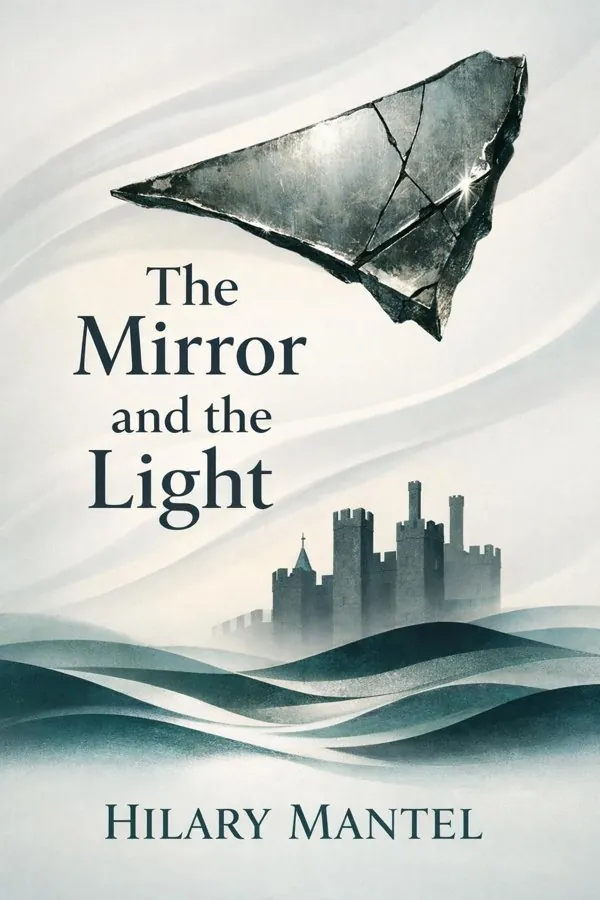
The Mirror and the Light: Summary & Key Insights
 10 min8 chaptersAudio available
Key Takeaways from The Mirror and the Light
Power often looks most secure at the exact moment it becomes most dangerous.
Lasting influence comes not from spectacle but from building systems that outlive a single moment.
The nearer Cromwell stands to the king, the more exposed he becomes.
Statesmen do not stop being human when they enter government; they simply hide the evidence better.
Political strategy collapses when leaders mistake appearances for substance.
What Is The Mirror and the Light About?
The Mirror and the Light by Hilary Mantel is a classics book spanning 5 pages. Hilary Mantel’s The Mirror and the Light is the magnificent final volume of her Thomas Cromwell trilogy, tracing the statesman’s ascent to the very summit of Tudor power and the perilous path that follows. Opening in the aftermath of Anne Boleyn’s execution in 1536, the novel follows Cromwell as he navigates court intrigue, religious upheaval, foreign diplomacy, family loss, and the increasingly volatile will of Henry VIII. What makes this book extraordinary is not only its historical sweep, but its intimate psychological depth: Mantel turns one of history’s most controversial figures into a man of memory, appetite, calculation, grief, and fear. The novel matters because it transforms familiar Tudor history into a study of power itself—how it is built, how it is performed, and how quickly it can vanish. Mantel writes with unmatched authority, having already won two Booker Prizes for Wolf Hall and Bring Up the Bodies, and here she brings her trilogy to a close with richness, precision, and tragic force. This is historical fiction at its most intelligent, humane, and haunting.
This FizzRead summary covers all 8 key chapters of The Mirror and the Light in approximately 10 minutes, distilling the most important ideas, arguments, and takeaways from Hilary Mantel's work. Also available as an audio summary and Key Quotes Podcast.
The Mirror and the Light
Hilary Mantel’s The Mirror and the Light is the magnificent final volume of her Thomas Cromwell trilogy, tracing the statesman’s ascent to the very summit of Tudor power and the perilous path that follows. Opening in the aftermath of Anne Boleyn’s execution in 1536, the novel follows Cromwell as he navigates court intrigue, religious upheaval, foreign diplomacy, family loss, and the increasingly volatile will of Henry VIII. What makes this book extraordinary is not only its historical sweep, but its intimate psychological depth: Mantel turns one of history’s most controversial figures into a man of memory, appetite, calculation, grief, and fear. The novel matters because it transforms familiar Tudor history into a study of power itself—how it is built, how it is performed, and how quickly it can vanish. Mantel writes with unmatched authority, having already won two Booker Prizes for Wolf Hall and Bring Up the Bodies, and here she brings her trilogy to a close with richness, precision, and tragic force. This is historical fiction at its most intelligent, humane, and haunting.
Who Should Read The Mirror and the Light?
This book is perfect for anyone interested in classics and looking to gain actionable insights in a short read. Whether you're a student, professional, or lifelong learner, the key ideas from The Mirror and the Light by Hilary Mantel will help you think differently.
- ✓Readers who enjoy classics and want practical takeaways
- ✓Professionals looking to apply new ideas to their work and life
- ✓Anyone who wants the core insights of The Mirror and the Light in just 10 minutes
Want the full summary?
Get instant access to this book summary and 100K+ more with Fizz Moment.
Get Free SummaryAvailable on App Store • Free to download
Key Chapters
Power often looks most secure at the exact moment it becomes most dangerous. The Mirror and the Light begins on the day of Anne Boleyn’s execution, a scene that should mark Thomas Cromwell’s political triumph. He has helped destroy the queen who once threatened his position, and he stands closer than ever to Henry VIII. Yet Mantel presents this victory as uneasy, almost spectral. Cromwell understands that in a court where a crowned woman can be reduced to dust in hours, no success is final. The fall of Anne clears the path for Jane Seymour and consolidates Cromwell’s reputation as the king’s indispensable minister, but it also exposes the brutal logic of Tudor rule: the system consumes the very people who sustain it.
Mantel uses this moment to show how politics and morality become inseparable from survival. Cromwell is not a melodramatic villain delighting in bloodshed; he is a man who knows that hesitation can be fatal. Anne’s execution is therefore both an end and a warning. It strengthens the machinery of royal government while reminding everyone at court that favor rests on unstable ground.
In practical terms, this opening offers a sharp lesson in institutional life. When a rival falls, the event may create opportunity, but it also reveals how ruthless the structure really is. Organizations, governments, and even social circles often signal their deepest values not by how they reward loyalty, but by how they punish failure.
Actionable takeaway: When a major power shift benefits you, don’t read it as security. Read it as information about the system you are serving, and prepare accordingly.
Lasting influence comes not from spectacle but from building systems that outlive a single moment. One of Cromwell’s defining strengths in this novel is that he is more than a court intriguer. After Anne Boleyn’s fall and Jane Seymour’s rise, he turns to the architecture of England itself: finance, law, administration, and the dissolution of monasteries. Mantel shows him as a man who understands that real power lies in paperwork, revenue, communication, and institutional reform. While noblemen still imagine politics as lineage and display, Cromwell thinks in ledgers, decrees, and networks.
The novel explores how the Reformation is not merely a spiritual dispute but a national reordering. Monastic wealth is transferred, local loyalties are disturbed, and the crown’s reach extends into places that once stood partly outside it. Cromwell is central to this transformation. He is practical, relentless, and often visionary, but Mantel does not romanticize the process. Reform enriches the state and advances royal control, yet it also produces resentment, displacement, and moral ambiguity. Creation and destruction are braided together.
This idea has modern resonance. Institutions change not because people declare new values, but because someone redesigns incentives, authority, and information flows. A manager who restructures a department, a founder who standardizes operations, or a policymaker who reforms funding mechanisms is doing something recognizably Cromwellian: converting intention into structure.
Actionable takeaway: If you want meaningful change, move beyond rhetoric. Identify the systems—money, process, reporting, ownership—that actually govern behavior, and focus your energy there.
The nearer Cromwell stands to the king, the more exposed he becomes. One of the novel’s central tensions is the relationship between Henry VIII and Thomas Cromwell, a bond built on usefulness, habit, intelligence, and mutual dependence. Cromwell reads Henry better than almost anyone. He anticipates moods, frames decisions, absorbs anger, and turns desire into policy. For long stretches, this makes him appear invulnerable. Yet Mantel insists that service to a monarch is not friendship, and influence over a ruler is never the same as control.
Henry is charming, sentimental, theatrical, and deeply dangerous. He can be affectionate one hour and vindictive the next. He needs Cromwell precisely because Cromwell can achieve what others cannot, but that need creates no stable protection. In fact, the minister’s competence becomes part of the threat. The more indispensable Cromwell appears, the more others resent him and the more the king may someday wish to prove that no subject is irreplaceable.
Mantel captures a truth that extends far beyond Tudor monarchy. In modern organizations, proximity to the top can create the illusion of immunity. Trusted advisers, senior deputies, and high-performing executives often assume that access equals security. But leaders under pressure may sacrifice their closest operators to preserve authority, satisfy factions, or redirect blame.
The practical lesson is to distinguish between influence and safety. Cromwell has the first in abundance and mistakes it, at moments, for the second. His tragedy lies partly in how long he can survive this misunderstanding before the political weather changes.
Actionable takeaway: If your power depends on one powerful person’s favor, build wider alliances and protect your reputation independently. Access is valuable, but it is not armor.
Statesmen do not stop being human when they enter government; they simply hide the evidence better. Amid the pageantry and danger of court, Mantel repeatedly returns Cromwell to his losses—his wife and daughters long dead, the remembered poverty of his childhood, and the continuing fragility of his family ties. Even as he manages national affairs, he remains a man haunted by absences. This emotional undercurrent gives the novel much of its power. Cromwell’s decisions are not only strategic calculations; they are informed by memory, longing, protectiveness, and fear.
The death of Jane Seymour after giving birth to Prince Edward is politically significant, but Mantel also uses it to deepen the atmosphere of grief that surrounds the court. Human beings are continually being converted into symbols: queens into wombs, ministers into instruments, daughters into marriage prospects. Cromwell resists this flattening because he remembers individuals vividly, even those long gone. His inner life complicates his outer role.
This idea matters because public competence often conceals private burden. Leaders, parents, teachers, and professionals can appear efficient while carrying unresolved sorrow that shapes their tone, patience, ambition, and judgment. Mantel’s Cromwell reminds us that emotional history is never separate from decision-making; it simply works in quieter ways.
A modern application is to recognize that resilience is not numbness. People can function at a high level while still being driven by grief or unfinished memory. Better leadership, whether of self or others, begins with acknowledging that hidden emotional factors are often influencing visible choices.
Actionable takeaway: Before making a major decision, ask what private fear or grief may be steering you. Naming the emotional pressure can keep it from secretly controlling the outcome.
Political strategy collapses when leaders mistake appearances for substance. One of the book’s most consequential developments is the attempt to secure Henry VIII’s marriage to Anne of Cleves. Cromwell supports the match because it promises diplomatic advantage, Protestant alliance, and strategic stability in a dangerous European landscape. On paper, it is sensible. In practice, it becomes disastrous. Henry dislikes Anne almost immediately, and the marriage turns into a public humiliation that enemies can use against Cromwell.
Mantel shows that the failure is not simply romantic or personal. It reveals how fragile political planning becomes when it depends on managing ego, image, and expectation. Cromwell has negotiated complex reforms and survived lethal rivalries, but here he cannot control the king’s vanity or the gap between diplomatic necessity and private desire. A decision that looked rational within an international framework becomes fatal once filtered through Henry’s temperament.
The episode illustrates a timeless leadership problem: a plan can be analytically sound and still fail if it ignores the emotional and symbolic dimensions of decision-making. In business, a merger may make financial sense but collapse because of cultural mismatch. In government, a policy may be technically elegant but politically impossible if stakeholders feel slighted or misled. In personal life, a practical choice may unravel when it neglects identity or pride.
Mantel’s insight is that no amount of intelligence can fully compensate for misreading the human heart of a decision. Cromwell’s brilliance falters because he cannot make Henry want what reason recommends.
Actionable takeaway: Before committing to a major plan, test not only whether it works in theory, but whether the key people involved can genuinely live with it in practice.
Competence attracts dependence, but it also breeds hostility. As Cromwell rises higher, Mantel makes clear that his greatest danger does not come from one obvious rival but from the accumulation of resentments around him. Aristocrats despise his low birth. Conservatives distrust his religious changes. Traditional courtiers resent his administrative style. Those who need him publicly may still work against him privately. His success enlarges his target.
This is one of the novel’s sharpest social observations. Cromwell is efficient, informed, and often right, but these qualities do not neutralize class prejudice or political envy. In fact, they intensify them. He has entered a world that prizes bloodlines and inherited prestige, and his mastery of it humiliates those born to advantages he never had. The more he proves merit can outmaneuver pedigree, the more fiercely pedigree strikes back.
Mantel avoids a simple moral of meritocracy. Being capable is not enough; one must also understand how identity, status, and symbolism shape opposition. Modern workplaces reveal similar patterns. A high-performing outsider may transform an institution while simultaneously provoking defensiveness from insiders who feel displaced. Rational results do not erase emotional resistance.
Cromwell’s tragedy is partly that he sees plots clearly but still underestimates the long-term force of collective resentment. His enemies do not need to outperform him. They need only wait for a mistake, or for the king to tire of him, and then reinterpret his strengths as crimes.
Actionable takeaway: If your success disrupts an established hierarchy, don’t rely on performance alone. Map the resentments you are generating and manage relationships as carefully as results.
A person can rise far in the world without ever truly leaving their earlier self behind. Throughout The Mirror and the Light, Cromwell is both the king’s chief minister and the blacksmith’s son from Putney who learned to survive by wit, speed, and adaptability. Mantel continuously layers past into present. Childhood violence, continental travels, mercantile habits, legal training, and family loyalties all remain alive within him. His political identity is not a mask replacing the old self; it is a structure built on remembered hardship.
This gives the novel unusual emotional complexity. Cromwell can speak with nobles, bishops, merchants, and diplomats because he contains multiple social worlds within him. He understands aspiration from the inside. He also knows how fragile advancement can be. That is why he stores information, notices details, and keeps moving. His memory is not decorative; it is a survival technology.
For readers, this idea has immediate relevance. Professional reinvention often creates pressure to behave as if the past no longer matters. But Mantel suggests the opposite. The most durable forms of authority may come from integrating earlier experiences rather than denying them. Someone who has worked across classes, industries, or cultures can often read situations more fully than those raised inside a single elite environment.
Cromwell’s life also warns that reinvention has limits. Society may profit from your transformation while still refusing to forget where you came from. That tension between self-creation and social labeling remains intensely modern.
Actionable takeaway: Treat your past as an operating asset, not an embarrassment. The experiences that once made you vulnerable may be exactly what now makes your judgment sharper.
No matter how elaborate the plan, death waits just outside the chamber. As the novel moves toward Cromwell’s arrest and execution, Mantel shifts from expansion to reckoning. The title itself points to illumination and exposure: the light that reveals also judges. Cromwell, who has spent years managing events, now becomes subject to them. Accusations harden, allies fade, and the mechanisms he once used against others are turned on him. The result is not just political downfall but existential confrontation.
Mantel’s treatment of his final days is remarkable for its calm intensity. She does not reduce him to a martyr or excuse his ruthlessness. Instead, she allows him to think, remember, and recognize the strange nearness of the dead. What remains when office vanishes? What survives when a person can no longer act, negotiate, or postpone? The novel’s answer is that character is revealed most starkly when agency narrows. Cromwell’s intelligence remains, but now it serves reflection rather than control.
This movement gives the book its deepest meaning. Political ambition, reform, and historical achievement matter, but they do not cancel mortality. Every human system eventually meets the boundary of time, body, and loss. In that sense, the novel is not only about Tudor England. It is about the universal shock of discovering that mastery has limits.
For modern readers, the lesson is sobering and useful. Careers, titles, and influence are temporary. What endures more meaningfully are relationships, inner clarity, and the values one has practiced when power was available.
Actionable takeaway: Build a life that can still make sense if status disappears. If your identity depends entirely on position, you are already more fragile than you think.
All Chapters in The Mirror and the Light
About the Author
Hilary Mantel (1952–2022) was a major British novelist, essayist, and short story writer whose work combined sharp intelligence, dark wit, and extraordinary historical imagination. She studied law briefly before turning to writing, and over the course of her career built a reputation for psychologically rich fiction that explored power, belief, and identity. Mantel achieved worldwide recognition with her Thomas Cromwell trilogy—Wolf Hall, Bring Up the Bodies, and The Mirror and the Light—which redefined the historical novel for modern readers. She won the Booker Prize for both Wolf Hall and Bring Up the Bodies, an exceptional achievement that confirmed her place among the leading writers of her generation. Celebrated for her precision, depth, and originality, Mantel brought the Tudor world to life with unmatched subtlety and force.
Get This Summary in Your Preferred Format
Read or listen to the The Mirror and the Light summary by Hilary Mantel anytime, anywhere. FizzRead offers multiple formats so you can learn on your terms — all free.
Available formats: App · Audio · PDF · EPUB — All included free with FizzRead
Download The Mirror and the Light PDF and EPUB Summary
Key Quotes from The Mirror and the Light
“Power often looks most secure at the exact moment it becomes most dangerous.”
“Lasting influence comes not from spectacle but from building systems that outlive a single moment.”
“The nearer Cromwell stands to the king, the more exposed he becomes.”
“Statesmen do not stop being human when they enter government; they simply hide the evidence better.”
“Political strategy collapses when leaders mistake appearances for substance.”
Frequently Asked Questions about The Mirror and the Light
The Mirror and the Light by Hilary Mantel is a classics book that explores key ideas across 8 chapters. Hilary Mantel’s The Mirror and the Light is the magnificent final volume of her Thomas Cromwell trilogy, tracing the statesman’s ascent to the very summit of Tudor power and the perilous path that follows. Opening in the aftermath of Anne Boleyn’s execution in 1536, the novel follows Cromwell as he navigates court intrigue, religious upheaval, foreign diplomacy, family loss, and the increasingly volatile will of Henry VIII. What makes this book extraordinary is not only its historical sweep, but its intimate psychological depth: Mantel turns one of history’s most controversial figures into a man of memory, appetite, calculation, grief, and fear. The novel matters because it transforms familiar Tudor history into a study of power itself—how it is built, how it is performed, and how quickly it can vanish. Mantel writes with unmatched authority, having already won two Booker Prizes for Wolf Hall and Bring Up the Bodies, and here she brings her trilogy to a close with richness, precision, and tragic force. This is historical fiction at its most intelligent, humane, and haunting.
More by Hilary Mantel


You Might Also Like





Browse by Category
Ready to read The Mirror and the Light?
Get the full summary and 100K+ more books with Fizz Moment.