
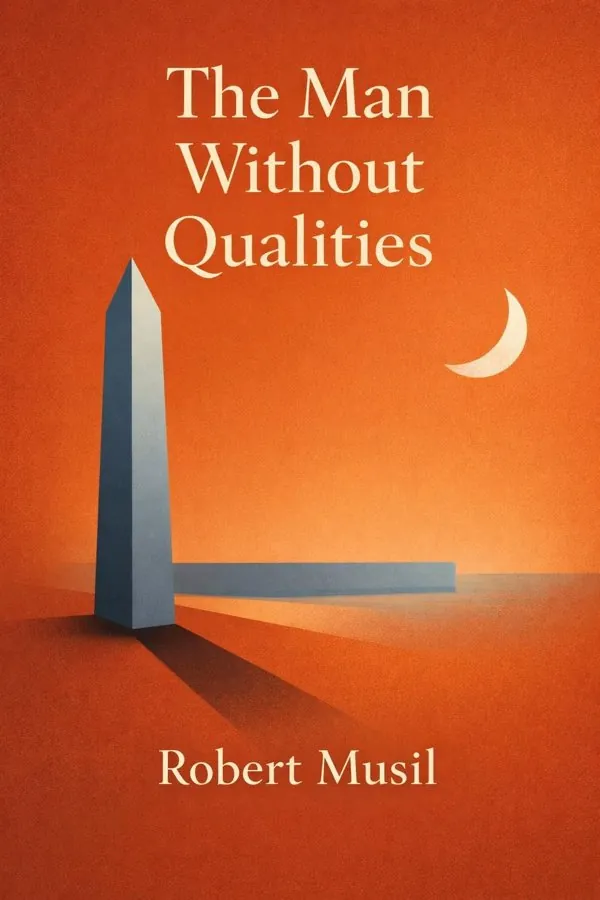
The Man Without Qualities: Summary & Key Insights
by Robert Musil
 10 min8 chaptersAudio available
Key Takeaways from The Man Without Qualities
Sometimes the most revealing act is not to choose a path, but to suspend choosing altogether.
Public life often becomes most ceremonial when it has least to say.
Desire does not merely reveal what we want; it exposes how uncertain we are about who we are.
A functioning society needs practical people, but a living mind needs alternatives.
The deepest human longings often appear when ordinary language starts to fail.
What Is The Man Without Qualities About?
The Man Without Qualities by Robert Musil is a classics book spanning 5 pages. Robert Musil’s The Man Without Qualities is one of the great achievements of modern literature: a vast, brilliant, unfinished novel that examines what happens when a civilization becomes intellectually sophisticated but spiritually unmoored. Set in Vienna on the eve of World War I, it follows Ulrich, a mathematically minded, emotionally detached intellectual who takes a “year off from life” and drifts into the orbit of the so-called Parallel Campaign, a patriotic committee preparing a grand celebration for the Austrian emperor. What begins as social comedy opens into a profound inquiry into identity, politics, desire, morality, and the instability of modern existence. Musil writes with unusual authority because he was both a novelist and a rigorous thinker, trained in engineering, psychology, and philosophy. That rare combination allows him to unite narrative with sharp conceptual insight. The result is not just a story about one man, but a diagnosis of a culture living on borrowed time. The Man Without Qualities matters because it captures a condition that still feels contemporary: a world overflowing with information, roles, ideologies, and possibilities, yet starving for coherence, conviction, and meaningful direction.
This FizzRead summary covers all 8 key chapters of The Man Without Qualities in approximately 10 minutes, distilling the most important ideas, arguments, and takeaways from Robert Musil's work. Also available as an audio summary and Key Quotes Podcast.
The Man Without Qualities
Robert Musil’s The Man Without Qualities is one of the great achievements of modern literature: a vast, brilliant, unfinished novel that examines what happens when a civilization becomes intellectually sophisticated but spiritually unmoored. Set in Vienna on the eve of World War I, it follows Ulrich, a mathematically minded, emotionally detached intellectual who takes a “year off from life” and drifts into the orbit of the so-called Parallel Campaign, a patriotic committee preparing a grand celebration for the Austrian emperor. What begins as social comedy opens into a profound inquiry into identity, politics, desire, morality, and the instability of modern existence.
Musil writes with unusual authority because he was both a novelist and a rigorous thinker, trained in engineering, psychology, and philosophy. That rare combination allows him to unite narrative with sharp conceptual insight. The result is not just a story about one man, but a diagnosis of a culture living on borrowed time. The Man Without Qualities matters because it captures a condition that still feels contemporary: a world overflowing with information, roles, ideologies, and possibilities, yet starving for coherence, conviction, and meaningful direction.
Who Should Read The Man Without Qualities?
This book is perfect for anyone interested in classics and looking to gain actionable insights in a short read. Whether you're a student, professional, or lifelong learner, the key ideas from The Man Without Qualities by Robert Musil will help you think differently.
- ✓Readers who enjoy classics and want practical takeaways
- ✓Professionals looking to apply new ideas to their work and life
- ✓Anyone who wants the core insights of The Man Without Qualities in just 10 minutes
Want the full summary?
Get instant access to this book summary and 100K+ more with Fizz Moment.
Get Free SummaryAvailable on App Store • Free to download
Key Chapters
Sometimes the most revealing act is not to choose a path, but to suspend choosing altogether. Ulrich, the novel’s central figure, begins by taking what he calls a “year off from life.” He is not lazy, broken, or romantically rebellious. He is, rather, a man too intelligent to accept ready-made identities. He has been a soldier, an engineer, and a mathematician, but none of these roles satisfies him because each seems partial, temporary, and somehow arbitrary. His leave from life is an experiment: what if one refused to become fixed too quickly? What if one treated identity not as destiny, but as a field of possibilities?
This makes Ulrich the “man without qualities.” The phrase does not mean he lacks character or ability. It means he resists being reduced to stable labels. He sees that much of social life depends on conventions people mistake for truths: careers become personalities, opinions become morals, and habits become fate. Ulrich steps back from this machinery in order to observe it.
In practical terms, Musil’s insight speaks directly to modern life. Many people drift through professional roles, social expectations, and public personas without asking whether these actually express who they are. Ulrich’s pause resembles a contemporary sabbatical, career reset, or existential inventory. It can be healthy to stop performing competence long enough to ask deeper questions: Which of my commitments are genuine? Which are inherited? Which possibilities have I abandoned too soon?
Musil does not present suspension as a permanent solution. Endless possibility can become paralysis. Yet he insists that some distance from one’s social script is necessary if one hopes to live deliberately rather than mechanically.
Actionable takeaway: Set aside time to examine the roles that define you and identify one assumption about your identity that you are willing to question this week.
Public life often becomes most ceremonial when it has least to say. In The Man Without Qualities, the Parallel Campaign is a committee formed to organize a magnificent celebration of Emperor Franz Joseph’s reign, partly in competition with Germany’s plans to honor Kaiser Wilhelm. It attracts aristocrats, bureaucrats, intellectuals, patriots, mystics, opportunists, and social climbers, all eager to attach themselves to a lofty cause. Yet the campaign’s supposed purpose remains frustratingly vague. What exactly is being celebrated? What ideal unites these people? The more they speak, the less substance emerges.
Musil uses the campaign as a social laboratory and a satire of elite discourse. Meetings overflow with noble language about culture, nation, progress, morality, and spiritual renewal, but practical clarity never arrives. The campaign becomes a symbol of a decaying empire trying to perform meaning after losing the power to generate it. People are active, articulate, and sincere in their own ways, but they are not oriented toward reality. They are staging significance.
This dynamic is intensely recognizable today. Organizations frequently substitute mission statements for mission, conferences for action, branding for conviction, and rhetoric for truth. Political coalitions may unite around vague values because vagueness allows everyone to imagine they agree. Social prestige often rewards participation in the appearance of seriousness rather than serious work itself.
Musil’s point is not that institutions are worthless. It is that collective projects become hollow when language detaches from consequences. The Parallel Campaign reveals how easily a society can become intoxicated by abstraction while drifting toward catastrophe.
Actionable takeaway: The next time you join a meeting, initiative, or public cause, ask one concrete question: What specific reality are we trying to change, and how will we know if we have succeeded?
Desire does not merely reveal what we want; it exposes how uncertain we are about who we are. In Musil’s novel, Ulrich’s encounters with women are never simple romantic episodes. Figures such as Diotima, Bonadea, Clarisse, and Agathe are not decorative side characters but crucial mirrors of the age’s emotional and intellectual disorder. Through them, Musil explores erotic longing, idealization, projection, spiritual hunger, and the search for meaning through intimacy.
Diotima embodies moral and cultural idealism, aspiring to elevate politics through salon conversation and spiritual seriousness. Bonadea turns desire into a form of emotional improvisation, seeking rescue and intensity through adulterous passion. Clarisse moves toward visionary extremity, where artistic and psychological intensity threaten to become madness. Agathe, Ulrich’s sister, becomes the most profound and unsettling relationship of all, opening the possibility that love might become an attempt to step outside ordinary reality altogether.
What unites these relationships is Musil’s refusal to treat love as straightforward fulfillment. Desire in this novel is often an effort to transcend fragmentation. People seek in one another what they cannot stabilize within themselves: certainty, ecstasy, innocence, transformation. Yet because the self is unstable, the beloved becomes overloaded with impossible meanings.
This remains practical and modern. Relationships often fail not because feeling is absent, but because expectation is excessive. We ask partners to provide identity, healing, status, excitement, purpose, and metaphysical reassurance all at once. Musil suggests that love becomes distorted when it is made to carry the entire burden of meaning.
Actionable takeaway: Reflect on one important relationship and ask whether you are responding to the actual person in front of you, or to a symbolic role you unconsciously need them to play.
A functioning society needs practical people, but a living mind needs alternatives. One of Musil’s most famous ideas is the contrast between the “sense of reality” and the “sense of possibility.” The sense of reality recognizes facts, limitations, institutions, and what currently exists. The sense of possibility asks what might also be true, what could be different, and whether accepted arrangements deserve their authority. Ulrich is defined by this second capacity. He sees that reality is not neutral; it is structured by habits, interests, and decisions that could have been otherwise.
Musil’s genius lies in refusing to romanticize either side. Pure reality can harden into conformity, bureaucracy, and spiritual exhaustion. Pure possibility can dissolve into indecision, irony, and detachment from consequence. Ulrich’s brilliance is also his weakness: because he sees too many alternatives, action becomes difficult. Yet Musil insists that possibility is not frivolous. It is the source of moral imagination, scientific invention, and political reform. Without it, society becomes obedient to whatever already exists.
This tension appears everywhere in contemporary life. A business may rely on operational discipline but die without innovation. A person may maintain a stable routine yet feel trapped in a life they never examined. A citizen may accept institutions as inevitable rather than asking whether they are just. The challenge is to bring possibility into contact with reality rather than allowing the two to split apart.
Musil offers no simple formula, but he gives us a valuable mental tool: whenever something is presented as natural, permanent, or practical, ask what hidden possibilities have been excluded.
Actionable takeaway: Choose one area of your life that feels fixed and write down three realistic alternatives, even if you do not act on them immediately.
The deepest human longings often appear when ordinary language starts to fail. In the later sections of the novel, Ulrich’s relationship with his sister Agathe becomes the center of an extraordinary experiment in consciousness. Reunited after years apart, they develop an intimacy that feels at once emotional, intellectual, spiritual, and morally unsettling. Together they pursue what Musil calls the “other condition,” a state beyond the fragmented, practical, everyday self. It is an attempt to live in heightened unity, where thought and feeling, self and world, cease to be divided in familiar ways.
This idea is one of the most difficult and fascinating in the novel. Ulrich and Agathe are not simply having forbidden feelings; they are trying to discover whether another mode of being is possible beyond social roles, rational calculation, and ordinary morality. Their bond becomes a test case for transcendence in a disenchanted age. Can modern people still access states once associated with mysticism, grace, or sacred experience? And if they can, what happens when such experience can no longer be safely contained by tradition?
Musil does not resolve these questions neatly. The “other condition” is both exalted and dangerous. It offers release from the deadening routines of modern life, but it can also blur ethical boundaries and detach people from the world they must still inhabit.
In practical terms, many people recognize the desire behind this idea: the wish to experience moments of radical presence, unity, or meaning beyond productivity and social performance. Art, meditation, love, and nature can all offer glimpses of such states. Musil warns, however, that transcendence without grounding can become delusion.
Actionable takeaway: Create one deliberate space this week for contemplative experience, but pair it with a grounding practice such as journaling, walking, or discussing insights with someone you trust.
A brilliant culture can still drift toward collapse if intelligence is not joined to wisdom. Musil’s Vienna is dazzling: intellectually rich, artistically vibrant, socially refined, and conceptually sophisticated. Yet beneath that brilliance lies an alarming moral and political weightlessness. People can analyze everything, but they struggle to commit to anything. They speak in elevated concepts while remaining detached from the historical forces gathering around them. This is one of the novel’s most enduring diagnoses of modernity: intelligence alone does not secure seriousness.
Ulrich himself embodies the problem. He is perceptive, ironic, and exceptionally capable of understanding complexity, but his detachment often prevents decisive engagement. Around him, others pursue idealism, ambition, erotic intensity, or mysticism, yet they too are vulnerable to self-deception. The culture is not lacking in thought; it is lacking in integration. Ideas circulate freely, but they fail to crystallize into responsible action.
This has obvious contemporary applications. We live amid unprecedented access to information, commentary, and analysis. It is easier than ever to sound informed and harder than ever to translate knowledge into conviction. People may critique systems endlessly while remaining personally passive. Institutions may cultivate expertise while neglecting ethical formation. Even individual self-awareness can become a substitute for change.
Musil does not attack intelligence. He asks more of it. True intelligence should deepen one’s contact with reality, not merely increase one’s ability to evade commitment through nuance. To understand complexity is valuable; to hide in complexity is dangerous.
Actionable takeaway: When you find yourself analyzing a problem repeatedly, identify one concrete responsibility that follows from your analysis and act on it, however modestly.
Laughter can sometimes expose a civilization more accurately than outrage. One reason The Man Without Qualities remains so fresh is that Musil is not only philosophical but also very funny. His satire is cool, patient, and devastating. He does not caricature people as simple fools; rather, he shows how vanity, idealism, ambition, sentimentality, and intellectual seriousness blend together in absurd ways. The result is a comedy of manners that gradually reveals itself as a pathology report on an entire society.
Musil’s satirical method matters because it preserves complexity. The characters are rarely wholly ridiculous or wholly admirable. Diotima’s spiritual posturing is empty, yet she is not insincere. Arnheim, the polished industrialist-intellectual, is both impressive and opportunistic. Bureaucrats, aristocrats, reformers, and visionaries all speak partly in good faith and partly in performance. Satire allows Musil to show how self-deception flourishes not despite intelligence, but through it.
In everyday life, satire can function as a powerful form of critical awareness. It helps us notice inflated language, moral vanity, empty prestige, and institutional ritual. It reminds us that systems often become absurd not because evil masterminds control them, but because ordinary people adapt to nonsense and call it seriousness. A healthy sense of the comic can puncture pomposity and prevent blind reverence.
Yet Musil’s satire is never merely cynical. Its purpose is diagnostic. He mocks social performance because he still cares about truth, clarity, and authentic seriousness. The joke is not that nothing matters; it is that too much pretending gets in the way of what matters.
Actionable takeaway: The next time an idea, trend, or institution impresses you, try describing it in plain language; if it sounds faintly absurd, you may have discovered an important truth.
History often becomes most feverishly ceremonial just before it breaks apart. The Man Without Qualities is set in the final years of the Austro-Hungarian Empire, a world Musil sometimes refers to with ironic affection as “Kakania.” It is a state of elaborate administration, competing nationalities, legal formalism, cultural sophistication, and chronic indecision. On the surface, it appears durable; underneath, it is exhausted. Musil’s great historical achievement is to portray collapse not as sudden chaos, but as a prolonged condition of unreality before the fall.
The significance of this setting extends beyond Austrian history. Musil shows how societies decline when symbolic order outlasts substantive coherence. Institutions continue functioning, titles remain meaningful, and public rituals proliferate, but collective purpose weakens. The empire does not lack activity; it lacks inner conviction. This makes the novel a haunting prelude to World War I, which readers know is coming even as the characters continue their salons, projects, affairs, and speculations.
This pattern has broad relevance. Organizations, political orders, and even personal lives can survive for years on momentum after their original purpose has faded. Warning signs are often interpreted as temporary complications rather than structural decay. People continue planning ceremonies while avoiding the possibility that the framework itself is unstable.
Musil’s historical imagination therefore teaches a practical lesson in attention. Stability should never be judged only by surface continuity. One must ask whether institutions still command trust, whether language still corresponds to reality, and whether shared goals remain believable.
Actionable takeaway: In any system you depend on, look beyond appearances and ask what underlying assumptions must remain true for it to work—and whether those assumptions are still intact.
All Chapters in The Man Without Qualities
About the Author
Robert Musil (1880–1942) was an Austrian novelist, essayist, and one of the defining voices of European modernism. Born in Klagenfurt, he was educated first in military and engineering institutions before turning toward philosophy, psychology, and literature. That unusual intellectual formation shaped his writing, which blends analytical rigor with artistic subtlety. Musil first gained attention with Young Törless, but his reputation rests primarily on The Man Without Qualities, the vast unfinished novel that occupied much of his life. Exiled by political upheaval and later living in difficult financial circumstances, he spent his final years in Switzerland. Though underappreciated by many during his lifetime, Musil is now celebrated for his penetrating psychological insight, ironic intelligence, and unmatched ability to diagnose the spiritual and social tensions of modernity.
Get This Summary in Your Preferred Format
Read or listen to the The Man Without Qualities summary by Robert Musil anytime, anywhere. FizzRead offers multiple formats so you can learn on your terms — all free.
Available formats: App · Audio · PDF · EPUB — All included free with FizzRead
Download The Man Without Qualities PDF and EPUB Summary
Key Quotes from The Man Without Qualities
“Sometimes the most revealing act is not to choose a path, but to suspend choosing altogether.”
“Public life often becomes most ceremonial when it has least to say.”
“Desire does not merely reveal what we want; it exposes how uncertain we are about who we are.”
“A functioning society needs practical people, but a living mind needs alternatives.”
“The deepest human longings often appear when ordinary language starts to fail.”
Frequently Asked Questions about The Man Without Qualities
The Man Without Qualities by Robert Musil is a classics book that explores key ideas across 8 chapters. Robert Musil’s The Man Without Qualities is one of the great achievements of modern literature: a vast, brilliant, unfinished novel that examines what happens when a civilization becomes intellectually sophisticated but spiritually unmoored. Set in Vienna on the eve of World War I, it follows Ulrich, a mathematically minded, emotionally detached intellectual who takes a “year off from life” and drifts into the orbit of the so-called Parallel Campaign, a patriotic committee preparing a grand celebration for the Austrian emperor. What begins as social comedy opens into a profound inquiry into identity, politics, desire, morality, and the instability of modern existence. Musil writes with unusual authority because he was both a novelist and a rigorous thinker, trained in engineering, psychology, and philosophy. That rare combination allows him to unite narrative with sharp conceptual insight. The result is not just a story about one man, but a diagnosis of a culture living on borrowed time. The Man Without Qualities matters because it captures a condition that still feels contemporary: a world overflowing with information, roles, ideologies, and possibilities, yet starving for coherence, conviction, and meaningful direction.
You Might Also Like





Browse by Category
Ready to read The Man Without Qualities?
Get the full summary and 100K+ more books with Fizz Moment.