
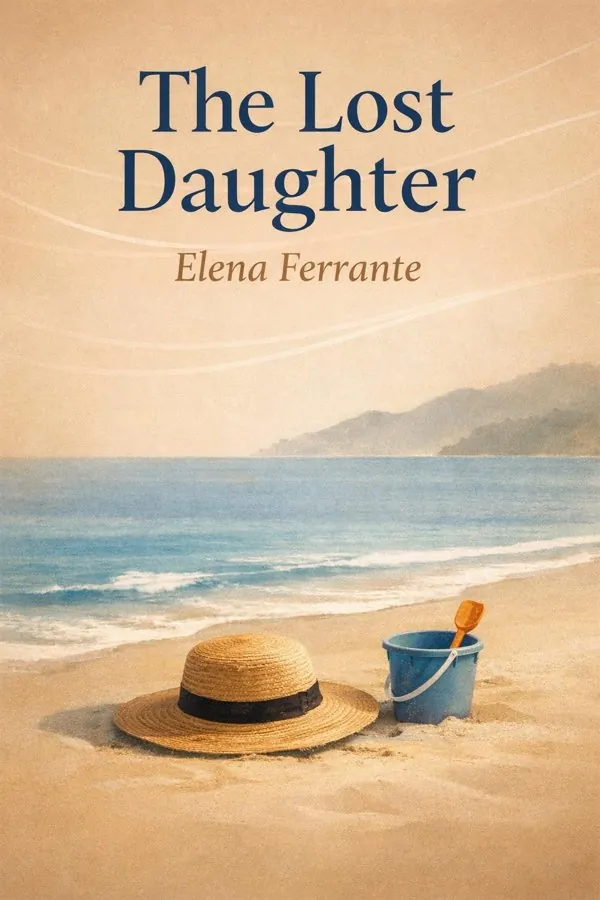
The Lost Daughter: Summary & Key Insights
 10 min8 chaptersAudio available
Key Takeaways from The Lost Daughter
Solitude often feels peaceful until it begins to speak back to us.
Few experiences are as culturally idealized as motherhood, which is why Ferrante’s portrayal feels so disruptive.
Freedom is rarely clean, and Ferrante is too honest to pretend otherwise.
One of the most radical things literature can do is tell the truth about emotions that society insists should not exist.
Small objects in literature often carry the emotional weight that people cannot express directly.
What Is The Lost Daughter About?
The Lost Daughter by Elena Ferrante is a classics book spanning 3 pages. Elena Ferrante’s The Lost Daughter is a short novel with the force of a confession. First published in 2006, it follows Leda, a middle-aged literature professor who takes a seaside holiday expecting rest and solitude, only to find herself unsettled by a young mother, Nina, and Nina’s small daughter. What begins as a quiet vacation slowly becomes a psychological excavation. Everyday incidents at the beach, especially the disappearance of a child’s doll, stir up Leda’s buried memories of early motherhood, desire, shame, and the choices that shaped her life. What makes this novel so powerful is its refusal to sentimentalize motherhood or female sacrifice. Ferrante writes with rare honesty about ambivalence: the coexistence of love and resentment, care and exhaustion, attachment and the urge to flee. In Leda, she creates a narrator who is intelligent, unsettling, self-aware, and often morally compromised. That complexity is precisely the point. Ferrante, one of contemporary literature’s most penetrating voices on women’s inner lives, turns a compact story into a profound study of identity, freedom, and guilt. The Lost Daughter matters because it gives language to feelings many people experience but few dare to admit.
This FizzRead summary covers all 8 key chapters of The Lost Daughter in approximately 10 minutes, distilling the most important ideas, arguments, and takeaways from Elena Ferrante's work. Also available as an audio summary and Key Quotes Podcast.
The Lost Daughter
Elena Ferrante’s The Lost Daughter is a short novel with the force of a confession. First published in 2006, it follows Leda, a middle-aged literature professor who takes a seaside holiday expecting rest and solitude, only to find herself unsettled by a young mother, Nina, and Nina’s small daughter. What begins as a quiet vacation slowly becomes a psychological excavation. Everyday incidents at the beach, especially the disappearance of a child’s doll, stir up Leda’s buried memories of early motherhood, desire, shame, and the choices that shaped her life.
What makes this novel so powerful is its refusal to sentimentalize motherhood or female sacrifice. Ferrante writes with rare honesty about ambivalence: the coexistence of love and resentment, care and exhaustion, attachment and the urge to flee. In Leda, she creates a narrator who is intelligent, unsettling, self-aware, and often morally compromised. That complexity is precisely the point. Ferrante, one of contemporary literature’s most penetrating voices on women’s inner lives, turns a compact story into a profound study of identity, freedom, and guilt. The Lost Daughter matters because it gives language to feelings many people experience but few dare to admit.
Who Should Read The Lost Daughter?
This book is perfect for anyone interested in classics and looking to gain actionable insights in a short read. Whether you're a student, professional, or lifelong learner, the key ideas from The Lost Daughter by Elena Ferrante will help you think differently.
- ✓Readers who enjoy classics and want practical takeaways
- ✓Professionals looking to apply new ideas to their work and life
- ✓Anyone who wants the core insights of The Lost Daughter in just 10 minutes
Want the full summary?
Get instant access to this book summary and 100K+ more with Fizz Moment.
Get Free SummaryAvailable on App Store • Free to download
Key Chapters
Solitude often feels peaceful until it begins to speak back to us. At the beginning of The Lost Daughter, Leda arrives at a southern Italian seaside town for what seems like an ordinary holiday. She is alone, temporarily free from obligations, and ready to enjoy the simple pleasures of reading, swimming, and observing the world from a distance. Yet the setting is deceptive. The beach, with its openness and light, becomes the stage for an inward drama. Rather than calming her, this temporary freedom sharpens her attention and makes her vulnerable to memory.
Leda’s quiet routine is disrupted when she notices a large, noisy Neapolitan family gathered nearby, especially Nina and her young daughter Elena. There is nothing extraordinary about them on the surface. But to Leda, they become charged figures, almost symbolic. Nina’s beauty, fatigue, sensuality, and maternal strain mirror a life Leda once lived. The child’s dependence and the mother’s divided attention draw Leda into a chain of recollections she had not intended to revisit.
Ferrante shows how another person can act as a mirror, not because they are identical to us, but because they reveal a version of ourselves we thought we had left behind. A vacation, a new city, or a pause from routine can produce this effect in real life as well. When the noise of obligation fades, unresolved questions grow louder: Who am I when no one needs me? What did I give up to become who I am?
Leda’s seaside holiday reminds us that changing location does not erase the self. Sometimes distance only clarifies what still lives within us. Actionable takeaway: treat moments of solitude not just as escape, but as opportunities to notice which people, memories, or emotions immediately rise to the surface and ask why they still matter.
Few experiences are as culturally idealized as motherhood, which is why Ferrante’s portrayal feels so disruptive. Through Leda’s memories, The Lost Daughter explores the emotional split between maternal duty and personal desire. Leda loved her daughters, Bianca and Marta, but she also experienced them as an overwhelming claim on her body, her time, and her intellectual life. She remembers fatigue, irritation, loss of self, and the humiliating sense that her once-expansive inner world had narrowed to chores, crying, and constant need.
This is not a rejection of love. Ferrante’s insight is more difficult than that. Leda’s problem is that love does not cancel resentment, and care does not automatically produce fulfillment. She wants to be a good mother, but she also wants to remain a thinking, desiring, ambitious woman. Instead of resolving that tension, the novel insists on its reality. That insistence is one of Ferrante’s boldest contributions: she refuses the lie that maternal devotion should erase all competing impulses.
The stolen doll becomes the object through which these buried feelings re-emerge. In private, Leda examines it obsessively, as if it were a relic from her own past. The doll’s damaged body evokes childhood, dependency, and the maternal labor of repair. It also reveals how distorted memory can become when wrapped in guilt. In practical terms, the novel speaks to anyone balancing caregiving with personal aspiration. Parents, children of parents, and anyone responsible for others can recognize the emotional contradiction of wanting to stay and wanting to disappear.
Ferrante asks us to make room for morally uncomfortable truths. Actionable takeaway: when caring for others, name your competing desires honestly instead of treating them as proof of failure; clarity is healthier than silence.
Freedom is rarely clean, and Ferrante is too honest to pretend otherwise. As The Lost Daughter moves toward its final stretch, Leda’s memories and present actions tighten into a reckoning shaped by guilt, aggression, and an uneasy idea of liberation. Her past decision to leave her daughters for a period of time in order to pursue a passionate affair and reclaim a sense of self remains the central wound of the novel. She remembers that departure not as a simple act of selfishness or courage, but as both at once.
What makes the book unsettling is that guilt does not lead to easy repentance, nor does liberation arrive as triumph. Leda did recover something of herself in leaving. She also inflicted pain. Ferrante refuses the comforting structure in which suffering automatically produces moral clarity. Instead, Leda lives inside contradiction. That contradiction grows more intense in the present-day plot, especially through the doll and her interactions with Nina. What might have remained private remorse turns outward, becoming tangled with secrecy, manipulation, and eventually physical violence.
The novel suggests that suppressed truths do not disappear; they distort behavior. People who do not confront their own shame may express it indirectly, through cruelty, theft, obsession, or self-sabotage. In everyday life, this may look less dramatic but follows the same pattern: an unspoken resentment leaks into relationships, a buried regret turns into harsh judgment, or a personal crisis is displaced onto someone else.
Yet Ferrante also leaves room for something fragile: survival without full resolution. Leda is not purified by the end, but she is stripped of illusion. Sometimes liberation begins not with innocence regained, but with the acceptance that one is divided and still alive. Actionable takeaway: if a past choice continues to shape your present reactions, confront it directly in writing, therapy, or honest conversation before it emerges in destructive forms.
One of the most radical things literature can do is tell the truth about emotions that society insists should not exist. In The Lost Daughter, Ferrante dismantles the sentimental image of motherhood as pure instinct, endless patience, and immediate self-sacrifice. Leda’s recollections show the physical and psychological burden of raising children while trying to maintain an independent identity. Her daughters are loved, but love is not shown as soothing or sacred in every moment. It can be repetitive, exhausting, and sometimes suffocating.
Ferrante’s achievement lies in refusing to flatten this complexity into a moral lesson. Leda is neither a villainous mother nor a misunderstood saint. She is a woman whose intelligence makes her especially aware of what she has lost and what she cannot admit publicly. The novel reveals how cultural expectations deepen private shame. If mothers are expected to feel grateful at all times, then irritation becomes monstrous. If maternal care is treated as natural rather than labor, then fatigue becomes a personal defect instead of a structural reality.
This insight extends beyond parenting. Any role built around service, such as caregiving, teaching, nursing, or supporting family members, can generate a split between outer duty and inner depletion. Ferrante invites readers to see that resentment is often a sign not of moral failure, but of an unsupported burden. A more honest culture would make room for that truth before it turns into crisis.
In practical terms, the novel encourages more generous conversations about caregiving. Instead of asking whether a mother is devoted enough, we might ask what support she has, what parts of herself she misses, and what forms of freedom are still available to her. Actionable takeaway: challenge idealized language around care by speaking more concretely about labor, exhaustion, and the need for personal identity alongside responsibility.
Small objects in literature often carry the emotional weight that people cannot express directly. In The Lost Daughter, the child’s doll becomes the novel’s most haunting symbol. When Elena loses the doll and Leda secretly takes it, the act appears irrational, even petty. But that is exactly why it matters. The theft is not about the object’s material value. It is a compulsive gesture loaded with memory, envy, identification, and power.
The doll works on several levels at once. It represents childhood dependence and the rituals of care that define early motherhood: dressing, cleaning, soothing, carrying, repairing. It also mirrors Leda’s own daughters and perhaps even Leda herself, a figure once handled, shaped, and burdened by expectation. The doll’s damaged, dirty body evokes neglect as well as tenderness. By hiding it, washing it, carrying it around, and studying it in private, Leda turns it into a physical container for emotions she cannot otherwise order.
Ferrante uses the doll to show how unresolved feelings often attach themselves to manageable things. In real life, people do this constantly. A letter becomes the focus of grief. A piece of clothing carries a failed relationship. A family object becomes the site of resentment that is actually about years of silence. The object seems trivial until we understand that it has become symbolic storage for what the mind cannot speak plainly.
The brilliance of Ferrante’s symbolism is that it never feels abstract. The doll remains eerie because it is both ordinary and charged. It sits in Leda’s apartment like a witness. Actionable takeaway: pay attention to the objects you cannot throw away, stop thinking about, or explain to others; they may reveal emotional conflicts that deserve closer examination.
Ferrante understands that women do not only nurture one another; they also compare, envy, judge, and project. Leda’s fascination with Nina is not simple sympathy. She sees in the younger woman a troubling combination of beauty, erotic possibility, maternal strain, and vulnerability. Nina becomes both a person and a screen onto which Leda projects her younger self, her regrets, and perhaps her fantasies of what might have been different.
This dynamic is crucial because it expands the novel beyond motherhood into a broader study of female selfhood. Leda is not only remembering her children; she is reckoning with her body, her sexual past, and the choices that age has made irreversible. Nina awakens not just memory but envy. She appears trapped in a domestic role, yet she still possesses a form of immediacy Leda no longer has. At the same time, Leda can see dangers Nina may not fully recognize, especially the risk of becoming consumed by family demands and male attention.
Ferrante is especially sharp about how women can recognize each other deeply while still misunderstanding one another. Leda tries to advise, interpret, and connect, but her insight is entangled with intrusion. This happens often in life: we see someone standing where we once stood and feel compelled to intervene, not always for their sake alone, but to repair our own history through them.
The novel suggests that selfhood is never formed in isolation. It develops through comparison, imitation, rivalry, admiration, and fear. Recognizing this can make us more honest about our relationships. Actionable takeaway: when you feel unusually drawn to or irritated by someone, ask what part of your own unresolved identity their life is reflecting back to you.
We often think of memory as a record, but Ferrante treats it as a living force that reshapes the present. The Lost Daughter unfolds through Leda’s narration, and her voice is intelligent, candid, and unsettlingly selective. She remembers episodes from her daughters’ childhood with intense sensory detail, yet the emotional meaning of those scenes is unstable. At times she is harsh on herself; at others, defensive. She confesses, but she also frames. The result is not unreliability in a cheap, twist-driven sense, but something truer: memory as interpretation.
This matters because the novel is built on the tension between what happened and what Leda can bear to say about it. She returns to moments of exhaustion, cruelty, embarrassment, and abandonment, but always through the pressure of the present. Nina and Elena do not merely trigger recollection; they reshape it. What Leda notices now alters what the past means. Ferrante captures a familiar human process: we do not revisit memory as neutral observers. We revisit it from where we are now, with current fears and needs coloring every detail.
In everyday life, this insight can be liberating. People often become trapped by a rigid personal story: I was a bad parent, I was neglected, I made one unforgivable mistake, I was the strong one. Ferrante shows that such stories can be both true and incomplete. Memory is morally serious, but it is not fixed evidence. It is narrative, and narratives can be reexamined.
That does not mean rewriting reality to avoid responsibility. It means understanding that self-knowledge requires interpretation, context, and revision. Actionable takeaway: revisit one memory that defines how you see yourself and ask what details, pressures, or alternate meanings you may have ignored for years.
Many novels explore the dream of escape, but Ferrante is interested in what comes after escape. Leda’s time alone is not only a break from family life; it is a test of who she becomes when no one is actively demanding care from her. Solitude gives her pleasure, but it also exposes the cost of the choices that made it possible. Her daughters are grown, her professional life is established, and she has earned a kind of independence. Yet independence does not erase history. It arrives carrying absences.
Ferrante refuses to romanticize either side of the equation. Domestic life once constrained Leda, but freedom has its own loneliness. To have a self apart from others requires boundary, distance, and at times refusal. Those refusals can preserve one’s mind and ambitions. They can also injure people. The novel’s power comes from recognizing that adult life is often structured by choices that are both necessary and regrettable.
This is why The Lost Daughter speaks to more than mothers. Anyone who has left a relationship, moved away from family, chosen work over expectation, or protected their inner life at a social cost can recognize Leda’s dilemma. To choose oneself is never purely noble or purely selfish. It is usually a mixture, and maturity means learning to live with that mixture without collapsing into self-justification or self-hatred.
Ferrante’s deeper argument is that identity is not found once and for all. It is negotiated repeatedly, especially at the intersections of attachment and autonomy. Actionable takeaway: when reflecting on a difficult life choice, resist the urge to label it simply right or wrong; instead, identify both what it preserved in you and what it cost others.
All Chapters in The Lost Daughter
About the Author
Elena Ferrante is the pseudonymous Italian author of some of the most acclaimed fiction of the past few decades. Though her real identity has never been publicly confirmed, her work has achieved international recognition for its emotional intensity, psychological precision, and fearless portrayal of women’s inner lives. Ferrante is best known for the Neapolitan Novels, but books such as The Days of Abandonment and The Lost Daughter show the same signature strengths: moral complexity, sharp insight into family dynamics, and a refusal to soften difficult truths. Her novels often explore motherhood, friendship, class, desire, and the unstable process of becoming oneself. Ferrante’s anonymity has only deepened readers’ focus on the writing itself, which remains her strongest authority and enduring appeal.
Get This Summary in Your Preferred Format
Read or listen to the The Lost Daughter summary by Elena Ferrante anytime, anywhere. FizzRead offers multiple formats so you can learn on your terms — all free.
Available formats: App · Audio · PDF · EPUB — All included free with FizzRead
Download The Lost Daughter PDF and EPUB Summary
Key Quotes from The Lost Daughter
“Solitude often feels peaceful until it begins to speak back to us.”
“Few experiences are as culturally idealized as motherhood, which is why Ferrante’s portrayal feels so disruptive.”
“Freedom is rarely clean, and Ferrante is too honest to pretend otherwise.”
“One of the most radical things literature can do is tell the truth about emotions that society insists should not exist.”
“Small objects in literature often carry the emotional weight that people cannot express directly.”
Frequently Asked Questions about The Lost Daughter
The Lost Daughter by Elena Ferrante is a classics book that explores key ideas across 8 chapters. Elena Ferrante’s The Lost Daughter is a short novel with the force of a confession. First published in 2006, it follows Leda, a middle-aged literature professor who takes a seaside holiday expecting rest and solitude, only to find herself unsettled by a young mother, Nina, and Nina’s small daughter. What begins as a quiet vacation slowly becomes a psychological excavation. Everyday incidents at the beach, especially the disappearance of a child’s doll, stir up Leda’s buried memories of early motherhood, desire, shame, and the choices that shaped her life. What makes this novel so powerful is its refusal to sentimentalize motherhood or female sacrifice. Ferrante writes with rare honesty about ambivalence: the coexistence of love and resentment, care and exhaustion, attachment and the urge to flee. In Leda, she creates a narrator who is intelligent, unsettling, self-aware, and often morally compromised. That complexity is precisely the point. Ferrante, one of contemporary literature’s most penetrating voices on women’s inner lives, turns a compact story into a profound study of identity, freedom, and guilt. The Lost Daughter matters because it gives language to feelings many people experience but few dare to admit.
More by Elena Ferrante
You Might Also Like






Browse by Category
Ready to read The Lost Daughter?
Get the full summary and 100K+ more books with Fizz Moment.