
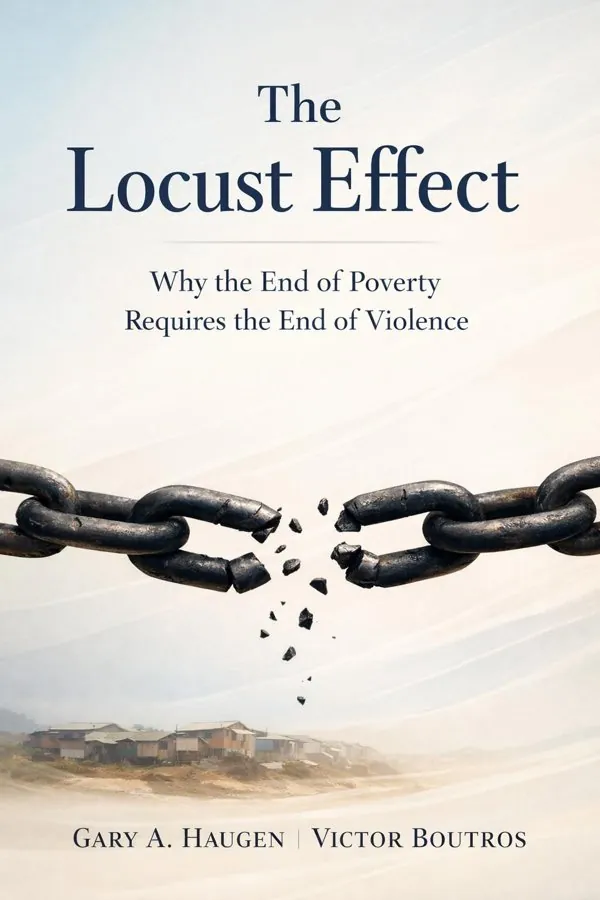
The Locust Effect: Why the End of Poverty Requires the End of Violence: Summary & Key Insights
by Gary A. Haugen, Victor Boutros
 10 min8 chaptersAudio available
Key Takeaways from The Locust Effect: Why the End of Poverty Requires the End of Violence
A person cannot build a future when survival is under daily attack.
Justice is often promised to everyone, but in many places it is delivered only to the powerful.
What if violence against the poor is not a side issue in development, but one of its central failures?
Predators thrive where consequences disappear.
Real change rarely comes from imported slogans; it comes from transforming how institutions behave on the ground.
What Is The Locust Effect: Why the End of Poverty Requires the End of Violence About?
The Locust Effect: Why the End of Poverty Requires the End of Violence by Gary A. Haugen, Victor Boutros is a general book. Why do billions of dollars in aid, development, and economic reform still fail to lift many communities out of poverty? In The Locust Effect, Gary A. Haugen and Victor Boutros argue that one crucial answer is often ignored: everyday violence. For the world’s poorest people, the greatest threat is not only hunger, disease, or lack of opportunity, but the constant risk of abuse, exploitation, forced labor, sexual assault, land theft, and police corruption. Like a swarm of locusts devouring a harvest, violence destroys the gains of the poor before they can take root. The book reframes poverty as not just an economic problem but a justice problem. Haugen, founder of International Justice Mission, and Boutros, a federal prosecutor and legal scholar, draw on years of frontline experience investigating violence against vulnerable communities. Their central claim is both urgent and practical: the end of extreme poverty will remain out of reach unless societies build reliable systems of law enforcement and justice that protect poor people from everyday predation. This is a powerful, unsettling, and deeply important book for anyone interested in development, human rights, policy, or the true conditions facing the global poor.
This FizzRead summary covers all 8 key chapters of The Locust Effect: Why the End of Poverty Requires the End of Violence in approximately 10 minutes, distilling the most important ideas, arguments, and takeaways from Gary A. Haugen, Victor Boutros's work. Also available as an audio summary and Key Quotes Podcast.
The Locust Effect: Why the End of Poverty Requires the End of Violence
Why do billions of dollars in aid, development, and economic reform still fail to lift many communities out of poverty? In The Locust Effect, Gary A. Haugen and Victor Boutros argue that one crucial answer is often ignored: everyday violence. For the world’s poorest people, the greatest threat is not only hunger, disease, or lack of opportunity, but the constant risk of abuse, exploitation, forced labor, sexual assault, land theft, and police corruption. Like a swarm of locusts devouring a harvest, violence destroys the gains of the poor before they can take root.
The book reframes poverty as not just an economic problem but a justice problem. Haugen, founder of International Justice Mission, and Boutros, a federal prosecutor and legal scholar, draw on years of frontline experience investigating violence against vulnerable communities. Their central claim is both urgent and practical: the end of extreme poverty will remain out of reach unless societies build reliable systems of law enforcement and justice that protect poor people from everyday predation.
This is a powerful, unsettling, and deeply important book for anyone interested in development, human rights, policy, or the true conditions facing the global poor.
Who Should Read The Locust Effect: Why the End of Poverty Requires the End of Violence?
This book is perfect for anyone interested in general and looking to gain actionable insights in a short read. Whether you're a student, professional, or lifelong learner, the key ideas from The Locust Effect: Why the End of Poverty Requires the End of Violence by Gary A. Haugen, Victor Boutros will help you think differently.
- ✓Readers who enjoy general and want practical takeaways
- ✓Professionals looking to apply new ideas to their work and life
- ✓Anyone who wants the core insights of The Locust Effect: Why the End of Poverty Requires the End of Violence in just 10 minutes
Want the full summary?
Get instant access to this book summary and 100K+ more with Fizz Moment.
Get Free SummaryAvailable on App Store • Free to download
Key Chapters
A person cannot build a future when survival is under daily attack. One of the book’s most powerful insights is that extreme poverty is sustained not only by lack of resources, but by the constant presence of violence that strips people of whatever progress they make. Haugen and Boutros describe violence as a hidden force that sabotages development from below. A family may receive microloans, education, or healthcare, but if a daughter can be assaulted with no legal consequence, or a farmer’s land can be stolen by force, those gains become fragile and temporary.
The authors challenge the common development mindset that assumes poverty can be solved mainly through markets, infrastructure, and aid. Those tools matter, but they do not work well in an environment where the poor are defenseless. Violence acts like an invisible tax imposed by criminals, traffickers, abusive employers, corrupt officials, and even police. The result is fear, lost income, trauma, and a deep erosion of trust.
The book uses the image of locusts because violence consumes opportunity the way locusts consume crops. It destroys productivity, deters investment, breaks families, and teaches people that effort may not be rewarded. Even basic freedoms become uncertain when the rule of law exists only for the wealthy.
In practical terms, this idea changes how we think about anti-poverty work. It suggests that schools, clinics, and business programs should be paired with systems that keep people safe. Communities need credible policing, functioning courts, and legal protection as much as they need economic support.
Actionable takeaway: When evaluating any poverty solution, ask one question first: will poor people actually be safe enough to benefit from it?
Justice is often promised to everyone, but in many places it is delivered only to the powerful. Haugen and Boutros argue that the global poor are not merely underserved by justice systems; they are effectively excluded from them. On paper, laws may forbid slavery, rape, assault, or land theft. In reality, those laws often go unenforced when the victims are poor. This gap between written rights and lived experience is at the heart of the book.
The authors show that for affluent people, safety is usually assumed. They can call the police, hire lawyers, and expect some form of response. Poor communities, by contrast, frequently encounter police who are absent, indifferent, abusive, or corrupt. Courts may be inaccessible, intimidating, costly, or painfully slow. As a result, violence becomes normalized. People learn not to report crimes because reporting can bring retaliation without protection.
This insight is important because many conversations about global justice focus on dramatic crises such as war crimes or genocide. The book does not deny those horrors, but it insists that the more common reality for the poor is everyday violence: domestic abuse, bonded labor, sex trafficking, forced eviction, and violent intimidation. These abuses rarely make headlines, yet they shape daily life for millions.
A practical application of this idea is to broaden what we mean by access. Legal rights are meaningless if people cannot safely use them. Justice reform therefore requires local police posts that function, complaint systems that are trusted, and procedures simple enough for ordinary citizens to navigate.
Actionable takeaway: Do not confuse the existence of laws with the existence of protection; look at whether poor people can realistically report abuse and receive help.
What if violence against the poor is not a side issue in development, but one of its central failures? Haugen and Boutros make exactly this case. They argue that everyday violence should be treated with the same seriousness as disease, illiteracy, and hunger because it blocks progress across nearly every area of life. Development efforts often measure income, schooling, and health outcomes, but too rarely measure whether people are safe from predators.
The authors emphasize that violence is economically destructive. A woman trapped in abuse may be unable to work consistently. A child forced into labor loses education and future earnings. A shop owner extorted by gangs cannot save or invest. A village terrorized by officials will avoid asserting property rights or seeking public services. In this way, violence suppresses productivity, weakens local markets, and discourages initiative.
The consequences are also social and psychological. Communities living in fear become less willing to cooperate, organize, or trust institutions. Children exposed to chronic violence carry trauma that affects learning and health. Families may spend scarce money on bribes, medical costs, or recovery from theft rather than on education or business.
This broader framing has practical implications for policy. Development organizations, investors, and governments should treat public safety and justice as foundational infrastructure. Just as roads connect markets, basic security connects people to opportunity. Programs that improve livelihoods will be more effective when paired with violence prevention, legal aid, and accountability for law enforcement.
Actionable takeaway: If you care about development results, include safety and justice indicators alongside economic and social metrics rather than treating violence as someone else’s issue.
Predators thrive where consequences disappear. A major theme of The Locust Effect is that violence against the poor persists not because it is culturally inevitable, but because local justice systems are too weak to restrain it. Haugen and Boutros reject fatalistic explanations that portray abuse as an unchangeable part of life. Instead, they point to a more practical diagnosis: under-resourced police, poor training, corruption, lack of supervision, broken courts, and low political will create an environment where offenders operate freely.
The authors focus especially on everyday systems of public justice. In many poor countries, police may lack transportation, forensic capacity, investigative skills, or even basic salaries that reduce incentives for bribery. Courts may have huge backlogs and little ability to protect witnesses. Victims can face ridicule, extortion, or pressure to settle privately. In such conditions, the rational calculation for criminals is simple: they are unlikely to be stopped.
This matters because it shifts the debate from charity to institution-building. The poor do not only need rescue after abuse occurs; they need systems strong enough to deter abuse in the first place. Reliable enforcement changes behavior. When traffickers, rapists, or abusive employers know they may actually be investigated and punished, the operating environment begins to change.
Examples from the book suggest that targeted improvements can matter: specialized police units, better case management, victim-centered procedures, and leadership committed to integrity. Reform does not require perfection overnight, but it does require seriousness about frontline enforcement.
Actionable takeaway: When considering solutions to violence, prioritize strengthening local accountability systems so the cost of abusing the poor becomes real.
Real change rarely comes from imported slogans; it comes from transforming how institutions behave on the ground. Haugen and Boutros stress that ending violence against the poor cannot be achieved by abstract declarations alone. International conventions, national laws, and donor frameworks are important, but protection only becomes real when local police officers investigate crimes, local prosecutors pursue cases, and local judges deliver fair outcomes.
This local focus is one of the book’s most practical contributions. The authors argue that justice reform should not be designed as a distant, elite exercise. It must respond to the actual threats people face in specific communities. In one area, the pressing issue may be bonded labor; in another, sexual violence; in another, land seizure or police abuse. Solutions should be tailored accordingly.
A grounded approach also means working with existing institutions rather than imagining they can be bypassed forever. Nonprofits can provide legal aid, shelters, and advocacy, but they cannot replace public justice systems at scale. Sustainable safety requires governments to perform their basic duty of protection. That involves training, supervision, data collection, internal discipline, and community trust-building.
For practitioners, this insight encourages humility. Effective reform begins with listening to victims, understanding bottlenecks, mapping case flows, and identifying where cases collapse. It also means celebrating incremental wins, such as improved response times or better treatment of survivors, because these changes can restore confidence and create momentum.
Actionable takeaway: Support justice solutions that are specific, local, and institution-focused rather than relying only on high-level declarations or short-term external interventions.
Safety is not a luxury that follows prosperity; it is a precondition for it. One of the book’s most hopeful ideas is that protecting poor people from violence can unleash enormous human and economic potential. Haugen and Boutros do not present justice reform merely as a moral obligation, though it certainly is that. They also present it as a practical engine of development.
When people are secure, they are more willing to invest in farms, businesses, homes, and education. Parents can send children to school without as much fear. Workers can keep more of what they earn. Women can participate more fully in public and economic life. Communities can organize, cooperate, and advocate for services. In short, the removal of predatory violence creates room for initiative and growth.
The opposite is equally true. If gains can be stolen overnight, rational people become cautious. They may avoid formal markets, keep savings hidden, or withdraw from opportunities that attract attention. This is why conventional development interventions often underperform in violent environments. The issue is not that the poor lack ambition; it is that risk is too high and protection too weak.
A useful application of this insight is for governments and donors to treat justice spending as productive investment rather than administrative overhead. Funding better policing, case tracking, victim services, and legal enforcement can generate returns in labor participation, education, health, and enterprise.
Actionable takeaway: Reframe public safety for the poor as a catalyst for growth, and support programs that connect protection directly to long-term economic and social opportunity.
Problems that remain unseen rarely become priorities. Haugen and Boutros point out that violence against the poor has been neglected in part because it is poorly measured, underreported, and politically invisible. Development debates often focus on what can be quantified easily: income levels, school enrollment, vaccination rates, or infrastructure output. By contrast, everyday violence is harder to capture, especially where victims fear reporting crimes and institutions lack reliable records.
This absence of data creates a dangerous cycle. Because violence is not measured well, it appears less central. Because it appears less central, governments and donors invest less in solving it. And because investment remains low, institutions do not improve enough to generate better data. The authors argue that breaking this cycle is essential.
Better measurement does more than inform policy; it can change moral imagination. When the scale of sexual violence, forced labor, police abuse, or land theft becomes visible, it becomes harder to treat these harms as isolated incidents. Data can expose patterns, identify hotspots, and reveal where cases fail in the justice process. It can also help evaluate reform efforts and direct resources more intelligently.
For organizations working in development, this means incorporating violence-related questions into needs assessments and impact evaluations. For journalists and advocates, it means telling stories that connect individual suffering to systemic failure. For governments, it means collecting and publishing crime and justice performance data in ways the public can use.
Actionable takeaway: What gets measured gets addressed, so insist on making violence against the poor visible in research, budgets, and development planning.
The deepest injustices often survive not because they are defensible, but because confronting them is inconvenient. The Locust Effect argues that ending violence against the poor demands more than compassion; it demands political courage. Leaders, institutions, and even aid systems can become comfortable focusing on less controversial problems while avoiding the failures of policing, prosecution, and accountability. But the authors insist that protection is one of government’s first responsibilities, and neglecting it has devastating consequences.
This idea challenges a quiet assumption in development work: that justice reform is too political, too slow, or too complex to prioritize. Haugen and Boutros acknowledge the difficulty, yet they argue that avoiding the issue is costlier. If violence remains unchecked, other investments are continually undone. Moral seriousness means being willing to address corruption, impunity, and institutional weakness even when these topics threaten entrenched interests.
Political courage also matters at the public level. Citizens in wealthier nations may support anti-poverty efforts in principle but fail to grasp that poor people need protection, not just provision. The book calls readers to expand their sense of solidarity. Helping the poor means caring whether they are safe from being beaten, enslaved, raped, or dispossessed with no recourse.
In practical terms, courage looks like funding justice institutions, backing reform-minded local leaders, demanding accountability, and refusing to accept violence as normal. It means treating the lives of the poor as equally worthy of legal protection.
Actionable takeaway: Support policies and organizations willing to confront impunity directly, even when justice reform is politically harder than traditional aid.
All Chapters in The Locust Effect: Why the End of Poverty Requires the End of Violence
About the Authors
Gary A. Haugen is a human rights lawyer, speaker, and founder of International Justice Mission, a global organization that works to protect vulnerable people from violence, trafficking, slavery, and abuse. He previously served in roles involving human rights investigation and legal accountability, including work connected to major atrocity inquiries. Victor Boutros is a federal prosecutor, legal expert, and former law clerk with experience in criminal justice and international law. Together, they combine frontline exposure to violence against the poor with deep institutional knowledge of how justice systems succeed or fail. Their collaboration in The Locust Effect reflects both moral urgency and legal realism, making the book a significant contribution to debates on poverty, governance, and the rule of law.
Get This Summary in Your Preferred Format
Read or listen to the The Locust Effect: Why the End of Poverty Requires the End of Violence summary by Gary A. Haugen, Victor Boutros anytime, anywhere. FizzRead offers multiple formats so you can learn on your terms — all free.
Available formats: App · Audio · PDF · EPUB — All included free with FizzRead
Download The Locust Effect: Why the End of Poverty Requires the End of Violence PDF and EPUB Summary
Key Quotes from The Locust Effect: Why the End of Poverty Requires the End of Violence
“A person cannot build a future when survival is under daily attack.”
“Justice is often promised to everyone, but in many places it is delivered only to the powerful.”
“What if violence against the poor is not a side issue in development, but one of its central failures?”
“Predators thrive where consequences disappear.”
“Real change rarely comes from imported slogans; it comes from transforming how institutions behave on the ground.”
Frequently Asked Questions about The Locust Effect: Why the End of Poverty Requires the End of Violence
The Locust Effect: Why the End of Poverty Requires the End of Violence by Gary A. Haugen, Victor Boutros is a general book that explores key ideas across 8 chapters. Why do billions of dollars in aid, development, and economic reform still fail to lift many communities out of poverty? In The Locust Effect, Gary A. Haugen and Victor Boutros argue that one crucial answer is often ignored: everyday violence. For the world’s poorest people, the greatest threat is not only hunger, disease, or lack of opportunity, but the constant risk of abuse, exploitation, forced labor, sexual assault, land theft, and police corruption. Like a swarm of locusts devouring a harvest, violence destroys the gains of the poor before they can take root. The book reframes poverty as not just an economic problem but a justice problem. Haugen, founder of International Justice Mission, and Boutros, a federal prosecutor and legal scholar, draw on years of frontline experience investigating violence against vulnerable communities. Their central claim is both urgent and practical: the end of extreme poverty will remain out of reach unless societies build reliable systems of law enforcement and justice that protect poor people from everyday predation. This is a powerful, unsettling, and deeply important book for anyone interested in development, human rights, policy, or the true conditions facing the global poor.
You Might Also Like
Duct Tape Marketing: The World's Most Practical Small Business Marketing Guide
John Jantsch
10 minDusk, Night, Dawn: On Revival and Courage
Anne Lamott
10 minFinish Big: How Great Entrepreneurs Exit Their Companies on Top
Bo Burlingham
10 minFirst As Tragedy, Then As Farce
Slavoj Zizek
10 minFirst Principles: What America's Founders Learned from the Greeks and Romans and How That Shaped Our Country
Thomas E. Ricks
10 minGood Habits, Bad Habits: The Science of Making Positive Changes That Stick
Wendy Wood
10 minBrowse by Category
Ready to read The Locust Effect: Why the End of Poverty Requires the End of Violence?
Get the full summary and 100K+ more books with Fizz Moment.