
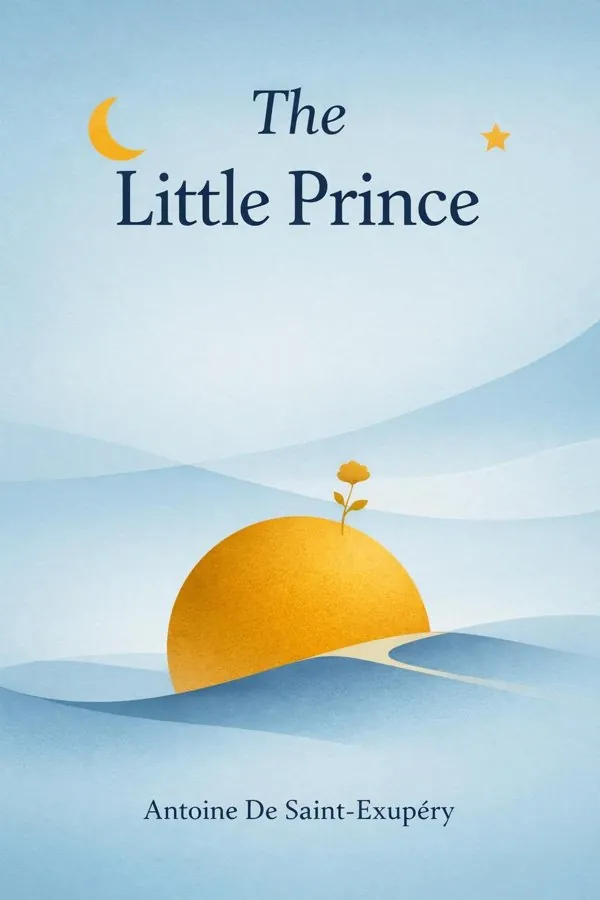
The Little Prince: Summary & Key Insights
 10 min5 chaptersAudio available
What Is The Little Prince About?
The Little Prince by Antoine De Saint-Exupéry is a classics book spanning 5 pages. The Little Prince is a poetic and philosophical tale in which a pilot stranded in the Sahara Desert meets a young prince from another planet. Through their conversations, the story explores themes of love, friendship, loneliness, and loss, while offering a critique of the superficiality of the adult world.
This FizzRead summary covers all 5 key chapters of The Little Prince in approximately 10 minutes, distilling the most important ideas, arguments, and takeaways from Antoine De Saint-Exupéry's work. Also available as an audio summary and Key Quotes Podcast.
The Little Prince
The Little Prince is a poetic and philosophical tale in which a pilot stranded in the Sahara Desert meets a young prince from another planet. Through their conversations, the story explores themes of love, friendship, loneliness, and loss, while offering a critique of the superficiality of the adult world.
Who Should Read The Little Prince?
This book is perfect for anyone interested in classics and looking to gain actionable insights in a short read. Whether you're a student, professional, or lifelong learner, the key ideas from The Little Prince by Antoine De Saint-Exupéry will help you think differently.
- ✓Readers who enjoy classics and want practical takeaways
- ✓Professionals looking to apply new ideas to their work and life
- ✓Anyone who wants the core insights of The Little Prince in just 10 minutes
Want the full summary?
Get instant access to this book summary and 100K+ more with Fizz Moment.
Get Free SummaryAvailable on App Store • Free to download
Key Chapters
When the aviator crashes in the Sahara Desert, solitude reduces life to essentials—water, air, survival. Yet in that barren place appears the Little Prince, unannounced and filled with calm assurance. His presence disrupts ordinary logic. He speaks without urgency, asks simple yet impossible questions, and restores the aviator’s dormant imagination. The request to draw a sheep may seem trivial, but in truth it revives a forgotten ability: the capacity to create without purpose other than delight. Through the act of drawing, the aviator reconnects with the part of himself that still dreams.
Their companionship forms quickly but profoundly. The aviator, hardened by adult responsibilities, learns again to listen, while the Prince shows no fear of silence or solitude. Each exchange in the desert is less about dialogue than about discovery—the rediscovery of imagination as the source of intimacy. As the sun rises over empty sands, the aviator realizes that isolation can breed clarity; the desert is not emptiness, but purity. In the Prince’s presence, he witnesses the beauty of a mind untainted by habit, and the gentle insistence of innocence refusing to vanish.
The Little Prince soon reveals his origin: a minute planet no larger than a house, containing three volcanoes, some baobab sprouts, and a single rose. The rose is at once his joy and his torment. She is vain, proud, yet tender, her beauty commanding his devotion and his confusion. In her he learns the paradox of love—the balance between admiration and misunderstanding. The Prince’s care for the rose defines his existence; she depends on his attention, but masks vulnerability behind airs of superiority. Unable to comprehend her pride, the Prince grows disillusioned and departs, believing himself unloved.
In this small drama, I wished to show how love often falters not from lack of feeling but from lack of comprehension. We guard our hearts with vanity or fear, forgetting that affection must be expressed in words and gestures. As the Prince later travels, he carries the silent ache of that separation. His volcanoes symbolize the tempered energy of duty—things that must be tended even when unglamorous. The baobabs, if ignored, threaten his world, like resentment left unchecked. Through these images, every reader can see themselves: the need to cultivate our relationships as we cultivate our inner land, uprooting destructive growth, cherishing fragile beauty.
+ 3 more chapters — available in the FizzRead app
All Chapters in The Little Prince
About the Author
Antoine de Saint-Exupéry (1900–1944) was a French writer, poet, and aviator. Known for his aviation stories and humanist works, he also wrote Night Flight and Wind, Sand and Stars. Disappearing during a World War II mission, he remains an iconic figure in French literature.
Get This Summary in Your Preferred Format
Read or listen to the The Little Prince summary by Antoine De Saint-Exupéry anytime, anywhere. FizzRead offers multiple formats so you can learn on your terms — all free.
Available formats: App · Audio · PDF · EPUB — All included free with FizzRead
Download The Little Prince PDF and EPUB Summary
Key Quotes from The Little Prince
“When the aviator crashes in the Sahara Desert, solitude reduces life to essentials—water, air, survival.”
“The Little Prince soon reveals his origin: a minute planet no larger than a house, containing three volcanoes, some baobab sprouts, and a single rose.”
Frequently Asked Questions about The Little Prince
The Little Prince by Antoine De Saint-Exupéry is a classics book that explores key ideas across 5 chapters. The Little Prince is a poetic and philosophical tale in which a pilot stranded in the Sahara Desert meets a young prince from another planet. Through their conversations, the story explores themes of love, friendship, loneliness, and loss, while offering a critique of the superficiality of the adult world.
You Might Also Like






Browse by Category
Ready to read The Little Prince?
Get the full summary and 100K+ more books with Fizz Moment.